
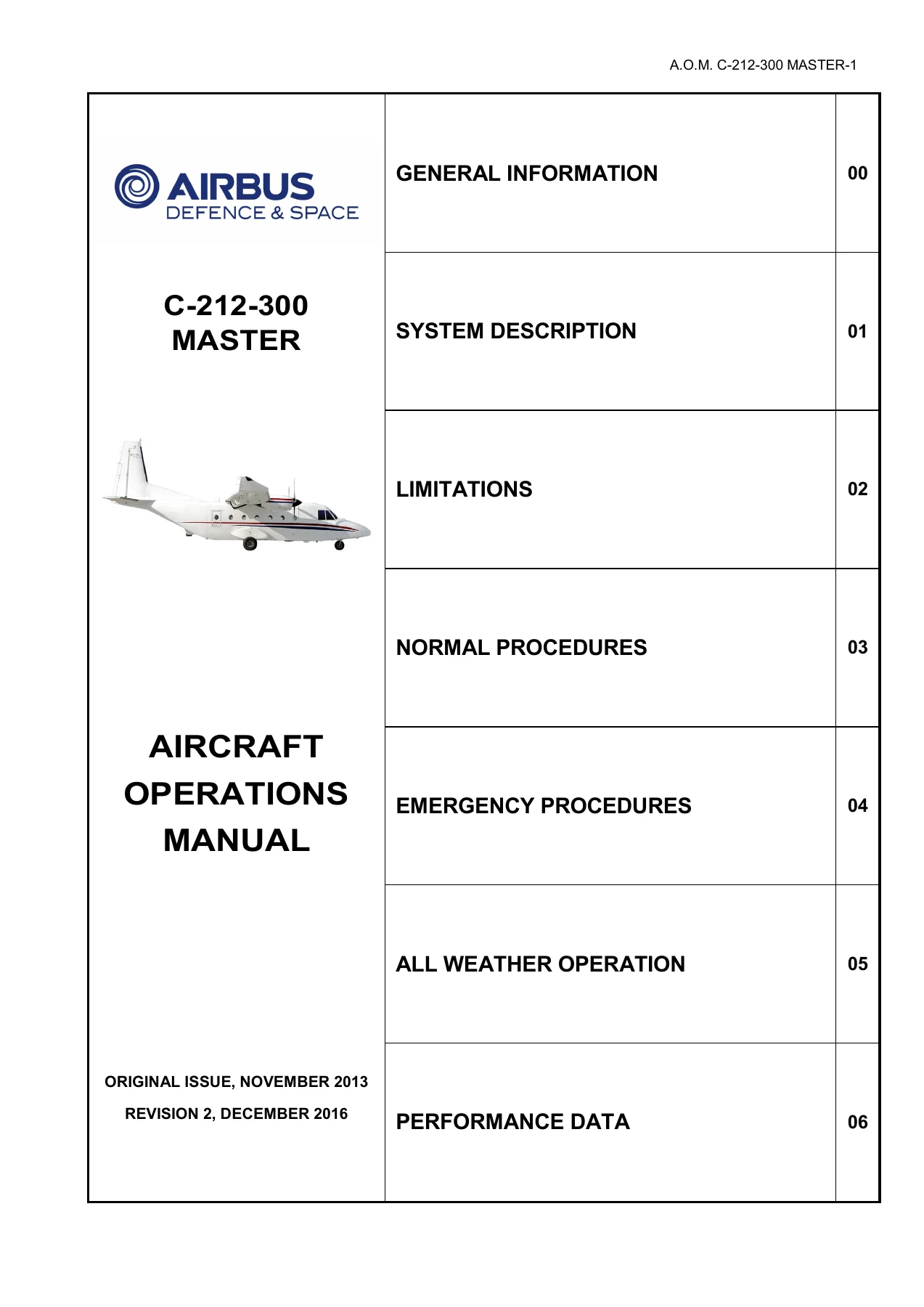
C-212-300 Aircraft Operations Manual – Airbus Defence and Space AOM (November 2013)
Original price was: $44.95.$26.95Current price is: $26.95.
Complete 360-page C-212-300 Aircraft Operations Manual from Airbus Defence and Space, Original Issue November 2013. Covers system descriptions, limitations, normal procedures, emergency procedures, all weather operation and performance data for the C-212 Series 300 with Garrett TPE 331-10R-513C engines.
Description
File Details
- Manual type: Aircraft Operations Manual (AOM), Master
- Aircraft: C-212-300 / C-212 Series 300
- Publisher: Airbus Defence and Space
- Issue: Original Issue, November 2013
- Language: English
- File format: PDF
- Length: 360 pages
- Document structure: Section 01 System Description through Section 06 Performance Data
- Powerplant covered: Two Garrett TPE 331-10R-513C turboprops driving Dowty Rotol R.334/4 four-blade reverse-pitch propellers
What the C-212-300 Aircraft Operations Manual Contains
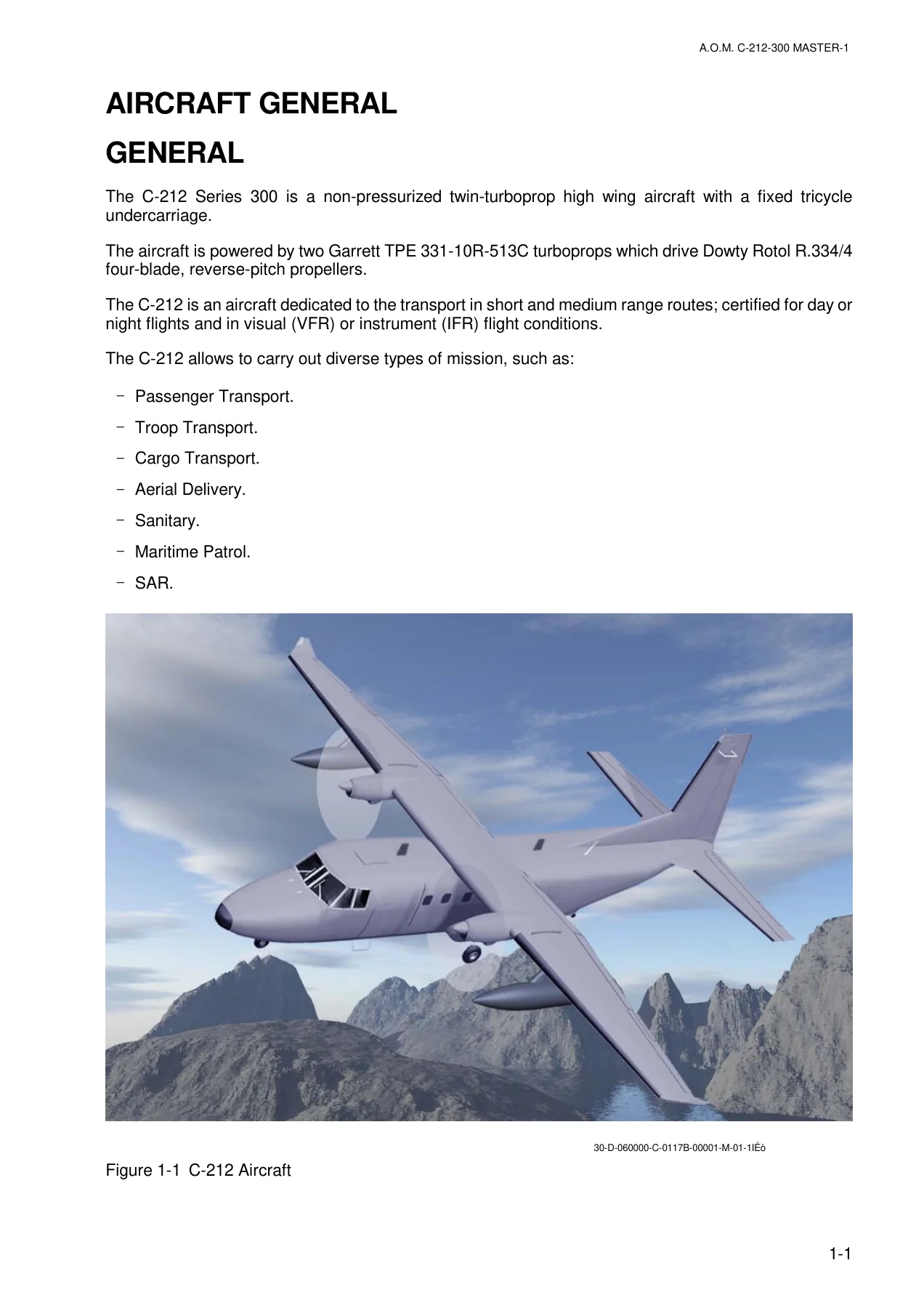
This C-212-300 Aircraft Operations Manual is the Master issue of the operations documentation prepared by Airbus Defence and Space for the C-212 Series 300, a non-pressurised twin-turboprop high-wing aircraft with a fixed tricycle undercarriage. The manual is built around six numbered sections that run from a full technical description of the airframe and its systems through to the limitations, the day-to-day procedures and the performance material a crew needs on the line.
The contents are organised as follows:
- General Information – scope of the manual, applicability notes, revision handling, warning/caution/note definitions, glossary of abbreviations and symbols, colour code key
- Section 01 – System Description: aircraft general and main dimensions, interior furnishings and flight compartment layout, environmental control (ventilation, heating, air conditioning), automatic flight control system, autopilot, flight director and modes of operation, electrical system (AC and DC generation and distribution), emergency equipment, portable extinguishers, oxygen system (fixed and portable), fire protection and engine fire extinguishing, flight controls (roll, yaw, pitch, flaps, gust lock), fuel system, hydraulic system, ice and rain protection, flight instruments, landing gear, brakes, nosewheel steering, lighting, doors, seats, power plant, propellers, negative torque system and propeller synchronisation
- Section 02 – Limitations: weight limitations (civil and military), centre of gravity limits, powerplant ratings and torque/EGT/RPM limits, fuel system limitations and usable fuel quantities, propeller limitations, oil temperature and oil pressure limits, airspeed limitations (civil and military), operating envelopes, acceleration limitations, minimum flight crew, electrical system limits
- Section 03 – Normal Procedures: exterior and interior preflight inspection, C/M-1 and C/M-2 cockpit preparation, engine start (automatic ground start), before taxiing, taxiing, before takeoff, takeoff, climb, cruise, descent, approach, landing, go-around, after landing, parking, engine shutdown, NTS check and overspeed governor check
- Section 04 – Emergency Procedures: on-ground emergencies, engine fire on ground, electrical fire on ground, uncommanded torque and EGT increase, manual ground start, ground start failure, ground evacuation, takeoff emergencies, engine failure on aborted and continued takeoff, inflight engine failures, engine fire in flight, both engine failure, engine airstart, fuel system failures, electrical system failures, hydraulic system failures, flight control system failures, anti-ice system failures, smoke evacuation, spin recovery and landing emergencies
- Section 05 – All Weather Operation: pointers to the applicable all-weather documentation set
- Section 06 – Performance Data: guidance on the performance material to be held for each operator and aircraft
Read as a whole, the C-212-300 Aircraft Operations Manual gives a technician or flight crew member a complete operational picture of the type rather than a collection of isolated data points. Systems are described with their controls and indicators listed and illustrated, limitations are stated with the exact values the aircraft was published with, and the procedures are written as readable step sequences with the reasoning behind each step. Schematic illustrations, control panel photographs and system diagrams run alongside the text, so a component can be located on the aircraft as well as understood on paper.
Systems Described in Detail
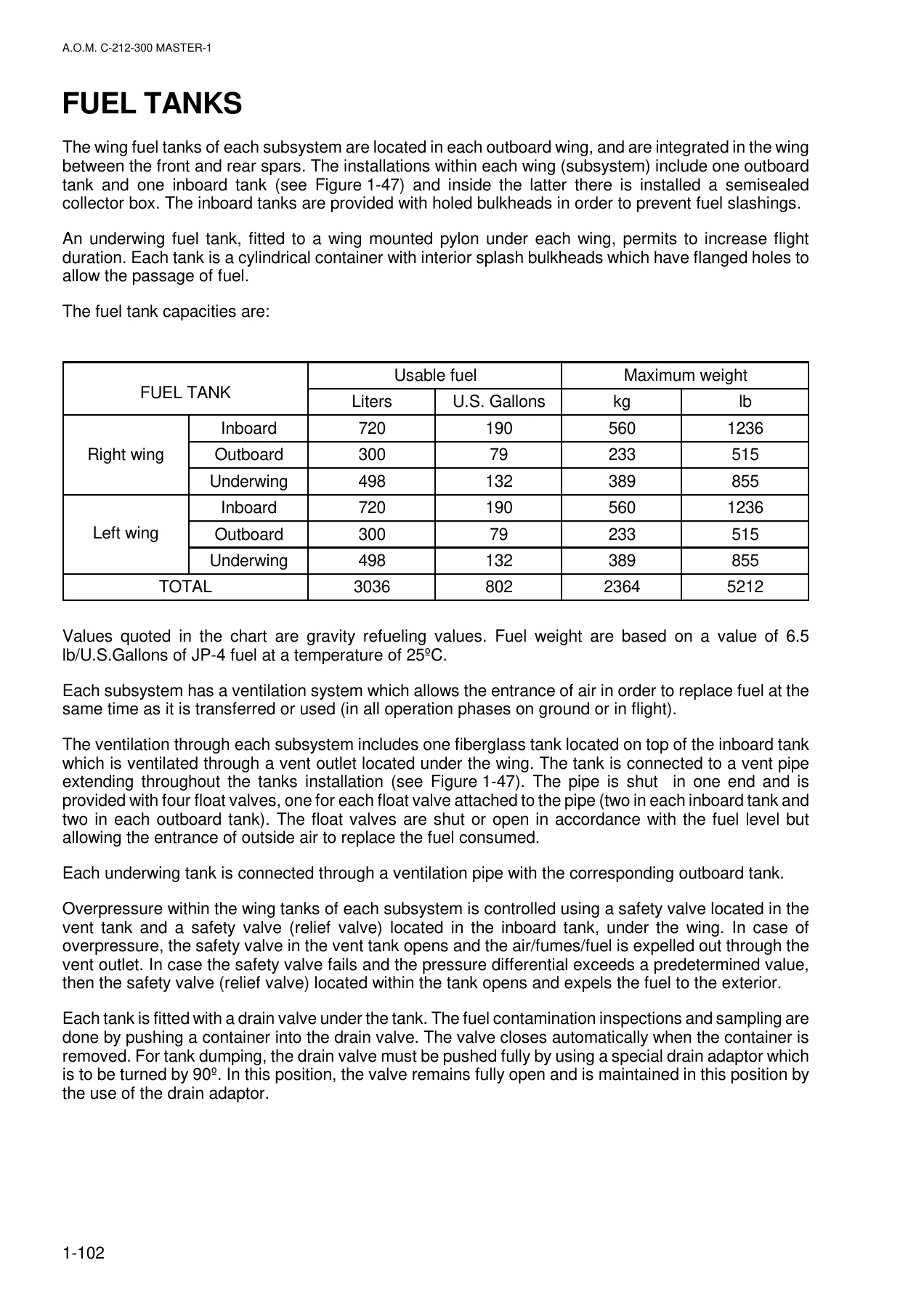
The System Description section is the technical core of this C-212-300 Aircraft Operations Manual. It documents the environmental control system, including cockpit and cabin ventilation, bleed-air heating with regulator valves and the LEFT/RIGHT WING HOT warning annunciators, and the air conditioning packs with their condenser and evaporator stages. The automatic flight section explains the AFCS, the autopilot and flight director, and the complete set of lateral and vertical modes including HDG, NAV, BC, ALT, VS, IAS, ALT SEL, APR, ILS, VOR approach and go-around. The electrical chapter details AC generation from the three inverters with their 115 VAC and 26 VAC buses, DC generation from the two starter-generators and the three nickel-cadmium batteries, ground power unit operation and the full bus-bar distribution scheme. Fire protection, oxygen, hydraulics, fuel transfer and distribution, ice and rain protection, pitot-static instrumentation and nosewheel steering are all covered to the same level.
Limitations, Normal Procedures and Emergency Procedures
The limitations chapter gives the structural weights, the civil and military gross weight limits, the weight limitations chart zones with their associated manoeuvre load factors, centre of gravity graphs for both civil and military roles, and the powerplant tables for takeoff, APR and maximum continuous power with the corresponding torque and EGT values. Airspeed limitations include VMO, VA, VFE figures, minimum control speeds and the miscellaneous limits such as maximum reverse thrust speed and maximum ramp and cargo door operating speed.
The normal procedures walk through every phase of a flight in the order the crew performs it, including the exterior inspection route, the C/M-2 and C/M-1 cockpit preparation scans and the engine start sequence with the speed and temperature targets to monitor. The emergency procedures cover engine fire on the ground and in flight, aborted and continued takeoff with an engine failure, single engine landing and go-around, engine airstart with both automatic and manual technique, fuel leaks and low pressure, battery overheat, generator and inverter failure, hydraulic supply failure with flap emergency setting, pitch trim runaway and total loss of braking.
Important Note on This Document
The foreword of this C-212-300 Aircraft Operations Manual states clearly that the procedures it contains have not been certified by the aviation authorities, and that the manual complements the approved Airplane Flight Manual, which remains the final authority whenever discrepancies arise between the two. The manual also reflects a standard-equipped C-212 aircraft, so individual operators may have differences arising from their own specifications.
Who This C-212-300 AOM Is Written For
This document suits line pilots, type-rated crews, instructors, maintenance and flight-line technicians, and operators building a reference library for a C-212 Series 300 airframe. It is equally useful during familiarisation and initial operation with the aircraft, where the expanded procedure descriptions act as training material, and later as a reference for system behaviour, control locations, limitation values and abnormal handling.
Get the C-212-300 Aircraft Operations Manual Instantly
IMAGES PREVIEW
With this C-212-300 Aircraft Operations Manual in hand you can work through the complete system description for the C-212 Series 300, verify limitation values before a flight or a maintenance action, follow the normal procedures phase by phase from preflight inspection through engine shutdown, and apply the correct emergency procedure when something goes wrong on the ground or in the air. Having the published figures and the manufacturer’s procedure wording to hand matters because torque, EGT, RPM and airspeed limits on this aircraft are not guesswork, and the sequence in which an emergency is handled can be the difference between a contained situation and a damaged engine or airframe. The file is delivered as an instant PDF download after payment, with no shipping and no waiting, and it can be read on a laptop, tablet or phone, searched and printed for the hangar or the flight bag.
Reviews
There are no reviews yet.