
Caterpillar Custom Track Service Handbook 17th Edition – Undercarriage Inspection, Wear Limits & Track Management Manual PDF
Original price was: $44.95.$26.95Current price is: $26.95.
776-page Caterpillar Custom Track Service Handbook, 17th Edition (PEKP9400-05, 2013). Undercarriage measurement techniques, percent-worn charts, wear limits, wear pattern interpretation, pin and bushing turn ratios, roller and idler swapping rules, seal replacement intervals and CTS report calculations for elevated and low sprocket tractors, loaders, excavators, forest machines and paving equipment.
Description
Caterpillar Custom Track Service Handbook 17th Edition
Whether you run a single track-type tractor or manage a mixed fleet of crawler machines, the Caterpillar Custom Track Service Handbook 17th Edition turns undercarriage inspection from guesswork into a measured, repeatable process. This 776-page Caterpillar Custom Track Service handbook, publication PEKP9400-05 dated 2013, is the working reference behind the CTS programme, and it walks every component of a crawler undercarriage, from link and bushing through to shoe, idler, carrier roller, track roller and sprocket, with the measurement techniques, percent-worn charts and wear limits needed to decide what to run, what to turn, and what to replace.
File Details
- Manual type: Custom Track Service (CTS) undercarriage technical handbook
- Brand: Caterpillar
- Edition: 17th Edition
- Publication number: PEKP9400-05
- Publication date: 2013
- Language: English
- Page count: 776 pages
- File format: PDF
Chapters Covered in the 17th Edition
- Introduction and General Information
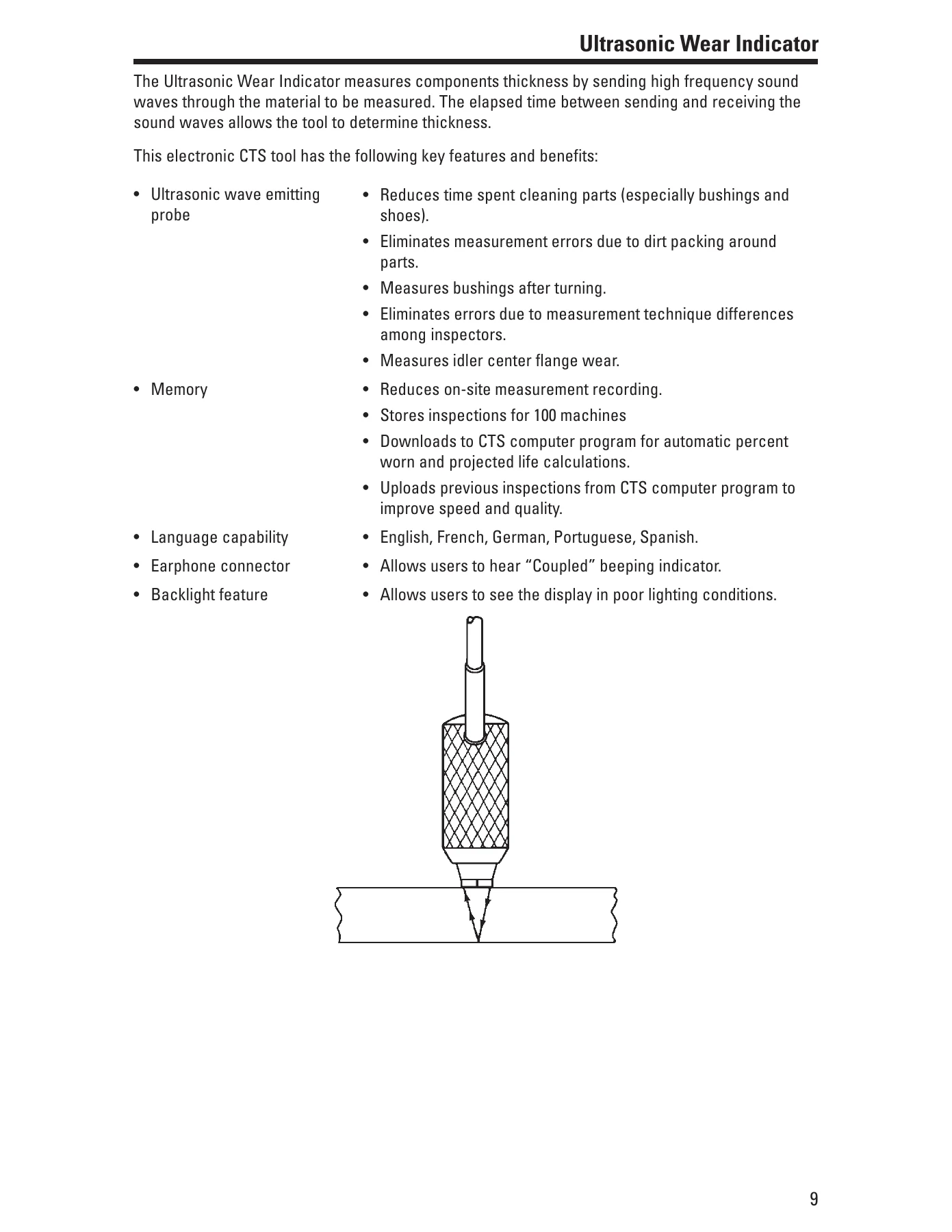
- Measurement Tools, including the 6V-9413 CTS Tool Kit, the 423-0478 Ultrasonic Wear Indicator IV Group and the earlier Ultrasonic Wear Indicator III group
- Controllable Variables: track adjustment (tension and sag), track shoe width, alignment
- Partially Controllable Variables: speed, turning, slipping tracks, preferred-side dozing
- Non-Controllable Variables: soil and underfoot conditions, abrasiveness, impact, packing, environmental variables and terrain conditions
- Component Discussions covering links, bushings, shoes, idlers, carrier rollers, track rollers, sprockets and guards
- Links: measurement technique, wear limits, greater and lesser allowable wear, wear charts, link wear patterns and structural problems
- Former Link Service Limits
- Sealed and Lubricated Track Pins and Bushings
- Sealed Track Pin and Bushings
- Shoes: grouser wear, plate and edge wear, structural problems and proper shoe selection
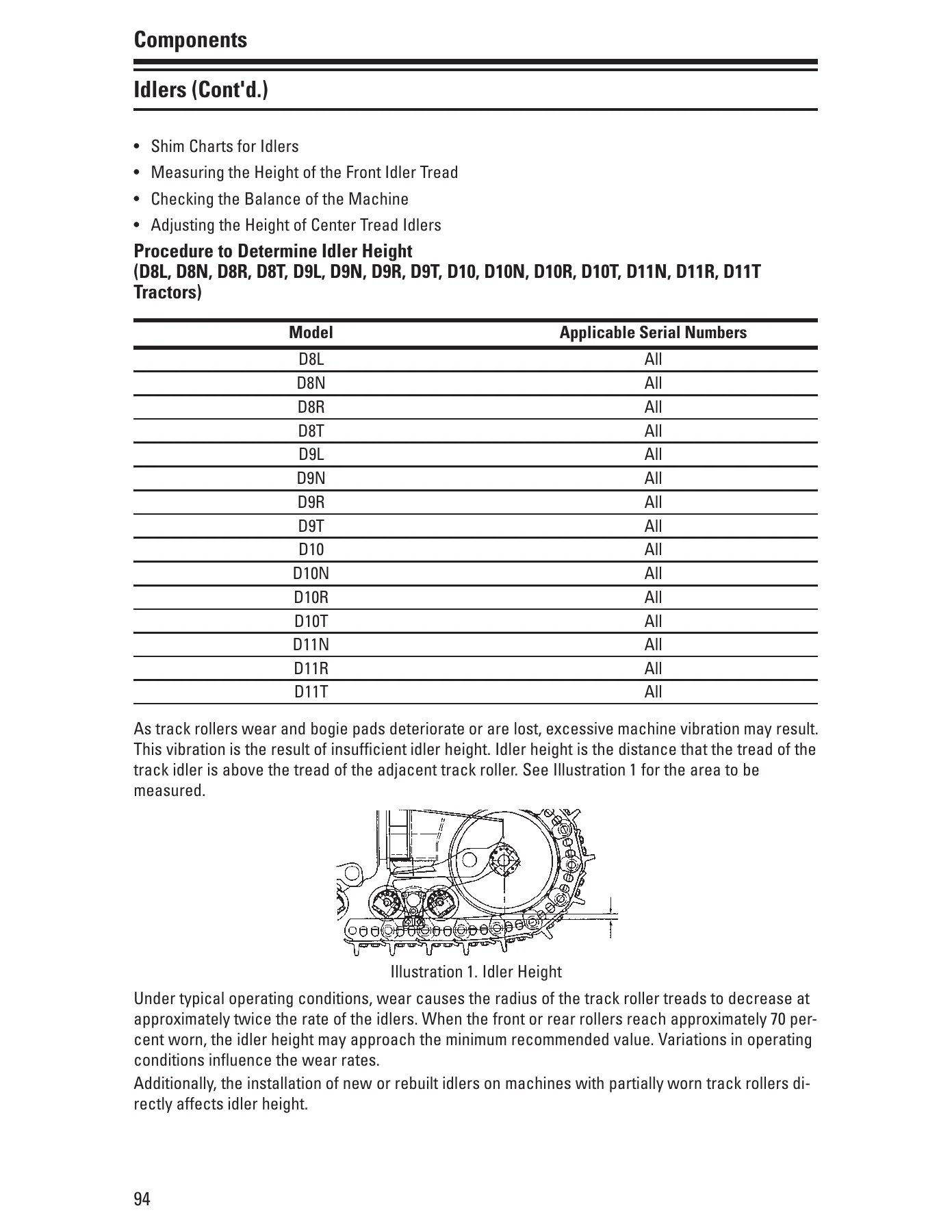
- Idlers: conventional, center tread and relieved center tread idlers, rebuildability and idler position
- Carrier Rollers: tread wear measurement, wear patterns and swapping criteria
- Track Rollers: tread measurement, wear limits, wear patterns and roller swapping guidelines
- Sprockets: wear patterns, mud and snow segments and rims, segment hardware torque procedure
- Guards: end and center guiding guards, roller guards and conditions for their use
- Management and Merchandising: track management, wear limits, track seal replacement recommendations
- CTS Inspection Report and Calculations
- Using CTS Reports To Manage Undercarriage, including the Percent Worn, Hour Meter Reading, Remaining Life and Projected Life reports
- CTS on the Personal Computer
- Competitive Machine Undercarriage Conversion, including basic convertibility measurements for track group, sprocket and rolling components
- Elevated Sprocket Machines, with individual sections from the D4H and D5M family through to the D11N, D11R and D11T
- Low Sprocket Machines, from the D3C, D3G and D3K families through to the D9 and 594
- Hydrostatic Loaders: 943, 953 and 963 and 973
- Excavators and Forest Machines, from the 304 and 305 mini excavators through to the 5230
- Paving Products and Drive Belts, covering PM465, AP650, AP1050, BG225, BG245, SF250B, TR225B, PR450, SF350, PR750, PR1000, SF500, SF550, TR500 and PM565
The Caterpillar Custom Track Service Handbook 17th Edition is not a repair manual in the usual sense. It is a measurement and decision handbook. Every chapter is built around a repeatable inspection routine, a set of dimensions to record, and a chart that converts those dimensions into a percent-worn figure. That percent-worn figure is then used to project remaining life, schedule the next maintenance window, and estimate cost per hour. For a technician or product support representative, that structure is the whole point: it means an undercarriage inspection produces numbers that can be compared across machines, across shifts and across a fleet, rather than an opinion that cannot be defended.
What the Caterpillar Custom Track Service Handbook Actually Lets You Do
The first half of the book is dedicated to the variables that shape undercarriage life. Controllable variables, track adjustment, shoe width and alignment, are covered with the specific effects each one produces on bushing life, link cracking, roller flange wear and pin retention. Non-controllable variables such as abrasiveness, impact, packing, moisture and terrain are broken down so you can recognise which of them is driving the wear you are seeing. Partially controllable variables such as speed, turning and slipping tracks are discussed as operator habits, with the management actions that follow from each. The result is that a wear pattern on a link rail or a roller flange can be traced back to a cause, rather than simply noted and replaced.
From there the handbook moves into components, and this is where the Caterpillar Custom Track Service Handbook 17th Edition earns its place on the shelf. Each component receives its own measurement technique, its own wear limits, its own charts and its own wear pattern catalogue. Links are measured by depth gauge or Ultrasonic Wear Indicator, with the measurement location specified and the allowable wear expressed as a fraction of the clearance between link and roller. Bushings are measured by ultrasonic probe, caliper or depth gauge, with the errors that each method can introduce explained so they can be avoided. Shoes, idlers, carrier rollers, track rollers and sprockets each get the same treatment, including the specific positions on the component where a reading must be taken and the positions where a reading will mislead you.
The wear pattern sections are the part most technicians come back to. Rail top wear, scalloping, pin boss side wear, rail side wear, counterbore elongation and depth wear, pin boss tip wear, face wear and guiding guard wear are all illustrated with the causes, accelerators, effects and remedies for each. The same pattern-based approach is applied to bushings, shoes, idlers, carrier rollers, track rollers and sprockets, so a wear pattern observed on a machine can be matched against the handbook and traced to a controllable cause before parts are ordered.
Machine Coverage: Elevated Sprocket, Low Sprocket, Loaders, Excavators and Paving
Undercarriage wear charts are machine-specific, and the Caterpillar Custom Track Service Handbook 17th Edition is organised that way. Elevated sprocket machines are covered in their own major section, with separate subsections for the 6.75 in. (171.5 mm) pitch D4H, D5M and D5N group, the 7.50 in. (190 mm) D5H, D6M and D6N group, the 8.00 in. (203.2 mm) D6H, D6R and D6T group, the 8.50 in. (215.9 mm) D7H, D7R and 572R group, the D8N, D8R and D8T family, the 8.50 in. D8L, D8N, D8R, D8T, 578, 583R, 583T, 587R and 587T group, the 9.45 in. (240 mm) D9N, D9R and D9T group, the 9.00 in. (228.6 mm) D9L and 589 group, the 10.25 in. (260.4 mm) D10N, D10R and D10T group, the D10, and the 12.50 in. (317.5 mm) D11N, D11R and D11T group.
Low sprocket machines follow, covering the 6.91 in., 6.125 in. and 6.75 in. families including the D3C, D3G, D3K, D4C, D4G and D4K, the D3, 931, 933, 935, D4B and D4C, the D4 and 941, the D5K, the D5, D5C and 939, the D5, 955, 951 and 561, the D6K and PL61, the D6 and 955, the D7E, the D7 and 977, the D8 and 983, and the D9 and 594. Hydrostatic loaders 943, 953, 963 and 973 have their own dedicated section, and the excavator and forest machine coverage runs from the 304 and 305 mini excavators and 307 and 308 through the 312, 313, 314, 315, 317, 318, 319, 320, 321, 322, 323, 324, 325, 328, 329, 330, 336, 340, 345, 349, 350, 365, 374, 375, 385, 390, 5080, 5090, 5110, 5130 and 5230, plus the TK711, TK732, TK751 and TK752 forest machines. Paving products and drive belt equipped machines close out the machine-specific coverage.
Track Management, Seal Life and the CTS Reports
The management half of the handbook is what turns the measurements into money. The link is treated as the base component that everything else is matched to, and the pin and bushing to link ratio table sets out exactly when to turn bushings, when to replace them, and when replacing the track group with Sealed and Lubricated Track makes more sense. Roller and idler swapping rules are given with the ratio thresholds that justify a swap, and the swapping sequence is explained so that most rollers, idlers and links reach their limits at roughly the same time.
Track seal replacement recommendations are split by machine group and by projected bushing life, with intervals given in SMU for the smaller elevated sprocket machines, the larger D8 through D11 machines, and the D11N, D11R and D11T with sleeve bearing track. The section on detecting dry joints in Sealed and Lubricated Track, using an infrared temperature gun or by hand after the machine has been working, is included along with the caution that pin and bushing of a dry joint can be hot enough to burn fingers.
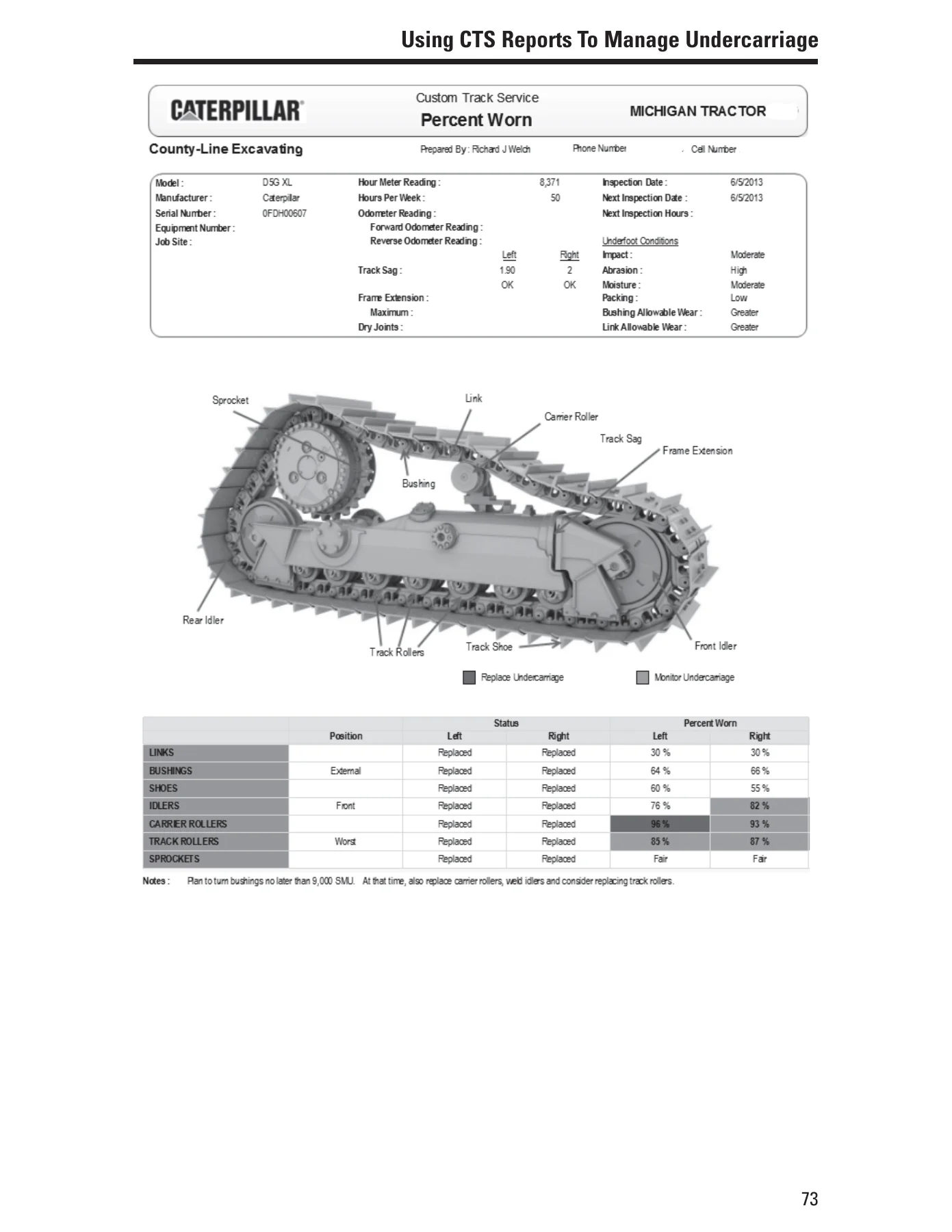
The CTS Inspection Report chapter explains how the form is filled in, how hours on wear surface are calculated, how percent worn is read from the charts, and how total potential hours to 100 percent and to 120 percent worn are projected. The worked examples use a 500 SMU, 25 percent worn component to show the arithmetic, and the section on using CTS reports shows the Percent Worn report, the Hour Meter Reading report, the Remaining Life report and the Projected Life report in their detailed, simple and graph formats, with notes on the limitations of each. A short chapter covers the CTS software itself, including downloading measurements directly from the Ultrasonic Wear Indicator and producing reports for customers.
IMAGES PREVIEW
Who the Caterpillar Custom Track Service Handbook 17th Edition Is Written For
This is a working handbook for anyone who has to make a call about an undercarriage. Field service technicians measuring links, bushings, shoes, idlers, rollers and sprockets will use the measurement techniques and the wear charts. Product support representatives preparing an inspection report for a customer will use the CTS report sections and the track management guidelines. Fleet managers comparing maintenance options will use the pin and bushing to link ratio table, the roller and idler swapping rules and the cost per hour logic. Owners of a single crawler machine who want to know when a track really needs turning, rather than trusting a visual impression, will find the percent worn charts and the wear pattern interpretation the most valuable part of the book.
Because the wear charts are machine and link specific, the handbook is also useful when a machine has been fitted with a non-standard track group or when a competitive machine is being considered for conversion to Caterpillar undercarriage. The chapter on competitive machine undercarriage conversion sets out the four measurements, pitch, bushing outside diameter, inside rail spread and outside rail spread, that determine whether a Cat track group can be wrapped onto a competitive machine, and the sprocket measurements that determine whether a weld-on rim or adapter is required.
Get Instant Access to the Caterpillar Custom Track Service Handbook 17th Edition
The Caterpillar Custom Track Service Handbook 17th Edition gives you the full CTS wear chart set for elevated sprocket tractors, low sprocket tractors, hydrostatic loaders, excavators, forest machines and paving equipment in one document, together with the measurement procedures that make those charts usable in the field. With it you can measure a link, bushing, shoe, idler, carrier roller, track roller or sprocket and convert the reading into a percent-worn figure, project the remaining hours to the 100 percent service point and the 120 percent destruction point, decide whether to turn or replace a pin and bushing set, plan a roller or idler swap, and assemble a CTS inspection report that a customer can act on.
Correct procedures and correct specification values are what separate an undercarriage that reaches its projected life from one that fails early through tight track, wrong shoe width, missed bushing turns or a swapped roller that should have been replaced. This handbook is the reference that keeps those decisions on the right side of the line.
Delivery is instant. The Caterpillar Custom Track Service Handbook 17th Edition is supplied as a PDF download, available immediately after payment and accessible on any device. No shipping, no waiting for a parcel, and the pages you use most can be printed and taken to the machine.

Reviews
There are no reviews yet.