
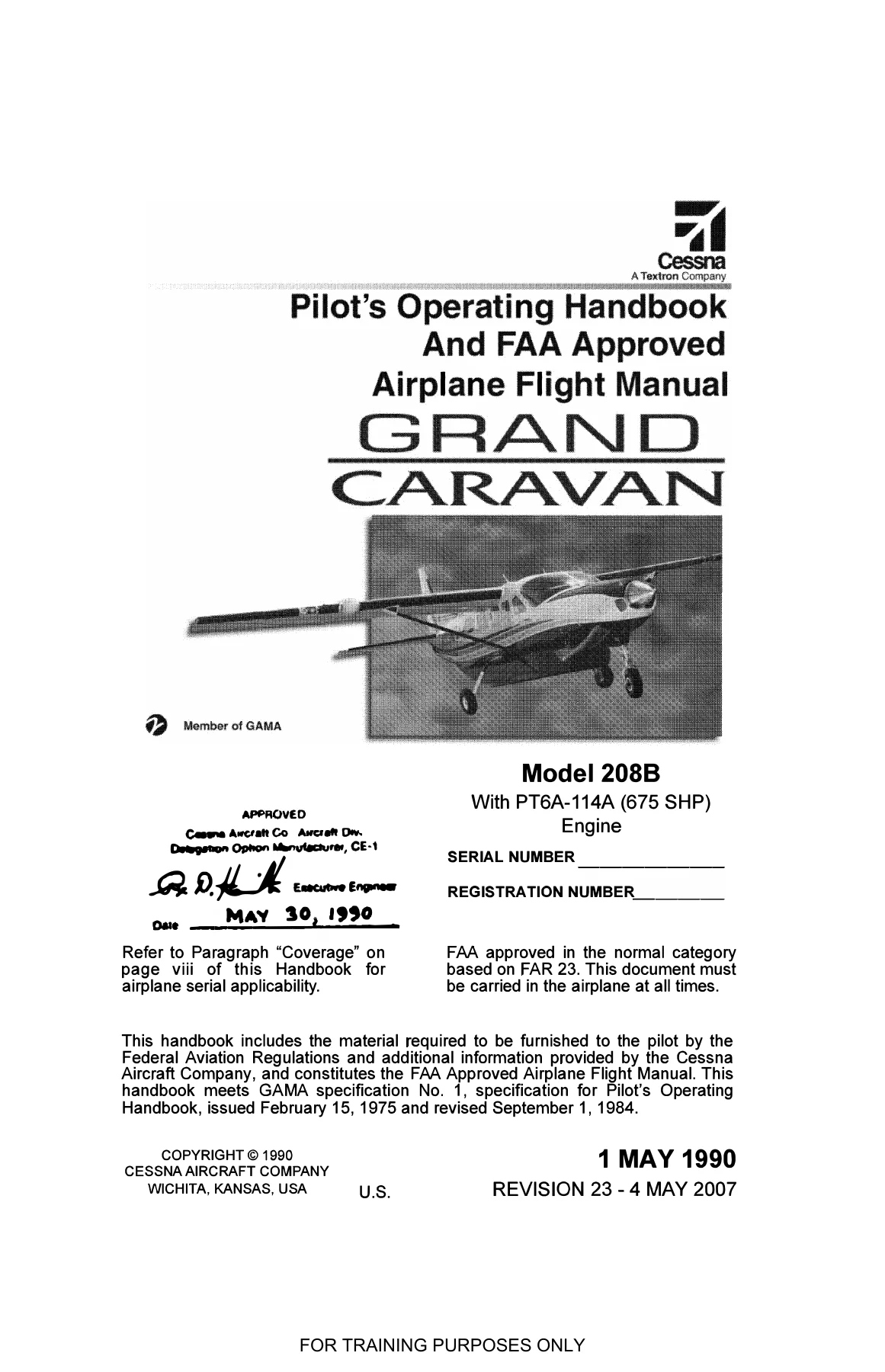
Cessna Grand Caravan 208B (675 SHP) Pilot’s Operating Handbook & FAA Approved Flight Manual – Revision 23
Original price was: $34.95.$19.95Current price is: $19.95.
Complete Cessna Grand Caravan 208B (675 SHP) Pilot’s Operating Handbook and FAA Approved Airplane Flight Manual, Revision 23. Covers PT6A-114A engine, all systems, limitations, emergency and normal procedures, performance charts, weight and balance, and all Section 9 supplements S1 through S66.
Description
Cessna Grand Caravan 208B (675 SHP) Pilot’s Operating Handbook and FAA Approved Airplane Flight Manual
This is the complete Pilot’s Operating Handbook (POH) and FAA Approved Airplane Flight Manual for the Cessna Grand Caravan 208B equipped with the Pratt & Whitney Canada PT6A-114A engine flat-rated at 675 shaft horsepower. Issued as Revision 23 dated 4 May 2007 in the Training Edition format, this document gathers the full basic manual plus every Section 9 supplement into one reference covering Serial 208B0179, 208B0230 and On, and Serials 208B0001 through 208B0178 and 208B0180 through 208B0229 modified by SK208-80.
The Grand Caravan 208B is a single-engine, high-wing turboprop built for utility and commuter work, and this handbook reflects that mission with cargo-version and passenger-version data presented side by side where the two diverge. Everything an operator or technician needs to understand the aircraft — from preflight and engine start through cruise, descent, landing and securing — is laid out section by section using the standard GAMA-1 handbook format.
File Details
- Manual type: Pilot’s Operating Handbook and FAA Approved Airplane Flight Manual
- Brand / Manufacturer: Cessna Aircraft Company
- Model: 208B (675 SHP) Grand Caravan
- Engine: Pratt & Whitney Canada PT6A-114A free-turbine turboprop, 675 SHP
- Document part number: D1329-23-13PH
- Original issue: 1 May 1990
- Revision: Revision 23, 4 May 2007
- Edition: Training Edition
- Language: English
- File format: PDF
Chapters Covered
The handbook is organized into nine sections. The basic manual carries the core operational content, and Section 9 gathers the supplements that adapt the aircraft for optional systems and special operations.
- Section 1 — General: descriptive data, engine and propeller description, fuel and oil, maximum certificated weights, standard airplane weights, cabin and entry door dimensions, baggage/cargo compartment dimensions, specific loadings, symbols, abbreviations, terminology, warnings, cautions and notes
- Section 2 — Limitations: airspeed limitations and indicator markings, power plant limitations, power plant instrument markings, miscellaneous instrument markings, preflight visual and tactile check, weight limits, center of gravity limits, maneuver limits, flight load factor limits, flight crew limits, kinds of operation limits, required equipment for day VFR, night VFR, IFR and flight into known icing, cold weather operations, fuel limitations, maximum operating altitude, outside air temperature limits, maximum passenger seating limits, flap limitations, Type II/III/IV anti-ice fluid takeoff limitations, flight in known icing visual cues, placards
- Section 3 — Emergency Procedures: operational checklists and amplified procedures covering engine failures, airstarts (starter assist and no starter assist), emergency landing without engine power, precautionary landing with engine power, ditching, smoke and fire, icing, static source blockage, spins, engine malfunctions, fuel system malfunctions, flap system malfunctions, landing gear malfunctions, electrical power supply system malfunctions, emergency descent, inadvertent opening of doors in flight, emergency exits
- Section 4 — Normal Procedures: speeds for normal operation, preflight inspection, before starting engine, starting engine (battery and auxiliary power), engine clearing, engine ignition, inertial separator procedures, taxiing, before takeoff, takeoff (normal, short field, Type II/III/IV anti-ice fluid), enroute climb, cruise climb, maximum performance climb, cruise, descent, before landing, landing (normal, short field, balked), after landing, shutdown and securing, overspeed governor check, autopilot checks, standby power check, known icing check, amplified procedures, cold weather operation, high altitude operation, engine compressor stalls, noise characteristics
- Section 5 — Performance: use of performance charts, sample problem, airspeed calibration (normal and alternate static source), altimeter correction, pressure conversion, temperature conversion, ISA conversion and operating temperature limits, stall speeds, wind components, maximum engine torque for takeoff, maximum engine torque for climb, takeoff distance, rate of climb, climb gradient, maximum rate of climb, cruise climb, balked landing climb, time/fuel/distance to climb, cruise performance tables at altitudes from 2,000 through 24,000 feet, cruise maximum torque, fuel and time required, range profile, endurance profile, time/fuel/distance to descend, landing distance
- Section 6 — Weight & Balance / Equipment List: airplane weighing form, sample weight and balance record, airplane weighing procedures, weight and balance, weight and balance plotter, loading manifest, crew/passenger loading, baggage/cargo loading, cabin area loading, cargo pod loading, maximum zone/compartment loadings, center of gravity precautions, cargo load restraint, transportation of hazardous materials, equipment list
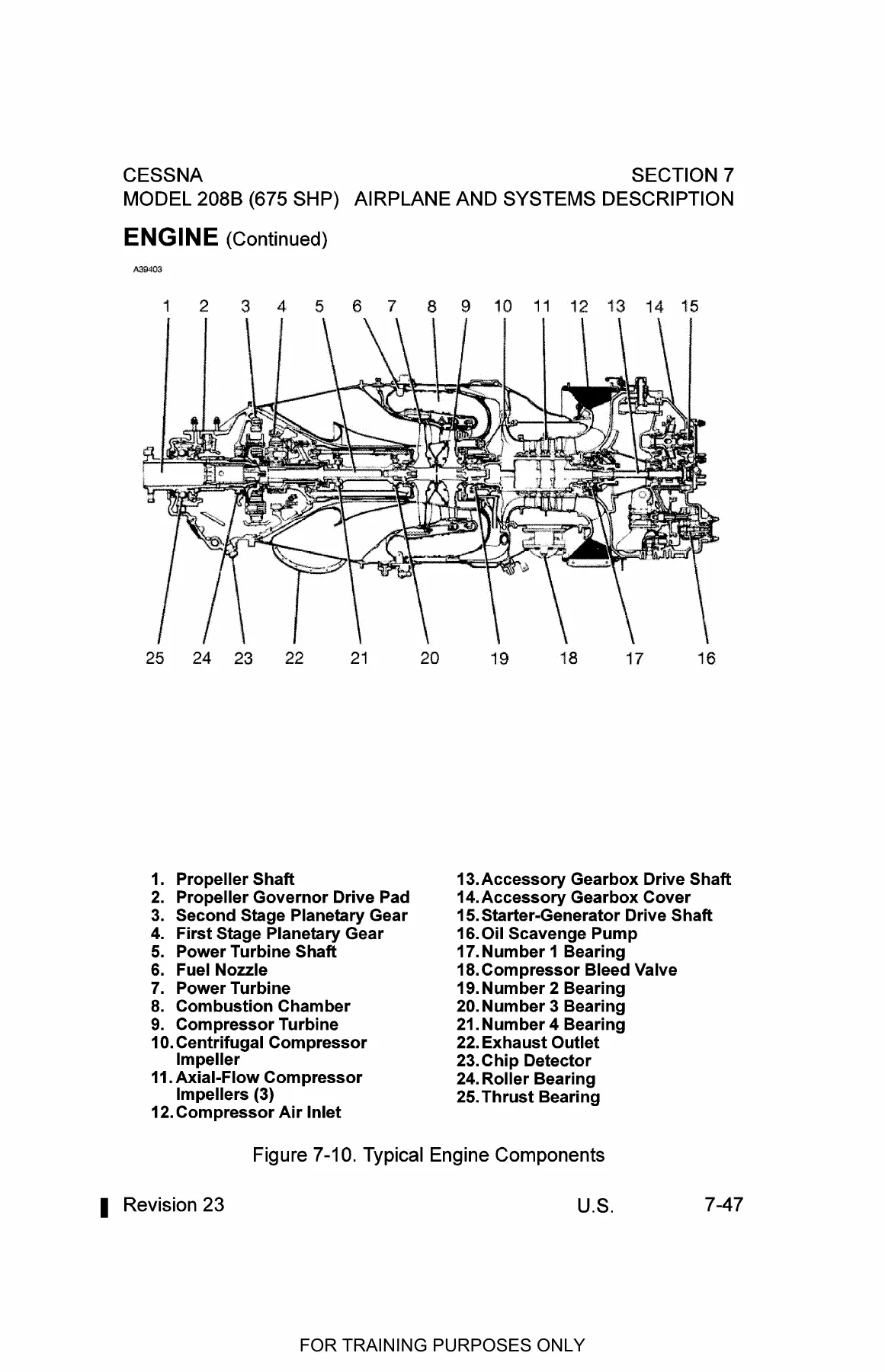
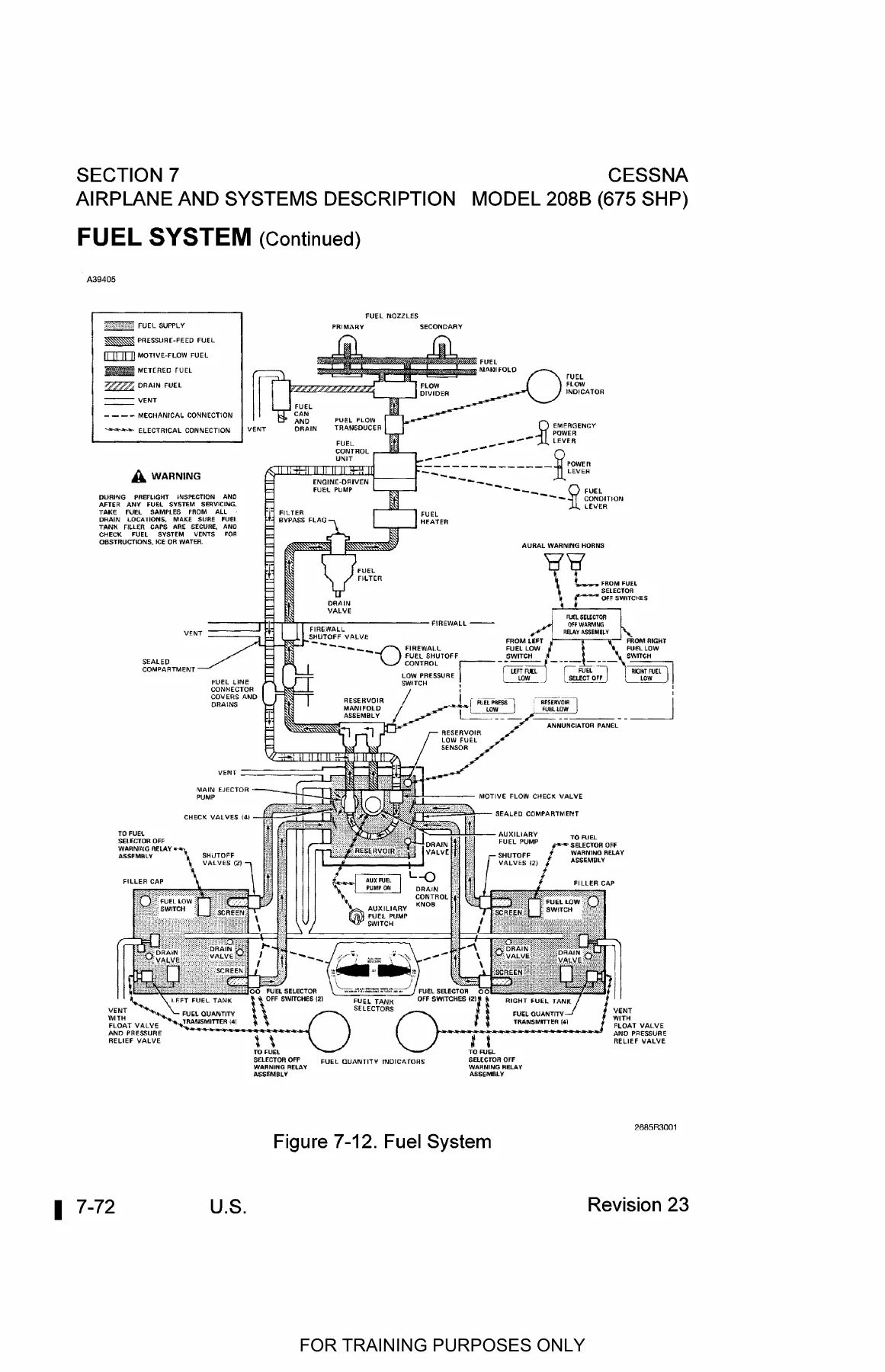
- Section 7 — Airplane & Systems Description: airframe, cargo pod, flight controls, trim systems, instrument panel, annunciator panel, ground control, wing flap system, landing gear, seats, cabin entry doors, cargo doors, windows, control locks, engine, engine controls, engine instruments, new engine break-in, lubrication, ignition, air induction, inertial separator, exhaust, fuel system, brake system, electrical system, lighting, cabin heating/ventilating/defrosting, oxygen, pitot-static system and instruments, vacuum system and instruments, stall warning, avionics support equipment, cabin features, miscellaneous equipment
- Section 8 — Handling, Service & Maintenance: identification plate, Cessna Owner Advisories, publications, airplane file, inspection periods, FAA required inspections, Cessna Progressive Care, Cessna Customer Care Program, CESCOM, Engine Condition Trend Monitoring, pilot-conducted preventive maintenance, alterations or repairs, ground handling (towing, parking, tie-down, jacking, leveling), servicing (oil, fuel, landing gear, oxygen, ground deice/anti-ice operations), cleaning and care (windshield and windows, painted surfaces, stabilizer abrasion boots, deice/anti-ice boot care, propeller care, engine care, interior care), prolonged out-of-service care, bulb replacement during flight
- Section 9 — Supplements: individual supplements covering known icing equipment, emergency locator transmitters, King and Bendix/King flight control and autopilot systems, digital ADF, high altitude takeoff and landing, parachute jumping installations, GPS navigation systems, Russian and China certification configurations, 30-amp power outlets, GPS/KLN 94, KLN 94 interfaced with KNI 582 RMI, hot weather operations, ARNAV MFD 5200 and Geolink, stand-alone VFR GPS, BFGoodrich SkyWatch SKY497 traffic advisory, BFGoodrich Stormscope WX-1000+/1000E and WX-500, Arctic Diesel fuel, 300-amp starter-generator, Shadin Mini-Flow fuel totalizer, King KY-196A digital comm, Bendix/King KN 53 nav receiver, light weight landing with cargo pod, oxygen systems in several configurations, seating options for international operations, Bendix/King KFC-225 flight control, dual HSI and FDI with KFC-225, Fairchild F1000 and FA2100 recorders, Bendix/King KRA-405 radar altimeter, five-place seating option for cargo version, Honeywell KMH 880 IHAS, Honeywell KTA 870 TAS, Garmin GMA 340 audio panel, Garmin GTX 327 and GTX 330 transponders, Spanish commercial night IMC operations, fuel totalizer system, British CAA kit configurations, Altair ADAS+ engine trend monitor, Bendix/King KI 825 EHSI, Bendix/King KT 73 transponder, US-configured aircraft on UK registration, 12 VDC power outlets, TKS ice protection for cargo pod equipped aircraft, Artex ME406 ELT, Honeywell KHF 1050 HF transceiver, Configuration Deviation List, and standby electrical system supplements for 75-amp and 81-amp alternator installations
Working through this handbook gives a technician or pilot the complete operational envelope of the Grand Caravan 208B: every limitation the FAA approved, every emergency checklist to commit to memory, every normal procedure from preflight through shutdown, all the performance charts needed to plan a flight, the weight and balance method for cargo and passenger loadings, a full systems description for troubleshooting, and the servicing and inspection guidance that keeps the aircraft airworthy. The Section 9 supplements extend that coverage to just about every avionics package, seating configuration, certification variant and optional system that has been installed on the type.
Why This Manual Matters
Operating a turboprop like the Grand Caravan 208B is a matter of limits. Torque, ITT, Ng, propeller RPM, oil pressure and temperature, fuel imbalance, center of gravity — all of them are specified in Section 2, and every one of them exists to protect the engine and the airframe. This handbook gives the exact numbers as published by Cessna and approved by the FAA, including the PT6A-114A engine operating limits chart, the airspeed limitation and indicator marking charts, the weight and CG envelopes, and the cargo zone load limits for both the cabin and the cargo pod.
The emergency procedures in Section 3 are written as operational checklists with amplified procedures that explain the reasoning behind each step. Engine failure after takeoff, airstart with and without starter assist, loss of oil pressure, fuel control unit malfunction, inadvertent icing encounter, electrical system failures, flap system malfunctions, landing with a flat tire — every one of them is covered. Having the correct sequence and the supporting explanation is what turns a bad day into a manageable one.
For maintenance and engineering work, the systems description in Section 7 combined with the handling and service information in Section 8 covers ground handling, jacking and leveling, fluid capacities and specifications, deice and anti-ice operations, cleaning and care, and the inspection schedule. Section 6 handles the paperwork side — weighing procedures, loading manifests, cargo restraint requirements, and the equipment list reference.
What You Get
This is a digital PDF download delivered instantly after purchase. No shipping, no waiting. The file can be opened on any device that reads PDFs — computer, tablet, or phone — and individual pages or sections can be printed for use in the cockpit, hangar or classroom. The Training Edition format makes it a useful teaching aid for transition training, recurrent training, or self-study on the Grand Caravan 208B.
Because the manual covers Serial 208B0179, 208B0230 and On, and the earlier serials modified by SK208-80, it applies to a broad slice of the 208B fleet, including aircraft equipped with the numerous optional systems documented in Section 9. If you operate, maintain or train on a Grand Caravan 208B with the 675 SHP PT6A-114A, this handbook is the reference the aircraft was delivered with.
Reviews
There are no reviews yet.