
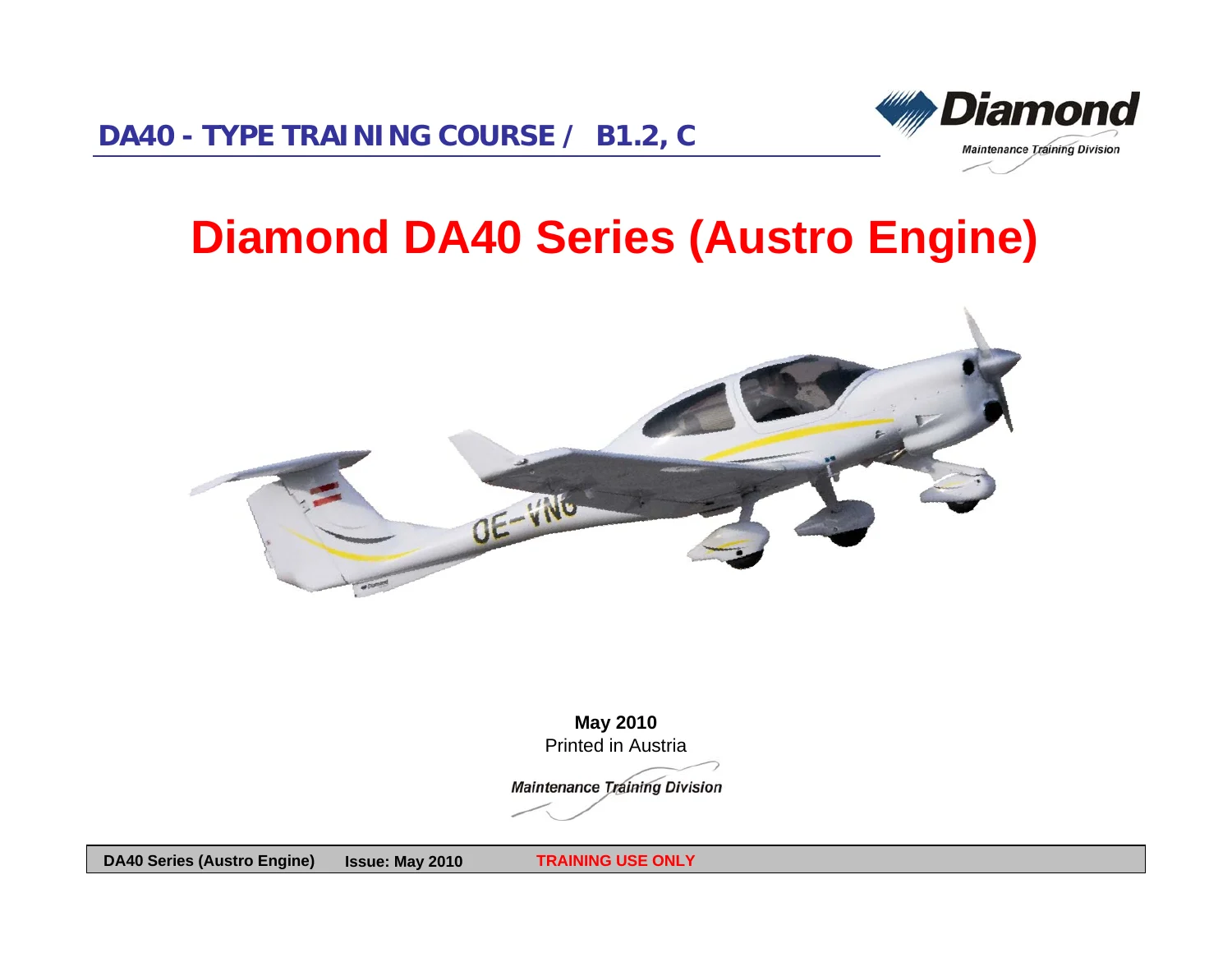
Diamond DA40 Series Austro Engine Maintenance Type Training B1.2 C May 2010
Original price was: $34.95.$19.95Current price is: $19.95.
May 2010 EASA Part 147 type training course for the Diamond DA40 NG with Austro Engine E4-A. Covers airframe systems, composite structure, MTV-6 propeller, FADEC power plant, and scheduled checks for B1.2 and C categories. Marked training use only.
Description
Diamond DA40 Series Austro Engine Maintenance Type Training B1.2 C May 2010
This download is the Diamond Maintenance Training Division type training course issued May 2010 for the DA40 Series (Austro Engine). The header identifies it as a DA40 Type Training Course for EASA licence categories B1.2 and C. The material is written as a bridge between the authorized aircraft manuals and classroom instruction. Every page carries the warning TRAINING USE ONLY. It is not a revision-controlled Airplane Maintenance Manual and must not be used as the working document for any maintenance or operational task. The Aircraft Flight Manual, Illustrated Parts Catalogue, Airplane Maintenance Manual, and the listed vendor manuals remain mandatory for work on the airplane.
File Details
- Manual type: EASA Part 147 maintenance type training course (B1.2, C)
- Brand / model: Diamond DA40 Series (Austro Engine) / DA40 NG
- Language: English
- Page count: 348
- File format: PDF
- Issue: May 2010, printed in Austria
- Publisher: Diamond Maintenance Training Division (EASA Part 147 approval AT.147.02 as stated in the introduction)
Airplane and Power Plant Covered
The Diamond DA40 Series Austro Engine Maintenance Type Training B1.2 C May 2010 is built around the DA40 NG: a four-seat, single-engine, low-wing monoplane with a T-tail, fixed tricycle landing gear, and a fiber-reinforced plastic airframe. Diamond Aircraft Industries GmbH, N. A. Otto-Straße 5, A-2700 Wiener Neustadt, is identified as the manufacturer. Fuselage half-shells are GFRP with carbon-fiber reinforcement in high-load areas. Each cantilever wing uses I-section spars with CFRP caps and GFRP/foam sandwich shells, attached to the center-section bulkheads with four large bolts per side.
Power comes from an Austro Engine E4-A liquid-cooled in-line four-stroke four-cylinder engine with double overhead camshafts and four valves per cylinder. Direct injection uses a common-rail system. A turbo-charger and intercooler supply charge air. An integrated gearbox with a torsional vibration damper drives the propeller. Dual EECU units provide full-authority digital control of engine and propeller pitch. Published operating limits in the power-plant chapter are maximum take-off power 123.5 kW (165.6 DIN-hp) at 2300 RPM, maximum continuous power 114.0 kW (152.9 DIN-hp) at 2100 RPM, and maximum overspeed 2500 RPM for not more than 20 seconds. Bare engine weight is given as 185 kg (407.9 lb).
The propeller chapter describes the MTV-6-R/190-69 three-blade variable-pitch unit. Blades are wood covered with GFRP, with stainless-steel leading-edge sheaths outboard and PU tape inboard. Pitch is governed hydraulically by gearbox oil under EECU command. Overall airplane dimensions listed in ATA 06 include wing span 11.63 m (38.16 ft), length 8.06 m (26.44 ft), and nominal height 1.97 m (6.46 ft). Wing area is 13.244 m² with a Wortmann FX 63-137/20-W4 airfoil. Electrical power is a 28 Volt system with battery and engine-driven alternator. Flight instruments and engine data are presented primarily on the Garmin G1000, with a GFC 700 autopilot installation covered in the auto-flight chapter.
How This Training Manual Relates to the AMM
The opening chapters explain ATA 100 numbering, AECMA Simplified English, page-block layout (description 1–99, trouble-shooting 101–199, maintenance practices 201–299), warnings/cautions/notes, and the difference between revisions, temporary revisions, and the four classes of Service Bulletin. Companion documents named for use with the Airplane Maintenance Manual include the DA40NG IPC and AFM, ELT operator data, the mt-Propeller owner’s and governor manuals, Austro Engine documents E4.01.01, E4.08.04 and E4.02.01, and Garmin G1000 / GFC 700 line-maintenance and troubleshooting references.
A note in the time-limits chapter states that at the time of this issue the DA40 NG engine was not type certified in the United States. Recommended scheduled-check intervals shown for training purposes are a 50-hour check (±10%), 100-hour check (±10%), 200-hour check (±5%), 1000-hour or 12-year check (±5%), first major structural inspection at 6000 hours or 12 years, and subsequent MSIs at 4000 hours or 12 years. Annual-inspection practice is split between USA-registered and other-country airplanes. Component time-limit examples and airworthiness-limitation items are presented as extracts from AMM chapters 04 and 05.
Chapters Covered
- ATA 01 – Introduction (manual purpose, related publications, warnings/cautions/notes, ATA numbering, chapter groups)
- ATA 02 – Manual System (applicability notes, revisions, temporary revisions, Service Bulletins A–D, Service Instructions, abbreviations)
- ATA 03 – General Description (airframe layout, composite construction, landing gear, flight controls, E4-A installation, fuel tanks, 28 V electrics, G1000 instruments)
- ATA 04 – Airworthiness Limitations
- ATA 05 – Time Limits / Maintenance Checks (hourly and calendar checks, MSI, component limits, checklist practice)
- ATA 06 – Dimensions and Areas (overall dimensions, control-surface deflections, adjustment report, balancing notes)
- ATA 07 – Lifting and Shoring (three jacking points)
- ATA 08 – Weighing and Leveling
- ATA 09 – Towing and Taxiing
- ATA 10 – Parking and Mooring
- ATA 11 – Placards and Markings
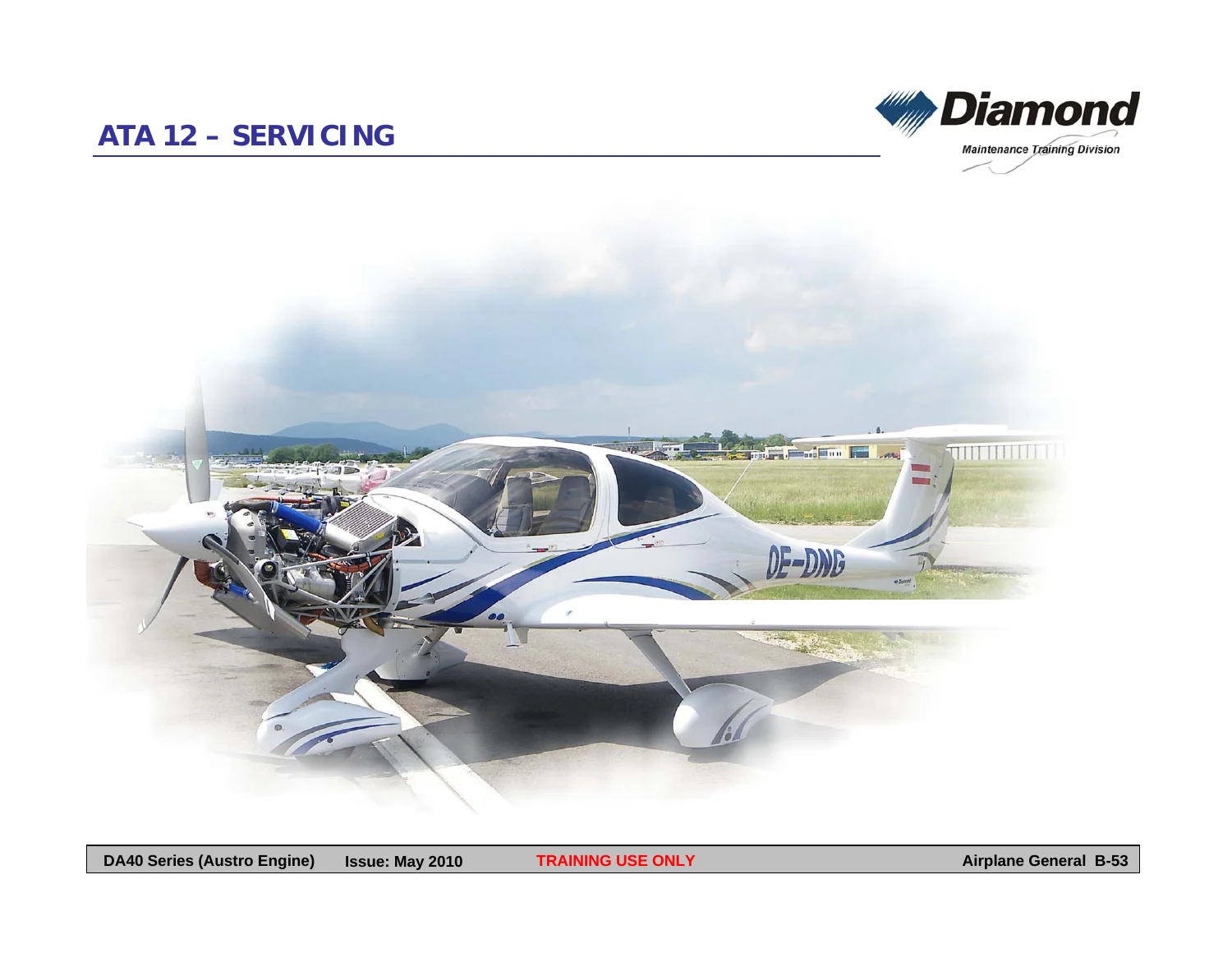
- ATA 12 – Servicing (fuel, engine oil, gearbox oil, coolant, cleaning, ice and snow)
- ATA 20 – Standard Practices (DIN/AN fasteners, standard and special torque values)
- ATA 21 – Air Conditioning (cabin heat from engine coolant, ventilation/cooling)
- ATA 22 – Auto Flight (GFC 700 modes as installed on the DA40 NG)
- ATA 23 – Communications
- ATA 24 – Electrical Power
- ATA 25 – Equipment / Furnishings (including ELT notes)
- ATA 26 – Fire Protection
- ATA 27 – Flight Controls (sticks, rudder cables, electric flaps, stall warning, trim)
- ATA 28 – Fuel System (standard and long-range tanks, transfer, indication on G1000 MFD)
- ATA 31 – Indicating Systems (G1000 PFD/MFD layout and engine/fuel displays)
- ATA 32 – Landing Gear
- ATA 33 – Lights
- ATA 34 – Navigation
- ATA 51 – Standard Practices and Structures (GFRP/CFRP sandwich, damage assessment, bonding, lightning protection)
- ATA 52 – Doors (canopy, passenger door, access panels)
- ATA 53 – Fuselage
- ATA 55 – Stabilizers (horizontal stabilizer, elevator, rudder)
- ATA 56 – Windows
- ATA 57 – Wings
- ATA 61 – Propeller (MTV-6-R/190-69 assembly, governor schematic, tracking notes)
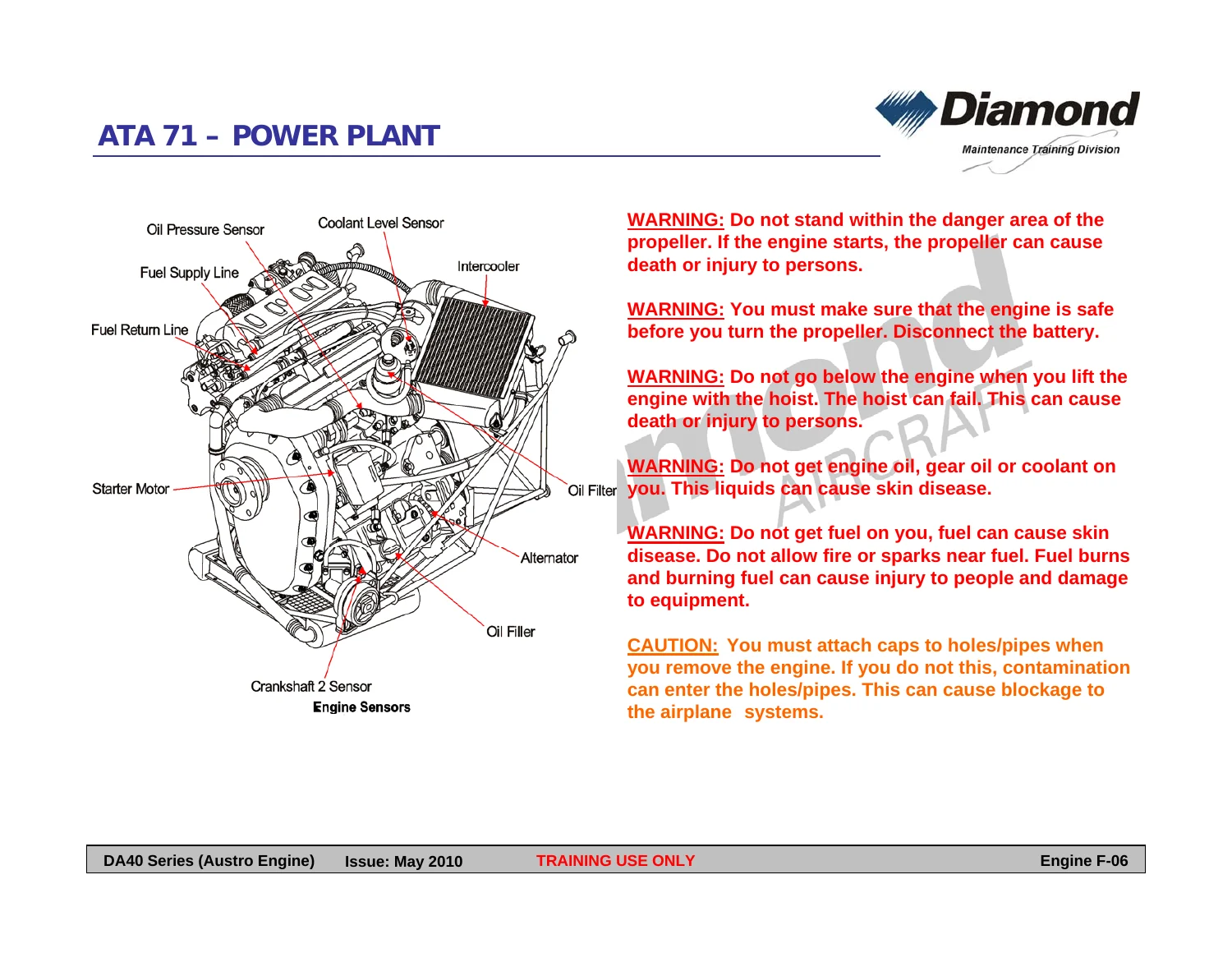
- ATA 71 – Power Plant (cowlings, mount, E4-A specification table)
- ATA 72 – Engines (oil-system maintenance points; authorized AE organizations note)
- ATA 73 – Engine Fuel and Control
- ATA 75 – Engine Cooling
- ATA 76 – Engine Controls
- ATA 77 – Engine Indication
- ATA 78 – Exhaust
- ATA 79 – Oil
- ATA 80 – Starting
- ATA 81 – Turbo Charger (filter, alternate air, waste gate, intercooler)
Taken together, the Diamond DA40 Series Austro Engine Maintenance Type Training B1.2 C May 2010 walks a technician through how the DA40 NG is built, how its systems interact, where scheduled work sits in ATA 05, and which vendor manuals close the loop on engine, propeller, and avionics tasks that this course only introduces.
Servicing Figures Taught in the Course
ATA 12 records usable fuel as 14 US gal (53 liters) per tank in the standard single-chamber configuration and 19.5 US gal (74 liters) per tank with the long-range two-chamber configuration under OÄM 40-130. Engine wet-sump capacity is 7.0 liters (7.4 US qt) with a minimum safe quantity of 5.0 liters (5.3 US qt). Maximum oil consumption is given as 0.1 liter/hr. Gearbox oil quantity is 2.1 liters (2.2 US qt), checked at a sight glass on the gearbox. Coolant is liquid, with an expansion tank and pressure-regulating valve on the left side of the engine; the course warns not to remove the cap when hot and to investigate any coolant loss before further running. Replenishment-point drawings show wing fillers and drains, the fuselage gascolator drain, engine oil, gearbox oil, and coolant.
Standard torque tables cover AN fine-thread and DIN/LN metric fasteners, plus special values such as engine-mount-to-firewall bolts (40 Nm corners, 60 Nm center), forward shock-mount arm bolts (85 ± 8 Nm), and horizontal-stabilizer attaching bolts (45 Nm). Control-surface deflection ranges for elevator, aileron, flap, and rudder are illustrated so a trainee can read an Adjustment Report against the delivered airplane.
IMAGES PREVIEW
Systems Emphasis for B1.2 and C Students
Airframe-system chapters describe cabin heating from the engine coolant heat-exchanger, GFC 700 mode keys as they apply to this installation (several keys are noted as inactive on the DA40 NG), G1000 COM/ICS behavior, 28 V generation and external power, furnishings and ELT, portable extinguisher limits, mechanical stall warning, electric flap logic with fail-safe travel stops and a torsion tube against asymmetric flap, and the aluminum wing tanks with electric transfer from right (aux) to left (main) on the long-range layout. Fuel quantity and fuel temperature for each wing are shown on the G1000 MFD.
Structure chapters treat sandwich skins, drain and vent holes that must stay open after repair, and the bonding system required because GFRP/CFRP does not conduct lightning current like metal. Engine chapters add labeled sensor and oil-service locations, the note that only Austro Engine authorized organizations may perform certain engine work, and the turbo path from NACA inlet and filter through alternate-air valve, compressor, intercooler, and intake manifold, with waste-gate position commanded by the EECU.
Get the Diamond DA40 Series Austro Engine Maintenance Type Training B1.2 C May 2010
Use this course to prepare for DA40 NG type work: reading ATA chapter structure, locating jacking and weighing points, interpreting scheduled-check intervals and airworthiness limitations, identifying GFRP/CFRP repair boundaries, tracing fuel, 28 V, G1000/GFC 700, flap, and landing-gear systems, and understanding E4-A oil, coolant, gearbox, common-rail, EECU, and turbo-intercooler layouts before you open the current AMM or Austro Engine manuals. Correct ATA references, torque figures, tank capacities, and engine limits matter because the live airplane is maintained to the revision-controlled manuals this course points to, not to a static training pack. After payment you receive an instant PDF download — no shipping, readable on any device, and printable for study notes. Keep the May 2010 TRAINING USE ONLY limitation in view and always perform actual tasks from the current AFM, IPC, AMM, and vendor data.
Reviews
There are no reviews yet.