
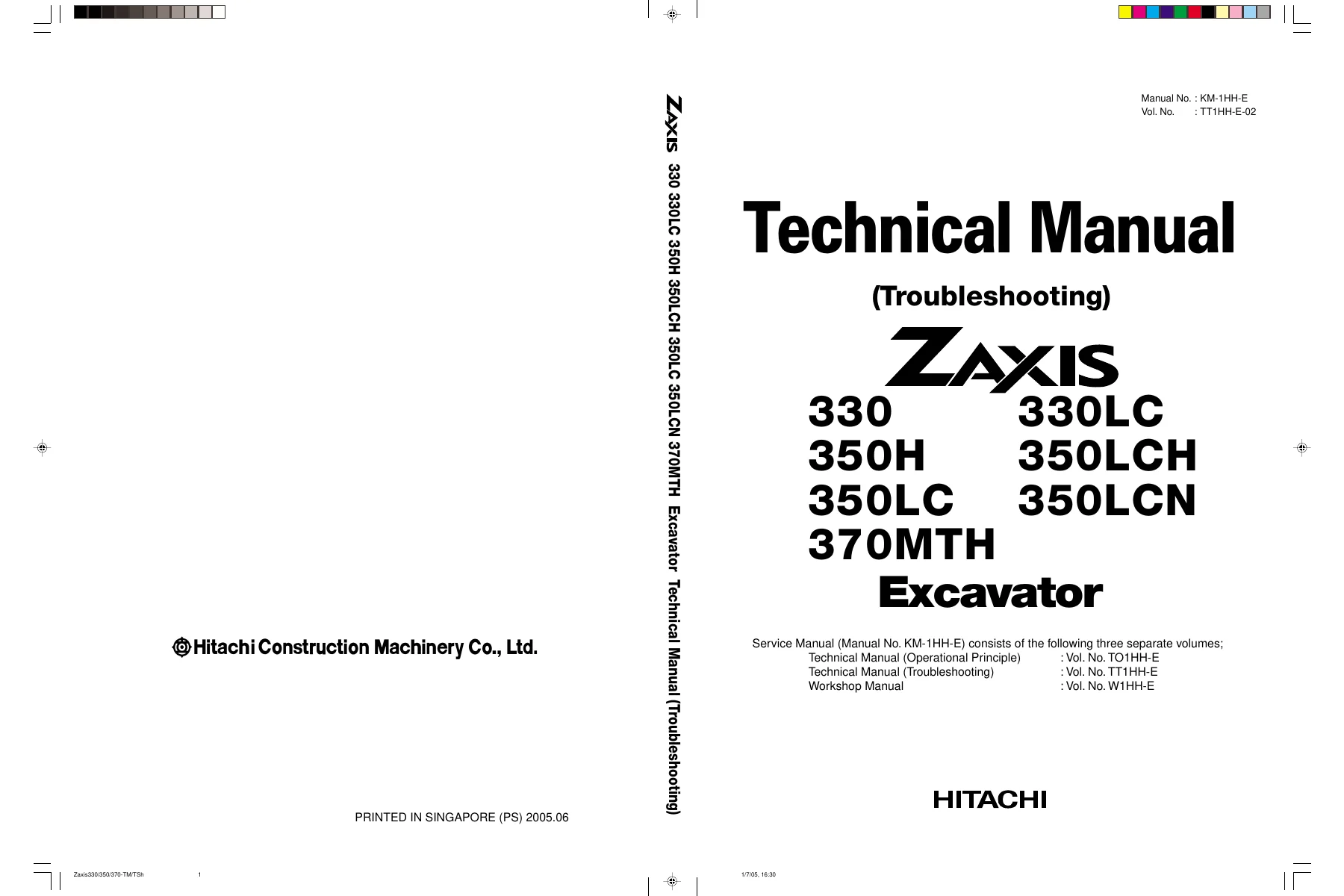
Hitachi ZAXIS 330 350 370 Series Excavator Technical Manual Troubleshooting TT1HH-E PDF
Original price was: $34.95.$21.95Current price is: $21.95.
Hitachi ZAXIS 330, 330LC, 350H, 350LCH, 350LC, 350LCN and 370MTH excavator Technical Manual (Troubleshooting) TT1HH-E — 344 pages of operational performance testing, fault-code diagnosis, Dr.ZX procedures, hydraulic and electrical troubleshooting.
Description
The Hitachi ZAXIS 330 350 370 Series Technical Manual (Troubleshooting) is the diagnostic volume of the Hitachi excavator service documentation set — Manual No. TT1HH-E, issued in 2005 by Hitachi Construction Machinery Co., Ltd. It covers the ZAXIS 330, 330LC, 350H, 350LCH, 350LC, 350LCN and 370MTH excavators, and it exists to answer one question on the shop floor: why is this machine not performing to specification, and what has to be done about it. The companion Operational Principle volume explains how the machine is built; this troubleshooting manual tells the technician how to measure it, test it and trace a fault to its actual cause.
File Details
- Manual type: Technical Manual — Troubleshooting
- Manual number: TT1HH-E (this volume issued as TT1HH-E-02)
- Parent service manual: KM-1HH-E — the three-volume set comprising Technical Manual (Operational Principle) TO1HH-E, Technical Manual (Troubleshooting) TT1HH-E and Workshop Manual W1HH-E
- Brand: Hitachi
- Models covered: ZAXIS 330, 330LC, 350H, 350LCH, 350LC, 350LCN, 370MTH
- Language: English
- File format: PDF
- Length: 344 pages
- Document date: 2005 — Hitachi Construction Machinery Co., Ltd., Tokyo, Japan
Chapters Covered
The Hitachi ZAXIS 330 350 370 Series Technical Manual (Troubleshooting) is arranged into two large sections — a performance-testing section and a troubleshooting section — each broken into numbered groups.
Section 4 — Operational Performance Test
- Group 1 Introduction — purpose of the performance tests, the kinds of tests used, performance standards, evaluation precautions, test area preparation and precise-measurement practice
- Group 2 Standard — the operational performance standard table, main pump P-Q curve, injection pump test conditions and settings, Dr.ZX monitor indicating values and sensor activating ranges
- Group 3 Engine Test — engine speed, engine compression pressure, valve clearance adjustment, nozzle check, injection timing and lubricant consumption
- Group 4 Excavator Test — travel speed, track revolution speed, mistrack check, travel parking leakage, swing speed, swing function drift check, swing motor leakage, maximum swingable slant angle, swing bearing play, hydraulic cylinder cycle time, dig function drift check, control lever operating force, control lever stroke, combined boom raise/swing function check, and combined boom raise and arm roll-in operation
- Group 5 Component Test — solenoid valve set pressure, main pump delivery pressure, main relief valve set pressure, relief pressure, overload relief valve set pressure, main pump flow rate test, swing motor drainage and travel motor drainage
- Group 6 Adjustment — engine speed adjustment and engine learning, governor and fuel cut-off lever positions, primary and secondary pilot pressure adjustment, pump regulator adjustment and relief valve set-pressure adjustment procedures
Section 5 — Troubleshooting
- Group 1 General — the six-step diagnosing procedure, built-in diagnosing system activation and display list, Dr.ZX operation, Dr.ZX fault code list, monitoring item list, special functions (WU and ECO deactivation), service mode, learning data display, parameter change and adjustment data list
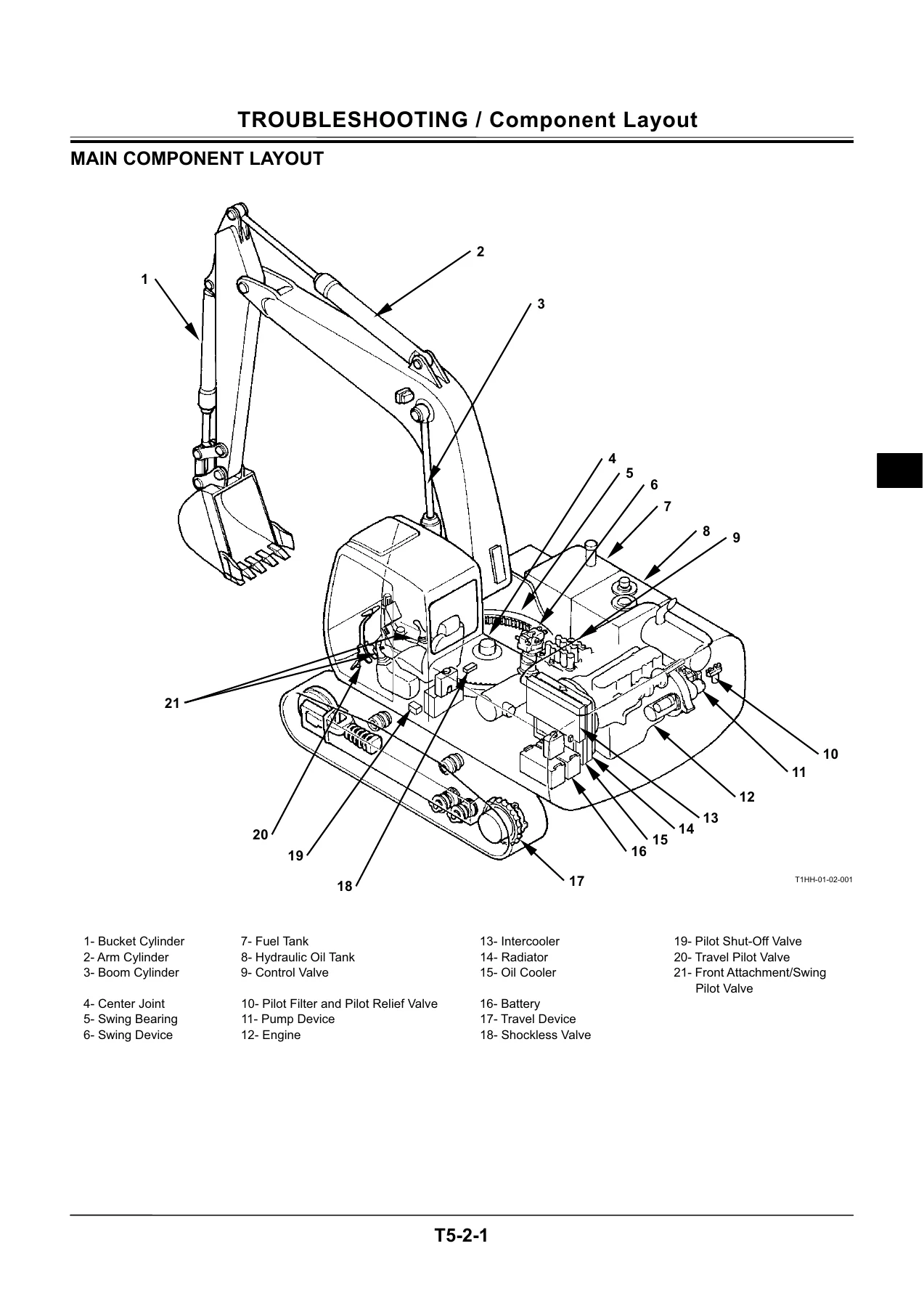
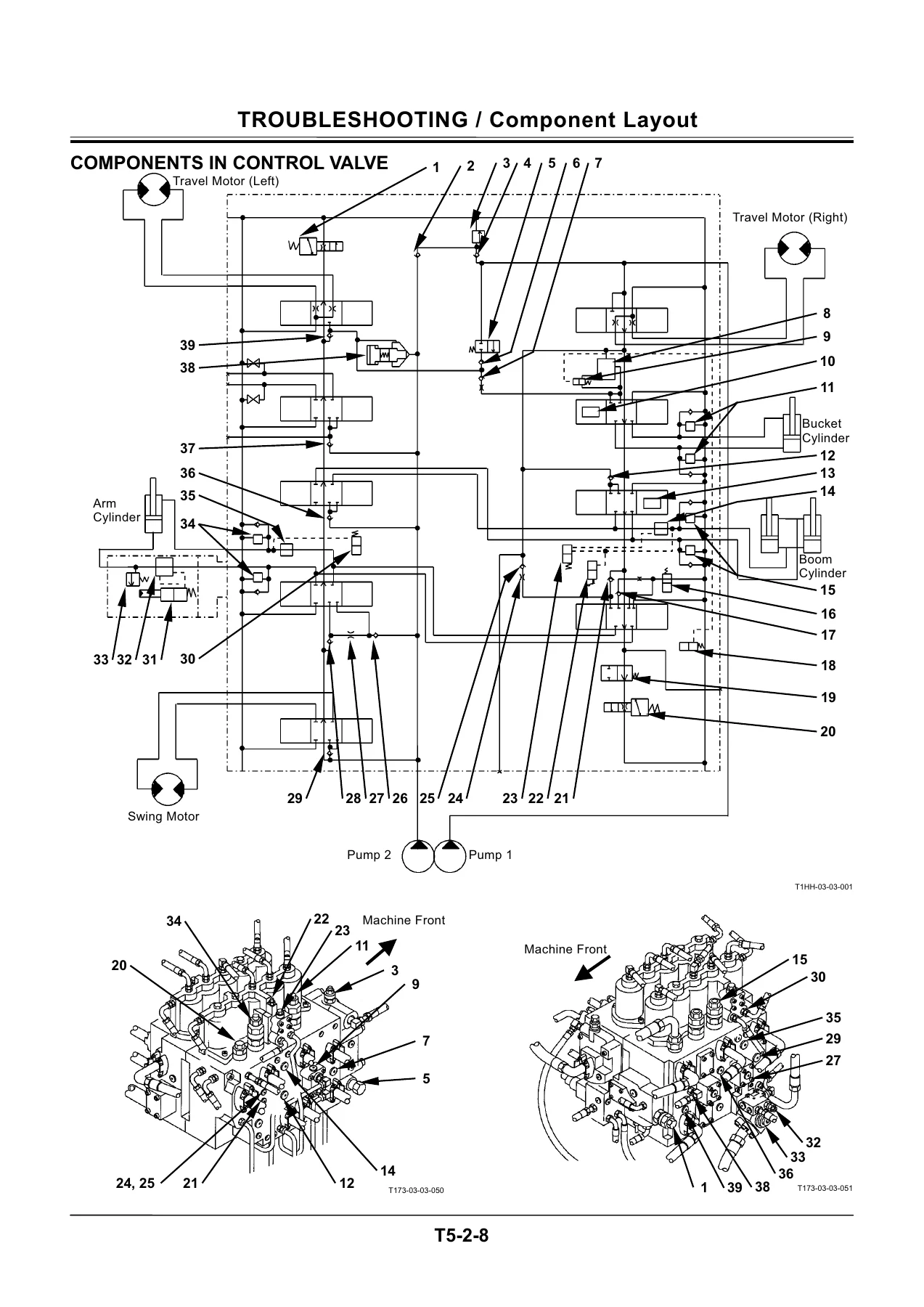
- Group 2 Component Layout — main component layout, electrical component layout, relay, monitor and switch layouts, engine, pump device, swing device, control valve, solenoid valve unit, travel device, shockless valve, positioning control valve and components inside the control valve
- Group 3 Troubleshooting A — fault code diagnosis for codes 01, 02, 03, 04, 06, 07, 10, 11, 12, 13, 14, 15, 16, 18 and 19, with connector pin references and sensor resistance and voltage specifications
- Group 4 Troubleshooting B — correlation tables between trouble symptoms and part failures, then engine system, all-actuator system, front attachment system, swing system, travel system and other system troubleshooting, plus exchange inspection and the emergency boom lowering procedure
- Group 5 Troubleshooting C — monitor diagnosis for the coolant temperature gauge, fuel gauge, indicator light check system, preheat indicator, engine oil level indicator, coolant level indicator, alternator indicator, engine oil pressure indicator, overheat indicator, air filter restriction indicator, buzzer, LCD and hour meter, plus the optional hydraulic oil filter indicator
- Group 6 Electrical System Inspection — inspection and maintenance precautions, wire colour coding, connector disconnection instructions, fuse and fusible link inspection, battery voltage check, alternator troubleshooting, continuity and short-circuit checks, voltage and current measurement, 5-volt circuit testing, false-signal checks and the test harness list
- Group 7 ICX — information controller outline, daily report data list, frequency distribution data list, cumulative operation hour list, alarm list, trouble list, ICX fault codes and satellite terminal fault codes
Between them, these two sections give a technician a complete diagnostic loop. The performance-test section supplies the target numbers — flow rates, pressures, cycle times, leakage limits, slant angles, lever strokes and operating forces — measured at a defined hydraulic oil temperature of 50 ±5 °C. The troubleshooting section supplies the path: if the fault is electrical and the controller catches it, the fault-code flow charts in Troubleshooting A identify the sensor, harness or controller; if the controller records nothing, the symptom tables in Troubleshooting B point at the mechanical, hydraulic or electronic parts most likely to be responsible; and if the problem is only in the gauges or warning lamps, Troubleshooting C isolates the monitor circuit.
What the Operational Performance Test Section Gives You
The standard tables in Group 2 are the backbone of the book. They list engine speeds for slow idle, fast idle, ECO-deactivated fast idle, E mode, HP mode, auto-idle, auto-acceleration and warm-up, along with compression pressure, valve clearance, first- and second-stage nozzle injection pressures, injection timing and lubricant consumption limits. The main pump P-Q curve is plotted against delivery pressure with lettered points from A to F, and a second P-Q curve is plotted against pump control pressure signal — both measured at a rated pump speed of 1900 min-1 and a hydraulic oil temperature of 50 ±5 °C. Excavator tests give travel speed and track revolution speed figures for fast and slow modes across the model range, swing speed, maximum swingable slant angle, allowable swing bearing play, cylinder cycle times for boom, arm and bucket, and dig function drift allowances for the maximum-reach and arm-roll-in positions.
How the Troubleshooting Section Is Organised
Troubleshooting A is reached when the main controller has stored a fault code. Each code is presented as a flow chart with decision points, connector terminal references, harness-end views and the specification to compare against — for example EC sensor voltage ranges, engine control dial voltages, oil temperature sensor resistance values, and the 5 ±0.5 V supply checks used across the pressure sensors. Troubleshooting B is reached when no fault code appears but the machine is still misbehaving. It opens with large correlation tables mapping each symptom to the parts that can cause it, then walks through engine, actuator, front attachment, swing, travel and other systems in dedicated flow charts — including the emergency boom lowering procedure using the needle valve in the control valve. Troubleshooting C then handles monitor-only faults such as a gauge that will not move, a pointer that swings over scale, or an indicator that stays lit.
Electrical, Dr.ZX and ICX Coverage
Because so much of the diagnostic path runs through the electronic control system, the manual includes the Dr.ZX operation sequence, the Dr.ZX fault code and monitoring item lists, the built-in diagnosing system display list, and the service mode for learning data display, parameter change and monitor display configuration. Group 6 supplies the electrical testing fundamentals needed to use those tools correctly — how to disconnect the different connector lock types, how to test fuses and fusible links with a tester rather than by eye, how to measure battery and alternator voltage, how to perform single-line and multi-line continuity and short-circuit checks, and which test harness part numbers (ST 7123, ST 7125, ST 7126, ST 7129, ST 7227) apply to which circuit. Group 7 covers the ICX information controller and the optional satellite terminal, listing recorded daily report data, frequency distribution data, cumulative operating hours, alarm records and ICX communication fault codes.
Who This Troubleshooting Manual Is For
This is a working diagnostic book, not a sales brochure. It suits the technician who already understands the machine’s systems and needs the correct test conditions, the right measurement location and the factory figure to compare against — whether that is a pump flow rate on a hydraulic tester, a relief pressure on a gauge, an EC sensor voltage on a meter, or a fault code displayed through Dr.ZX. It is equally useful for a shop setting up a performance test on a ZAXIS 330, 330LC, 350H, 350LCH, 350LC, 350LCN or 370MTH before and after a repair, so the result can be proven rather than assumed.
IMAGES PREVIEW
Instant PDF Delivery
With the Hitachi ZAXIS 330 350 370 Series Technical Manual (Troubleshooting) TT1HH-E in hand, you can run a full operational performance test on the machine, read and clear controller fault codes, follow the factory flow charts from symptom to failed component, verify sensor and harness circuits with the correct voltages and resistances, adjust relief and pilot pressures to specification, diagnose gauge and monitor faults, and use the ICX data records to see how the machine has actually been working. Correct pressures, cycle times and clearances are what separate a repair that holds from one that comes back — and having the manufacturer’s own test conditions and limits removes the guesswork. The manual is delivered as an instant PDF download after payment, with no shipping and no waiting; it can be opened on any device and individual pages can be printed for use at the machine.

Reviews
There are no reviews yet.