
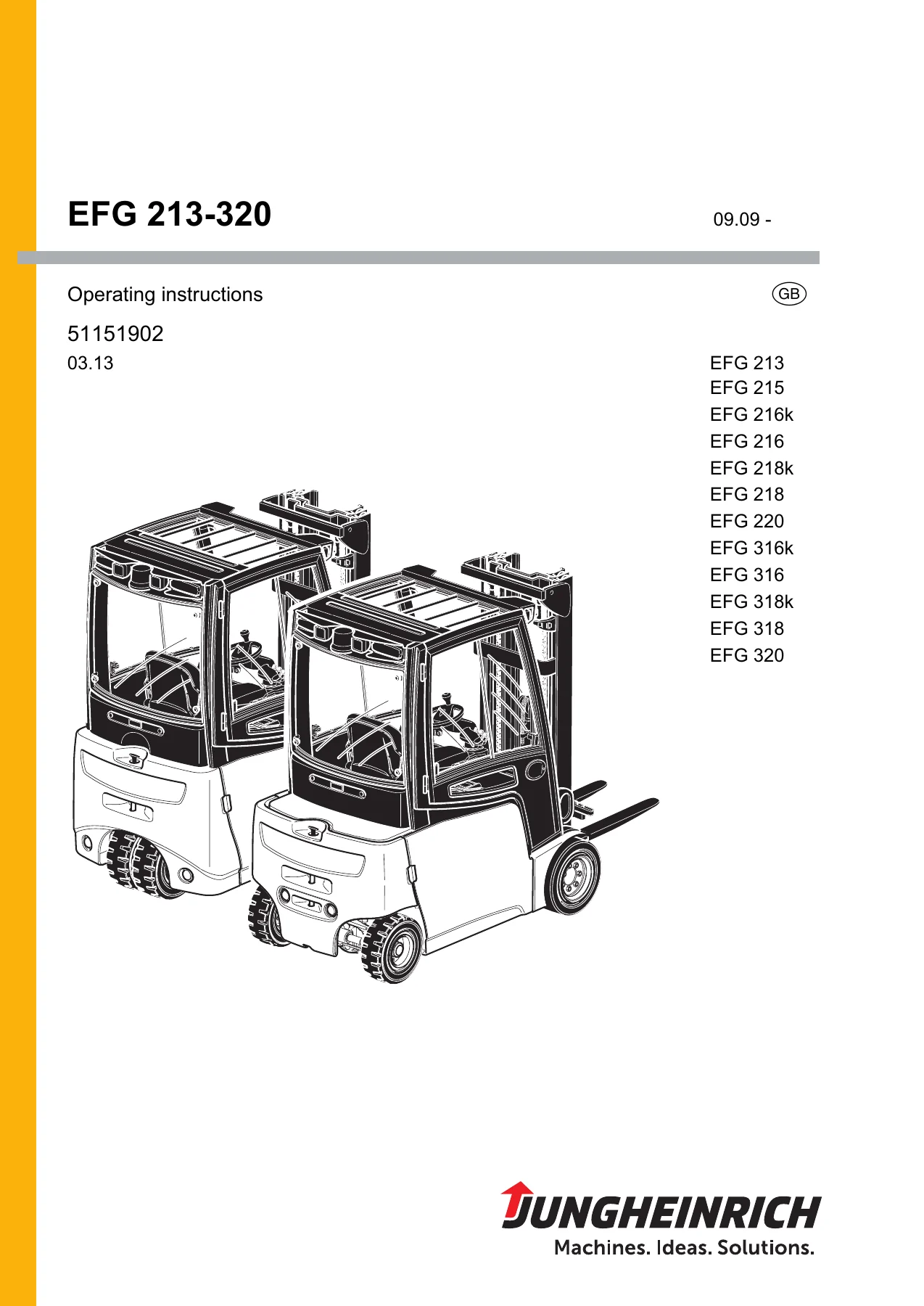
Jungheinrich EFG 213-320 Electric Forklift Operating Instructions Manual 51151902 PDF
Original price was: $52.95.$34.95Current price is: $34.95.
Complete operating instructions for Jungheinrich EFG 213, 215, 216k, 216, 218k, 218, 220, 316k, 316, 318k, 318 and 320 electric counterbalanced forklifts. Doc 51151902, edition 03.13. Covers operation, battery handling, maintenance, hydraulics, safety and troubleshooting.
Description
Jungheinrich EFG 213-320 Electric Forklift Operating Instructions Manual
This is the complete operating instructions manual for the Jungheinrich EFG 213-320 series of electric counterbalanced forklift trucks. Document number 51151902, edition 03.13, this manual covers the EFG 213, EFG 215, EFG 216k, EFG 216, EFG 218k, EFG 218, EFG 220, EFG 316k, EFG 316, EFG 318k, EFG 318 and EFG 320 models. It is the definitive guide for safe operation, daily maintenance, battery handling and troubleshooting of these machines.
File Details
- Manual Type: Operating Instructions
- Brand: Jungheinrich
- Models Covered: EFG 213, EFG 215, EFG 216k, EFG 216, EFG 218k, EFG 218, EFG 220, EFG 316k, EFG 316, EFG 318k, EFG 318, EFG 320
- Document Number: 51151902
- Edition: 03.13
- Language: English
- Page Count: Approx. 243
- File Format: PDF
Chapters Covered
- A – General
- B – Truck Description
- C – Transport and Commissioning
- D – Battery
- E – Operation
- F – Industrial Truck Maintenance
- Appendix – JH Traction Battery Operating Instructions
Chapter A – General
This opening chapter establishes the ground rules. It covers correct application of the truck, approved application conditions, proprietor responsibilities, and the procedure for adding attachments or optional equipment. The manual is explicit about what the truck must not be used for: do not travel with a raised load above 30 cm, do not carry or lift passengers, and do not operate on inclines greater than 15%. Approved operating conditions specify a permissible temperature range of -20°C to 40°C, operation only on secure, level surfaces with sufficient capacity, and the rule that travel on inclines must always be with the load facing uphill.
Chapter B – Truck Description
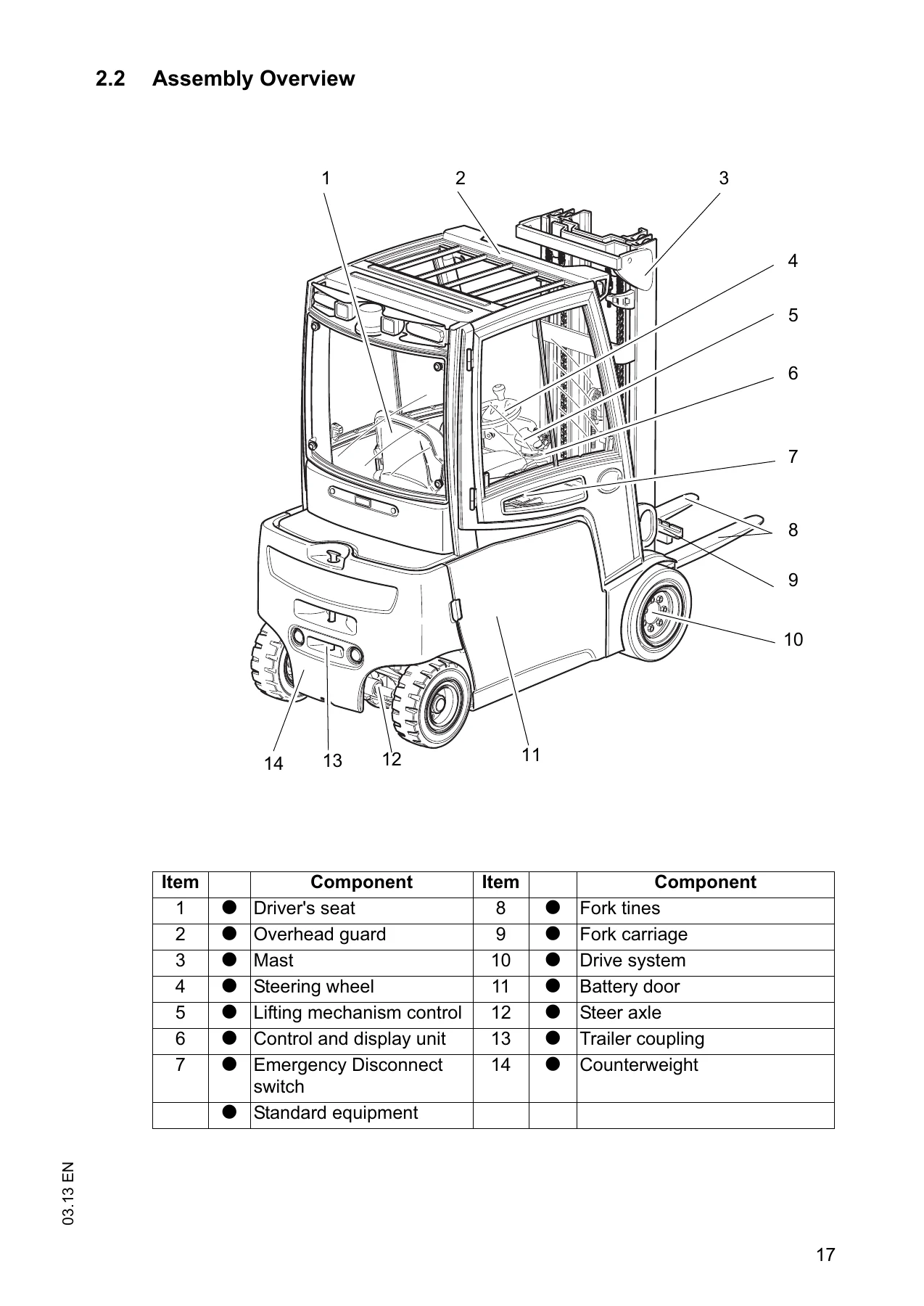
This is the reference chapter. It opens with truck models and rated capacity—explaining how the model name breaks down (e.g., EFG 213: series 2, rated capacity 13 x 100 kg)—then moves into assemblies and functional description with a full component overview: chassis, operator position, overhead guard, steering, wheels, drive and brake system, emergency stop feature, hydraulic system, mast and attachments.
The technical specifications section is extensive. Performance data covers travel speed (16/16 km/h for EFG 213-216k, 17/17 km/h for EFG 316k-318, 17/16 km/h for EFG 320), lift speed with and without load, lowering speed, gradeability, acceleration and operating pressure. Dimensions include mast height retracted, free lift, lift height, mast height extended, overhead guard height, seat height, coupling height, mast tilt, length including forks, headlength, overall width, fork width, ground clearance, working aisle width for 800×1200 and 1000×1200 pallets, turning radius, load distance and wheel distance. Weights are listed for net weight including battery, front axle load with and without lifting load, and rear axle load with and without lifting load. Mast versions, tyre types with pressures and torques, engine data (drive motor, lift motor, steer motor), EN norms for noise emission and vibration, and conditions of use are all detailed. Identification points and data plates are covered with an illustrated key.
Chapter C – Transport and Commissioning
Everything needed to move the truck before it enters service. It covers lifting the truck by crane with the prescribed strap points, loading with another industrial truck, securing the truck during transport with fastening belts and wedges, and using the truck for the first time. This chapter matters for anyone receiving a new or replacement truck on site and needing to commission it correctly.
Chapter D – Battery
A complete guide to lead-acid battery handling. It begins with safety regulations governing the handling of lead-acid batteries—fire protection, battery maintenance, battery disposal and general notes. It covers battery types and dimensions for the 48 V batteries used across the EFG range, then explains how to expose the battery. Charging procedures are detailed for both stationary chargers and on-board chargers, including LED displays for battery charger and battery controller, float charge and partial charging. Battery removal and installation is covered using multiple methods: EJE pallet truck with Snapfit battery holder, hand pallet truck with Snapfit battery holder, multi-adapter, worktable for crane loading, fork shoe, roller conveyor and hook-on battery door removal and installation.
Chapter E – Operation
This is the chapter operators and supervisors will use most. It opens with safety regulations for forklift truck operation: driver authorisation, operator rights and obligations, unauthorised use, damage and faults, repairs, and the hazardous area definition. The displays and controls section walks through the control panel with display unit, armrest control panel switch, side compartment control panel switch, and the display with its battery discharge indicator, battery discharge monitor, residual time display, hourmeter, travel direction, speed and wheel position display, operating program display and error display.
Preparing the truck for operation covers checks before daily operation, entry and exit, trucks with reduced headroom, setting up the operator position (adjusting the driver’s seat, steering column, armrest), and the seat belt. Industrial truck operation covers safety regulations, preparing the truck for operation, setting the time, parking the truck securely, emergency disconnect, travel, steering, brakes (service brake, coasting brake, parking brake), adjusting the forks, replacing the forks, lifting, transporting and depositing loads, operating the lift mechanism and integrated attachments, operating additional attachments for the SOLO-PILOT and Multi-Pilot, fitting additional attachments, and towing trailers. Optional equipment covered includes CanCode keypad, assistance systems (Access Control, Drive Control, Lift Control), steel cab, sliding windows, automatic/mechanical folding gate, panel door, operator position extension, adjusting the driver’s seat, heating, removable load backrest, lift cutout override, fire extinguisher, tilt angle display, Rockinger coupling, camera system and control layout “N”. Troubleshooting, operating the truck without its own drive system and emergency lowering complete the chapter.
Chapter F – Industrial Truck Maintenance
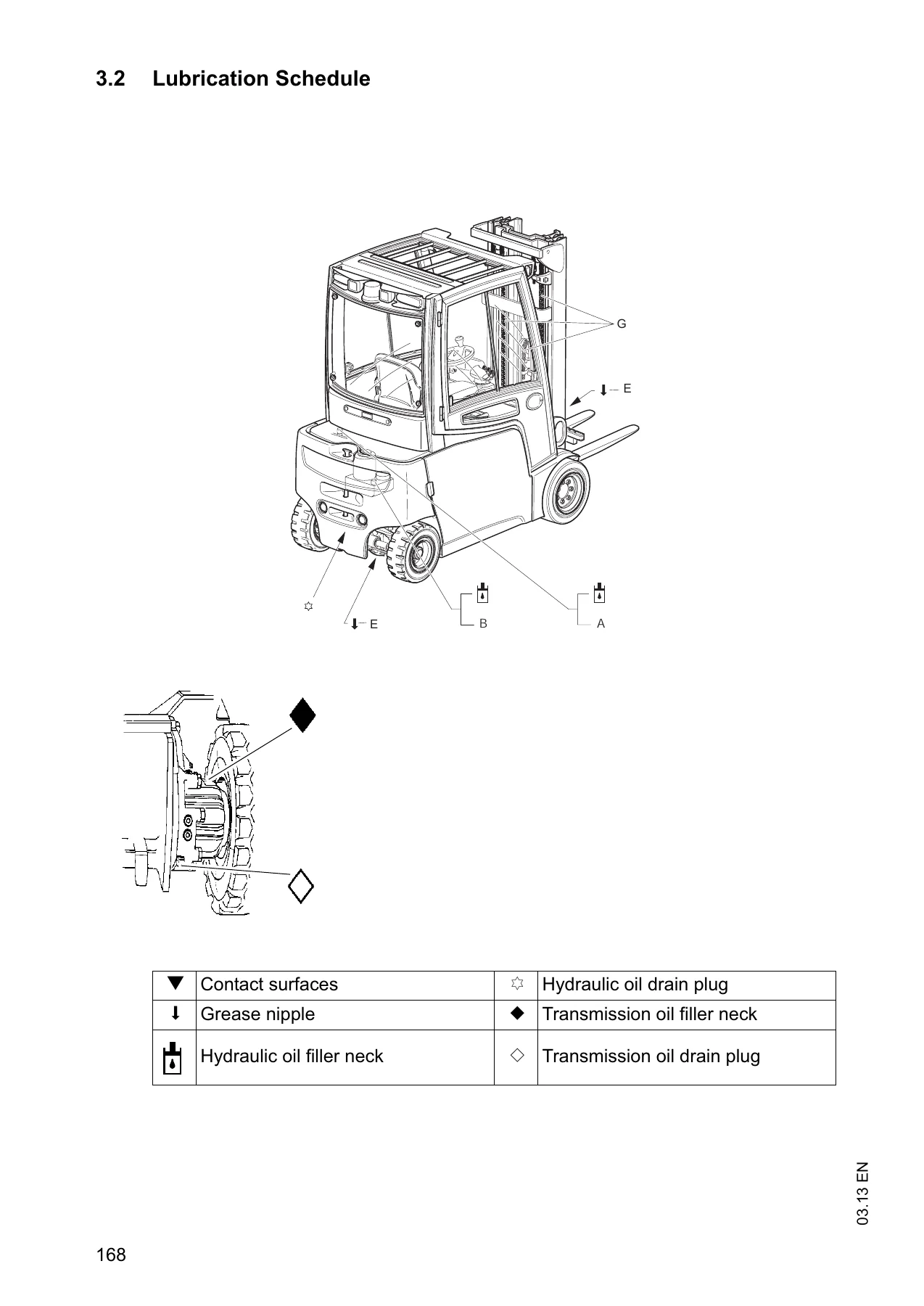
For the maintenance technician and the operator responsible for daily care. It covers operational safety and environmental protection, maintenance safety regulations, consumables and used parts, wheels, lift chains and the hydraulic system. Lubricants and the lubrication schedule are detailed with a diagram showing contact surfaces, hydraulic oil drain plug, grease nipple, transmission oil filler neck, hydraulic oil filler neck and transmission oil drain plug. Consumables are listed with order numbers, package quantities, capacities and applications.
Maintenance and repairs cover preparing the truck for maintenance and repairs, lifting and jacking up the truck safely, opening the rear panel, checking wheel attachments, replacing wheels, hydraulic system service, replacing the hydraulic oil filter, replacing the ventilation/discharge filter, checking the gear oil level, heating, adding window washer system fluid, checking electrical fuses with full fuse ratings tables, cleaning, working on the electrical system, and restoring the truck to service after maintenance and repairs. Decommissioning, safety tests at intervals and after unusual incidents, final de-commissioning and disposal, human vibration measurement, and servicing and inspection are also covered. Two maintenance checklists are included: one for EFG 213-220 and one for EFG 316-320, each with operating company and customer service sections.
Appendix – JH Traction Battery Operating Instructions
A dedicated battery manual covering correct use and application, data plate information, safety instructions, warning indications and other notes. It details lead-acid batteries with armour plated cells and liquid electrolyte, PzV and PzV-BS lead-acid batteries with sealed armour plated cells, the Aquamatik water replenishment system, electrolyte circulation, cleaning batteries, storing the battery, troubleshooting and disposal.
Why This Jungheinrich EFG Operating Instructions Manual Matters
The Jungheinrich EFG 213-320 is a substantial piece of industrial equipment. Getting the operating procedures right is not just about efficiency—it is about safety. This manual specifies the exact load limits, travel speeds for different conditions, brake procedures and battery handling protocols that keep operators and bystanders safe. It provides the maintenance schedules and torque values that keep the truck running reliably over thousands of service hours.
For maintenance teams, the manual is indispensable. The hydraulic system specifications, fuse ratings, lubrication schedule and gear oil levels are all here. The troubleshooting chapter helps localise and rectify basic faults before calling in the manufacturer’s service department. The maintenance checklists give you a structured way to track service intervals across your fleet.
For operators new to the EFG series, the controls and displays chapter is a complete walkthrough—from the key switch and Emergency Disconnect to the SOLO-PILOT and Multi-Pilot hydraulic controls. The manual explains each function, each warning indicator and each operating program so you can get the most from the truck’s performance settings.
IMAGES PREVIEW
Instant PDF Delivery
This Jungheinrich EFG 213-320 operating instructions manual is delivered as a PDF download. No shipping, no waiting. Once your order is complete, you can download the manual immediately and access it on any device—laptop, tablet or smartphone. Print the pages you need for the workshop, or keep the entire manual on a tablet for quick reference. The PDF format makes it easy to navigate, search and archive.
Whether you are a fleet manager needing to train new operators, a technician preparing for scheduled maintenance, or an owner-operator who wants the full documentation for your EFG forklift, this manual gives you the complete picture.
Reviews
There are no reviews yet.