


Liebherr FCC CBG 25(30)/30 Litronic Operating Manual Volume 1 – PDF
Original price was: $34.95.$21.95Current price is: $21.95.
Volume 1 operating manual for the Liebherr FCC CBG 25(30)/30 Litronic electro-hydraulic four-rope grab deck crane, serial numbers 162 549 – 162 550, version 001 dated 21.05.2007. Covers start-up, crane operation, emergency operation and maintenance in 173 English-language pages.
Description
File Details
- Manual type: Operating Manual – Volume 1 (start-up, operation and maintenance)
- Brand: Liebherr
- Machine: FCC CBG 25(30)/30 Litronic electro-hydraulic four-rope grab deck crane
- Serial numbers covered: 162 549 – 162 550
- Document version: Version 001 – 21.05.2007
- Publisher: LIEBHERR-WERK NENZING GMBH, A-6710 Nenzing, Austria
- Language: English
- Page count: 173
- File format: PDF
Chapters Covered
- 1. Introduction – Foreword, Using the Documentation, Design of Volume 1, Current Status of the Documentation, Storing the Documentation, CD-ROM Documentation
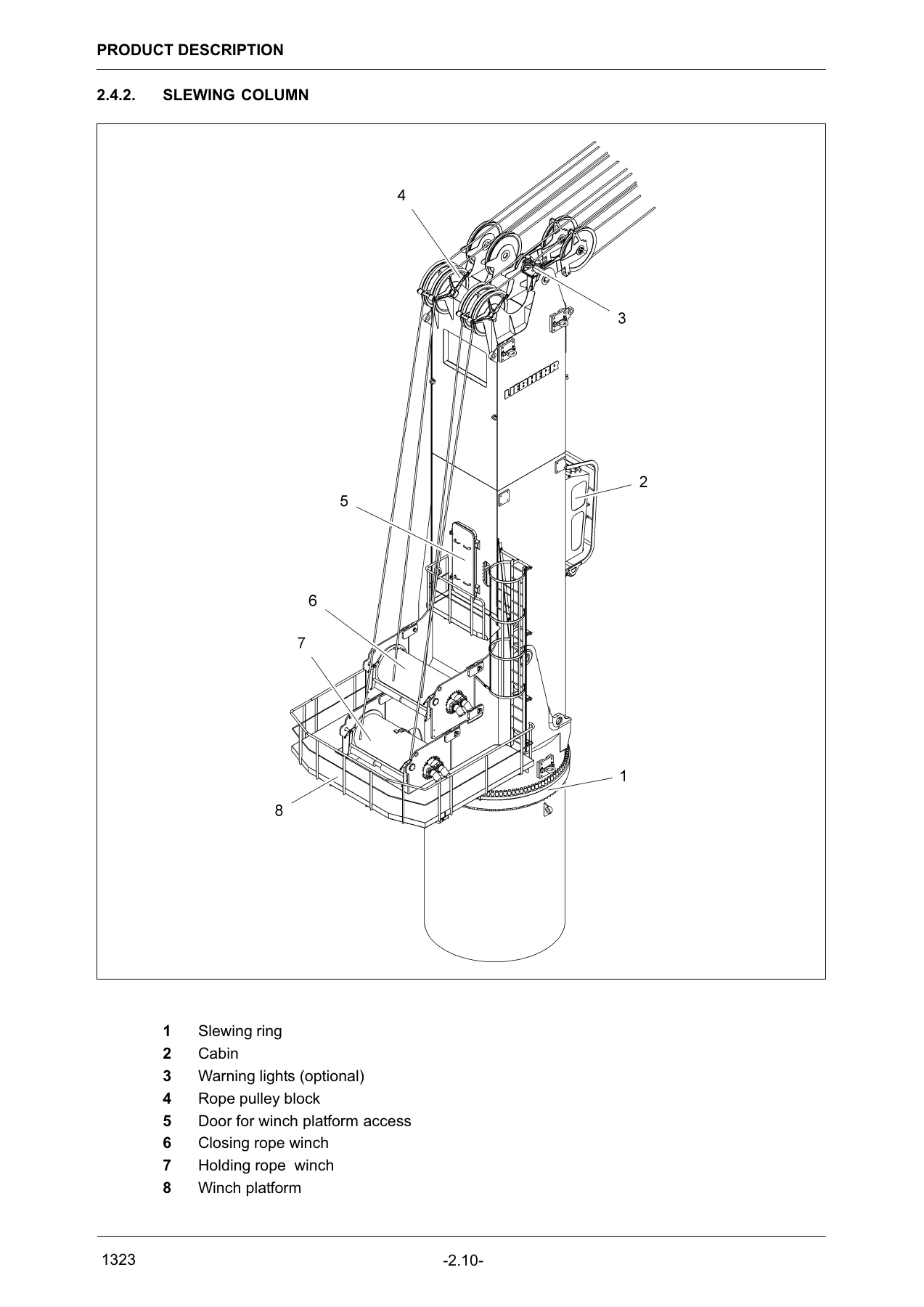
- 2. Product Description – Utilisation as Directed, Machine Passport, Technical Data, General Arrangement, Safety and Rescue Equipment
- 3. Safety Guideline – General, Danger Symbols, Areas of Responsibility, Personal Requirements of the Crane Operator, Personal Protective Gear, Work Area, Safety and Monitoring Devices, Safety Signs on the Machine, Machine Specific Dangers, Additional Dangers, Notes on Safety for the Machine Operator and Site Personnel
- 4. Control and Operating Elements – Operator’s Controlstand, Control Panels X20 / X23 / X24, Emergency Stops, Monitor, Indications on the Monitor, Camera Monitoring System, Switch Cabinets X1 and X2
- 5. Crane Operation – Checks Before Daily Start Up, Daily Start-Up, Hook Operation, Grab Operation, Synchronization, Additional Functions, Load Recording System, Litronic Test System
- 6. Emergency Operation – Instructions for Emergency Hand Pump, Procedure to Open the Grab, Procedure to Lower the Grab, Procedure to Release the Slewing Brakes, Procedure to Lower the Boom
- 7. Maintenance – Qualified Persons, Service Spare Parts and Standard Tools, Maintenance Intervals, Greasing and Oil Filling Schematics, Electric Motor, Gearboxes, Multiple Disc Brakes, Crane Ropes, Rope Pulleys, Hydraulic Lines and Hoses, Hydraulic Oil Tank, Liebherr Condition Monitoring, Pressure Accumulators, Maintenance of Oil Coolers, Electrical System, Slip Ring Unit
Volume 1 is the working document for the FCC CBG 25(30)/30 Litronic itself, not a generic crane primer. It opens with the machine passport and the technical data block that fixes the crane’s design conditions, working range, permissible capacities and speeds, then moves into the operational layer: the operator’s controlstand, switch units X20, X23 and X24, the emergency stops, and the full monitor layout with its crane operation, grab operation, bulky goods, information, operations hour counter, synchronization and message pages. From there the manual walks through daily start-up, hook and grab operation, synchronization of the holding and closing winches, sector operation and the seaseate preselection, before covering the emergency hand pump procedures and the complete maintenance schedule with greasing and oil filling schematics.
What a Technician Gets From This CBG Litronic Operating Manual
The technical data section alone is enough to set up and check the machine properly. It states the design standards used (DIN, ISO, IEC, EN, FEM 1.001, with a Liebherr works certificate in accordance with LRS rules), the ambient temperature envelope of -25 to +45 degrees C, relative humidity up to 93 percent, a maximum heel and trim of 5 degrees and 2 degrees, a maximum working wind speed of 20 m/s and a stowed wind speed of 63 m/s. Working radius runs from 4.4 m minimum to 30 m maximum. The hoisting gear is rated at 25 metric tonnes SWL in grab operation and 30 metric tonnes SWL in hook operation, with hoisting speeds of 0 – 60 m/min at full load and 0 – 78 m/min without load. Luffing takes 60 seconds from maximum to minimum radius at full load, and the slewing gear turns 360 degrees unlimited at 0 – 0.96 rpm with full load at 5 degrees heel and 2 degrees trim.
The electric power section is documented in the same detail: a 400 V, 60 Hz, three-phase main supply with a 230 V, 60 Hz, three-phase auxiliary supply, and a three-phase electric squirrel cage prime mover rated 470 kW at S6-40% ED with a star-delta starter system. The load diagram for the CBG 25(30)/30 Litronic is reproduced in full, including the working conditions for OH up to SWH 0.6 m, OG up to SWH 0.8 m, and 1H and 1G at SWH 1.1 m, along with the barge inclination tolerance of +/- 5 degrees and the operating wind speed of 20 m/s.
Controls, Monitor Pages and Operating Modes
The control chapter describes every element by location and function rather than in the abstract. Switch unit X20 carries the key switch for control on/off, the motor on/off push button with pilot light, main switch on/off, the load recorder start/stop and pause buttons, the set trigger point button, cabin lighting, crane lighting, flood light, wiper operation, screen wiper pump and the service socket restricted to authorised service personnel. Switch unit X23 on the left-hand control desk holds the luff/slew control lever, the bypass park position and warning horn push buttons, the service operation key switch, synchronize, hook operation, grab operation, grab operation bulky goods and the preselection seastate button. Switch unit X24 on the right-hand desk carries the hoist/grab control lever, grab slowly lifting and lowering, more and less closing way, receipt bulky goods, and the red emergency stop.
Because the Litronic control system is the interface between operator and machine, the manual also documents the monitor in depth. Each function key is explained – crane operation picture, information page, operations hour counter, reset rope length, set weight of tare load, message page, synchronization page and buzzer off – followed by the meaning of every status indication the operator can see. That includes the prewarning symbol that flashes with a buzzer at 90 percent utilisation and the overload STOP symbol at 110 percent, the slack rope indication, hook in upper and lower limit, boom in upper and lower limit, slewing left and right in limitation, helf/trim warning, winches not synchron, load recorder states, free space on the memory card, and the running pressure and temperature readouts for the holding winch, closing winch, luffing and slewing circuits.
Grab, Hook, Synchronization and Load Recording
Grab operation is treated as a discipline of its own. The manual explains lifting and lowering the grab, opening and closing it from the right-hand control lever, using the additional grab motion during opening and closing so the grab does not overfill, and adjusting the closing way steplessly from 100 percent down to 70 percent with the adjusted value shown on the monitor. Bulky goods operation has its own button and its own indication, and the manual notes that once the grab is closed the winches are hydraulically connected for load equalisation.
Synchronization is covered in two separate situations. During normal crane operation the holding and closing winches run parallel and the electronics control rope position, with a flashing winches not synchron indication stopping all operation modes until the system is resynchronised. After exchanging a lifting device or the hoisting ropes, the manual explains the service operation key switch positions that let each winch be driven independently, how to bring the rope ends to the same height, and how to reset the rope difference for hook operation and for grab open and grab closed positions.
The load recording system section explains taring of the load lifting device, starting and pausing recording, setting the trigger point, and what makes a load cycle valid – recording active, pause not engaged, trigger point crossed, load above the threshold for at least 10 seconds, and the load returned to ground. It documents the directory and file structure written to the flash card (Head.txt and Data.txt), how to pull the card and read it on a PC, and how to import the data into Microsoft Excel for evaluation.
Emergency Operation and Maintenance Content
Because the hydraulically controlled multiple disc brakes close without pressure, the emergency hand pump is the only way to move the machine at a total standstill. The manual lays out the pump components – hand valve, pressure line connection, pump, pump lever and suction port – and then gives step-by-step procedures to open the grab, lower the grab, release the slewing brakes and lower the boom, naming the hand valves and regulation valves involved (H62, H63, H63A, D62A, D62B, D62C, E62, E69) and stating what must be returned to normal position afterwards. It also warns plainly that limit switches and safety devices do not stop emergency movements, so the operation has to be supervised.
The maintenance chapter is built around operating-hour and calendar intervals that supplement each other, with a full general maintenance table plus separate tables for the greasing system, hydraulic system, slewing gearboxes and slewing bearing, ropes and rope pulleys, and the hoisting winches. Beyond the schedules, individual sections cover the electric motor and its lubrication plate, the distribution gearbox, slewing gearboxes and hoisting winch gearboxes with their drain, breather, dipstick and filler locations, multiple disc brake construction and spring arrangement, wire rope selection and installation including the correct uncoiling direction, rope maintenance and the illustrated discard criteria, rope pulley inspection intervals and LAMIGAMID chemical resistance, hydraulic lines and hoses with the six-year service life rule, the hydraulic oil tank and its return flow filter replacement, Liebherr Condition Monitoring with oil sampling technique and report symbols, pressure accumulator safety instructions, oil cooler cleaning methods, the electrical system and wet cleaning restrictions, and the slip ring unit with its terminal box, power section and signal section check intervals.
Get the Liebherr FCC CBG 25(30)/30 Litronic Operating Manual Volume 1
This Liebherr FCC CBG 25(30)/30 Litronic Operating Manual Volume 1 gives you the manufacturer’s own start-up sequence, control layout, monitor interpretations, grab and hook operating procedures, emergency hand pump routines and full maintenance schedule for serial numbers 162 549 – 162 550. Working from the correct procedures and the correct values is what keeps a four-rope grab deck crane productive, keeps the winches synchronised, and keeps the multiple disc brakes and wire ropes inside their service limits – guessing at any of that costs far more than the manual.
IMAGES PREVIEW
Delivery is instant. The Liebherr CBG 25(30)/30 Litronic operating manual arrives as a downloadable PDF the moment payment clears, with no shipping and no waiting. Read it on a laptop, tablet or phone at the quayside, or print the monitor pages, the greasing schematic and the maintenance tables and keep them in the cab where they are actually needed.



Reviews
There are no reviews yet.