
★ TRUSTED BY 321,897+ PROFESSIONALS WORLDWIDE
🏢
Trusted Business
Verified & Licensed
🛡️
Virus Free Files
100% Safe Downloads
🔒
Secure Payment
SSL Protected
Instant Delivery
Available Immediately
Sale!

Liebherr R920 Crawler Excavator Operator’s Manual – From S/N 40104

Original price was: $27.95.Current price is: $16.95.

Original Liebherr R920 Litronic crawler excavator operator’s manual (order no. 11824094, version 01, March 2015), covering machines from serial number 40104 – controls, operation, maintenance, and lubrication in downloadable PDF.

Instant PDF Download
Available immediately
💾
Save to Your Device
Download & keep forever
🛡️
Antivirus Scanned
100% virus-free
🌍
Trusted Worldwide
175,000+ customers

Description

Liebherr R920 Operator’s Manual – From Serial Number 40104

This is the complete original operator’s manual for the Liebherr R920 Litronic crawler excavator, applicable to machines built from serial number 40104 onward. Issued by Liebherr Machinery (Dalian) Co. Ltd. as document order number 11824094, version 01, dated March 16, 2015, this Liebherr R920 operator’s manual is written for the person who runs the machine day to day and for the maintenance staff who keep it running – not a stripped-down quick-start card, but the full factory reference the operator’s seat and toolbox are meant to have on hand.

  • Manual type: Original Operator’s Manual
  • Machine: Liebherr R920 Litronic Crawler Excavator, Type no. 1545
  • Applicability: From serial number 40104
  • Manufacturer: Liebherr Machinery (Dalian) Co. Ltd.
  • Document / order number: 11824094
  • Version: 01
  • Issue date: 2015-03-16 (March 2015)
  • Language: English
  • Page count: 240 pages
  • File format: PDF

Chapters Covered in This Liebherr R920 Manual

  • Product Description
    • Technical Description – Overview, Uppercarriage, Undercarriage
    • Technical Data – Vibration Emission, Specifications
  • Safety Warnings, Signs
    • Safety Advices and Symbols, Designated Use
    • Signs on the Machine, Type Plates
    • Safety Warnings – Crushing/Burning Injuries, Fire and Explosions, Vibration Protection, Starting, Working, Shutting Down, Transporting, Towing, Maintenance and Repair
  • Control and Operation
    • Control and Operating Elements, Control Unit B
    • Battery Main Switch, Entering/Exiting the Machine, Safety Lever, Operator Seat, Safety Belt, Windscreen, Lighting, Display, Status Symbols, Main Menu
    • Operating Status, General Settings, Machine-Specific Settings, Information, Tool Control, Messages Menus
    • Operation – Inspection Tour, Refuelling, Starting Diesel Engine, Travelling, Braking, Driving on Slopes, Controlling the Working Attachment, Overload Warning System
    • General Working Methods, Installation and Removal of Attachment Parts, Transport, Emergency Operation
  • Malfunctions
    • Service Code Tables, Warning Symbols
    • Fault – Cause – Remedy (Diesel Engine and Fuel System, Hydraulic System, Travel Gear, Electrical System, HVAC, Working Attachment)
    • Problem Remedy, Fuses and Relays
  • Maintenance
    • Inspection and Maintenance Schedule
    • Filling Quantities and Lubrication Chart, Recommended Lubricants and Fluids
    • Fuels, Lubricants and Operating Fluids – Diesel Fuels, Diesel Engine Lubricants, Coolant, Hydraulic Oils, Gearbox Oil, Greases, Screenwash
    • Access Points for Maintenance Work
    • General Maintenance – Welding, Bleeding Hydraulic Cylinders, Corrosion Protection, Cleaning
    • Drive Group, Cooling System, Working Hydraulics System, Electrical System
    • Tracked Travel Gear – Track Tension, Track Pads and Sprocket Wheels
    • Working Attachment, Operator’s Cab/HVAC, Lubrication System, Slewing Gear Mechanism
  • Appendix – Initial Torque and Tightening Angle Procedure, Index

Together these sections walk the R920 operator and technician through the full life of the machine – from reading the display and status symbols on start-up, through every daily operating routine and working technique, to diagnosing a fault code and carrying out the scheduled service on the diesel engine, hydraulics, travel gear and attachment.

IMAGES PREVIEW

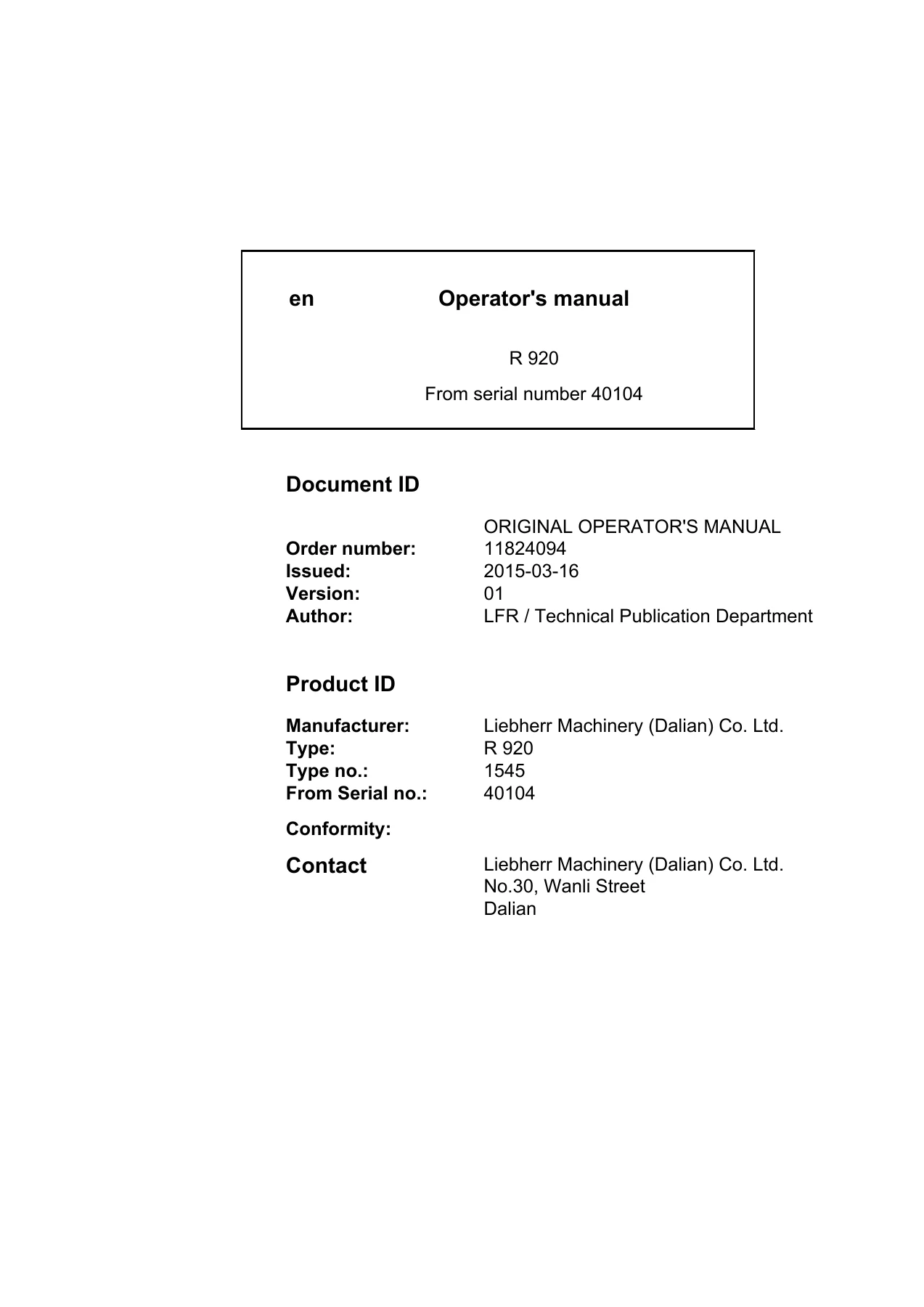
Liebherr R920 Crawler Excavator Operator's Manual - From S/N 40104 — PDF page 1 preview
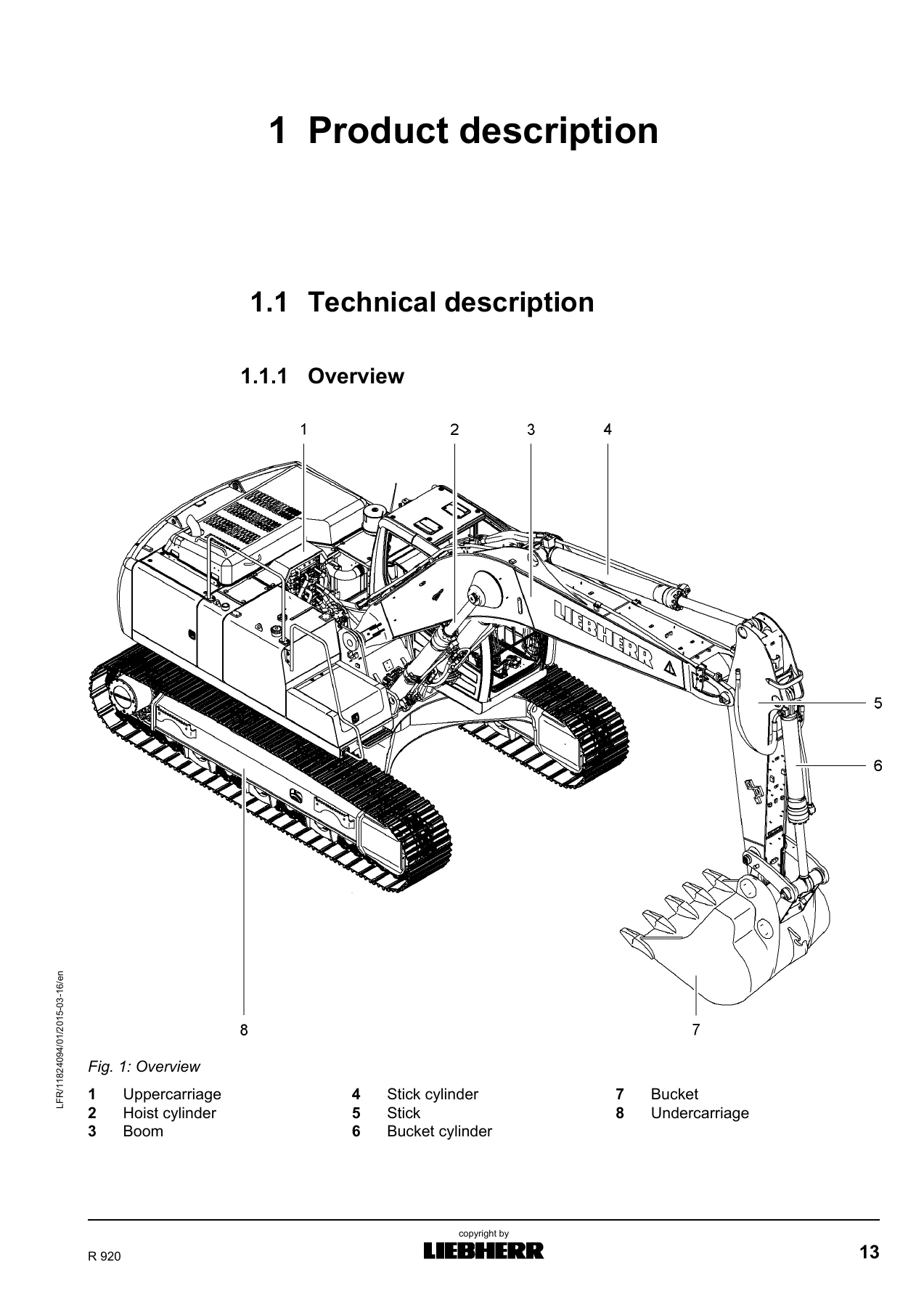
Liebherr R920 Crawler Excavator Operator's Manual - From S/N 40104 — PDF page 13 preview
Liebherr R920 Crawler Excavator Operator's Manual - From S/N 40104 — PDF page 19 preview

What This R920 Manual Actually Covers

The Product Description section identifies the R920’s main groups – uppercarriage with diesel engine, control valve block, radiator, air filter, slewing gearbox, hydraulic tank and pump; undercarriage with travel gearbox, carrier and track rollers, idler-wheel and rotary connection – and lists whole-body and hand/arm vibration emission data measured to ISO 5349-1:2001 and ISO/TR 25398:2006 for both crawler and wheeled excavator work cycles.

The factory specification sheet included in the manual states the R920 runs a 110 kW / 150 HP diesel engine meeting Stage IIIA / Tier 3 emissions, with an operating weight of 21,000-21,500 kg and a bucket capacity range of 0.60-1.25 m³.

The Control and Operation chapter is the largest section of the book. It walks through the operator’s platform layout and Control unit B, the full display and menu system (status symbols, main menu, operating status, general and machine-specific settings, information and tool-control menus, messages), and every stage of running the machine: pre-service inspection, refuelling, starting the diesel engine, sensor-controlled low idle automatic, travelling and braking, driving on slopes, controlling the working attachment, turning and braking the uppercarriage, and the optional overload warning system. Separate procedures cover operating a special working attachment both with and without a mini-joystick. General working methods address safe practice with a backhoe bucket, grading, a hydraulic hammer, grapple and clamshell, plus transferring and lifting loads (including with a quick coupler or a load-lift hook), installing and removing buckets and grapples, driving the machine onto a low-loader and tying it down for transport, and emergency procedures including emergency operation mode, jump-starting, the optional central lubrication system, and towing.

The Malfunctions chapter gives service code tables for warning symbols shown on the display (hydraulic oil level and temperature, fuel level and temperature, fuel pressure thresholds, coolant level, and more), each with its effect and remedy, plus fault-cause-remedy tables organised by system and a fuses-and-relays problem-remedy section.

Complete PDF Bookmark Tree

Complete Bookmarks

The complete bookmarks in the “Liebherr R920 Crawler Excavator Operator's Manual – From S/N 40104” are as follows:

Operator's manualp. 1
Prefacep. 3
Contentsp. 7
1 Product descriptionp. 13
1.1 Technical descriptionp. 13
1.1.1 Overviewp. 13
1.1.2 Uppercarriagep. 14
1.1.3 Undercarriagep. 15
1.2 Technical datap. 16
1.2.1 Vibration emissionp. 16
1.2.2 Specificationsp. 17
2 Safety warnings, signsp. 43
2.1 Safety advices and symbolsp. 43
2.1.1 Designation of safety advicesp. 43
2.1.2 Other designationsp. 44
2.2 Additional rules and guidelinesp. 44
2.3 Designated usep. 44
2.4 Signs on the machinep. 45
2.4.1 Locations of signsp. 45
2.4.2 Warning signsp. 46
2.4.3 Information signsp. 48
2.4.4 Type platesp. 51
2.5 Safety warningsp. 51
2.5.1 General safety instructionsp. 51
2.5.2 Avoiding crushing and burning injuriesp. 52
2.5.3 Avoid fire and explosionsp. 52
2.5.4 Seeing and being seenp. 53
2.5.5 Protection against vibrationp. 54
2.5.6 Before taking into operationp. 55
2.5.7 Getting in and outp. 55
2.5.8 Starting the machinep. 56
2.5.9 Workingp. 56
2.5.10 Shutting down the machinep. 58
2.5.11 Transporting the machinep. 59
2.5.12 Towingp. 59
2.5.13 Maintenance and repairp. 59
2.5.14 Modifications, add-ons and conversionsp. 63
2.5.15 Removal and installation of the attachment pinsp. 63
2.5.16 Falling object protective structures (FOPS and FGPS)p. 64
2.5.17 Checking machine for cracksp. 64
2.5.18 Regular checksp. 65
3 Control and operationp. 67
3.1 Control and operating elementsp. 67
3.1.1 Overview of operator's platformp. 67
3.1.2 Control unit Bp. 68
3.2 Controlp. 69
3.2.1 Battery main switchp. 69
3.2.2 Entering and exiting the machinep. 70
3.2.3 Emergency exitp. 71
3.2.4 Fire extinguisher (option)p. 71
3.2.5 Safety leverp. 72
3.2.6 Operator seatp. 73
3.2.7 Safety beltp. 79
3.2.8 Hornp. 80
3.2.9 Windscreenp. 80
3.2.10 Sun blindp. 83
3.2.11 Side windowsp. 84
3.2.12 Exterior mirrorsp. 84
3.2.13 Lightingp. 85
3.2.14 Cab lighting systemp. 86
3.2.15 Windscreen wipersp. 86
3.2.16 Displayp. 86
3.2.17 Status symbolsp. 88
3.2.18 Main menup. 90
3.2.19 Heating and air conditioning unitp. 91
3.2.20 Operating status menup. 92
3.2.21 General settings menup. 93
3.2.22 Machine-specific settings menup. 98
3.2.23 Information menup. 99
3.2.24 Tool Control menup. 101
3.2.25 Messages menup. 102
3.3 Operationp. 103
3.3.1 Inspection tour before putting into servicep. 103
3.3.2 Refuellingp. 104
3.3.3 Starting diesel enginep. 105
3.3.4 Engine speed and operating modep. 106
3.3.5 After startingp. 107
3.3.6 Sensor-controlled low idle automaticp. 108
3.3.7 Automatic engine stop after idling (option)p. 110
3.3.8 Shutting off diesel enginep. 110
3.3.9 Travellingp. 111
3.3.10 Brakingp. 113
3.3.11 Travel alarm (option)p. 114
3.3.12 Driving on slopesp. 115
3.3.13 Controlling the working attachmentp. 116
3.3.14 Turning and braking uppercarriagep. 117
3.3.15 Overload warning system (option)p. 118
3.3.16 Controlling special working attachment without mini-joystick (option)p. 119
3.3.17 Controlling special working attachment with mini-joystick (option)p. 121
3.4 General working methodsp. 124
3.4.1 Safety beltp. 124
3.4.2 Drugs and alcoholp. 124
3.4.3 Working without damaging the machinep. 124
3.4.4 Preparatory workp. 126
3.4.5 Putting machine in working positionp. 127
3.4.6 Working with a backhoe bucketp. 127
3.4.7 Ground surface gradingp. 128
3.4.8 Working with a hydraulic hammerp. 129
3.4.9 Working with the grapplep. 130
3.4.10 Working with the clamshellp. 130
3.4.11 Transferring loadsp. 132
3.4.12 Loading a transport vehiclep. 132
3.4.13 Lifting loadsp. 133
3.4.14 Lifting loads with quick couplerp. 134
3.4.15 Lifting loads using working tool with load lift hookp. 135
3.5 Installation and removal of attachment partsp. 136
3.5.1 Installing and removing bucketp. 136
3.5.2 Installing and removing bucket with special sealp. 138
3.5.3 Using quick couplerp. 139
3.5.4 Installing and removing grapple on the stickp. 139
3.6 Transportp. 142
3.6.1 Driving machine onto low-loaderp. 142
3.6.2 Tying down the machinep. 144
3.7 Emergency operationp. 145
3.7.1 Using emergency operationp. 145
3.7.2 Jump startp. 147
3.7.3 Central lubrication system (option)p. 148
3.7.4 Towingp. 148
4 Malfunctionsp. 151
4.1 Service code tablesp. 151
4.1.1 Warning symbolsp. 151
4.2 Fault – Cause – Remedyp. 155
4.2.1 Diesel engine and fuel systemp. 155
4.2.2 Hydraulic systemp. 158
4.2.3 Travel gearp. 158
4.2.4 Electrical systemp. 159
4.2.5 Heating, ventilation, air-conditioning unitp. 159
4.2.6 Working attachmentp. 159
4.3 Problem remedyp. 161
4.3.1 Fuses and relaysp. 161
5 Maintenancep. 167
5.1 Inspection and maintenance schedulep. 167
5.2 Filling quantities and lubrication chartp. 173
5.2.1 Recommended lubricantsp. 173
5.2.2 Recommended fuels and operating fluidsp. 173
5.2.3 Lubrication chartp. 174
5.3 Fuels, lubricants and operating fluidsp. 177
5.3.1 General informationp. 177
5.3.2 Oil analysisp. 177
5.3.3 Diesel fuelsp. 177
5.3.4 Lubricants for the diesel enginep. 179
5.3.5 Coolant for the diesel enginep. 181
5.3.6 Hydraulic oilsp. 183
5.3.7 Lubricating oil for gearboxesp. 189
5.3.8 Greasesp. 190
5.3.9 Screenwashp. 191
5.3.10 Lubricants and care products for electrical and mechanical systemsp. 192
5.4 Access points for maintenance workp. 193
5.4.1 Access points on uppercarriagep. 193
5.4.2 Access points under the uppercarriagep. 194
5.4.3 Access points on the undercarriagep. 195
5.5 Safety measuresp. 196
5.6 General maintenancep. 197
5.6.1 Weldingp. 197
5.6.2 Bleeding hydraulic cylindersp. 197
5.6.3 Applying corrosion protection to piston rodsp. 198
5.6.4 Cleaning the machinep. 199
5.6.5 Cleaning the travel gearp. 201
5.6.6 Cleaning fan and radiatorp. 201
5.7 Drive groupp. 202
5.7.1 Diesel engine: Bringing into maintenance positionp. 202
5.7.2 Diesel engine: Checking oil levelp. 202
5.7.3 Fuel pre-filter: Draining waterp. 203
5.7.4 Fuel tank: Draining water and sedimentsp. 204
5.7.5 Air filter: Emptying dust collecting tankp. 204
5.7.6 Air filter: Replacing main filter cartridgep. 205
5.8 Cooling systemp. 207
5.8.1 Checking coolant levelp. 207
5.8.2 Coolant: Checking concentrationp. 208
5.9 Working hydraulics systemp. 212
5.9.1 Depressurising hydraulic systemp. 212
5.9.2 Hydraulic tank: Checking oil levelp. 212
5.9.3 Return filter: Checking and cleaning magnetic rodp. 215
5.10 Electrical systemp. 216
5.10.1 General informationp. 216
5.11 Tracked travel gearp. 217
5.11.1 Checking track tensionp. 217
5.11.2 Tightening the trackp. 218
5.11.3 Slackening the trackp. 219
5.11.4 Track pads and sprocket wheels: Checking mountingp. 220
5.12 Working attachmentp. 222
5.12.1 Lubricating working toolp. 222
5.12.2 Changing bucket teeth with Z systemp. 223
5.13 Operator's cab, heating, air conditioning systemp. 224
5.13.1 Filling with windscreen washer fluidp. 224
5.13.2 Switching on air conditioning unitp. 224
5.13.3 Cleaning cab air filterp. 224
5.14 Lubrication systemp. 227
5.14.1 Manually lubricating machinep. 227
5.14.2 Lubrication system: Filling greasep. 230
5.15 Slewing gear mechanism, slewing ringp. 231
5.15.1 Slewing gearbox: Checking oil levelp. 231
6 Appendixp. 233
6.1 Initial torque and tightening anglep. 233
6.1.1 Procedurep. 233
Indexp. 235

The Maintenance chapter is where this Liebherr R920 manual earns its keep for anyone servicing the machine. It opens with the full inspection and maintenance schedule (on handover, every 8-10, 50, 500, 1000 and 2000 hours, plus special intervals), then gives the recommended lubricants and fluids table with exact quantities: Liebherr Motoroil 10W-40/5W-30 for the diesel engine at 26.4 l, hydraulic system content/change/tank volumes of 330 l / 108 l / 139 l using Liebherr Hydraulic Basis 100, HVI or Plus Arctic oil, 4.6 l Liebherr Gear Basic 90 LS for the slewing gearbox, 2 x 4.3 l for the travel gearboxes, a 593 l diesel fuel tank, 47 l of Liebherr Antifreeze coolant, and 8.6 l of windscreen washer fluid. Detailed procedures follow for checking and changing oils, draining fuel and hydraulic tank sediment, cleaning or replacing air filter cartridges, checking coolant concentration, checking track tension (with the 25 ±5 mm sag specification) and tightening or slackening the track, checking track pad and sprocket wheel mounting bolts against listed test and pre-tightening torque values, lubricating the working attachment and changing bucket teeth with the Z system, and servicing the cab air filter, air conditioning and slewing gearbox. The closing appendix explains the initial torque and tightening-angle procedure for the track pad, sprocket, travel gear mechanism and travel motor mounting bolts, and the manual finishes with a full alphabetical index for fast lookup.

Get Correct Answers for Your R920, Every Time

This Liebherr R920 operator’s manual gives you the exact procedures, fluid specifications, torque values and maintenance intervals that apply to machines from serial number 40104 – the kind of detail that keeps you from guessing at oil grades, filter intervals, or track tension figures. Following the correct steps from the manufacturer protects the engine, hydraulics and undercarriage from avoidable wear and keeps the machine within its designed service life. This is an instant PDF download – no shipping, no waiting. It’s delivered straight to your device after purchase, works on a phone, tablet, laptop or desktop, and can be printed at home or in the shop whenever you need a page in hand next to the machine.

Reviews

There are no reviews yet.

Be the first to review “Liebherr R920 Crawler Excavator Operator’s Manual – From S/N 40104”

What Our Customers Say

★★★★★ Live reviews from customers
Loading customer reviews...
0
    0
    Your Cart
    Your cart is emptyReturn to Shop
    🛒
    Recently Purchased
    🕒 verified order