
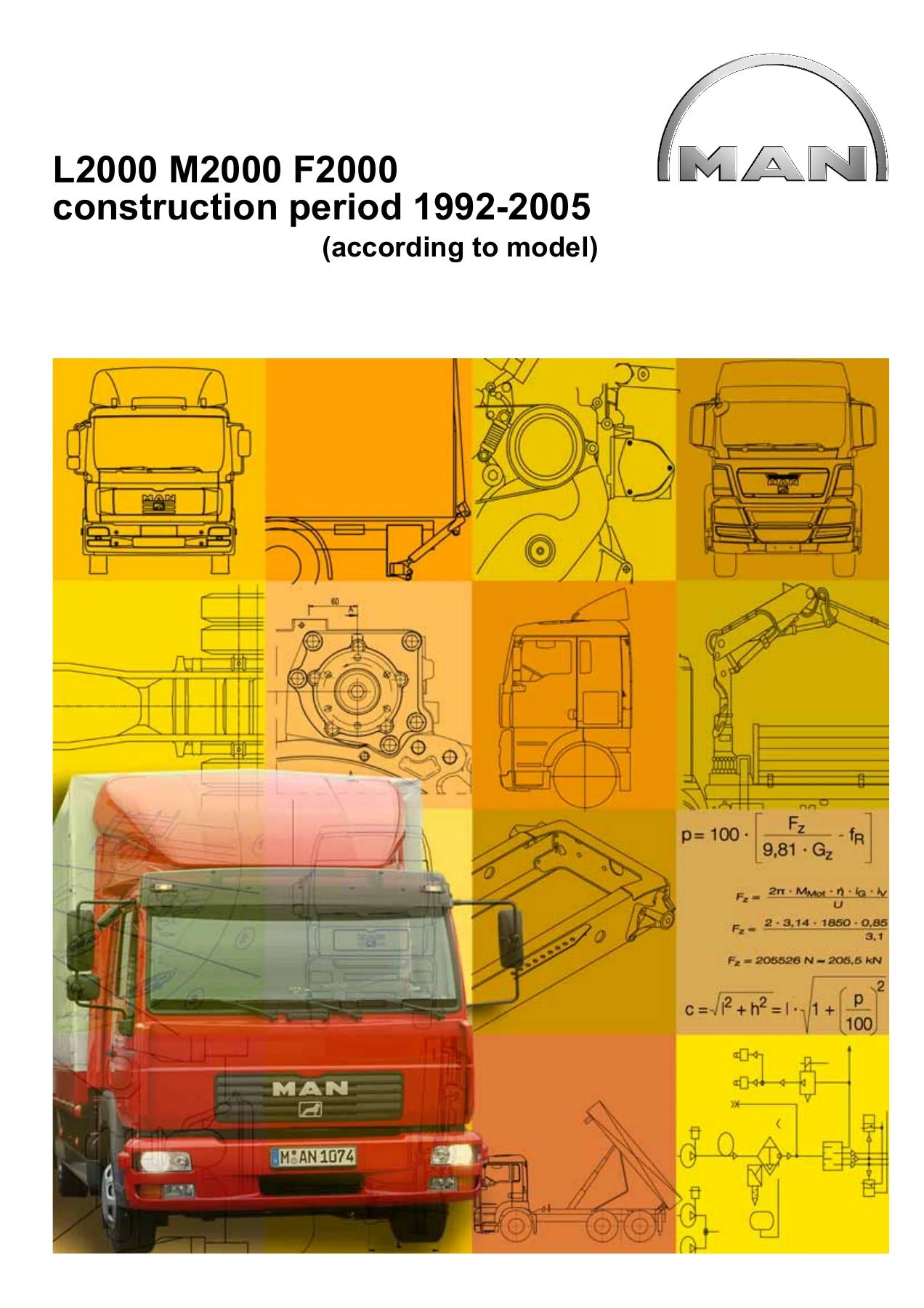
MAN L2000 M2000 F2000 E2000 Body Fitting Guidelines 1992-2005 – Truck Bodybuilder & Chassis Modification Manual PDF
Original price was: $44.95.$29.95Current price is: $29.95.
The complete MAN body fitting and chassis modification guide for L2000, M2000, F2000 and E2000 trucks built between 1992 and 2005. Covers frame modification, subframe design, bodies, coupling devices, loading cranes, tail-lifts, electrics, brakes, and all axle load and calculation data required for professional body installation.
Description
MAN L2000, M2000, F2000 and E2000 Body Fitting Guidelines — Construction Period 1992–2005
This is the complete bodybuilder’s reference for MAN’s L2000, M2000, F2000 and E2000 truck ranges, published by MAN Nutzfahrzeuge Aktiengesellschaft. It covers the construction period 1992–2005 (according to model) and provides the technical framework, dimensional data and calculation methods required to design, install and modify bodies on these chassis. Whether you are fitting a tipper, tanker, box body, loading crane, tail-lift or coupling device, the guide sets out the approved procedures and the limits that must be respected to keep the vehicle safe, legal and within its design parameters.
File Details
- Manual type: Body fitting and chassis modification guidelines
- Publisher: MAN Nutzfahrzeuge Aktiengesellschaft
- Copyright year: 2007
- Model ranges covered: L2000, M2000, F2000, E2000
- Construction period: 1992–2005 (according to model)
- Language: English
- File format: PDF
Chapters Covered
- 1. Applicability of the Guide
- 2. Vehicle designations
- 3. General
- 4. Modifying the chassis
- 5. Bodies
- 6. Electrics
- 7. Power take-offs
- 8. Brakes, lines
- 9. Calculations
Applicability and Vehicle Designations
The opening chapters explain who the guide is for, which vehicles it applies to, and how MAN’s model designation system works. It decodes the three-digit model number, model code, vehicle identification number (VIN), basic vehicle number and vehicle number, then breaks down the wheel formula, chassis suffix codes, suspension codes, steering layout, factory-fitted body codes, dimensions sections and body/conversion codes. Full model number tables cover the L2000 (L20–L36), M2000L (L70–L95), M2000M (M31–M44), F2000 (T01–T78) and E2000 (E40–E99) ranges with tonnage, designation, suspension, engine and wheel formula for each. Engine designation is also explained, with the D08 and D28 diesel engine code structure.
General — Legal, Safety and Load Fundamentals
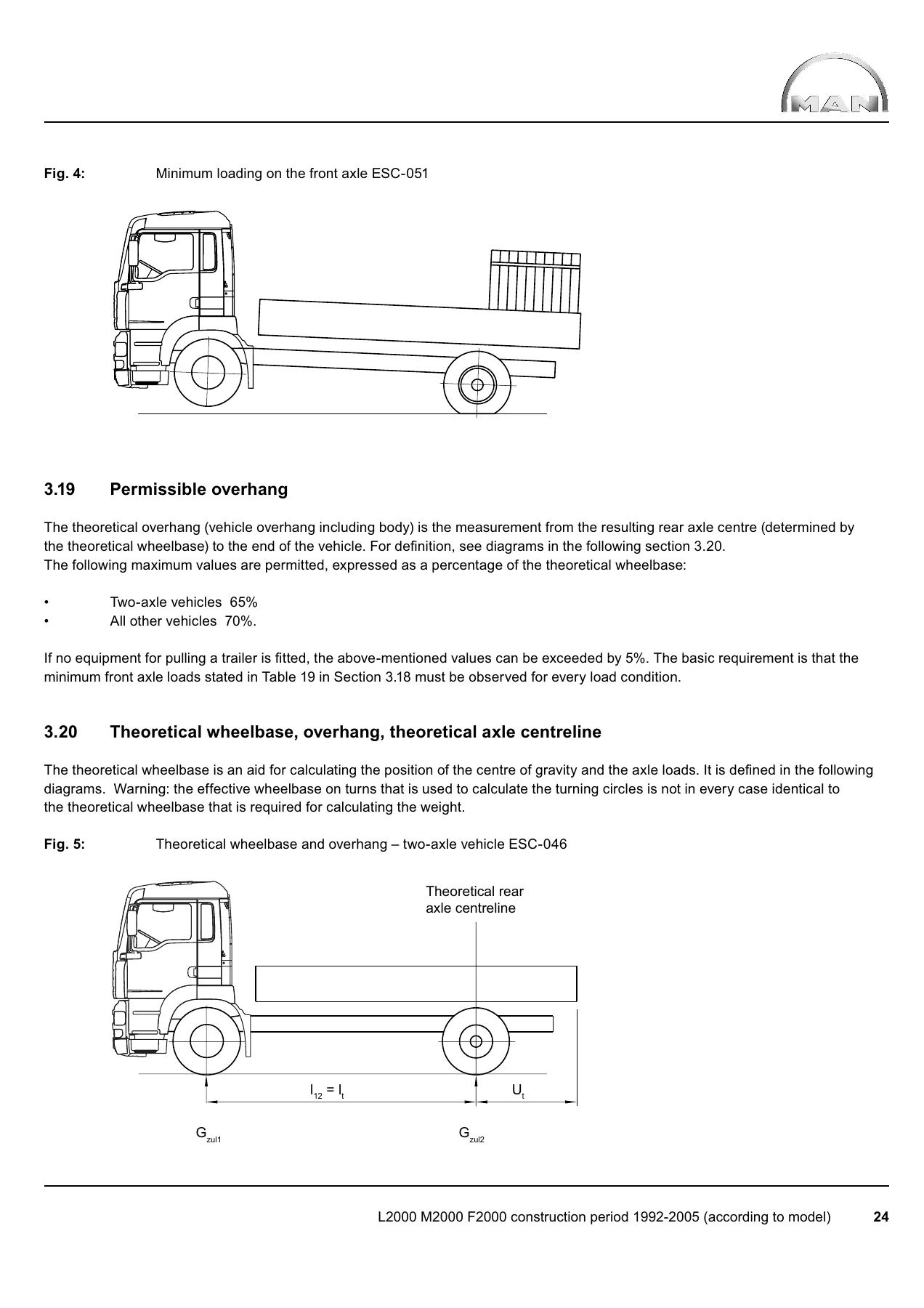
This chapter covers the legal agreements and approval procedure, responsibility, quality assurance, warranty and liability. It then moves into the practical load data that governs every body installation: minimum front axle loads, permissible overhang, theoretical wheelbase and theoretical axle centreline for two-, three- and four-axle vehicles, axle load calculation procedures, weighing procedure, one-sided loading limits (maximum 4% wheel load difference), and the procedures for increasing or reducing permissible trailer load, axle load and gross weight. Tables give minimum front axle loading percentages for all model ranges and load conditions, with worked examples for wheel load difference and overhang limits.
Modifying the Chassis
Everything needed to modify the chassis safely: corrosion protection, storage, frame materials and frame data, the complete frame profile code allocation tables for every model number and wheelbase, and the profile data tables for longitudinal frame members. It then details drill holes, riveted joints, screw connections, cut-outs, welding procedures (including electrode and wire recommendations and the precautions for electronic assemblies), frame overhang modification, wheelbase modification, propshaft layout and phasing, central lubrication, cab modification, roof sleeper cabs and raised roofs, axle location and suspension, add-on frame components (underride guards, sideguards, spare wheel, wheel chocks, fuel tanks, liquefied gas systems), gas engine handling, engine modifications, and coupling devices including trailer couplings, D values, end cross members, ball-type couplings, fifth-wheel couplings and truck/tractor conversion.
Bodies
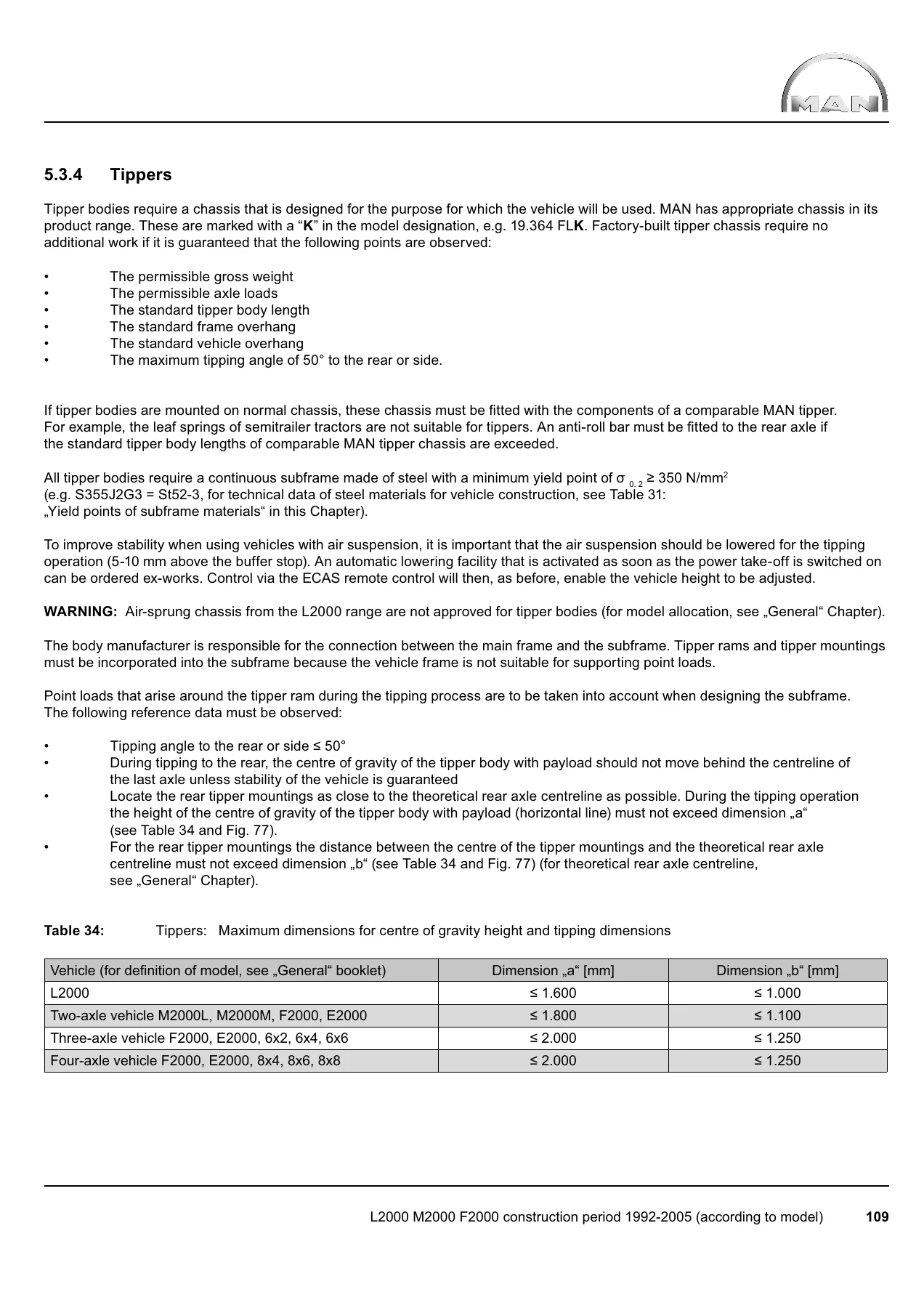
The core bodybuilding chapter. It starts with general requirements, accessibility and clearances, lowering the body, platforms and steps, and corrosion protection. Subframe design and attachment are covered in full: flexible connections, rigid connections, screw and riveted joints, self-supporting bodies without subframe, and the subframe sizing tables for L2000, M2000L, M2000M and F2000 tail-lift installations. Special bodies are then treated individually: single-pivot bodies, tank and container bodies (with and without subframes), tippers, set-down and roll-off skip loaders, platform and box bodies, interchangeable containers, loading cranes (behind cab, rear-mounted, and subframe requirements with geometrical moment of inertia diagrams), tail-lifts (with full subframe specification tables for each model, wheelbase and connection type), cable winches and transport mixers.
Electrics
Electrical and electronic system requirements for bodybuilders: references to repair manuals and standards, starting and tow-starting, battery handling and charging, additional wiring diagrams, fuse and power supply for additional consumers, conductor and relay types, lighting installations, interference suppression, electromagnetic compatibility, vehicle interfaces, body fittings, customer-specific parameter setting with MAN-cats, earth cable routing, and installation and routing of electric cabling and pipework. The chapter explains the separate earth cable system used on MAN vehicles and the common earth points.
Power Take-offs, Brakes and Lines
Power take-offs are covered in a separate booklet referenced from Chapter 7. Chapter 8 deals with brakes and compressed air lines: basic principles, plug connectors and the changeover to the Voss 232 system (with the two-stage engagement principle), installing and attaching lines, minimum bending radii for PA pipes, maximum clip spacing, compressed air loss limits, connecting ancillary consumers to the four-circuit protection valve, adjusting the automatic load-dependent brake system (ALB), and continuous brakes (hydrodynamic retarders and eddy-current brakes) including retrofit requirements.
Calculations
The final chapter provides all the formulae and worked examples needed to verify a body installation: speed and theoretical maximum speed, efficiency, tractive force, gradeability (including distance travelled on gradients, gradient angle, and gradeability taking road/tyre adhesion into account), torque, power output for lifting, plane and rotational motion, rotational speeds for power take-offs at the transfer case, driving resistances (rolling, climbing and air resistance), turning circle calculation, axle load calculation with a full worked table, calculation of weight with trailing axle lifted, support length for bodies without subframes, and coupling device calculations for trailer couplings, rigid drawbar/central axle trailers (Dc and V values) and fifth-wheel couplings. A complete axle load calculation table example is included, showing weight distribution across front and rear axles.
Why This Guide Matters for Your MAN Truck
Fitting a body or modifying a chassis on an L2000, M2000, F2000 or E2000 without the manufacturer’s data is a gamble with the vehicle’s structural integrity, braking performance and legal compliance. This guide gives you the exact frame profile data, subframe sizes, mounting methods, weld procedures, torque values and load limits that MAN specifies for these trucks. It is the same information bodybuilders and converters use to ensure their work does not compromise the chassis, overload an axle, or create a handling problem. Whether you are installing a tail-lift on an L2000, mounting a loading crane on an F2000, converting a tipper chassis to a tractor unit, or simply replacing a fuel tank, the calculations and dimensional limits are all here.
IMAGES PREVIEW
Instant PDF Delivery
This MAN body fitting guide is delivered as an instant PDF download. There is no shipping, no waiting, and no physical book to lose. Open it on any device — laptop, tablet or phone — or print the pages you need for the workshop. The PDF format lets you zoom into frame profile tables, subframe dimensions and calculation diagrams at full detail, so you can work directly from the screen or take the relevant pages to the chassis.

Reviews
There are no reviews yet.