
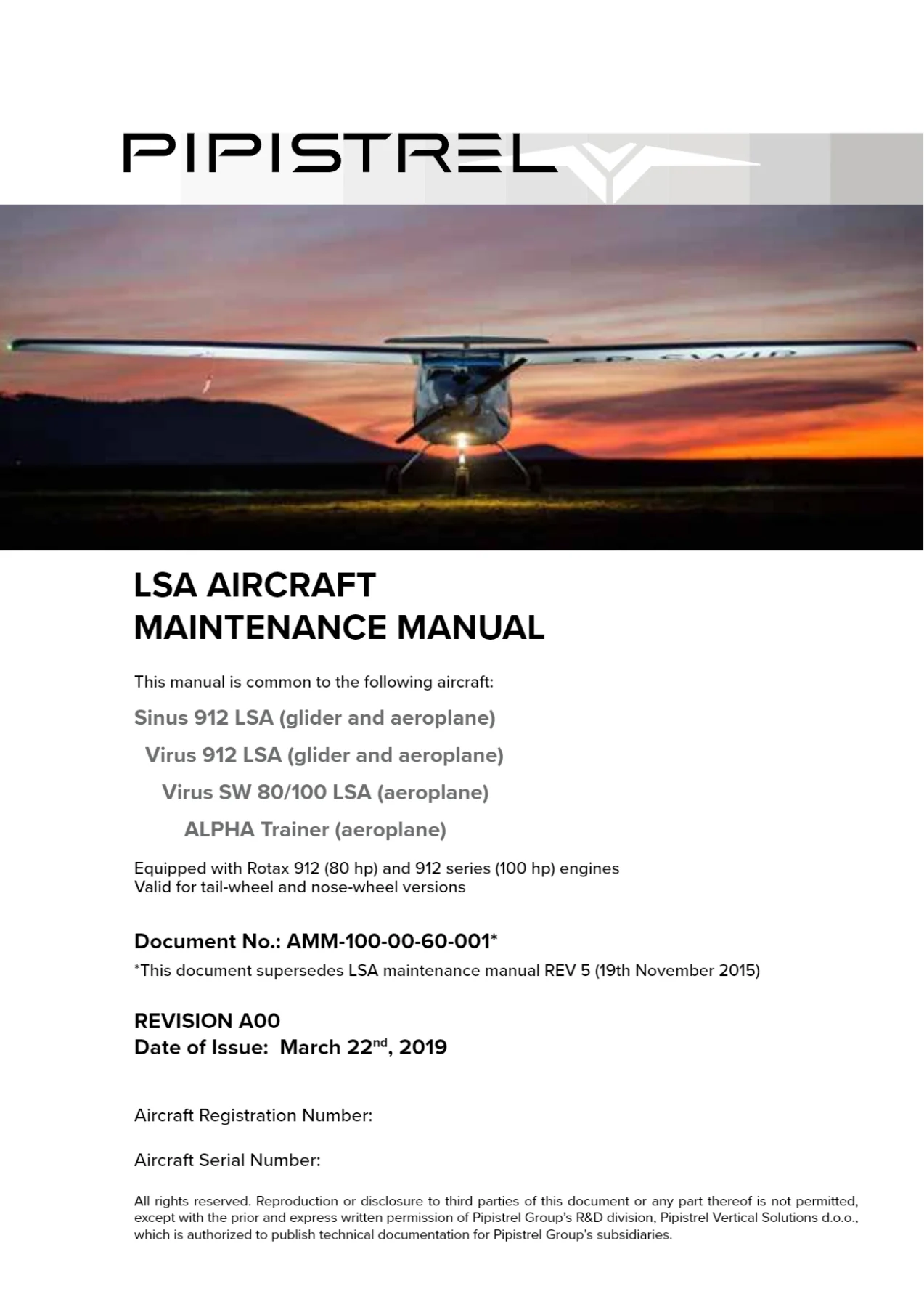
Pipistrel LSA Aircraft Maintenance Manual – Sinus 912, Virus 912, Virus SW 80/100 & ALPHA Trainer
Original price was: $39.95.$24.95Current price is: $24.95.
Complete Pipistrel LSA Aircraft Maintenance Manual covering Sinus 912, Virus 912, Virus SW 80/100 and ALPHA Trainer airframes powered by Rotax 912 engines. 386-page PDF with scheduled inspections, time limits, structural repairs, flight controls, landing gear, fuel, electrical and powerplant procedures.
Description
The Pipistrel LSA Aircraft Maintenance Manual is the full technical reference for maintaining the Sinus 912 LSA, Virus 912 LSA, Virus SW 80/100 LSA and ALPHA Trainer. Issued under document number AMM-100-00-60-001, Revision A00, dated March 22nd 2019, this manual supersedes the earlier LSA maintenance manual REV 5 and consolidates every airworthiness limitation, scheduled inspection and repair procedure into one ATA-indexed document.
File Details
- Manual type: Aircraft Maintenance Manual (AMM)
- Brand: Pipistrel
- Covered models: Sinus 912 LSA, Virus 912 LSA, Virus SW 80/100 LSA, ALPHA Trainer
- Covered engines: Rotax 912 (80 hp), Rotax 912 series (100 hp)
- Language: English
- Page count: 386
- File format: PDF
- Document number: AMM-100-00-60-001
- Revision: A00
- Date of issue: March 22nd, 2019
Chapters Covered
- 04 – Airworthiness Limitations: general, maintenance limitations, structural limitations
- 05 – Time Limits and Maintenance Checks: scheduled maintenance, 100 Hour/Annual inspections, operational and functional checks, unscheduled maintenance
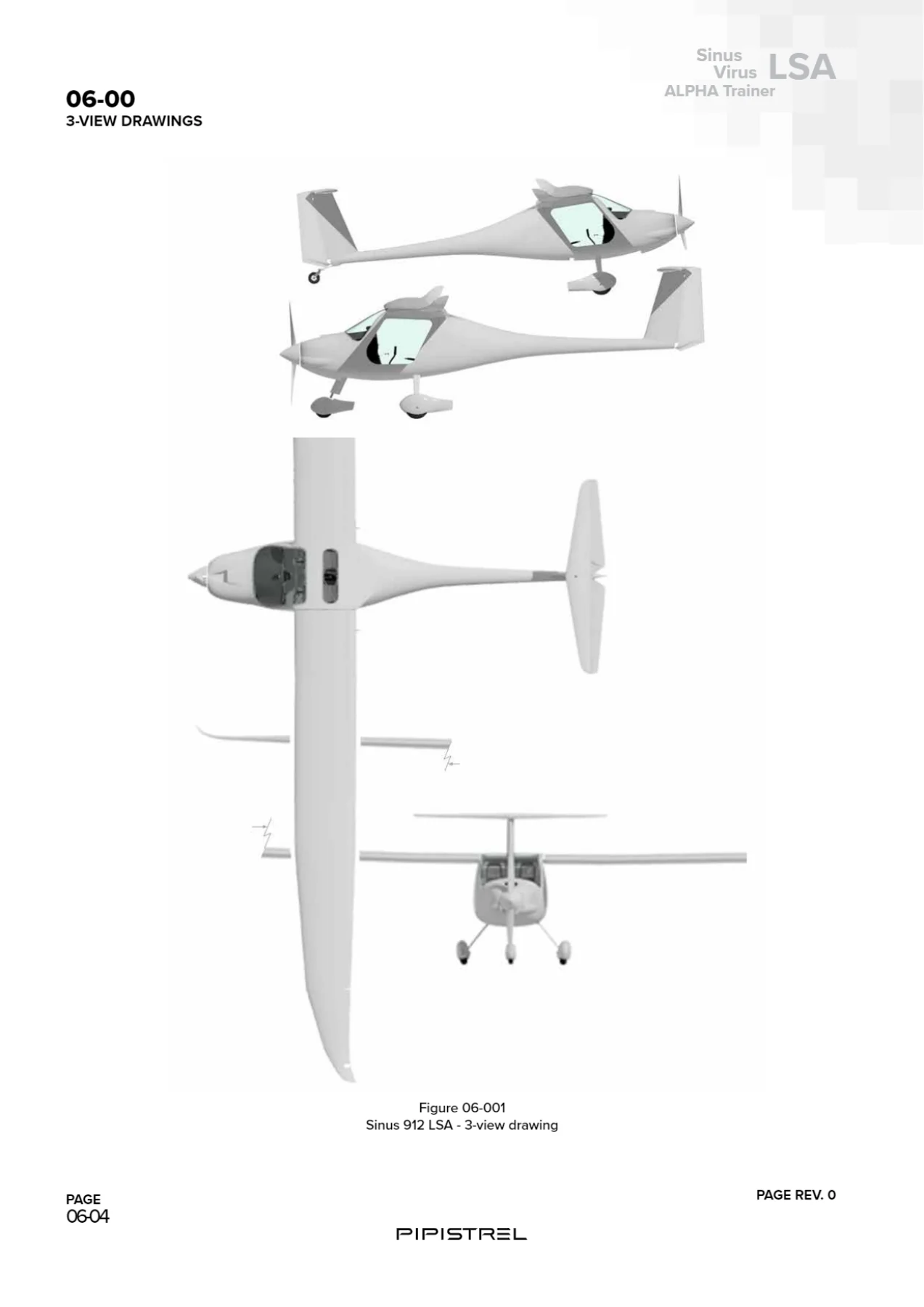
- 06 – Dimensions and Areas: airframe dimensions, wing and tail areas, 3-view drawings
- 07 – Lifting and Shoring: jacking the main gear strut, propping the nose gear, tail support
- 08 – Leveling and Weighing: leveling kit procedure, weighing and center of gravity measurement
- 09 – Towing and Taxing: forward, backward and turning procedures
- 10 – Parking, Mooring and Storage: temporary and long-term storage, tie-down points
- 11 – Required Placards: exterior and interior placards, removal and installation
- 12 – Servicing: replenishing fuel, oil, coolant, tires and brakes, lubrication schedule, cleaning
- 20 – Standard Practices – Airframe: sealants, lubricants, thread-locking fluids, torque values, adhesives
- 21 – Environmental Systems: cockpit ventilation, sliding windows and adjustable vents
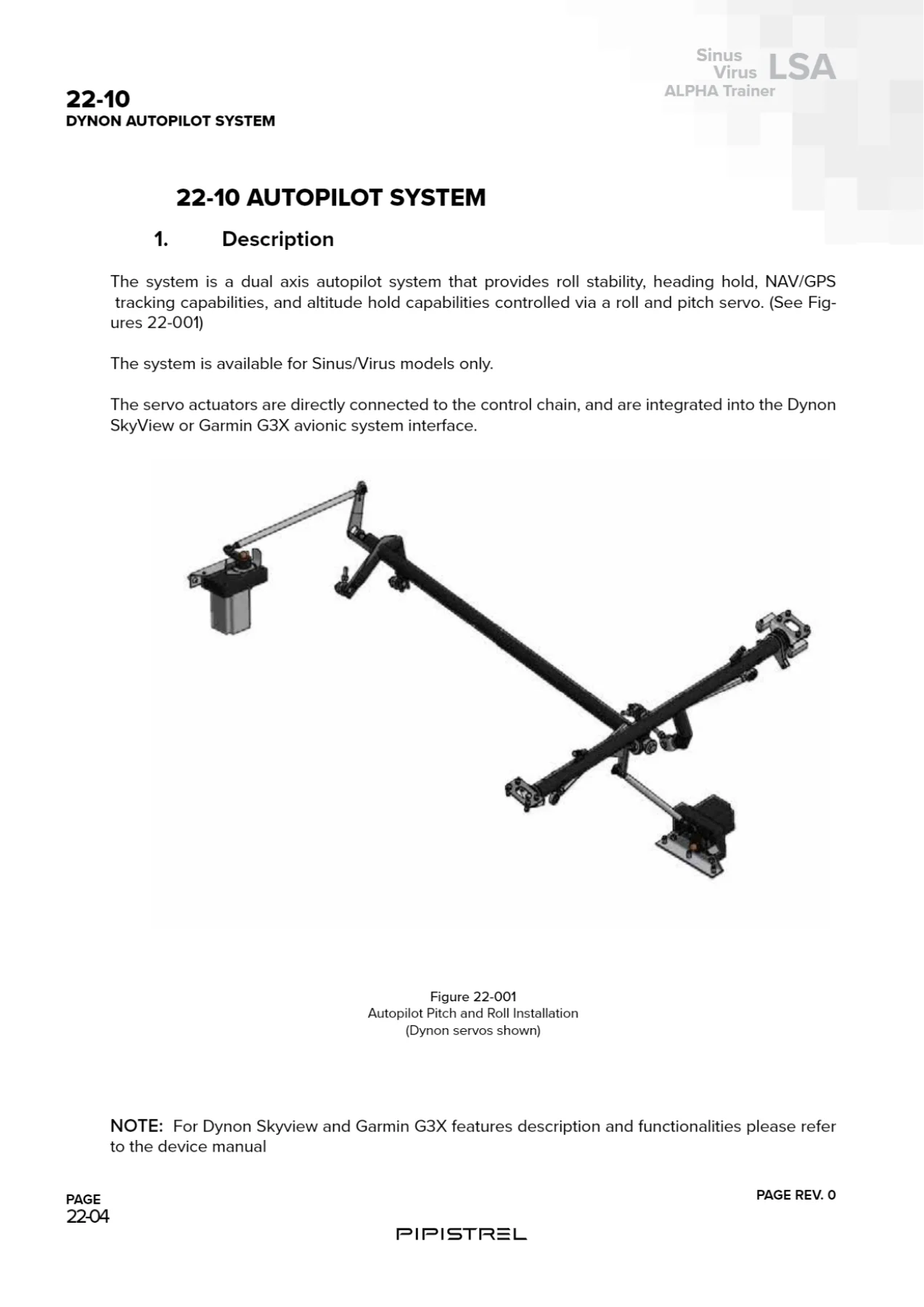
- 22 – Autopilot System: Dynon and Garmin dual-axis servo installation and inspection
- 24 – Electrical Power: battery removal/installation, DC generation, external power, load distribution
- 25 – Equipment and Furnishing: crew seats, safety harnesses, baggage compartment, ELT
- 27 – Flight Controls: rudder, elevator, flaperons, trim, air brake lever, push/pull rods
- 28 – Fuel: wing tanks, fuselage tank, collector tank, gascolator, fuel selector, fuel level sight gauge
- 31 – Indicating/Recording Systems: instrument panel, switch panel, internal inspection
- 32 – Landing Gear: main gear strut, nose gear, wheels, brakes, steering
- 51 – Standard Practices – Structures
- 52 – Doors
- 53 – Fuselage
- 55 – Stabilizers
- 56 – Windows
- 57 – Wings
- 61 – Propeller
- 71 – Power Plant
- 72 – Engine
- 73 – Engine Fuel
- 75 – Engine Cooling
- 76 – Engine Controls
- 77 – Engine Indicating
- 78 – Exhaust
- 91 – Wiring Diagrams
- 95 – Special Purpose Equipment
- 99 – Appendices
This Pipistrel LSA maintenance manual is arranged under the ATA 100 chapter numbering system and correlates with ASTM F2483-12 practice for light sport aircraft. Each task carries an applicability and qualification table so the technician immediately knows whether a procedure applies to Sinus, Virus, Virus SW or ALPHA Trainer, and whether it is open to an owner holding a sport pilot certificate, an LSRM, an AMT, or an Australian L1/L2 authority. That structure makes the manual usable across a mixed fleet without guesswork.
What the Manual Enables
At the heart of the document is the scheduled inspection program. The 50-hour, 100-hour, Annual, 200-hour, 500-hour, 1000-hour and 10000-hour checks are laid out as a single inspection report covering engine, propeller, cabin, fuselage and empennage, wing and landing gear groups. Special inspections and major inspections are flagged in red so nothing is missed – for example the horizontal stabilizer visual check every 100 hours, with a major tap-test inspection only every 2000 hours, or the control stick drive major inspection every 3000 hours. The Pipistrel time limits table lists overhaul and replacement intervals for the Beringer wheel and brake assemblies, brake discs, tires, hydraulic brake fluid, ELT battery and system, propeller assembly, engine fuel pump, auxiliary fuel pump, mufflers, exhaust springs, throttle and choke cables, engine TBO, coolant, nose gear shock absorber, flexible fuel, oil and vent lines, rubber coolant hoses, gascolator filter, engine mount rubber isolators, fuel filter, GRS ballistic parachute rescue system, TOST tow release, elevator trim cable, control system springs and electrical wiring.
Unscheduled maintenance is covered in depth for the events that actually ground an aircraft: wing strike, hard or overweight landing, exceeded speed limit, severe turbulence, lightning strike, high drag or side loads from ground handling, ground gusts over 40 knots, operation on unimproved runways, humid environments, propeller strike and flutter. Each one gives the inspection sequence – fuselage, main landing gear strut, nose gear and attaching structure, wings, trailing edge, flight control system – so the technician works through a defined path rather than improvising.
Systems and Structures
Flight controls are handled component by component. Rudder cables are inspected near the rudder, in the fuselage aft of the cabin and in the cabin near the pedals, with a specific note that a single damaged strand requires complete cable replacement. Rudder, elevator and flaperon free play limits are called out in millimetres, with deflection angle adjustment procedures for each surface using the WBR. Elevator trim, the horizontal elevator pushrod, control stick drive and flaperon bellcrank assembly all receive their own inspection and major inspection tasks, including the 0.15 mm pushrod gouge limit that mandates replacement.
The landing gear chapter covers the basalt fiber main gear strut, the steerable nose gear with its oleo shock absorber integrated into the engine mount, and both standard and Beringer wheel and brake systems. The fuel chapter distinguishes the ALPHA Trainer single 50 L fuselage tank from the Sinus and Virus twin wing tanks, explains the gravity-fed layout and gascolator location, and gives removal, installation, cleaning and leak inspection procedures for the Andair and non-Andair gascolator types. The electrical chapter covers the 12 V DC system, the integrated generator with rectifier regulator, the on-board battery and the instrument and switch panel.
Why This Manual Matters
Composite airframes, Rotax 912 powerplants and LSA certification create specific maintenance demands. Correct torque values, correct thread-locking fluids, correct composite inspection techniques and correct replacement intervals are what keep an LSA airworthy. This manual supplies them – the standard torque table for M4 through M14 fasteners, the approved sealants and lubricants with Pipistrel part numbers, the Loctite 243, 262, 270 and 577 thread-locking fluids, the approved adhesives, and the rule that locknuts are never reused. Visual inspection criteria are given separately for metal parts, moving components, fuel, air and oil lines, fastening material, composite components, electrical installations, filters and screens, and areas exposed to liquids.
Whether you are an owner performing permitted preventive maintenance, an LSRM or AMT running a 100-hour inspection, or a maintenance organisation carrying out structural repair, the Pipistrel LSA Aircraft Maintenance Manual gives you the procedure, the material list and the reference in one place.
IMAGES PREVIEW
Instant PDF Delivery
The manual is delivered as an instant-download PDF – no shipping, no waiting. It opens on any device, can be printed for the hangar and searched on screen. Keep a copy on the workshop tablet and a printed copy in the aircraft folder so the correct procedure is always at hand when the cowling comes off.
Reviews
There are no reviews yet.