
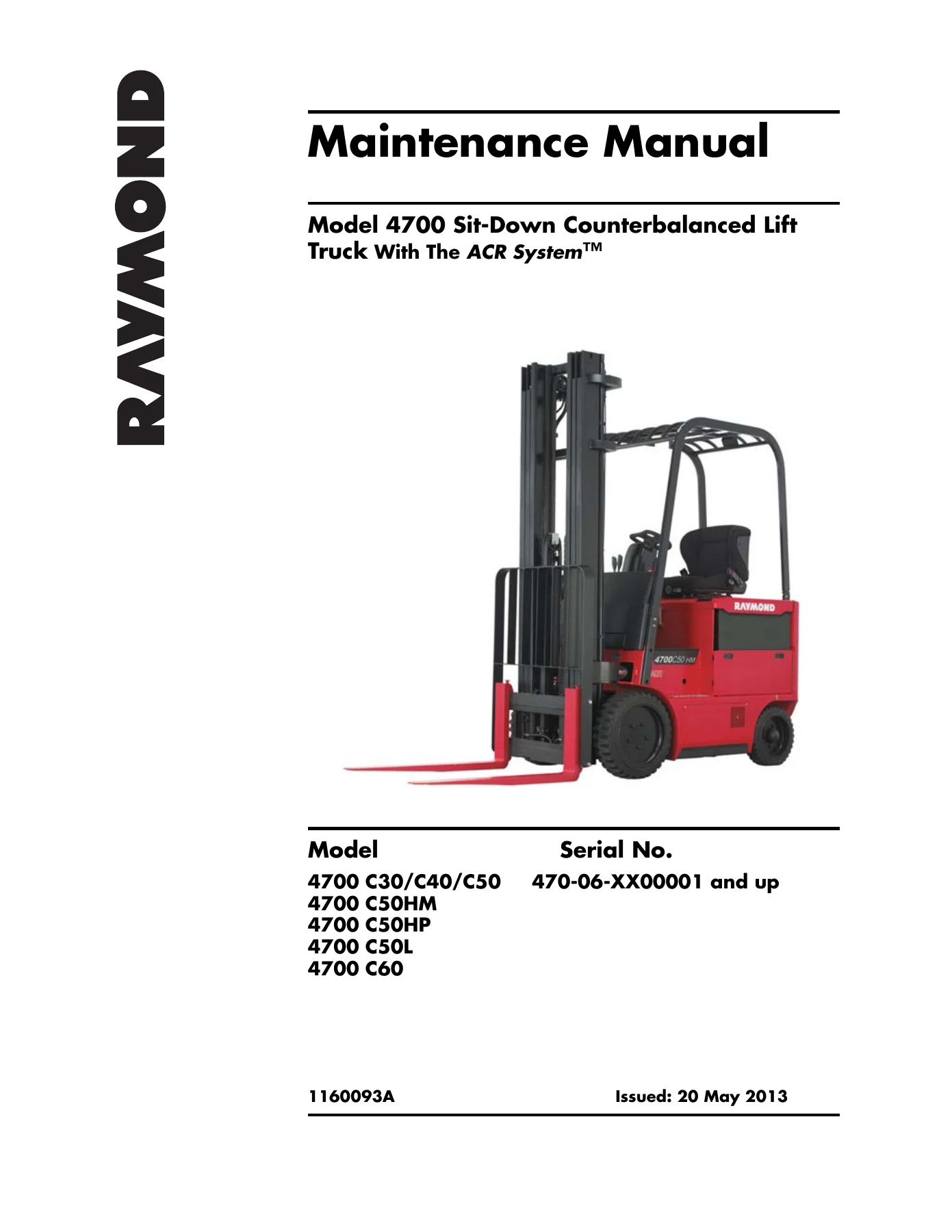
Raymond Model 4700 Sit-Down Counterbalanced Lift Truck Maintenance Manual 2013 – ACR System C30 C40 C50 C50HM C50HP C50L C60
Original price was: $39.95.$23.95Current price is: $23.95.
Raymond-published maintenance manual for the Model 4700 Sit-Down Counterbalanced Lift Truck with the ACR System. Publication 1160093A, issued 20 May 2013, covering C30, C40, C50, C50HM, C50HP, C50L and C60 from serial 470-06-XX00001 and up. Includes companion electrical and hydraulic schematics publication 1160095A.
Description
Raymond Model 4700 Sit-Down Counterbalanced Lift Truck Maintenance Manual – ACR System Edition (Publication 1160093A)
This is the Raymond-published maintenance manual for the Model 4700 Sit-Down Counterbalanced Lift Truck with the ACR System, released as Publication 1160093A on 20 May 2013. It supersedes Maintenance Manual 1056865C for all Model 4700 applications and covers every variant in the line: the C30, C40, C50, C50HM, C50HP, C50L (also designated SL) and C60, from serial 470-06-XX00001 and up. The electrical and hydraulic schematics publication 1160095A is bundled in the same file, so every diagram referenced inside the procedures is available on the spot.
File Details
- Manual type: Maintenance Manual
- Publisher: The Raymond Corporation, Greene, NY
- Equipment covered: Raymond Model 4700 Sit-Down Counterbalanced Lift Truck with the ACR System
- Publication number: 1160093A (schematics companion: 1160095A)
- Issue date: 20 May 2013
- Supersedes: Maintenance Manual 1056865C for all Model 4700 applications
- Revision: 1160093A
- Language: English
- Page count: 307
- File format: PDF
What This Raymond 4700 Maintenance Manual Gives You
The manual is built around the way a technician actually works on a Model 4700 – it starts with the systems overview and specification plate data, then walks through scheduled maintenance intervals, fault-code interpretation, component-level procedures, and finally the theory of operation that explains signal flow so diagnostics stop being guesswork. Because the truck can be ordered with a single traction motor or dual traction motors, and with lever hydraulic controls or the optional fingertip armrest controls, the text flags the differences throughout instead of forcing you to piece them together. The ACR System electrical architecture is documented end-to-end, including the CAN-Bus network, the Vehicle Manager, the Traction Power Amplifier, the Pump Power Amplifier, the Hydraulic Control Board, the Armrest Board and the Operator Display.
The maintenance chapter is organized by pump-hour intervals, and it is written so the same page can be used for the 90-day/250-hour initial service, the 180-day/500-hour service, the first 1500-hour drive-unit fluid change on trucks S/N 10677 and up, and the 360-day/2000-hour service. Fork and lift-chain inspection procedures are broken out separately with measured wear limits and the correct special tools named by Raymond part number.
The fault-code chapter lists the codes displayed on the Operator Display and pairs each one with the specific corrective action – what to check first, what voltage or resistance to expect, and when to replace a specific module. Symptom tables at the front of the troubleshooting chapter let you jump straight from a customer complaint to the most likely cause rather than reading the whole chapter. For anyone doing deeper electrical work, the Pinout Matrix in the Theory of Operation section gives the approximate voltage or resistance expected at each pin of each connector for each state of the truck.
Chapters Covered
- 1. How to Use This Manual
- Manual Design
- Interactive Electronic Technical Manuals
- Abbreviations and Symbols
- 2. Safety
- Definitions (WARNING / CAUTION)
- General Safety
- Battery Safety
- Static Precautions (ESD)
- Jacking Safety
- Welding Safety
- 3. Systems Overview
- General
- Lift Truck Specifications
- Controls (Operator Controls, Performance Modes LPH, Performance Reduction)
- FlashWare Program
- Alternative LEARN (Learn Drive, Learn Lift, Learn Steer, Learn Battery)
- 4. Scheduled Maintenance
- Maintenance Guidelines and Frequency Table
- Initial 90 Day / 250 Pump Hour Maintenance
- Every 180 Days or 500 Pump Hours
- First 1500 Pump Hours – Trucks S/N 10677 and up
- Every 360 Days or 2000 Pump Hours
- Chain Maintenance
- Fork Inspection
- 5. Troubleshooting
- Electrical Troubleshooting (including Shorts to Frame)
- Hydraulic Troubleshooting Guidelines
- Symptom Tables: Travel Functions
- Symptom Tables: Hydraulic Functions
- 6. Messages and Codes
- Operator Display Messages and Icons
- Fault Codes with Corrective Action
- 7. Component Procedures
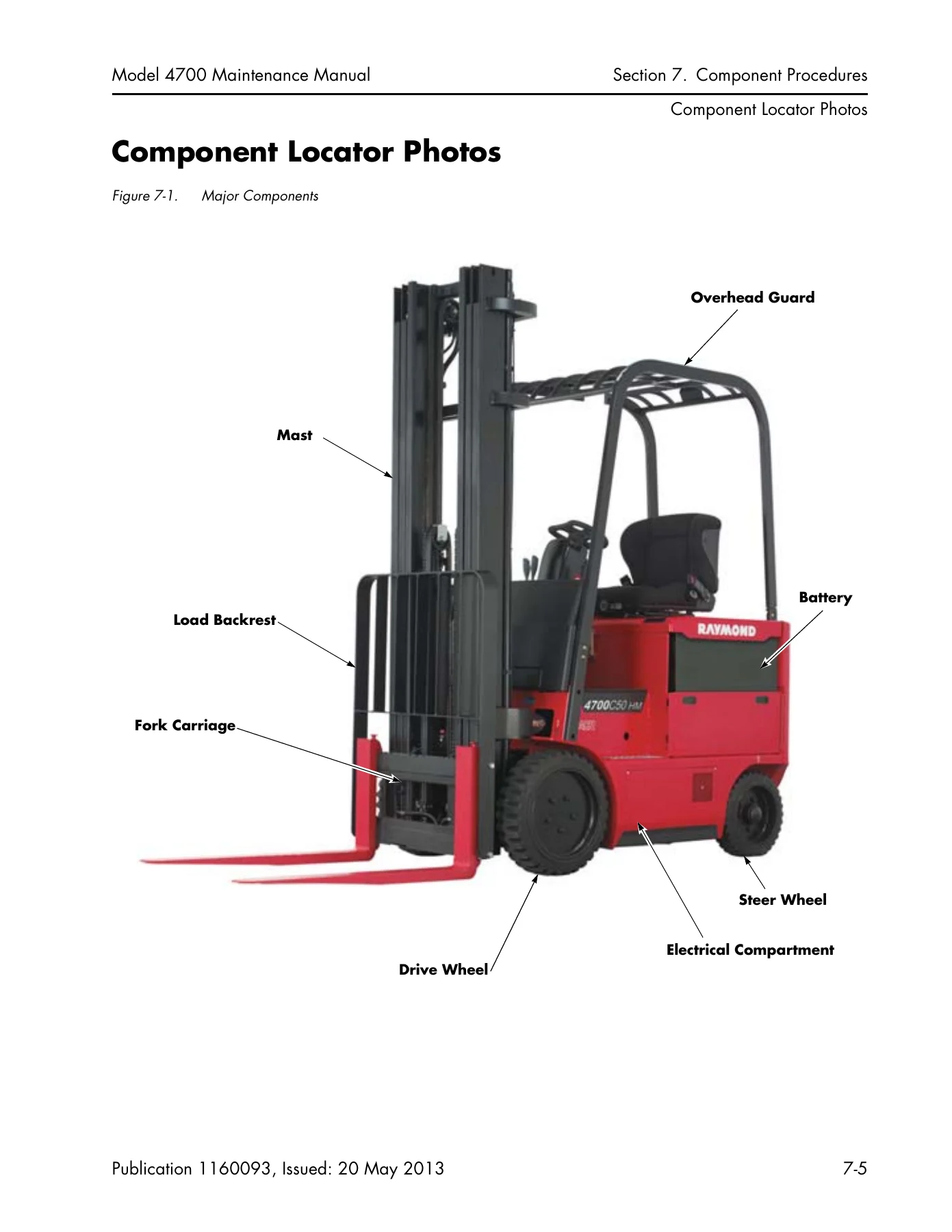
- Component Locator Photos
- Special Tools and Decals
- Steering and Controls
- Drive and Brake
- Electrical Components
- Hydraulic Components
- Mast
- 8. Theory of Operation
- System Architecture
- Traction System
- Hydraulic System
- Auxiliary Functions
- Steering System
- Options
- Pinout Matrix
- Appendix A
- Lubrication Specification Chart
- Thread Adhesives, Sealants, and Lubricants
- Component Specific Torque/Information Chart
- Torque Charts – Standard (Ferrous), Metric, Thread-Forming Screws, Hydraulic Fittings, Straight Thread Face Seal O-Rings
- Decimal Equivalent Chart and Standard/Metric Conversions
- Index
- Companion Schematics Publication 1160095A
- Power Distribution Diagram
- Electrical Schematics – dual traction motor trucks and single traction motor trucks, split by serial range
- Hydraulic Schematics – Lever Controls (dual and single traction motor) and Fingertip Controls
- Hydraulic Schematic – Bottler’s Tilt
Coverage by System
Electrically, the Raymond 4700 manual documents the ACR System from the battery connector through the contactor panel, the main fuse panel, the 24V fuse panel, the DC/DC converter, the Vehicle Manager, the Traction Power Amplifier, the Pump Power Amplifier, the Hydraulic Control Board and the Operator Display. Encoder and temperature-switch circuits for the traction and pump motors are traced pin-by-pin. The FlashWare program is covered for connecting a laptop to the truck through the USB/CAN interface module, updating software, configuring LPH performance parameters, and running Learn procedures. A backup alternative LEARN sequence using the LPH and Turtle buttons on the steering column is documented for when FlashWare is not available.
Hydraulically, the manual covers the priority valve, control valve assembly, lift/lower solenoids, tilt, sideshift and 4th-function solenoids, the drain proportional valve, and the emergency lower valve. It gives the lift pressure adjustment, auxiliary function pressure adjustment, steering pressure adjustment, and hydraulic fluid change and bleeding procedures for both TF/TT masts and Quad masts.
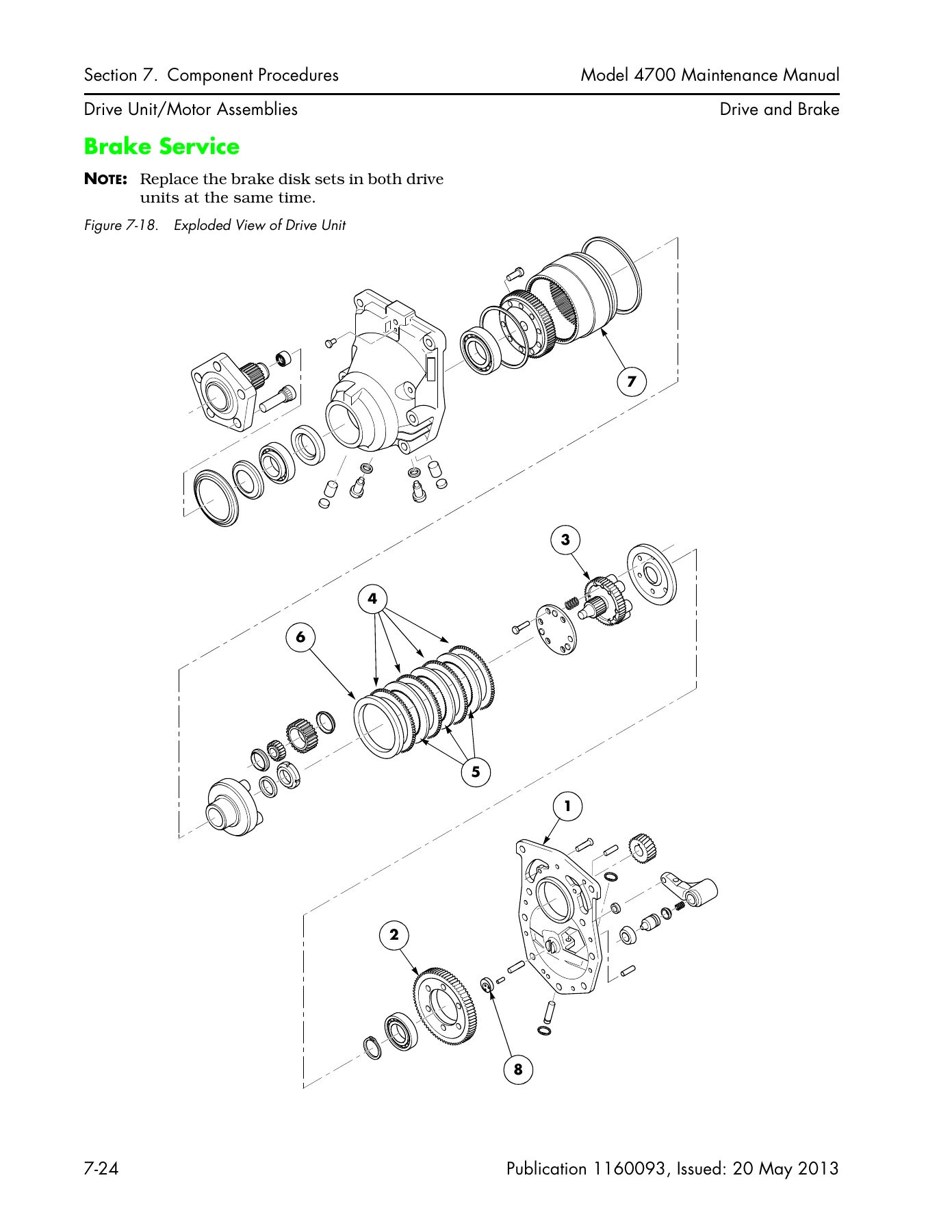
Mechanically, the drive and brake chapter covers both dual traction motor trucks (planetary gear drive unit with internal wet brake) and single traction motor trucks (planetary gear drive unit with either an automotive-style shoe brake below S/N 10677 or an internal wet brake from S/N 10677 up). Brake disc wear check, brake disc replacement, brake pedal adjustment, tire replacement, lift chain adjustment and removal, fork carriage removal, mast removal and installation, and the Quad mast tear-down/reassembly sequence are all documented with torque values.
Why This Raymond 4700 Service Information Matters
The Model 4700 is a sit-down counterbalanced truck built around the ACR System, and the service decisions it drives are not generic. Brake settings differ between serial ranges. Steer potentiometer behavior only applies to dual traction motor trucks. Battery voltage – 36V or 48V – changes module behavior and must match the configured setting in the truck, and the manual is explicit that changing battery voltage requires re-learning all potentiometers. Fault codes point to specific modules, and the corrective action under each code tells you whether you are looking at a wiring fault, a motor fault, or a module that has to be replaced. Trying to service one of these trucks without this document means guessing at voltages, torque values, fluid specs and learn procedures that the truck actually expects.
What You Can Do With This Manual
With this Model 4700 maintenance manual on hand, a technician or fleet shop can:
- Run the scheduled maintenance intervals – 90-day/250-hour, 180-day/500-hour, 1500-hour and 360-day/2000-hour – without looking up each task from memory
- Read and clear fault codes on the Operator Display and follow the specific corrective action for each one
- Diagnose travel and hydraulic complaints using the symptom tables and Pinout Matrix
- Remove and reinstall the drive unit, traction motor, pump motor, hydraulic pump, mast, carriage and lift cylinders
- Service the wet disc brakes or shoe brakes, depending on serial number
- Inspect and gauge forks, lift chains, mast rails, load rollers and guide shoes against the printed limits
- Adjust lift, auxiliary and steering pressures with the correct pressure-port procedure
- Change drive-unit fluid and hydraulic fluid with the correct fluid types from the Lubrication Specification Chart
- Run the alternative LEARN procedure for drive, lift, steer and battery when FlashWare is not available
- Trace every wire through the electrical schematics, including power distribution and the CAN-Bus network
- Reference torque values for standard and metric fasteners, hydraulic fittings and face-seal O-rings
IMAGES PREVIEW
Instant PDF Delivery
This Raymond Model 4700 Sit-Down Counterbalanced Lift Truck Maintenance Manual is delivered as a PDF download immediately after checkout, with no shipping and no waiting. The file opens on any laptop, tablet, desktop or smartphone, and every page can be printed for the shop or viewed on a screen in the service bay. Because the entire manual – including the companion schematics publication 1160095A – is in a single file, there is nothing extra to track down when a wiring or hydraulic diagram is needed mid-job.
Reviews
There are no reviews yet.