
Saab 340 Weight and Balance Manual – 340A, SF 340A, 340B Loading and CG Limits PDF
Original price was: $39.95.$23.95Current price is: $23.95.
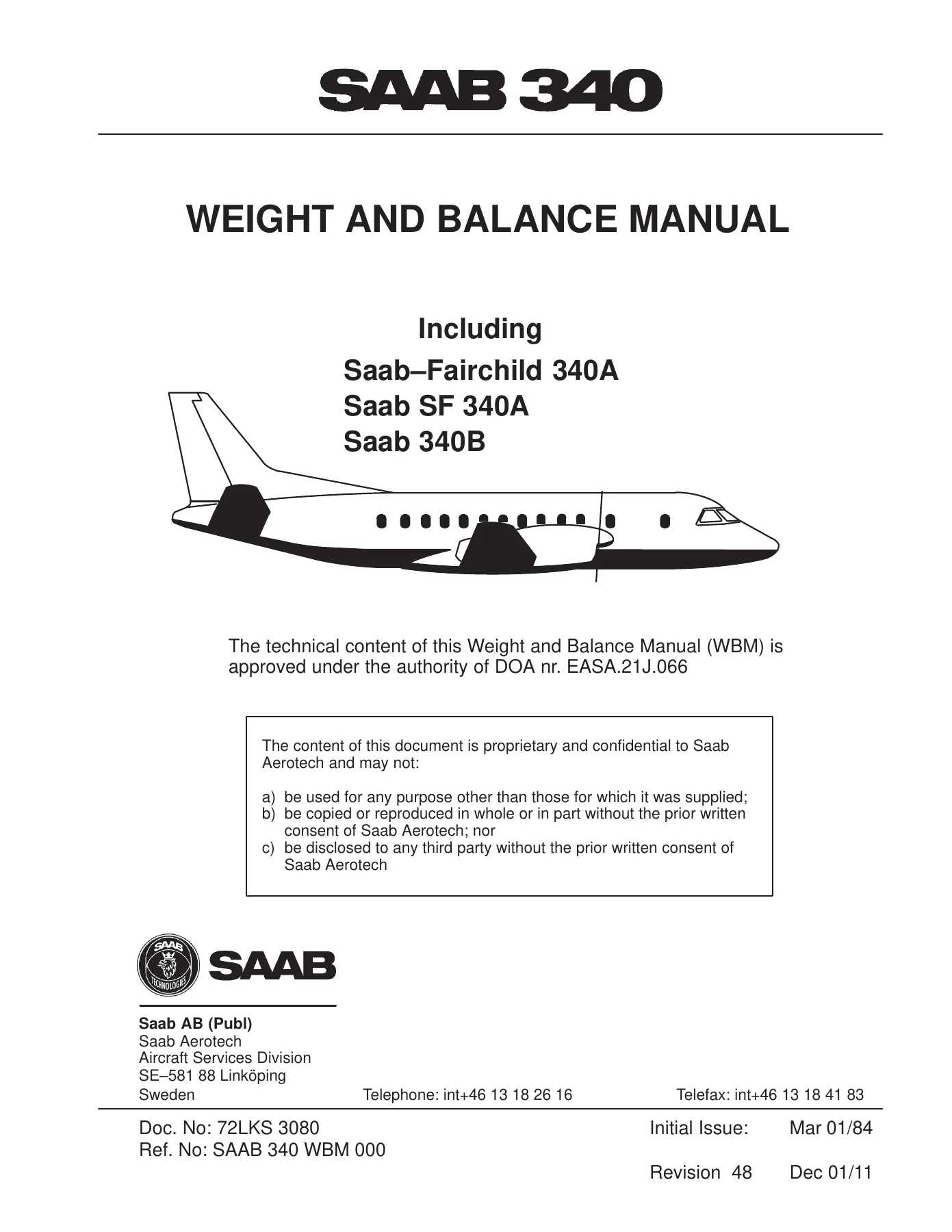
The Saab 340 Weight and Balance Manual for Saab-Fairchild 340A, Saab SF 340A and Saab 340B. Covers design weight limitations, CG envelopes, fuel and fluid moments, passenger and crew moment tables, cargo loading and tie-down limits, the Index Method, load planning and weighing procedures. Revision 48, Dec 01/11.
Description
Saab 340 Weight and Balance Manual – 340A, SF 340A and 340B
This Saab 340 Weight and Balance Manual is the control document that defines the weight and balance limitations and the loading capabilities of the Saab 340 family. It is issued by Saab AB (Publ), Saab Aerotech, Aircraft Services Division in Linköping, Sweden, and its technical content is approved under the authority of DOA nr. EASA.21J.066. Coverage spans the Saab-Fairchild 340A, the Saab SF 340A and the Saab 340B, and the manual is written so an operator can build their own weight and balance loading manifests from the tables and graphs it contains. In line with the ATA-100 specification the book is split into Chapter 1 “Control”, which applies to the aircraft type group, and Chapter 2 “Aircraft Reports”, which applies to each individual aircraft as delivered together with its equipment list.
File Details
- Manual type: Weight and Balance Manual (WBM)
- Manufacturer / publisher: Saab AB (Publ), Saab Aerotech, Aircraft Services Division, SE-581 88 Linköping, Sweden
- Aircraft covered: Saab-Fairchild 340A, Saab SF 340A, Saab 340B
- Language: English
- File format: PDF
- Page count: 328 pages
- Initial issue: Mar 01/84
- Current revision shown: Revision 48, Dec 01/11
- Approval: Technical content approved under the authority of DOA nr. EASA.21J.066
- Document structure: Chapter 1 “Control” and Chapter 2 “Aircraft Reports”, per ATA-100
Chapters Covered in This Saab 340 Weight and Balance Manual
- 01 Control – General, Identification, Units of Measurement, Conversion Factors, Reference System, Definitions and abbreviations, coding of operators
- 01-10 Design Weight Limitations and CG Limits – 340A pre-Mod 1531/1762/1763/1764 (SB SF-340-32-039), 340A post-Mod 1531/1762/1763/1764, 340A post-Mod 3139 (SB 340-51-026), 340B pre-Mod 2438 (SB SAAB 340-51-010) and 340B post-Mod 2438, plus safe moment tables in lb in and kg in and the corresponding CG limit graphs
- 01-20 Fuel – Fuel tank arrangement, Definitions and Fuel Weights, Usable Fuel Moment Tables in (lb in) and (kg in), Moment Reduction Due to Fuel Consumption
- 01-30 Fluids – Engine and Propeller Gearbox Oil, Hydraulic Fluid, Chemical Toilet Fluid, Washing Water and Oxygen
- 01-40 Personnel – General, Crew Moment Table, Passenger Moment Tables for 36 and 37 seat, 35 seat, 34 seat, 33 seat, 30 seat and under-30 seat configurations, and In-Flight Movements
- 01-50 Arrangements – Passenger Compartment and Door Opening, Flight Deck Stowages, Ballast Installation (weight and moment tables and examples), Passenger Compartment Stowages and Overhead Bins Gen I, II and III, Standard Seat Moment Tables, Lavatory and Galley/Stowage Moment Tables, Structural Load Limitation for Section A, and the stowage/galley and executive bar arrangements at STA 231, 245, 249, 252, 259, 262, 304.4, 307, 602 and 608
- 01-60 Cargo – General, Main Cargo Compartment, Loading Limitations (maximum distributed load, running load limitations, compartment and cumulative load limitations for each cargo net configuration), Cargo Tie-Down Limitations and allowable seat track loads, Integrated Payload Limitations, Cargo/Luggage Moments Tables for Section C1 and C2, and Package Sizes for the rear cargo compartments
- 01-70 Load Planning – General, The Index Method (Dry Operating Index, passengers, baggage, fuel and observer index, in-flight movements, graphs and seating check), CG limits envelopes for each modification status, and Load Sheet examples (empty and filled in)
- 01-80 Ground Operations – General, Weighing Methods (jackstand and platform weighing forms), and Equipment and Unit Removal Effects on Weight and A/C CG
- 01-90 Examples – Operational Empty Weight (OEW) and CG Build-Up, Operational Take-Off Weight (OTOW) and CG Build-Up, and the Manifest Form
- 02 Aircraft Reports – General, Delivery Weight and Balance Reports, Weight Change Record Form (lb and kg), Weight and Balance Report, Equipment List, Zoning
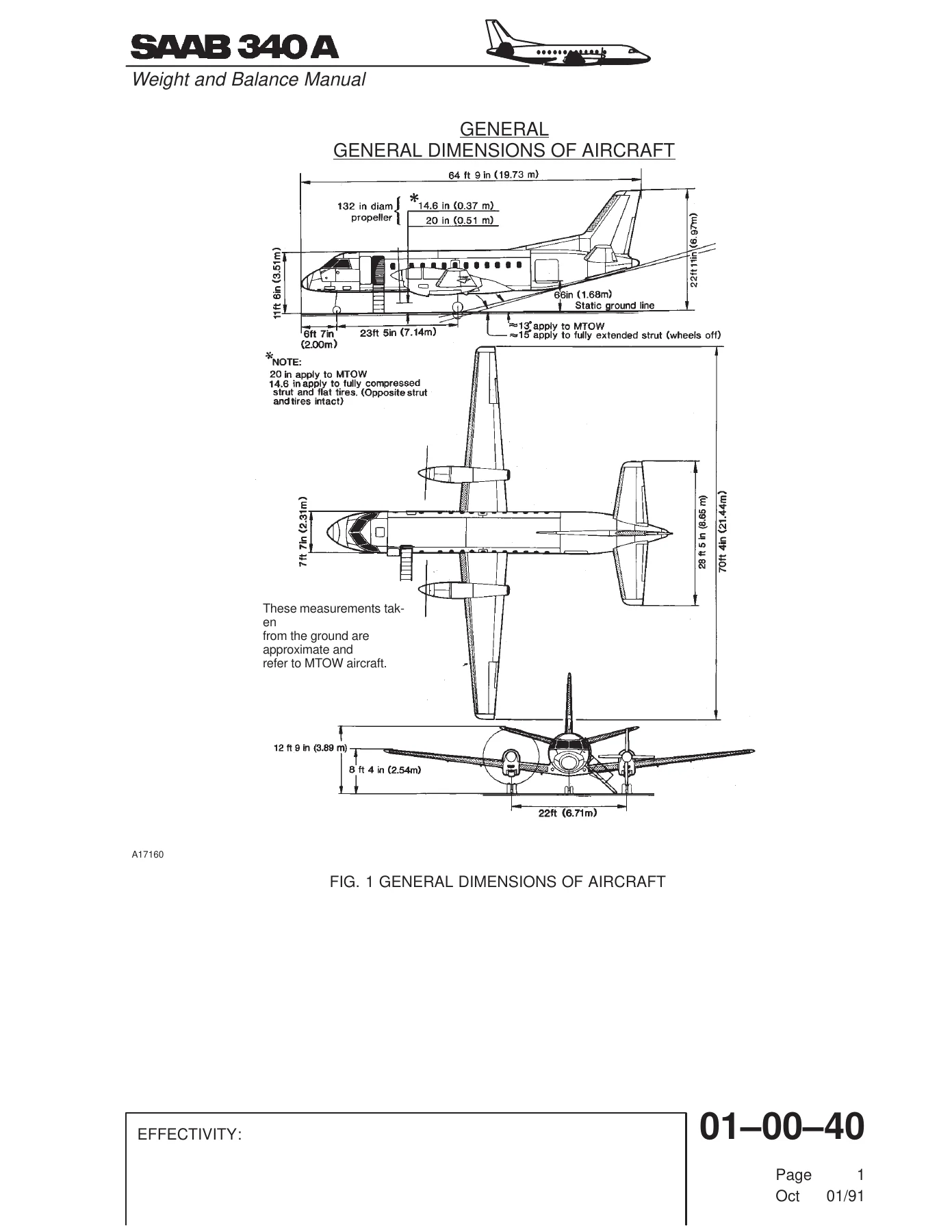
Taken as a whole, the manual gives a technician or load controller a complete working picture of how this aircraft may be loaded. It explains the fuselage, water line, buttock line and wing station reference system, states the MAC length and the LEMAC position, then moves through every category of weight that has to be accounted for – fuel, engine and propeller gearbox oil, hydraulic fluid, toilet fluid, washing water, oxygen, crew, cabin attendants, observers and passengers in each seat layout. From there it lays out the moment tables, galley and wardrobe stowage limits, cargo compartment load ceilings and cumulative limits, and finally the procedures used to weigh the aircraft on jacks or platform scales and calculate its centre of gravity.
Design Weight Limitations and CG Envelopes
Because the Saab 340 was delivered in several modification states, the manual separates the maximum design weights by aircraft status rather than giving one single set of numbers. Maximum Design Zero Fuel Weight, Maximum Design Taxi Weight, Maximum Design Take-Off Weight, Maximum Design Landing Weight and Minimum Design Flight Weight are each listed for 340A pre- and post-Mod 1531/1762/1763/1764, for 340A post-Mod 3139, and for 340B pre- and post-Mod 2438. Aircraft in passenger configuration and aircraft in cargo configuration are treated separately where the zero fuel weight differs, and a note is carried for operation under FAR PT 135 with its payload ceiling. Alongside the tables, the CG limit graphs plot forward and aft limits in flight and for take-off and landing against aircraft weight, so a load controller can read off the permitted envelope directly. The safe moment tables that follow give forward and aft CG limit moments in 100 lb in and 100 kg in for each weight step.
Fuel, Fluids and Personnel Data
The fuel section works from a stated density of 6.7 lb/US gal (0.802 kg/L) and gives usable fuel, unusable fuel, drainable unusable fuel, trapped fuel, maximum total fuel and the maximum allowable fuel unbalance. Usable fuel moment tables are provided in both US and metric units, together with a moment reduction table that lets you work out the shift in total fuel moment as fuel is consumed from a given take-off quantity. The fluids section covers engine and propeller gearbox oil tank locations, volumes and moments, hydraulic fluid, chemical toilet fluid, washing water and oxygen bottles. Personnel data includes a crew moment table for pilots, attendants and observer, and separate passenger moment tables for every cabin layout the aircraft was delivered with – 36 and 37 seats, 35 seats, 34 seats, 33 seats, 30 seats and configurations below 30 seats. Each table lists seat row, seat type, weight and moment so passenger loading can be totalled row by row.
Cargo, Loading Limitations and Tie-Down
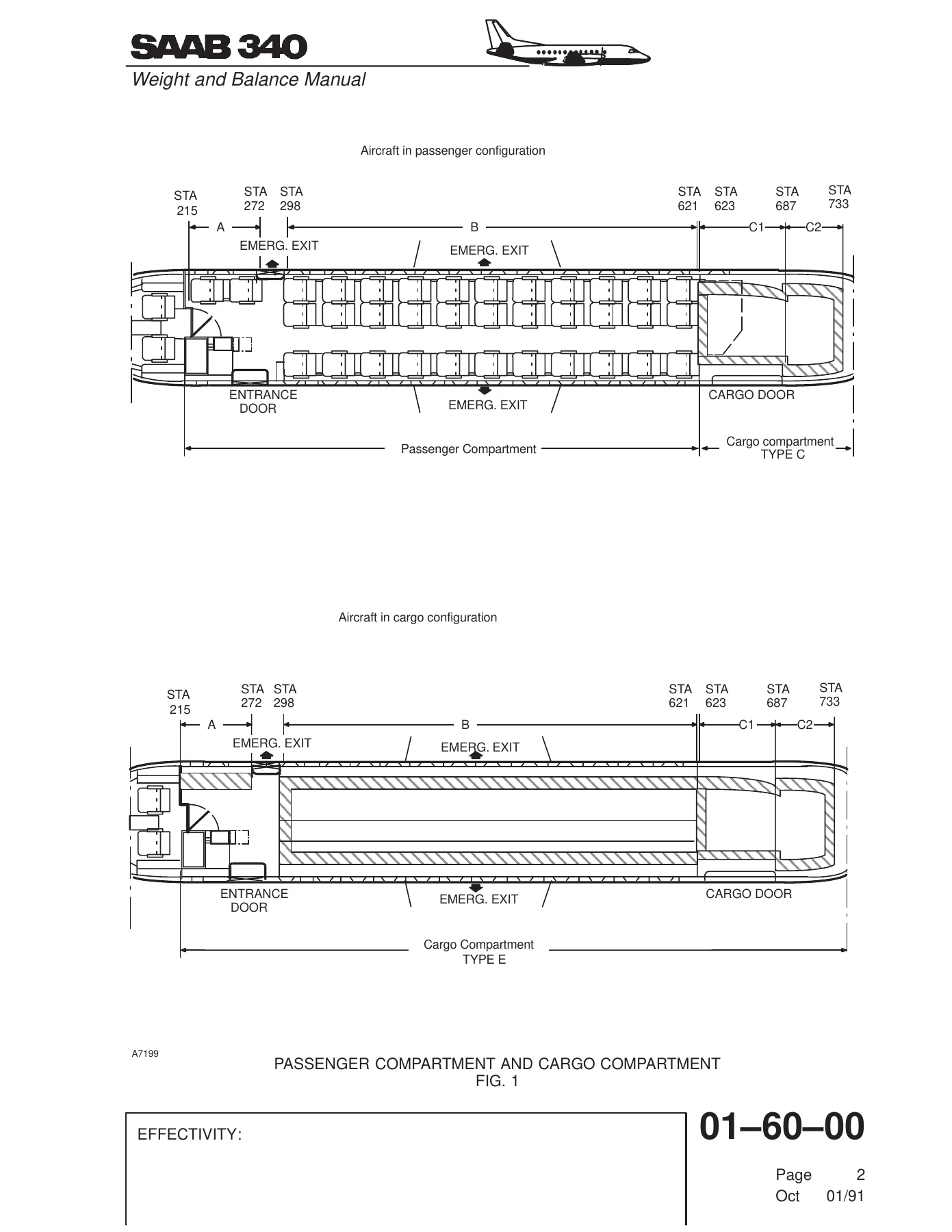
The cargo chapter is where the manual gets particularly detailed. It defines the fuselage sections A, B, C1 and C2, explains that the main cargo compartment sits between STA 623 and STA 733, and then sets out the limits that must be respected. Maximum distributed load is expressed in lb/ft2 (kg/m2) for Sections A, B and C, with different values depending on whether cargo rests directly on the floor panels or on spreaders laid across the tracks, and a maximum running load over Sections B and C is stated. Compartment load limitations and cumulative load limitations for C1 and C2 are then given for each cargo restraint net configuration, including the main net and side net or bag net combinations, with notes governing how high cargo may be stacked on the wall. The tie-down section lists the restraint factors used for forward, aft, sideways, upward and downward loads and the maximum allowable seat track loads, factored, for each track. Integrated payload distribution charts close the chapter, and package size tables give the maximum dimensions that will pass through the cargo and passenger door openings, split by aft toilet and forward toilet configuration.
Load Planning and the Index Method
For operators who prefer a shorthand system, the load planning chapter explains the Index Method in full. It shows how to calculate the Dry Operating Index from the Dry Operating Weight, how to build index tables for passengers, baggage, fuel and observer, which in-flight movements must be taken into account, and how the weight and CG envelopes are scaled. Worked examples walk through the establishment of DOW and DOI, observer index, passenger index, baggage index, fuel index and the calculation table, followed by empty and filled-in load sheet examples that show how a completed manifest should look.
Ground Operations, Weighing and Removal Effects
The ground operations chapter covers the two accepted weighing methods – jackstand weighing and platform weighing – and provides the forms used to record scale readings, tare and weight for the nose and wing or main gear positions, along with the CG calculation. A separate table lists the weight, STA and resulting CG shift when normally removable units such as airstairs, ailerons, avionics rack contents, batteries, cargo door, elevators, flaps, horizontal stabilizers, galleys, main and nose gear, power plants, propellers, rudder and complete seat rows are removed for maintenance.
What This Saab 340 Weight and Balance Manual Lets You Do
IMAGES PREVIEW
With this manual on hand you can calculate a correct and legally defensible loading manifest for a Saab-Fairchild 340A, Saab SF 340A or Saab 340B, check that the aircraft remains inside its certified CG envelope for the specific modification state it is in, and confirm that no individual hold, galley, wardrobe or stowage compartment exceeds its structural load ceiling. You can work out fuel moment and moment reduction as fuel burns off, account for crew, attendants, observers and every seat row in whatever cabin layout the aircraft carries, and verify that cargo in the rear compartment is within the compartment, cumulative and tie-down limits for the net configuration actually installed. Weight and balance errors are the kind of thing that show up in handling, performance and structural loading, so having the correct design weight limitations, moment tables and cumulative load limits in front of you is the difference between a properly planned load and an assumption. The file is delivered as an instant PDF download after checkout – nothing ships, and you can keep it on any laptop, tablet or phone, print the pages you need for the load sheet desk, and search the tables while you work.

Reviews
There are no reviews yet.