
Varian Clinac 6EX 21EX Novalis Radiation Safety QA Operating Procedures Manual PDF Download
Original price was: $29.95.$17.95Current price is: $17.95.
129-page MUHC Class II Radiation Safety and Quality Assurance Manual with dedicated operating, daily QA, safety and emergency procedures for Varian Clinac 6EX 6 MV, Clinac 21EX and Novalis IX linear accelerators, plus Tomotherapy, Cobalt T-780 and HDR brachytherapy coverage. Includes Clinac 6EX performance checklists, startup/warm-up values, BeamChecker checkout, interlock tests, Service Mode safety guidance and preventive-maintenance procedures. Instant PDF download.
Description
MUHC Class II Radiation Safety & Quality Assurance Manual – 129-Page Technical Reference
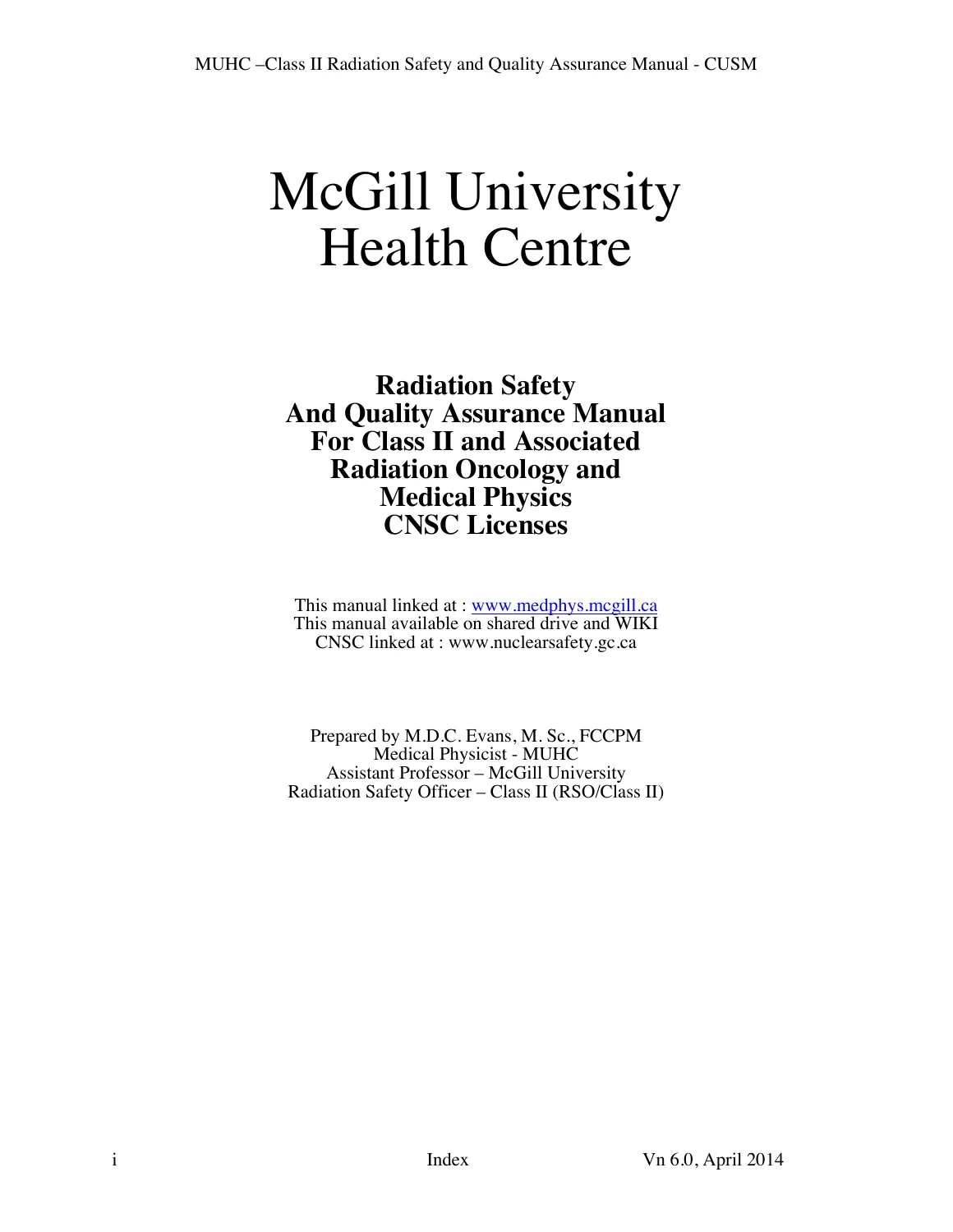
This 129-page English Radiation Safety and Quality Assurance Manual was prepared for the McGill University Health Centre (MUHC) Radiation Oncology and Medical Physics Class II and associated Canadian Nuclear Safety Commission licenses. This is Version 6.0, April 2014, prepared by M.D.C. Evans, M.Sc., FCCPM, Medical Physicist and Radiation Safety Officer – Class II at MUHC.
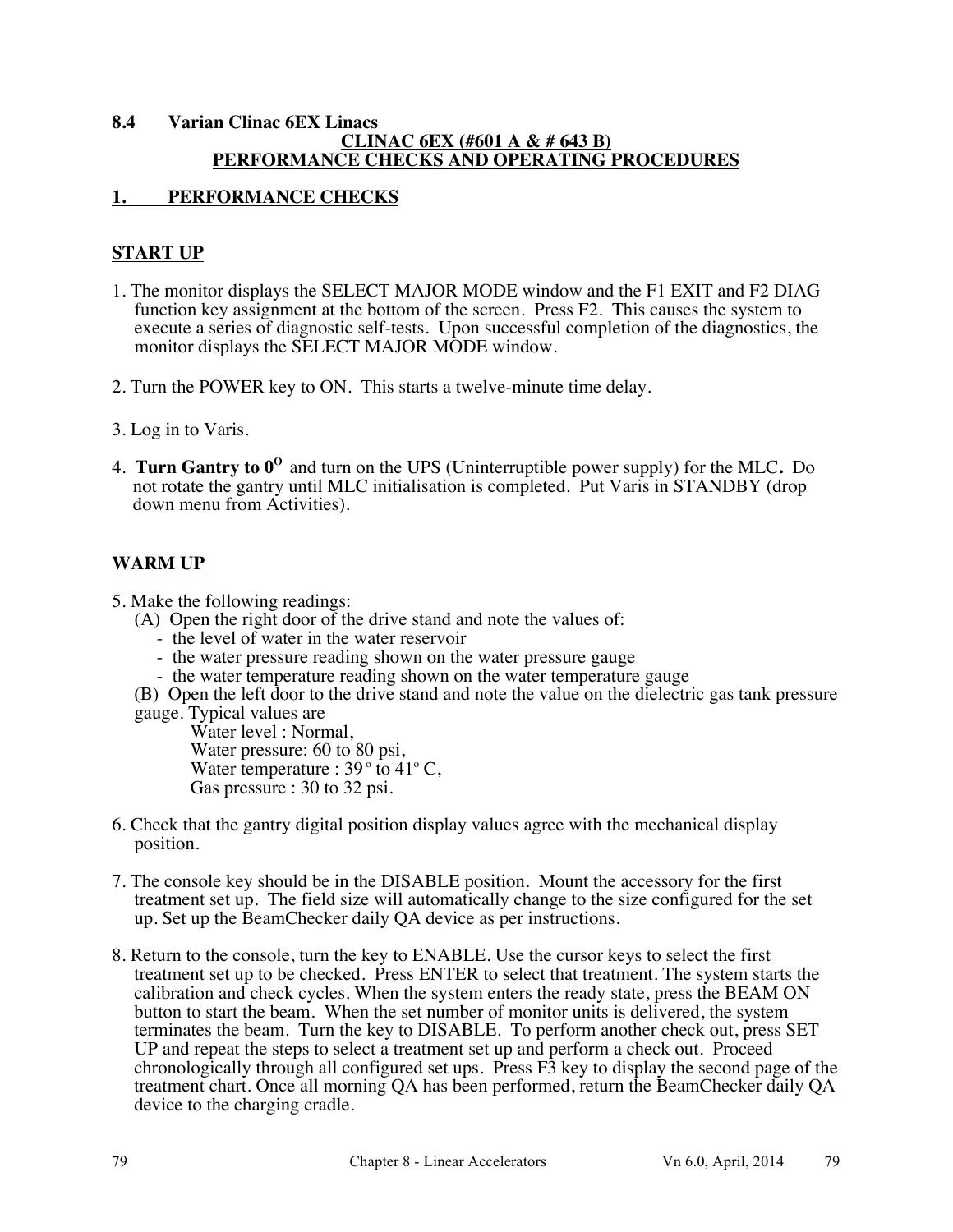
For technicians working with the Varian Clinac 6EX, this document contains a particularly useful dedicated section titled 8.4 Varian Clinac 6EX Linacs. That section provides actual startup, warm-up, daily performance-check, BeamChecker QA, interlock, patient-communication, laser/ODI, shutdown, safety and emergency procedures used for two 6 MV Clinac 6EX machines identified in the manual as #601 A and #643 B.
It is important to understand the scope correctly: this is not a Varian factory repair manual or component-level service manual. It is an institutional radiation-safety, operating and QA reference that documents how MUHC operated, checked and safely serviced its Class II radiotherapy equipment. Its value for a 6EX engineer lies in the detailed real-world performance checks, expected operating readings, emergency procedures, safety-interlock checks, Service Mode safety discussion, PMI framework and printable 6EX daily QA checklists.
Radiotherapy Equipment Explicitly Covered
The linear-accelerator chapter identifies six MUHC treatment machines:
- Varian Clinac 6EX – 6 MV – unit #601
- Varian Clinac 6EX – 6 MV – unit #643
- Tomotherapy – 6 MV – unit #130
- Varian Novalis IX – 18 MV – unit #4674
- Varian Clinac 21EX – 18 MV – unit #1662
- Varian Clinac 21EX – 18 MV – unit #1663
The wider manual also covers:
- MDS Nordion Theratron T-780 Cobalt teletherapy / TBI equipment
- microSelectron V2 HDR remote afterloader
- HDR and LDR brachytherapy safety
- I-125 and Ru-106 eye plaques
- Sr-90 pterygium treatment source procedures
Dedicated Clinac 6EX Coverage
The most relevant material for a Clinac 6EX owner or engineer begins in Section 8.4 – Varian Clinac 6EX Linacs. The procedures are specifically identified for:
- CLINAC 6EX #601 A
- CLINAC 6EX #643 B
- Photon energy: 6 MV
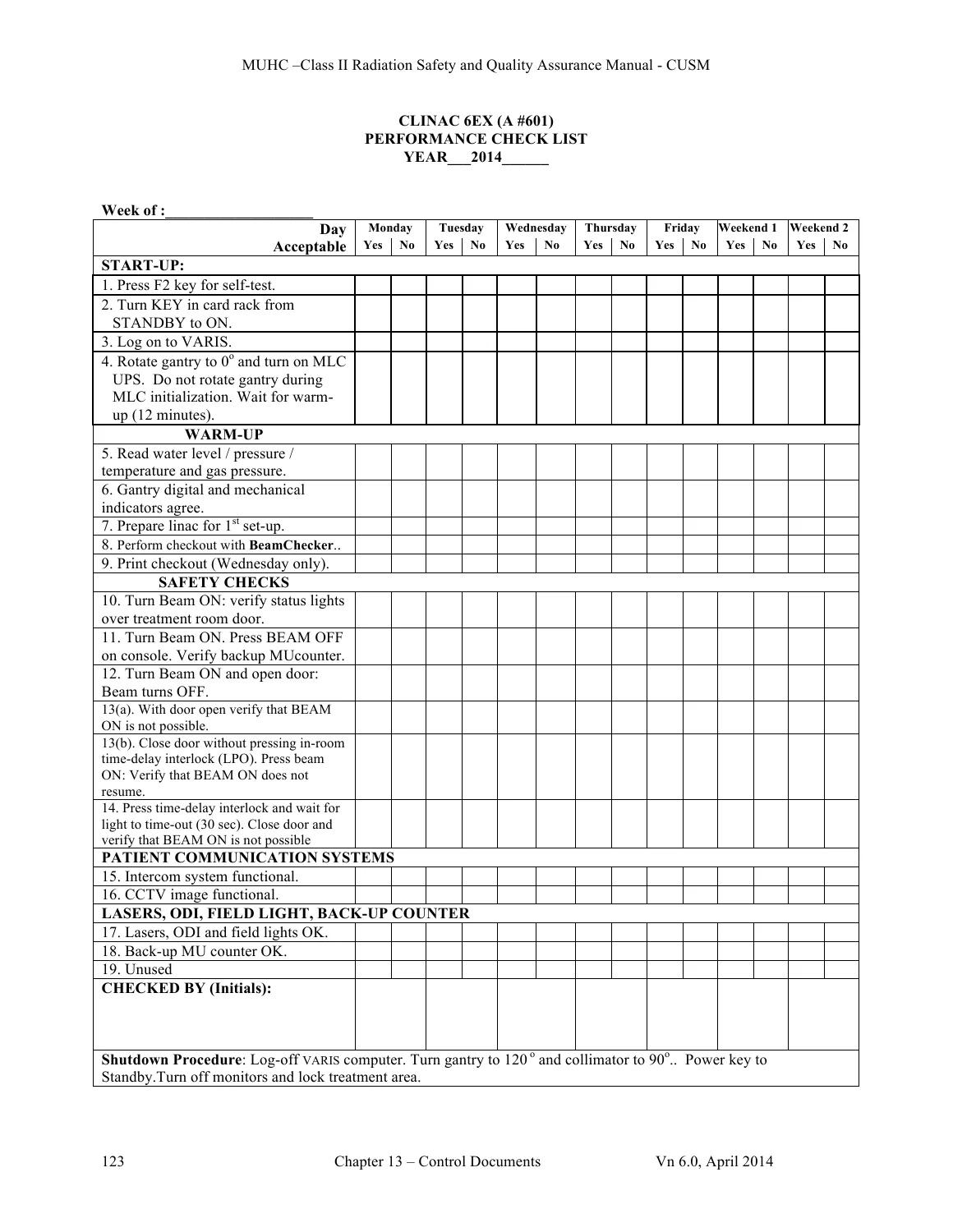
Separate printable performance-check forms for both machines are also reproduced in Chapter 13.
Clinac 6EX Startup Procedure
The manual documents the sequence used to bring the 6EX into its daily operating state:
- Run the F2 diagnostic self-test from the SELECT MAJOR MODE screen
- Turn the POWER key to ON
- Allow the documented 12-minute warm-up period
- Log into VARIS
- Rotate the gantry to 0 degrees
- Power the MLC UPS
- Do not rotate the gantry while MLC initialization is in progress
- Place VARIS in STANDBY
Clinac 6EX Warm-Up Readings and Expected Values
Before completing the morning checkout, the manual directs the operator to inspect the drive stand and record several machine operating values.
The typical values printed in the manual are:
- Water level: Normal
- Water pressure: 60 to 80 psi
- Water temperature: 39°C to 41°C
- Dielectric gas pressure: 30 to 32 psi
The procedure also requires confirmation that the gantry digital position indication agrees with the mechanical position display.
BeamChecker Morning QA / Checkout
The 6EX operating procedure includes a complete morning checkout sequence using the BeamChecker daily QA device.
The documented workflow includes:
- Place the console key in DISABLE while preparing the treatment setup
- Mount the accessory required for the first configured setup
- Position the BeamChecker daily QA device
- Return the console key to ENABLE
- Select the configured checkout treatment
- Allow the accelerator to perform its calibration and check cycles
- Start the beam when the system reaches READY
- Deliver the programmed monitor units
- Repeat the checkout through all configured setups
- Return the BeamChecker to its charging cradle after completion
- Enter the previously recorded operating parameters
- Print and retain the checkout log at the documented interval
- Exit MORNING CHECK OUT MODE
This is useful because the manual shows how daily 6EX performance verification was incorporated into the actual operating workflow rather than presenting only general QA principles.
Clinac 6EX Beam and Safety Checks
The dedicated safety-check sequence verifies several safety systems under controlled beam conditions.
- Set up a FIXED treatment using a small number of monitor units
- Verify the Ready – Yellow status light
- Verify the Beam-On – Red status light
- Interrupt the beam using the console BEAM OFF control
- Confirm that the remaining monitor units are displayed
- Verify operation of the backup MU counter
- Open the treatment-room door during beam-on and confirm that the beam terminates
- Verify that beam-on is impossible with the room door open
- Close the door without completing the LPO sequence and verify that beam-on cannot resume
- Allow the time-delay interlock cycle to expire and verify that beam-on remains inhibited
Last Person Out / Time-Delay Interlock
The 6EX bunkers documented by MUHC use a Last Person Out (LPO) time-delay interlock system to reduce the risk that staff remain inside when irradiation begins.
The manual explains that the 6EX rooms use an interior LPO button followed by treatment-room door closure. A timed sequence must be completed before beam-on can become possible. If the required sequence is not followed correctly or the interval expires, beam-on remains inhibited.
Patient Communication System Checks
Daily performance checks also include verification of the patient-monitoring systems:
- Intercom and speakers
- CCTV / TV monitor image
These checks form part of the formal Clinac 6EX performance checklist rather than being treated as unrelated facility equipment.
Lasers, ODI and Field-Light Checks
The 6EX QA procedure provides a practical daily geometric check of:
- Room positioning lasers
- Machine cross wires
- Machine isocenter
- Optical Distance Indicator – ODI
- Field light
- Backup monitor-unit counter
With the gantry in a lateral position, the lasers are checked against the cross wires. The gantry is then rotated to confirm that the laser system agrees at machine isocenter.
The manual specifies that with the gantry at 0 degrees and the couch at SSD 100 cm, the 100 cm SSD indication from the ODI should intersect the cross-wire center at the laser level within 1 mm.
Clinac 6EX Daily Shutdown
The documented 6EX shutdown procedure includes:
- Log off the computers / VARIS
- Rotate the gantry to 120 degrees
- Set the collimator to 90 degrees
- Turn off the MLC UPS
- Turn the card-rack power key to STANDBY
- Turn off monitors
- Lock the treatment area
The manual specifically notes that the gantry/collimator standby position is used to minimize the risk of damage associated with a possible water spill.
Clinac 6EX Emergency Procedures
The document contains a dedicated multi-page CLINAC 6EX Emergency Procedures section.
It covers:
- Treatment beam fails to terminate
- Hospital power failure
- Emergency couch movement during a power failure
- Use of the emergency pendant
- Manual longitudinal movement of the couch
- Emergency couch lowering
- Recording delivered monitor units after interruption
- Emergency-Off buttons
- Fire, smoke or gas fumes
- Failure of the Emergency-Off circuits
Treatment Beam Fails to Terminate
The manual defines the emergency condition as the accumulated monitor-unit display exceeding the preset MU1 treatment value. The documented response progresses through:
- BEAM OFF
- DISABLE/ENABLE key to DISABLE
- Nearest EMERGENCY OFF button if required
- Main facility circuit breaker if the beam remains on
- Patient removal
- Recording the delivered monitor units
- Removing the Clinac from use and contacting Medical Physics
Power Failure and Emergency Couch Recovery
The power-failure procedure contains detailed instructions for safely removing a patient when normal couch power is unavailable.
Coverage includes:
- Disable the machine
- Prevent couch rotation
- Access the emergency pendant in the drive stand
- Use the NORM / OUT / DOWN controls
- Release the longitudinal brake to move the couch manually
- Lower the couch electrically through the emergency pendant where available
- Return the pendant and Emergency-Off controls to their normal state
- Use the separate manual couch-lowering device if required
- Record monitor units delivered before the interruption
Emergency-Off Button Locations for Clinac 6EX
The manual identifies Emergency-Off controls at several locations around the 6EX installation, including:
- Console
- Treatment couch
- Treatment-room walls
- Drive stand
- Modulator cabinet
The document states that these controls stop the beam and can also stop unwanted gantry or couch motion.
Printable Clinac 6EX Daily Performance Checklists
Chapter 13 reproduces complete weekly control sheets for both documented Clinac 6EX units:
- CLINAC 6EX A #601 Performance Check List
- CLINAC 6EX B #643 Performance Check List
The forms provide Monday-Friday plus Weekend 1 and Weekend 2 columns and include checkboxes for the entire daily procedure.
Checklist categories include:
- Startup
- F2 self-test
- Power key
- VARIS login
- MLC UPS initialization
- 12-minute warm-up
- Water level, pressure and temperature
- Gas pressure
- Gantry indicators
- BeamChecker checkout
- Beam status lights
- BEAM OFF function
- Backup MU counter
- Door interlock
- LPO / time-delay interlock
- Intercom
- CCTV
- Lasers
- ODI
- Field lights
- Final operator initials
Clinac 21EX and Novalis IX Coverage
A separate part of Chapter 8 provides performance checks and operating procedures for:
- Clinac 21EX #1662
- Clinac 21EX #1663
- Varian Novalis IX #4674
These systems are identified as 18 MV machines in the equipment listing.
The procedures cover:
- System startup and diagnostic self-test
- VARIS login
- MLC UPS startup
- Pre-warm-up equipment readings
- Water and dielectric-gas checks
- Gantry position verification
- OBI safety checks where applicable
- OBI door and collision interlocks
- BeamChecker morning QA
- Linac safety checks
- Status lights
- Door interlock
- Last Person Out sequence
- Intercom and CCTV
- Lasers, ODI and field light
- Backup MU counter
- Daily shutdown
- Emergency procedures
Tomotherapy Coverage
Section 8.3 contains a separate Tomotherapy #130 Performance Checks Procedure.
Subjects include:
- Machine startup
- UPS startup sequence
- Power Control Panel operation
- Operator System login
- Warm-up
- Water-temperature requirement
- Five-minute warm-up scan
- Air Scan
- Morning QA imaging scan
- Phantom positioning
- Laser coincidence
- BeamChecker testing
- Entrance interlock status
- Time-delay interlock
- Beam termination when the room door opens
- Intercom and TV monitoring
- Shutdown
- Emergency procedures
The morning QA imaging section documents expected offsets of -10 lateral, 20 longitudinal and 30 vertical for the specific MUHC test phantom/setup described in the manual.
Chapter 10 – Service and Maintenance Safety
Another technically useful part of this document is the dedicated Service chapter. It describes MUHC procedures for servicing Class II radiation equipment under its CNSC service license.
The manual states that preventive maintenance and repairs are performed using the applicable manufacturer service manuals and manufacturer procedures. This distinction is important: the present PDF explains the safety and quality-control framework around servicing, but does not reproduce the underlying Varian component-repair manuals.
Safe Work Procedures During Linac Service
The service chapter discusses:
- Authorization to perform servicing
- Role of medical physicists and service engineers
- Use of TLD personal dosimetry
- Availability of a calibrated survey meter
- ALARA planning
- Removal of patients during servicing
- Recording completed service work
- Radiation hazards from activated accelerator components
- Return-to-clinical-service decisions after repair
- Testing or calibration following maintenance
Varian Service Mode Discussion
The manual contains a specific section on Service Mode for computer-controlled Varian linacs.
It explains that Service Mode:
- Is available to service engineers and physicists for maintenance and troubleshooting
- Allows many machine interlocks to be overridden
- Does not provide a software override of the treatment-room door interlock
- Uses an interface different from normal clinical mode
- Does not interface with the Record-and-Verify system
- Does not control the multileaf collimator
- Should not be left available for unattended clinical operation
This section is a safety and operating explanation of Service Mode; it is not a complete Service Mode command or calibration manual.
Interlock Bypass During Servicing
The manual contains a dedicated procedure for bypassing interlocks during servicing.
It states that:
- Emergency-Off circuits must not be bypassed or disabled during maintenance.
- Other interlocks may occasionally need to be bypassed for service.
- Service Mode must not normally be used for patient treatment.
- Expected external radiation levels should be reviewed before operation with certain interlocks bypassed.
- A survey meter must be available.
- A warning sign should be placed on the treatment-room door when door interlocks are bypassed.
- Intentional interlock bypasses are to be recorded.
Radiation Safety Around Activated Linac Components
The service chapter contains detailed discussion of residual activation following operation of high-energy linear accelerators.
Components identified as potential areas of higher activation include:
- Bending magnet assembly
- Target
- Target flattener
- Primary collimator
- Secondary collimators / jaws
- Other components within the accelerator head
The document provides measured radiation-level examples from a Varian Clinac 2300 C/D operating at 18X, including measurements after irradiation at isocenter, around the service plate, stand, klystron side, water-system side and accelerator waveguide.
The manual reports a short initial activation half-life of approximately 7-8 minutes in the documented measurement conditions and emphasizes time and distance as practical methods of reducing exposure.
RF-On Maintenance Safety
A dedicated section addresses the unusual situation in which a service engineer or medical physicist needs to remain in the treatment room while RF is present in the accelerator waveguide.
Subjects include:
- Use only when alternative diagnostic methods are inadequate
- Minimum time in the treatment room
- Two-person working requirement
- Calibrated radiation survey meter
- Possible use of a neutron survey meter for high-energy accelerators
- Potential radiation from dark current
- Influence of accelerator vacuum and RF arcing
- Disabling the electron gun where possible using an approved machine-specific procedure
- Reducing collimators to the smallest field
- Continuous intercom communication
- CCTV surveillance of the person in the room
- Verification of local radiation levels with the survey meter
Preventive Maintenance and Inspection – PMI
Section 10.7 discusses Preventive Maintenance and Inspection on Class II prescribed equipment.
PMI activity includes:
- Inspection
- Preventive maintenance
- Troubleshooting
- Repairs as required
- Emergency-Off system verification
- Backup dose-counter verification
- Treatment-room warning-light verification
- Modulator-room warning-light verification where applicable
- Emergency hand-pendant verification
For Varian EX and C/D linacs, the document describes the sequence used to verify the various Emergency-Off switches at the console, couch, stand, modulator and treatment room.
Important PMI Scope Limitation
This PDF does not contain the full manufacturer PMI checklist for every internal Clinac subsystem. It explicitly states that technical servicing and PMI are carried out according to the manufacturer’s service manuals and prescribed manufacturer checklists.
Therefore, a buyer looking for detailed procedures such as klystron measurements, gun-driver measurements, modulator maintenance, gantry-chain inspection, lubrication procedures or component-specific adjustment values should use the applicable dedicated Varian PMI/service publication. This MUHC document complements those manuals with institutional safety, operational and QA procedures.
Brachytherapy Coverage
Chapter 7 addresses radiation safety associated with brachytherapy activities including:
- HDR brachytherapy
- LDR procedures
- I-125 eye plaques
- Ru-106 eye plaques
- Sr-90 pterygium treatments
- Source handling
- Patient surveys
- Survey-meter use
- Emergency equipment and procedures
Cobalt T-780 Coverage
Chapter 9 covers the Theratron T-780 Cobalt teletherapy / TBI unit. The manual includes operational and safety guidance and directs users to the separate Theratron 780 Operator’s Manual for additional equipment information.
The service chapter also contains:
- Safety procedures around the Cobalt source
- Source-stuck emergency procedure
- Measured radiation levels around the TBI unit
- Service precautions
- Survey-meter requirements
Control Documents and Ready-to-Use QA Checklists
The final chapter contains printable weekly performance-check forms for several pieces of radiotherapy equipment.
Included forms cover:
- Varian Novalis #4674
- Clinac 21EX A #1662
- Clinac 21EX B #1663
- Clinac 6EX A #601
- Clinac 6EX B #643
- Tomotherapy #130
- T-780 Cobalt TBI #130
- microSelectron V2 HDR #31718
Complete Chapter Structure
The manual’s index lists the following major chapters:
- 1 – Introduction
- 2 – Organizational Structure
- 3 – Licensing
- 4 – Authorization
- 5 – Maximum Permissible Doses and Dosimetry
- 6 – Purchase, Inventory, Storage and Signs
- 7 – Brachytherapy
- 8 – Linear Accelerators
- 9 – Cobalt Teletherapy
- 10 – Service
- 11 – Blank Chapter
- 12 – Emergencies
- 13 – Control Documents
What This Manual Is
- A 129-page MUHC Radiation Safety and Quality Assurance Manual
- A real institutional operating and QA reference for Class II radiation equipment
- A document with explicit dedicated Clinac 6EX operating procedures
- A source of Clinac 6EX startup and warm-up procedures
- A source of typical 6EX water, temperature and gas-pressure readings
- A BeamChecker morning-QA workflow
- A Clinac safety-interlock verification reference
- A laser/ODI/field-light QA reference
- A backup-MU-counter check reference
- A Clinac 6EX emergency procedure reference
- A source of printable Clinac 6EX daily QA checklists
- A service-radiation-safety reference for medical linear accelerators
- A Service Mode safety reference
- An interlock-bypass safety reference
- A PMI framework and Emergency-Off verification reference
- A multi-equipment radiation-oncology safety manual covering Varian linacs, Tomotherapy, Cobalt and HDR equipment
What This Manual Is Not
This section is especially important for buyers seeking a technical repair manual.
- It is not a Varian factory Clinac 6EX service manual.
- It is not a complete electrical schematic or wiring-diagram package.
- It does not provide component-level circuit-board schematics.
- It does not provide a complete block diagram of the Clinac 6EX electronics architecture.
- It does not contain detailed kV/mA calibration; those terms are applicable to conventional X-ray equipment rather than the 6 MV linac workflow documented here.
- It is not a complete beam calibration or dosimetry commissioning manual.
- It is not a component replacement or disassembly manual.
- It is not a parts catalog.
- It does not reproduce the complete manufacturer PMI procedures; it explicitly states that manufacturer service manuals and checklists are used for those technical maintenance operations.
- The equipment-specific operating procedures represent the MUHC installations documented in 2014 and should not be assumed to match every later software, accessory or site configuration.
How This Complements a Clinac Technical Reference Guide
A Varian Clinac Technical Reference Guide explains Physics Mode, Service Mode, calibration functions, process values, beam-test controls and interlock troubleshooting in much greater technical depth. This MUHC manual serves a different purpose.
Its strength is showing how an actual radiation-oncology department translated the machine into a daily startup, performance-check, safety-check, shutdown, emergency-response and maintenance-safety workflow. For a technician building a broader Clinac 6EX reference library, the two document types are complementary rather than duplicates.
Document Identification
- Title: Radiation Safety and Quality Assurance Manual for Class II and Associated Radiation Oncology and Medical Physics CNSC Licenses
- Institution: McGill University Health Centre – MUHC
- Version: 6.0
- Date: April 2014
- Prepared by: M.D.C. Evans, M.Sc., FCCPM
- Language: English
- PDF page count: 129
- Dedicated Clinac 6EX section: Yes
- Clinac 6EX energy documented: 6 MV
- Clinac 6EX daily performance procedure: Yes
- Clinac 6EX emergency procedures: Yes
- Clinac 6EX printable checklists: Yes
- Service Mode discussion: Yes
- PMI discussion: Yes
- Interlock safety guidance: Yes
- Radiation-level measurements around high-energy linacs: Yes
Technical Use and Safety
This document concerns equipment capable of producing therapeutic levels of ionizing radiation. Many procedures are written for trained radiation therapists, medical physicists and service engineers operating within a licensed institutional radiation-safety program. Equipment-specific procedures, current manufacturer documentation and applicable local regulations should govern actual servicing or clinical use.
Instant PDF Download
This product is supplied as a 129-page English digital PDF. After payment is completed, the document is available for immediate download and can be retained as a searchable radiation-safety, operating and quality-assurance reference on a compatible computer, tablet or mobile device.
No printed book is shipped. You receive the downloadable PDF document described on this page.

Reviews
There are no reviews yet.