
Volvo Penta D4 D6 D11 D13 IPS EVC-E/E2 Installation Manual 2017
Original price was: $34.95.$21.95Current price is: $21.95.
Complete installation, auto-configuration and calibration manual for the Volvo Penta EVC-E and EVC-E2 Electronic Vessel Control system on D4, D6, D11, D13 and Volvo Penta IPS installations. Covers helm stations, controls, cables, sensors, displays, autopilot, interceptor system and every calibration procedure step by step.
Description
Volvo Penta EVC-E/E2 Installation Manual — D4, D6, D11, D13 and IPS
This is the full Volvo Penta installation manual for the EVC-E and EVC-E2 Electronic Vessel Control system used across the D4, D6, D11, D13 and Volvo Penta IPS ranges. It is the document a technician works from when a boat is being fitted with the EVC network from scratch, when a helm station is being added, or when a control lever, display, joystick or sensor is being replaced and the system has to be re-configured and calibrated correctly. Publication number 47706659, edition 02-2017.
What separates this manual from a generic engine book is that it is written around the network, not just the engine. EVC is a distributed system built from nodes — the PCU (Power Train Control Unit), the IPS drive SUS (Servo Unit Steering) and the HCU (Helm Control Unit) — all linked on a CAN bus. The manual explains how those nodes are laid out around the hull, how the multilink and AUX buses are wired, how termination plugs are placed, and how the whole system is brought online through auto-configuration once the hardware is in place.
File Details
- Manual type: Installation manual (with full calibration and settings procedures)
- Brand: Volvo Penta
- Models covered: D4, D6, D11, D13, Volvo Penta IPS
- System covered: EVC-E and EVC-E2 (Electronic Vessel Control)
- Publication number: 47706659
- Edition / date: 02-2017
- Language: English
- Page count: 194 pages
- Format: PDF
Chapters Covered
- General Information — about this installation manual, planning the installation, certified engines, mutual responsibility
- Volvo Penta EVC — system description, seaworthiness, CE labelling
- Cables and cable harnesses — maximum cable lengths, handling and routing rules
- Installation Tools and Documentation — publications, installation instructions, templates for panels and controls
- Special Tools — engine harness tools, breakout box, calibration tools, VODIA diagnostic tool, VODIA 5 PC-based diagnostics
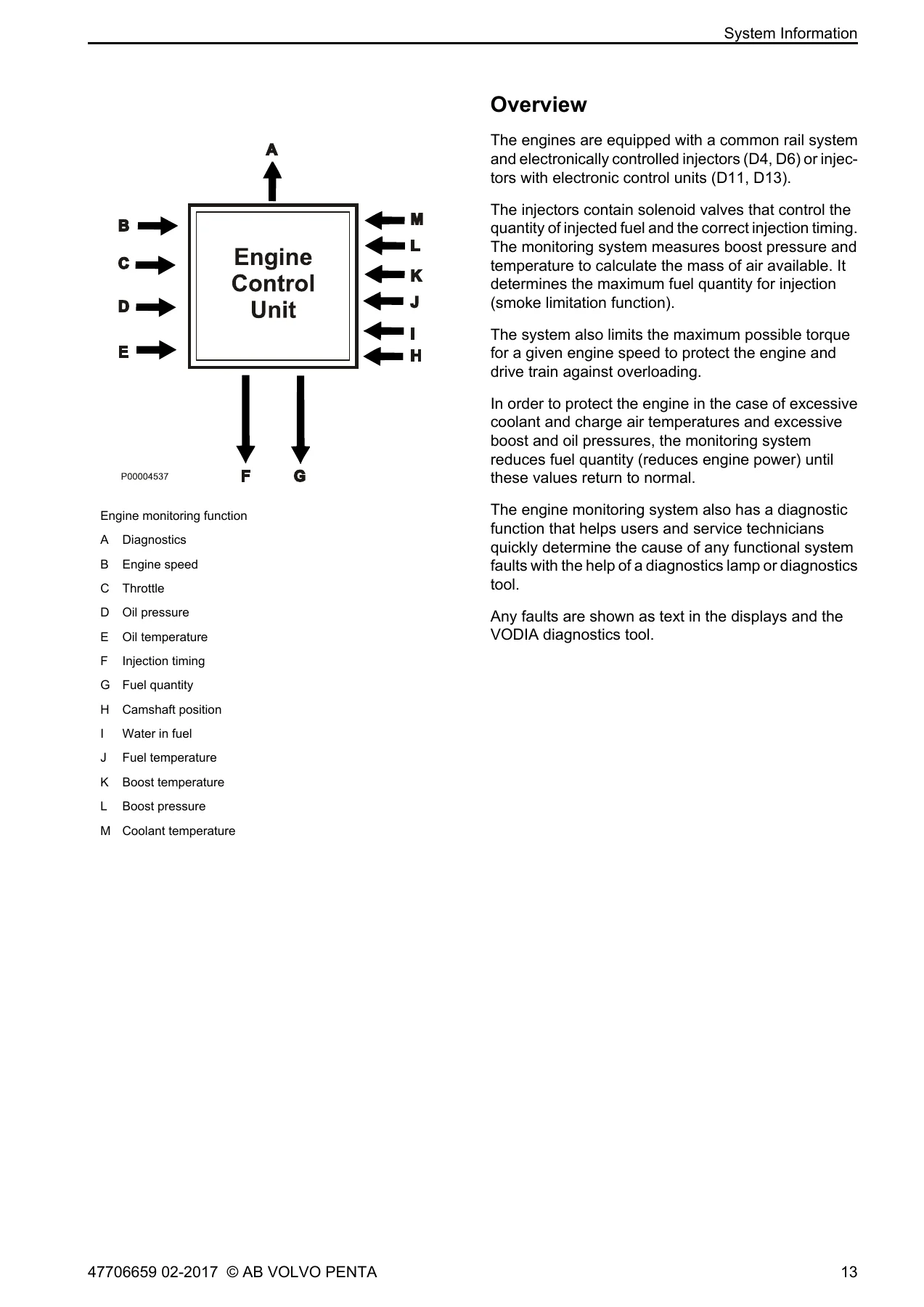
- System Information — distributed system architecture, EVC nodes, CAN bus data link
- Features — engine speed and gear shifting, additional helm stations, joystick, engine synchronizing
- Trip computer, Volvo Penta Lowspeed function
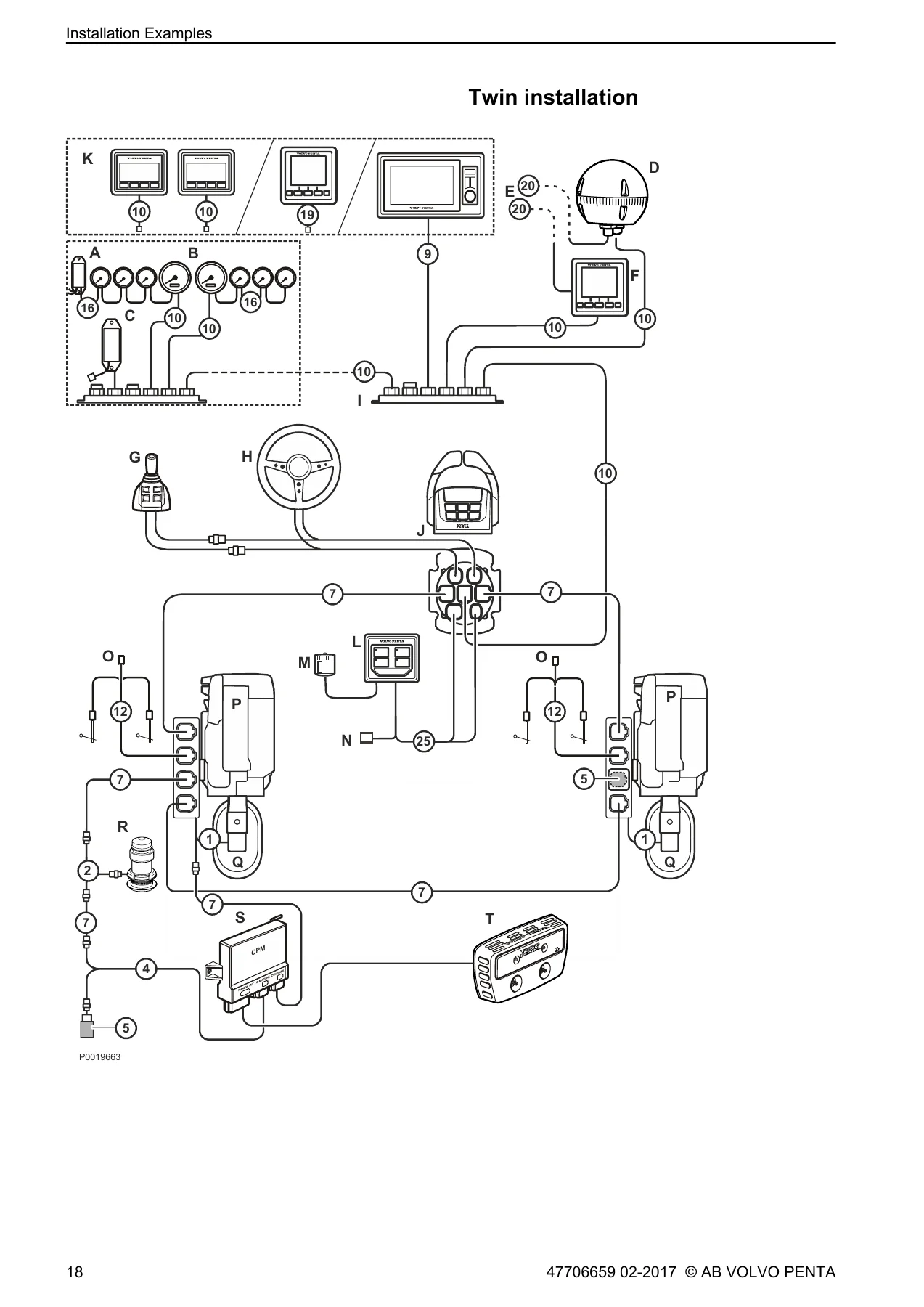
- Installation Examples — twin, triple and quad IPS layouts, secondary helm stations, docking stations, sportfish stations, main and secondary stations with analog control
- Display Options — 2.5″, 4″ and 7″ displays, Volvo Penta Glass Cockpit, minimum requirements per installation type
- Control System Installation — EVC network requirements, cable length limits
- Cables and cable harnesses — transmission cables (IPS350–IPS600, IPS800–950, IPS1050–1200), standard EVC bus cable, bulkhead cable, sender cable, e-Key harnesses, Y-splits, adapters, multilink cable, extension cables, NMEA2000 cables and connectors, interceptor servo cable, aux relay cable, termination plugs, connector dimensions
- Engine Room — PCU installation and mounting, Volvo Penta Interceptor System
- Controls — top mounted levers, joystick, HCU connections (X2:DATALINK, X4:KEY, X5:MULTILINK, X8:STEERING & JOYSTICK)
- Helm station — multilink hub, stand-alone HCU, control unit, e-Key, ignition lock
- Interface — 4–20 mA input data interface, NMEA0183 interface, NMEA2000 interface and supported parameters
- Sensor — fuel and fresh water level sensors, hull-mounted and transom-mounted sensors
- Optional Equipment — relay for external accessories, ADU (Auxiliary dimmer unit), Dynamic Positioning System (DPS)
- Calibration and Settings — general procedure, e-Key, alarm handling, add e-Key, IPS calibration with VODIA, steering mode, auto-configuration (twin, triple, quad, 4″ display, 7″ display, analog lever), language, units, lever calibration (top mounted and analog lever with stand-alone HCU), fuel tank settings and multi-point calibration, water in oil sensor, slip calibration, idle speed calibration, joystick calibration, docking force, calibration of the Interceptor System, depth alarm, autopilot 4″ display and Volvo Penta Glass Cockpit autopilot setup
- Alphabetical index
Beyond the chapter list, this manual delivers something no generic service book does: the exact order in which an EVC system has to be configured so it will actually run. Auto-configuration, lever calibration, tank calibration, slip calibration and joystick calibration are all documented as numbered on-screen sequences, showing which button is pressed, which menu appears and what the display should read at each step. Diagnostic parameters such as neutral signal activation are covered through VODIA, and the interface chapter explains the 4–20 mA aftermarket inputs with a diode indication table so a technician can confirm whether a signal is valid before chasing a fault further.
What This Manual Lets You Do
With this Volvo Penta EVC-E/E2 installation manual on hand you can plan a complete EVC network layout before any cable is run, choose the correct transmission cable for the IPS variant in front of you, and wire the multilink, AUX and data link buses without creating branches or exceeding the length limits that disrupt data transfer. You can mount the PCU correctly with its spacers and cable strain relief so water cannot enter the unit or its harnesses, install a helm station, docking station or sportfish station, and connect the displays, gauges and tachometers that the installation type requires.
More importantly, you can bring the system online. Auto-configuration on a twin, triple or quad installation is covered screen by screen, and so are the calibration routines that follow it — control lever positions, idle rpm ranges for each engine, fuel tank volume and multi-point tank calibration, trolling slip calibration, joystick centring and interceptor system setup. Autopilot calibration through the Sea Trial Wizard on both the 4″ display and Volvo Penta Glass Cockpit is documented as well.
Getting these procedures right matters because an EVC system that has not been configured and calibrated correctly will not behave the way the boat was designed to. Lever positions that are not stored properly, an uncalibrated joystick, or an interceptor system left without its parameter programming all lead to handling that feels wrong, alarms that should not appear, or a system that simply will not accept a start. Working from the printed sequence removes the guesswork.
IMAGES PREVIEW
The file is delivered as an instant PDF download — no shipping, no waiting. It opens on any computer, tablet or phone and every page can be printed if you prefer a paper copy at the boat or in the workshop.
Reviews
There are no reviews yet.