

Wacker Neuson WL 25 Wheel Loader Operator’s Manual 2012 Edition – PDF Download
Original price was: $44.95.$29.95Current price is: $29.95.
Complete January 2012 Wacker Neuson WL 25 wheel loader operator’s manual, document 1000213165. Covers operation, safety, maintenance, technical data, troubleshooting and servicing for the WL 25 compact wheel loader.
Description
Wacker Neuson WL 25 Wheel Loader Operator’s Manual – January 2012 Edition
The Wacker Neuson WL 25 is a compact articulated wheel loader built for loading, excavating, and material handling on construction sites, farms, and industrial yards. This operator’s manual is the document that ships with the machine, published in January 2012 under article number 1000213165. It walks through every phase of ownership — pre-start checks, daily operation, attachment changes, servicing intervals, hydraulic system work, troubleshooting, and final decommissioning. If you run a WL 25, maintain a fleet, or have just acquired a used machine, this PDF gives you the manufacturer’s own procedures and specifications rather than aftermarket guesswork.
File Details
- Manual type: Operator’s Manual
- Brand: Wacker Neuson
- Model: WL 25 Wheel Loader
- Document number: 1000213165
- Edition: January 2012
- Language: English
- Page count: 250 pages
- File format: PDF
Chapters Covered
- Basic Information
- Basic Safety Instructions
- Technical Data
- Description of the Indicator, Warning and Control Elements
- Operating and Operation
- Towing and Transporting
- Lowering Loader Arms
- Relieving Residual Pressure in the Hydraulic System
- Securing the Loader
- Servicing and Inspection
- Troubleshooting and Emergency Maintenance
- Safety Instructions for Repairs
- Final Shutdown of the Loader / Decommissioning
- Appendix
Basic Information and Basic Safety Instructions
The opening chapters explain how to use the manual itself, the meaning of the DANGER, WARNING, CAUTION, NOTICE and ENVIRONMENTAL NOTE signal words, warranty and liability terms, and the intended use of the WL 25. The safety section is extensive and covers organizational measures, personnel qualification, safety instructions for normal operation and other operating modes, and specific hazards such as forklift attachment work, overhead power lines, electrical power, flying sparks and fire, gas/dust/steam/smoke, hydraulics and pneumatics, tip-overs, noise, and handling of oils, grease and chemicals. Safety labels used on the machine are shown with their locations, and safety devices including the fire extinguisher, rotating beacon, seat belt, backup alarm, emergency exit, battery disconnect switch, and loader lift arm locking system are each described with operating instructions.
Technical Data
This chapter provides the technical description of the WL 25, loader data, product identification number plate locations and contents, and a full dimensional diagram with measurements for the 10×16.5 EM tire configuration. It lists the Perkins 4-cylinder diesel engine output, hydrostatic drive specifications, electrical system data, hydraulic flow rates and working pressures for the driving, working and steering circuits, weight specifications including operating weight, permissible total weight, permissible axle load, and permissible payload with shovel and pallet fork. Vibration and noise values are also provided.
Description of the Indicator, Warning and Control Elements
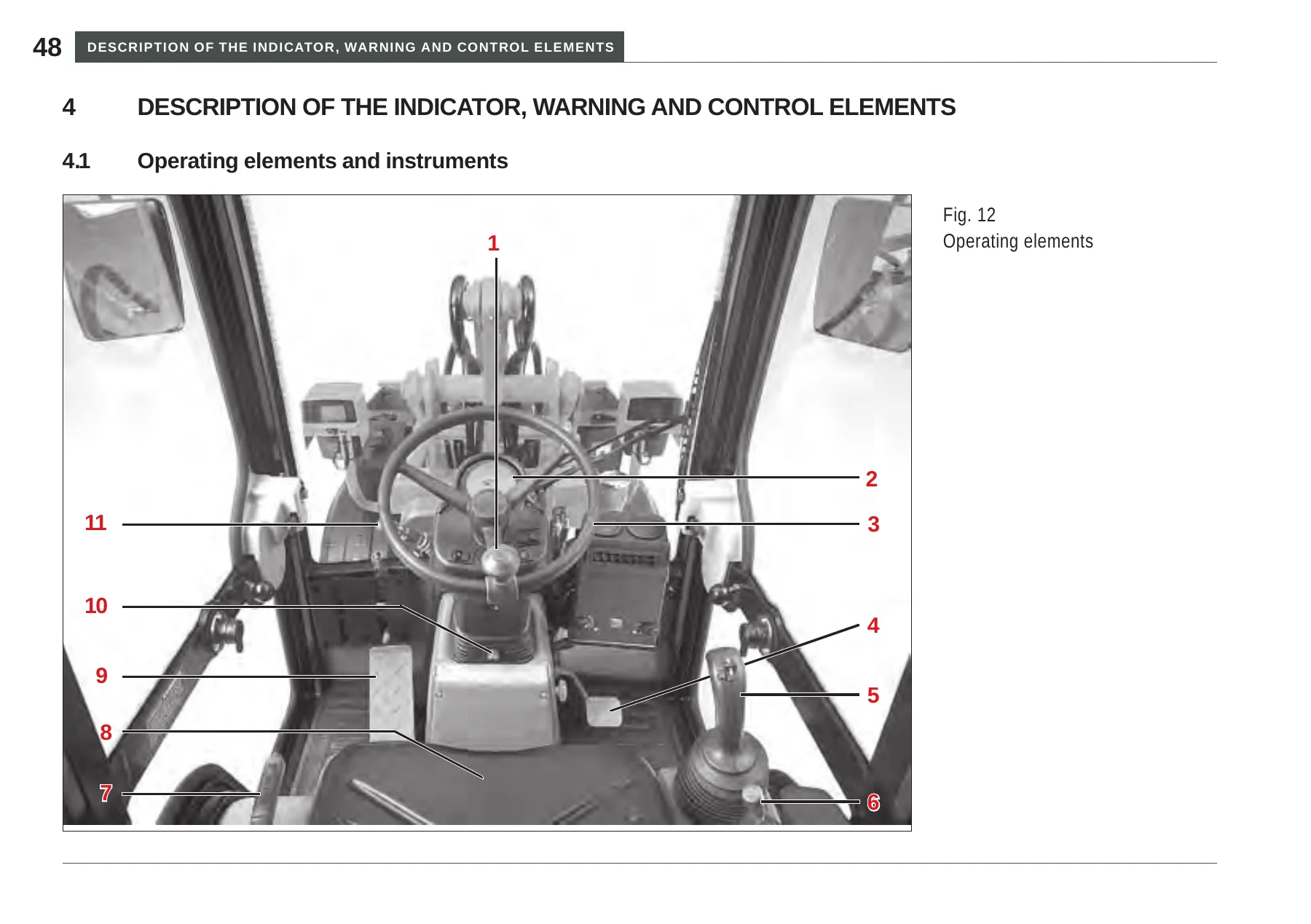
This section identifies every operating element and instrument in the cab with numbered illustrations: the steering wheel, instrument panel, accelerator, operating lever for the loader lift arms and drive, operating lever for optional hydraulics, parking brake lever, operator’s seat, braking-inching pedal, and the steering column adjustment lever. The control and warning indicator lights are shown in a circular instrument layout with a table explaining each symbol — engine oil pressure, generator, engine temperature, forward and reverse drive, crawler gear, parking brake, main beam, air filter, turn signal, return filter, hydraulic oil temperature, and overdrive. Switches and rocker switches for lighting, signal horn, hydraulic locking for attachments, hazard warning lights, windshield wipers, headlights, and the rotating beacon are all identified with their functions.
Operating and Operation
This is the largest chapter and covers the full operating cycle. It begins with fueling procedures and fuel filler neck location, then moves to operation checks before entering the cab, door and window latching, steering column and operator’s seat adjustment, and seat belt use. Starting up covers the lighting system and forward warning device, wipers and windshield washer system, headlights and rotating beacon, ventilation and heating controls, pre-start checks, and engine starting procedure including cold-weather precautions. Propulsion operation explains preparation for travel in public traffic, travel speed selection, changing travel directions, changing speeds between crawler gear and overdrive, braking and stopping with the braking-inching pedal, and stopping and parking. Work operation details the operating lever for the loader lift arms including float position, the operating lever for optional hydraulics, the loader lift arm locking system, differential lock, attachment changing for both manual and hydraulic quick-change systems, bucket work including loading and excavation techniques, tip-over procedures, and precautionary measures for high and low outside temperatures.
Towing, Transporting, and Securing the Loader
These chapters cover towing procedures with speed and distance limits, disconnecting the drive via the bypass valve, transporting the loader on a transport vehicle including loading with a crane, articulation frame lock installation, and tie-down points. Lowering the loader arms in an emergency is covered, along with relieving residual pressure in the hydraulic system and securing the loader for parking, servicing and repair.
Servicing and Inspection
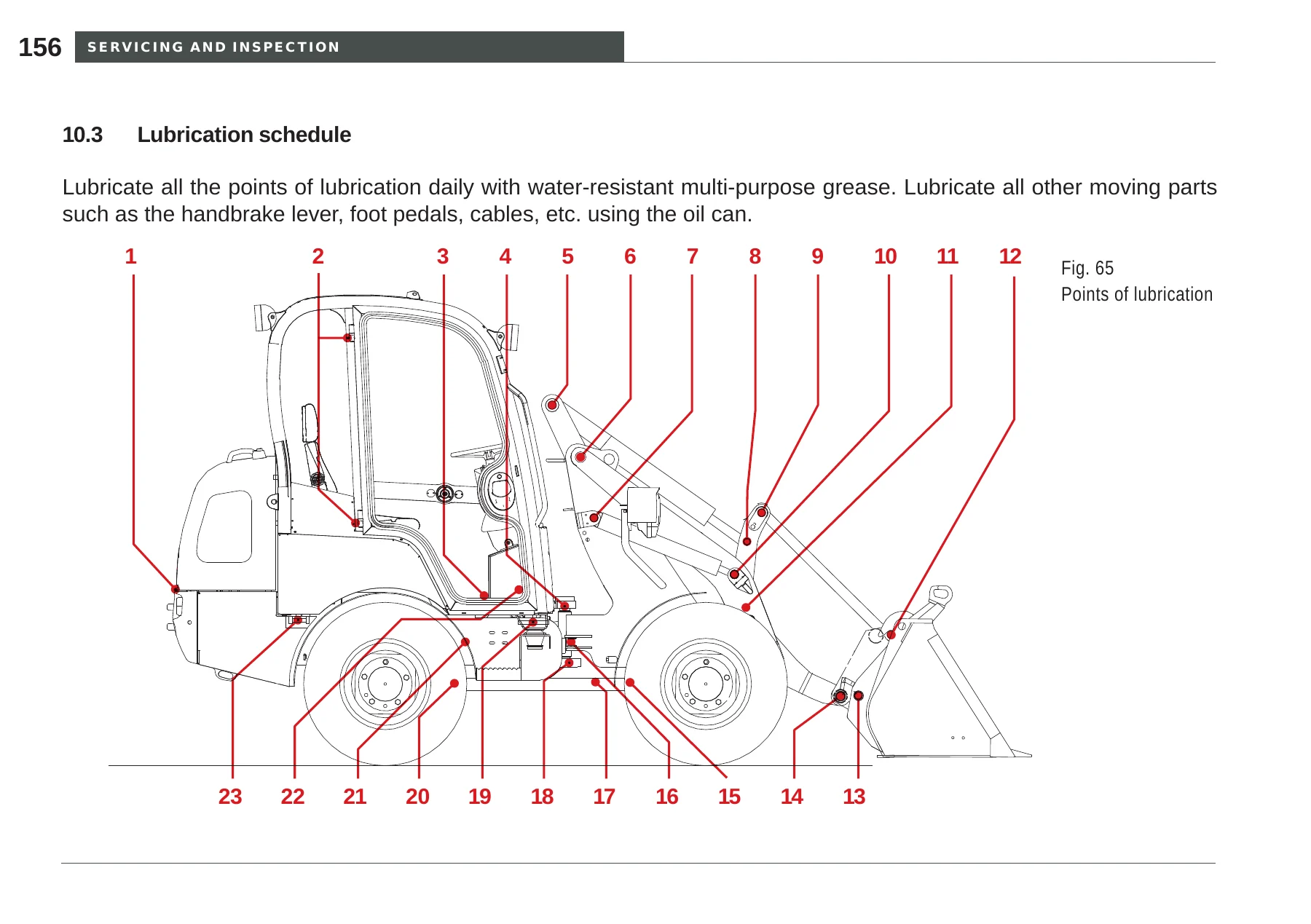
This chapter starts with basic safety instructions for servicing and inspection, then provides daily, weekly, 50-hour, 500-hour and interval-based servicing schedules. The lubrication schedule shows all grease points on the machine. Maintenance and inspection work covers preparation including opening the engine enclosure and tilting the operator’s platform, servicing the engine including oil and filter changes, servicing the fuel system including water separator and filter changes, servicing the air filter system, servicing the cooling system including coolant level and antifreeze checks, servicing the hydraulic system including fluid level, return filter and venting procedures, servicing the axles, servicing the cab vent filter, servicing the brakes, servicing the tires and wheels including inflation pressures and wheel bolt torques, servicing the electrical system including fuse allocation and battery maintenance, jump-starting procedures, and loader storage procedures.
Troubleshooting and Emergency Maintenance
This chapter provides fault tables for the engine, loader travel, engine overheating, hydraulic system overheating, machine performance, and the transmission pump and oil motor. Each entry lists the possible cause and the remedy, covering issues such as the engine not starting, the loader not driving, the engine getting too hot, the hydraulic system getting too hot, and low machine performance.
Safety Instructions for Repairs, Final Shutdown, and Appendix
The repairs section gives general safety regulations for repair work, specific safety instructions for the engine, welding work, the hydraulic system, and brakes. The final shutdown chapter covers decommissioning and disposal procedures. The appendix includes ordering replacement parts information, a loader data recording page, and inspection verification forms for recording completed services.
What This Manual Enables You to Do
With this Wacker Neuson WL 25 operator’s manual on hand, you can run the machine correctly from the first day and keep it running safely for years. The operating chapters give you the correct procedures for starting, traveling, working with the bucket and attachments, and parking. The maintenance schedules tell you exactly what to check daily, weekly, and at 50, 500, and 250-hour intervals. The troubleshooting tables help you diagnose common faults without waiting for a dealer. The specifications section gives you the hydraulic pressures, flow rates, capacities, tire pressures, and torque values needed to service the machine properly. And the safety instructions cover the hazards that matter on a compact wheel loader — tip-overs, overhead power lines, hydraulic injection, hot surfaces, and moving engine parts.
Every procedure in this manual is written for the WL 25 as configured with its Perkins diesel engine, hydrostatic drive, and articulated steering. The maintenance intervals are based on operating hours and calendar time, so you can plan service work around your schedule. The attachment changing sections cover both manual and hydraulic quick-change systems, which matters if your machine is equipped with optional hydraulics. And the lubrication schedule shows every grease point so nothing gets missed during routine servicing.
IMAGES PREVIEW
This is an instant PDF download — no shipping, no waiting. The file works on any device: laptop, tablet, or phone. You can print the pages you need for the workshop, keep the full manual on your computer for reference, and search the text to find the section you want quickly. Whether you are a first-time operator, a fleet maintenance manager, or someone bringing an older WL 25 back into service, this operator’s manual gives you the manufacturer’s own information in a convenient digital format.
Reviews
There are no reviews yet.