
Boeing 777 Aircraft Reference Guide – Systems Introduction Training Manual PDF
Original price was: $34.95.$21.95Current price is: $21.95.
Boeing 777 Aircraft Reference Guide covering all major aircraft systems, component locations, operation, and ground procedures. SG-215, September 2002. 748-page training manual for 777-200 systems.
Description
Boeing 777 Aircraft Reference Guide – Systems Introduction
The Boeing 777 Aircraft Reference Guide – Part I Systems Introduction is a comprehensive training and reference document (SG-215, September 2002) that introduces the major aircraft systems of the Boeing 777-200. This guide is designed to give airline maintenance personnel the knowledge necessary to safely and confidently operate and maintain the Boeing 777-200 systems. It covers component location, installation, system operation, and servicing locations across the entire aircraft.
This Boeing 777 Aircraft Reference Guide is organized by ATA chapter and provides a systems-level overview that serves as an excellent training companion for maintenance technicians, engineers, and flight crew who need to understand how the 777-200 systems function and interact. From electrical power and hydraulic systems to flight controls and the airplane information management system (AIMS), this guide delivers the foundational knowledge required for effective 777 maintenance and troubleshooting.
File Details
- Manual Type: Aircraft Reference Guide / Training Manual
- Brand: Boeing
- Model: 777-200, 777-200 IGW, 777-222
- Document Number: SG-215
- Date: September 2002
- Language: English
- Page Count: 748
- File Format: PDF
Chapters Covered
This Boeing 777 Aircraft Reference Guide covers the following ATA chapters and systems:
- CH 21 – Air Conditioning
- CH 22 – Autoflight
- CH 23 – Communications
- CH 23 – Communications (Cabin)
- CH 24 – Electrical Power
- CH 25 – Equipment and Furnishings
- CH 25 – Equipment and Furnishings (Flight Deck)
- CH 26 – Fire Protection
- CH 27 – Flight Controls
- CH 28 – Fuel
- CH 29 – Hydraulic Power
- CH 30 – Ice and Rain Protection
- CH 31 – Indicating and Recording System (AIMS)
- CH 32 – Landing Gear
- CH 33 – Lights
- CH 34 – Navigation
- CH 35 – Oxygen
- CH 36 – Pneumatic
- CH 38 – Water and Waste
- CH 45 – Central Maintenance
- CH 49 – Airborne Auxiliary Power
- CH 51 – Structures
- CH 52 – Doors
- CH 53 – Fuselage
- CH 54 – Nacelles/Pylons
- CH 55 – Stabilizers
- CH 56 – Windows
- CH 57 – Wings
- CH 71 – Power Plant
- CH 72 – Engine
- CH 73 – Engine Fuel and Control
- CH 74 – Ignition
- CH 75 – Engine Air
- CH 76 – Engine Controls
- CH 77 – Engine Indicating
- CH 78 – Exhaust
- CH 79 – Engine Oil
- CH 80 – Starting
Beyond the chapter list, this Boeing 777 Aircraft Reference Guide provides detailed system descriptions that include component location, component installation, system operation, and servicing locations. The guide opens with an introduction to the 777 airplane model, its dimensions, ground operations, range capabilities, payload capabilities, and maintenance documents. It then proceeds through structures, covering fuselage zones, station numbers, water lines, buttock lines, composite materials usage, and corrosion prevention. Equipment centers are thoroughly documented, including the main equipment center, forward equipment center, cargo door equipment racks, and overhead racks in the passenger compartment.
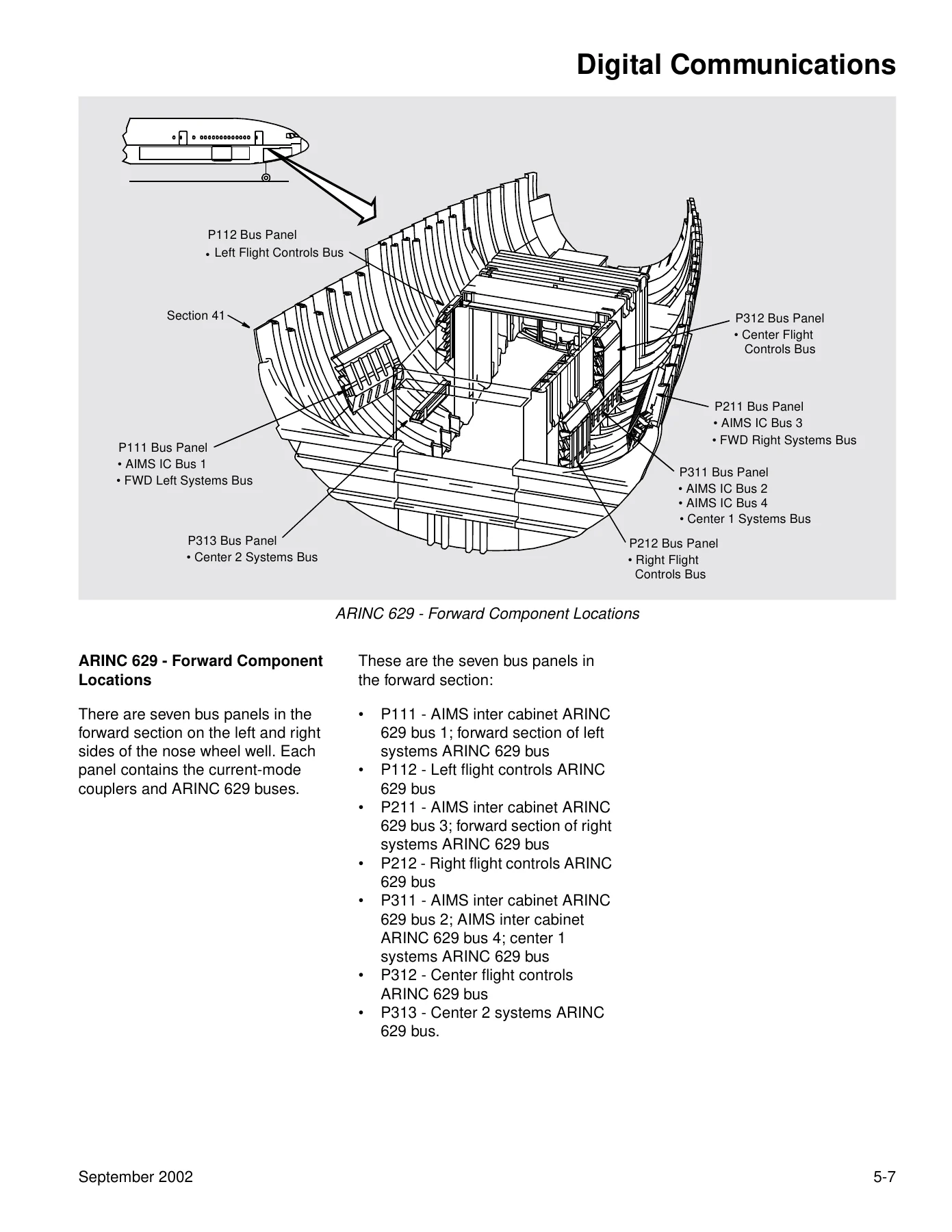
The flight deck section describes the flat-panel liquid crystal display units, control display units, maintenance access terminal, cursor control devices, flight deck panels, main instrument panels, glare shield panels, center forward panel, control stand, aft aisle stand panel, flight deck printer, overhead maintenance panel, annunciator lights, lighted push-button switches, crew seats, and emergency escape ropes. The digital communications chapter covers ARINC 429 and ARINC 629 data buses, onboard local area network (OLAN), overhead panel ARINC 629 system (OPAS), systems card files, and ARINC 629 current-mode couplers.
The airplane information management system (AIMS) chapter is extensive, covering AIMS cabinets, data conversion gateway function, primary display system, flight management computing system, thrust management computing system, central maintenance computing system, airplane condition monitoring system, flight data recording system, data communication management system, and maintenance access terminal. The electrical power chapter covers ELMS, generators, batteries, controls and indication, IDG/backup generator oil servicing, and external power operation. The fuel system chapter documents fuel tank arrangement, vent system, scavenge jet pumps, sump drain valves, refuel station, pressure refuel, engine fuel feed system, jettison system, defuel system, refuel system control, FQIS, FQPU, fuel tank sensors, and fuel quantity measuring sticks.
The auxiliary power unit chapter covers APU engine, control and indication, fuel system, lubrication system, air systems, ignition system, starting system, and APU operation. The power plant chapter covers engine hazards, engine specifications, engine cowling, thrust reverser latches, PDOS, engine fuel control system, EEC control system, EDIU, engine controls, engine fuel system, engine air system, engine ignition system, engine start system, engine oil system, and engine exhaust system. The fire protection chapter documents engine/APU fire detectors, duct leak detectors, engine fire and overheat detection, APU fire detection, wheel well fire detection, cargo compartment smoke detection, cargo fire extinguishing, and fire/overheat test system.
The environmental systems chapter covers the pneumatic system, engine air supply, air conditioning, gasper air, LLAR air, supplemental heating, humidity control, cargo compartment heating, equipment cooling, and cabin pressure control. The ice and rain protection chapter documents ice detection, wing anti-ice, engine anti-ice, air data probe heat, window heat, windshield rain removal, and water and waste heat. The hydraulic system chapter covers the left, right, and center hydraulic systems, hydraulic interface module cards, center hydraulic isolation system, engine driven pump, AC motor pump, air driven hydraulic pump, ram air turbine, RAT checkout module, hydraulic indication, hydraulic accumulators, reservoir servicing, and hydraulic operation.
The landing gear chapter covers nose landing gear, main landing gear, gear door operation, gear door safety lights, landing gear extension/retraction, wheels and brakes, brake system, antiskid/autobrake system, parking brake, brake temperature monitor system, airplane ground steering, air/ground system, proximity sensor system, landing gear position indicating and warning system, gear indications, and accumulator service. The flight controls chapter covers the primary flight control system, actuator control electronics, primary flight computers, roll control, spoilers and speedbrakes, yaw control, pitch control (elevator and stabilizer), PFCS indications, high lift control system, flap/slat electronics unit, trailing edge flaps, leading edge slats, and flap/slat indications.
The autopilot flight director system chapter covers the autopilot flight director computer, mode control panel, backdrive actuator, and AFDS indications. The navigation chapter covers the air data inertial reference system, ADIRU, SAARU, pitot-static system, air data module, standby instruments, ILS, VOR, DME, marker beacon, ADF, radio altimeter, ATC Mode S transponder system, TCAS, GPS, GPWS, weather radar, navigation antennas, warning electronic system, clock system, and standby magnetic compass. The communications chapter covers crew call, service interphone, flight interphone, VHF, HF, SATCOM, SELCAL, antenna locations, and voice recorder system.
The cabin systems chapter is extensive, covering passenger compartment equipment and furnishings, stowage bins, passenger compartment ceiling panels, service outlets, passenger and flight attendant seats, lavatories, buffets and galleys, galley air chillers, crew rest areas, detachable emergency equipment, cabin management system, cabin interphone, passenger address, passenger service, passenger entertainment, passenger telephone, video, flight crew oxygen, passenger oxygen, potable water system, gray water system, lavatory waste system, water and waste system cabin indications, and windows. The doors chapter covers passenger entry doors, cargo doors, bulk cargo door, and door indications. The lights chapter covers flight deck lights, exterior lights, passenger cabin lighting, reading lights, LLAR lights, service and cargo lights, cargo compartment lights, and emergency lights. The cargo systems chapter covers lower lobe cargo compartments and the cargo handling system.
A glossary is included at the end of the document, defining the abbreviations and acronyms used throughout the Boeing 777 Aircraft Reference Guide.
What This Boeing 777 Aircraft Reference Guide Delivers
This is not a simple overview document. It is a detailed systems introduction that walks through each major aircraft system with enough technical depth to support real maintenance planning, troubleshooting, and system familiarization. The Boeing 777 Aircraft Reference Guide provides component locations and access information that help technicians find what they need on the aircraft, system operation descriptions that explain how each system functions and interacts with others, and servicing locations that support routine maintenance tasks.
For maintenance personnel transitioning to the Boeing 777, this guide is an essential training resource. The 777 introduced several new technologies compared to earlier Boeing models, including fly-by-wire flight controls, ARINC 629 data buses, the airplane information management system, ultrasonic fuel quantity measuring, six-wheel landing gear trucks with steering, and an air data inertial reference system. This reference guide explains these systems in clear terms with supporting diagrams and component locations.
The Boeing 777 Aircraft Reference Guide covers the Boeing 777-200 as operated by United Airlines, with references to the 777-200 IGW (increased gross weight) variant and the 777-222 designation. Engine coverage includes the Pratt & Whitney PW4000 series, with specifications for the PW4077, PW4090, and PW4903 (PW4090-3) models. The guide includes engine specifications, hazard areas, cowling descriptions, thrust reverser details, and full engine system coverage including fuel, air, ignition, starting, oil, and exhaust systems.
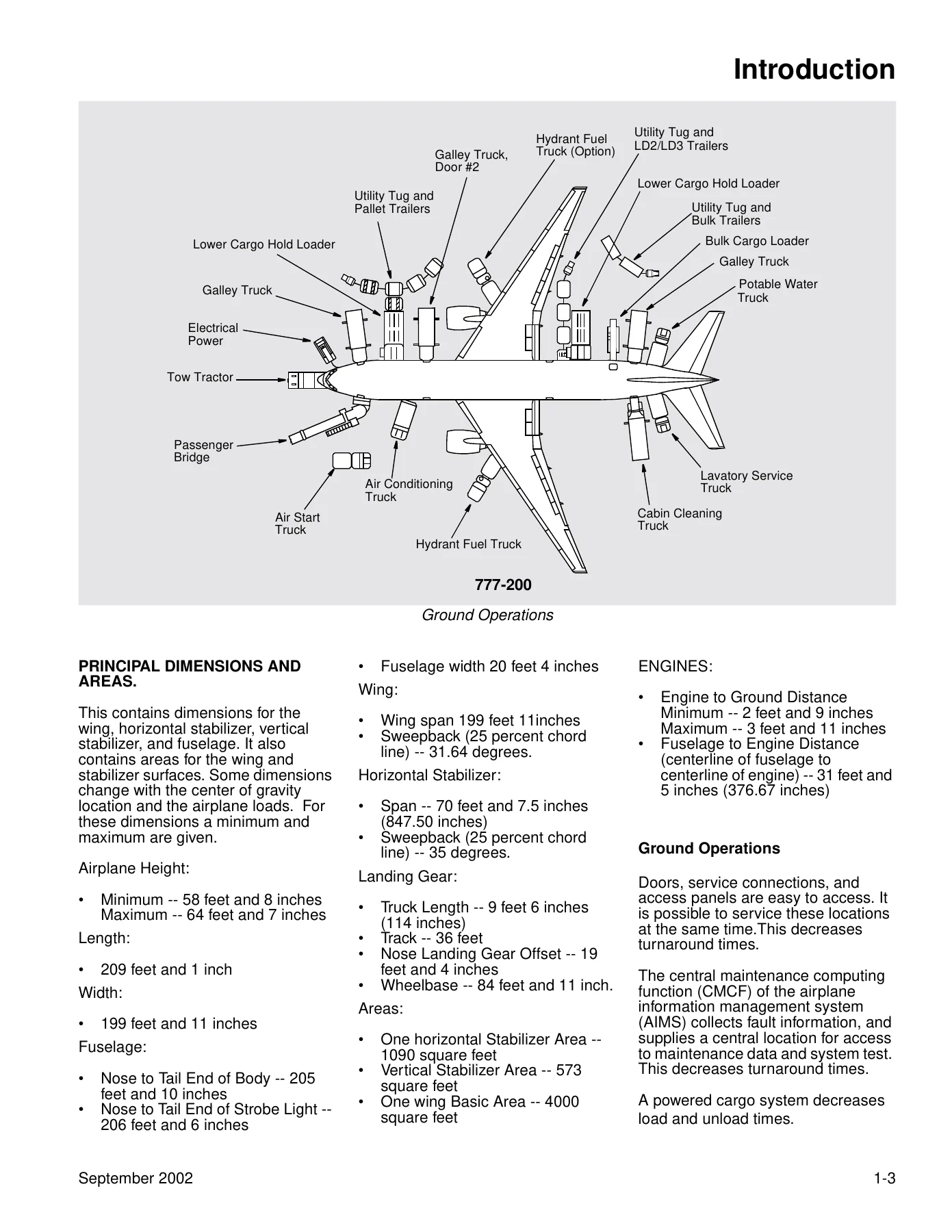
Ground operations are thoroughly documented, including airplane jacking with primary and auxiliary jack points, axle jacking, airplane leveling using inclinometers and plumb bob fittings, and airplane towing with tow fitting locations, hazard zones, and safety precautions. These procedures are critical for safe ground handling and are presented with the same level of detail as the systems chapters.
Structures coverage includes the major zone diagram dividing the airplane into eight major zones, subzones, and zones, with access panel identification codes. Station numbers, water lines, and buttock lines are explained to help technicians locate components and understand aircraft reference systems. Composite material usage, corrosion prevention, and static dischargers are also documented.
Why This Manual Matters
Correct procedures and accurate specifications are critical in aircraft maintenance. The Boeing 777 Aircraft Reference Guide provides the foundational knowledge that maintenance personnel need to work on the 777 safely and effectively. With detailed descriptions of component locations, system operation, and servicing procedures, this guide helps reduce troubleshooting time and supports correct maintenance practices.
The guide is specifically designed to support ATA 104 Level II standards and provides the knowledge necessary to safely and confidently operate and maintain the Boeing 777-200. It covers the electrical, digital communications, fuel, AIMS, APU, structures, power plant, equipment centers, flight deck, environmental control systems, doors, hydraulic power, lights, landing gear, cargo systems, flight controls, ice and rain protection, fire protection, communications, autopilot flight director system, navigation, maintenance access terminal, and cabin systems.
Whether you are a maintenance technician, engineer, or flight crew member, this Boeing 777 Aircraft Reference Guide gives you a comprehensive understanding of how the 777-200 systems work and how they are laid out on the aircraft. The combination of system descriptions, component locations, and operational details makes it a valuable reference for anyone working with the Boeing 777.
IMAGES PREVIEW
Instant PDF Delivery
This Boeing 777 Aircraft Reference Guide is delivered as an instant PDF download. No shipping, no waiting for a physical book. After payment, you can download the manual immediately and access it on any device — computer, tablet, or smartphone. The PDF is printable, so you can print the pages you need for the hangar or shop floor. Whether you are studying for training, preparing for maintenance tasks, or need a quick reference on the aircraft, this digital manual is available right when you need it.

Reviews
There are no reviews yet.