
DAF LF CF XF105 Bodybuilder Guidelines 2008-13 PDF – Chassis, Superstructure & Electrical Upfit Manual
Original price was: $61.95.$40.95Current price is: $40.95.
The complete DAF Bodybuilder Guidelines for LF45, LF55, CF65, CF75, CF85 and XF105 chassis – 2008-13 update. Covers chassis modification, BAM body attachment methods, superstructure mounting, PTO selection, electrical connection points and part numbers.
Description
DAF LF, CF and XF105 Bodybuilder Guidelines – 2008-13 Update
The DAF LF, CF and XF105 Bodybuilder Guidelines is the reference document DAF issues to bodybuilders, converters and workshops that mount superstructures, cranes, tippers, tanks, refuse bodies and other equipment on DAF truck chassis. This 2008-13 update covers the LF45, LF55, CF65, CF75, CF85 and XF105 vehicle ranges, and gives the chassis data, mounting methods, welding rules, weight-distribution limits and electrical interfaces needed to produce a homogeneous, safe and durable chassis-and-body assembly. Whether you are planning a fixed box body, a demountable swap-body, a vehicle loading crane, a tipper, a tanker, a concrete mixer, a refuse collector or a fifth-wheel tractor, these guidelines set out what DAF permits, what must be verified, and which attachment method applies to the chassis in front of you.
The document is written for the professional bodybuilding industry. It assumes you already know how to build a body – its job is to tell you where you may attach to the DAF chassis, how the attachment must be made, and what limits apply so that the finished vehicle keeps its type approval, its handling and its structural integrity.
File Details
- Manual type: Bodybuilder Guidelines (chassis upfit and superstructure mounting)
- Brand / model: DAF LF45, LF55, CF65, CF75, CF85 and XF105
- Language: English
- Page count: 348
- File format: PDF
- Update: 2008-13
Chapters Covered
- 1. General
- 2. Chassis information
- 3. General information on superstructures
- 4. Superstructures
- 5. Cab information
- 6. Energy consumers
- 7. Electrical system
- 8. Part numbers
Chapter 1 – General
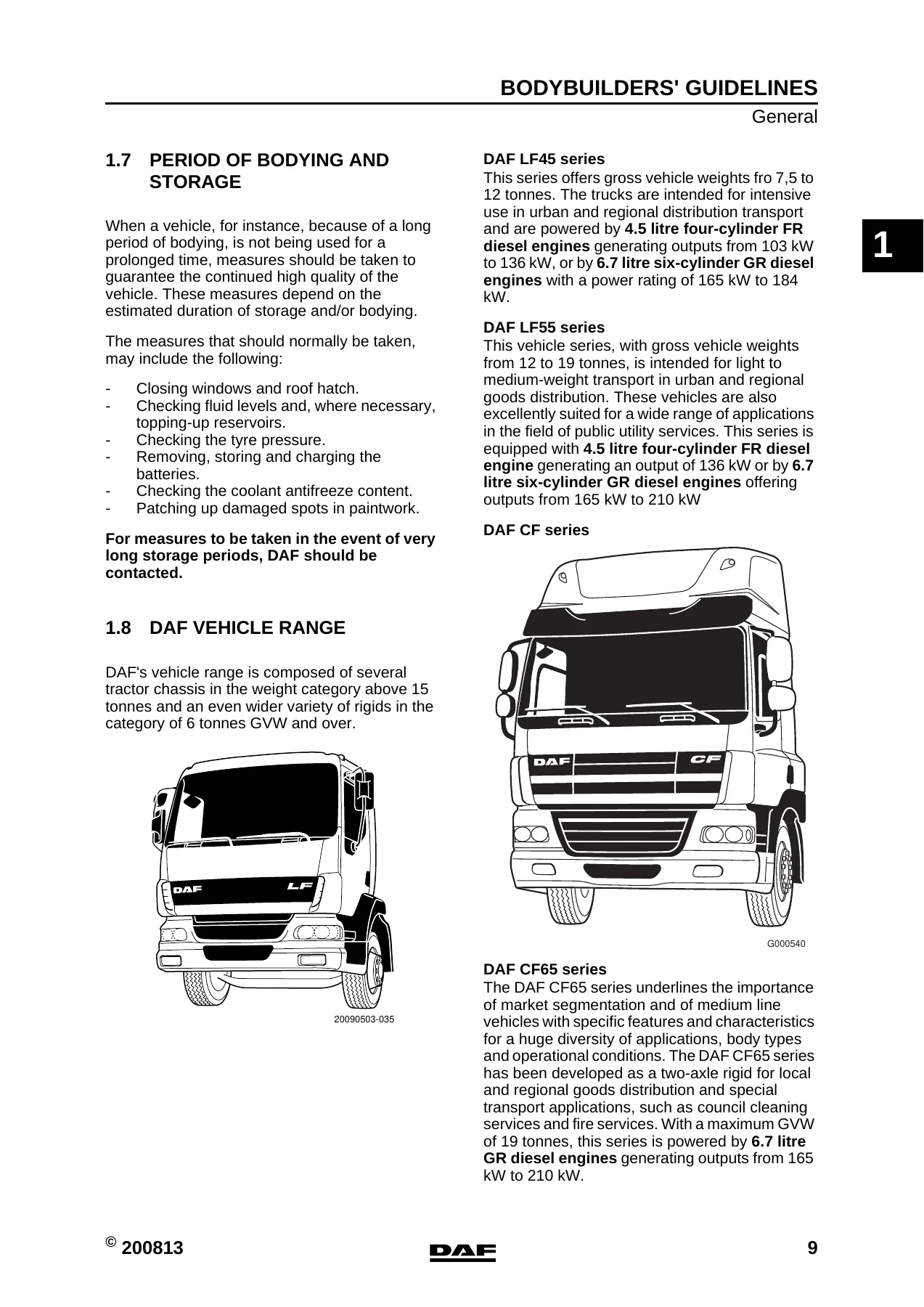
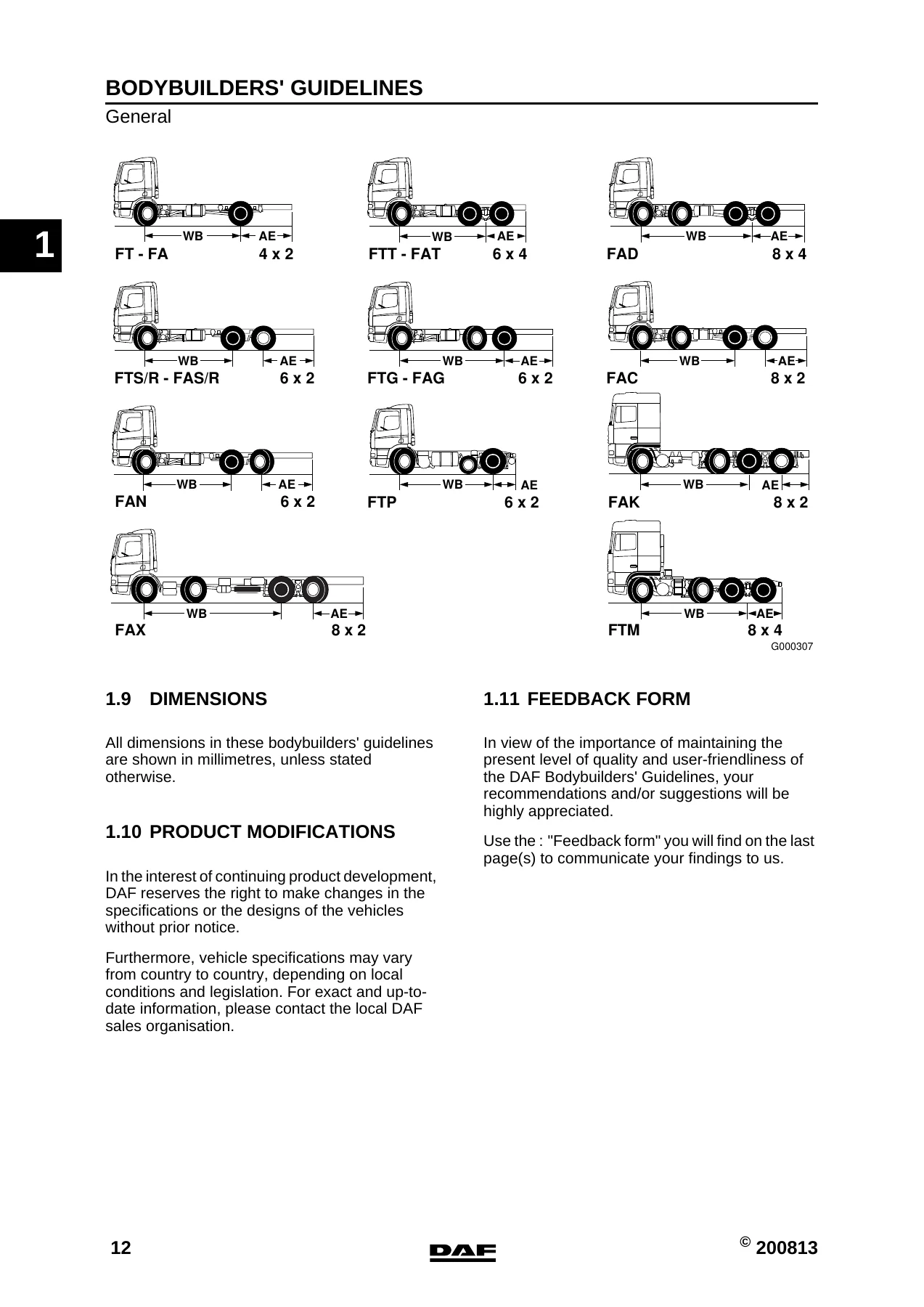
The opening chapter explains the purpose of the guidelines, the addresses to contact, the verification procedure for superstructures, and the statutory responsibilities that fall on the bodybuilder. It covers vehicle specification and layout drawings, the TOPEC calculation program, weight distribution rules (including the minimum 20% front-axle load for solo or conventional-trailer operation and the 30% figure for mid-axle trailer combinations), lateral stability considerations, and the measures to take when a chassis is stored or bodied over a long period. The chapter closes with an overview of the DAF vehicle range and a note on dimensions and product modifications.
Chapter 2 – Chassis Information
This is the core chassis-modification chapter. It sets out how to level an air-suspended chassis before bodying, where holes may and may not be drilled in the side members (including minimum edge distances and the ban on drilling flanges or tapered ends), and the strict welding rules for chassis, cab and superstructure. It then covers modifying the rear overhang, wheelbase modifications, attaching components to the chassis, replacing rivets with bolts, inlet and exhaust system work, the fuel system (including fitting an extra DAF tank), chassis dimensions, the drawbar cross member, rear light brackets, wheel mounting torques, wheel clearance, mudguard location, EC-approved rear underrun protection and automatic lubrication.
Chapter 3 – General Information on Superstructures
Chapter 3 is the structural heart of the manual. It explains when a sub-frame is required, how a sub-frame should be constructed and tapered, how torsional stiffening is provided, and then introduces the five DAF Body Attachment Methods (BAM 1, 2, 3a, 3b, 4 and 5) with their three underlying techniques: non-rigid tie-rod attachment, rigid attachment with plates, and console attachment. It explains the first attachment point, the type-of-superstructure/BAM matrix, and then gives vehicle-specific BAM instructions with attachment counts for FA LF45, FA LF55, FA LF55 18t, FA CF65, FA CF and XF, FAR/FAS, FAG, FAN, FAT, FAC/FAX, FAD and FAK chassis.
Chapter 4 – Superstructures
Chapter 4 applies the structural rules to specific body types. Separate sections cover fixed bodies and (high-) volume bodies, bodies with tail lifts (with minimum sub-frame dimension tables up to 2000 kg capacity), vehicle loading cranes (with crane-capacity graphs for behind-cab and rear-mounted positions), tipper bodies (front-end ram, central ram, three-way and tipping demountable), tankers (with sub-frame, fixed console, semi-flexible console, all-flexible console and three-point attachment options), concrete mixers and concrete pumps, public utility vehicles (refuse collectors, rotating-drum refuse bodies, road sweepers and gully emptiers) and fifth wheel mounting.
Chapter 5 – Cab Information
This chapter covers cab modification restrictions, the maximum permissible additional cab weights for LF, CF and XF day, sleeper, Space Cab and Super Space Cab versions, and the accessory mounting positions on each cab roof (roof spoiler, sun visor, aerials, beacons, spotlights). It also includes the procedure for setting the roof spoiler height using the two-slat method and the setting ranges for each cab variant.
Chapter 6 – Energy Consumers
Chapter 6 covers every way of taking power off the vehicle for the body. It starts with an overview of the ZF, Allison and Eaton gearboxes used across the range, then describes the available PTO types (front-end direct and indirect, DAF engine PTO, flywheel PTO, gearbox PTO and transfer case PTO). It gives PTO specification and selection guidance, torque and output calculations, drive-shaft alignment rules, clutch-independent and clutch-dependent PTO details, first and second PTO data tables for each gearbox, PTO operation and protection, the compressed air system (including air-consumer connection points and APU valve ports), tipper air-feed preparation and the load-area heating system.
Chapter 7 – Electrical System
The largest chapter covers the electrical interface between chassis and body. It includes safety instructions, circuit diagram and wiring colour/number conventions, earth connections, wire cross-section selection, assisted starting and battery charging, peak-voltage protection, EMC compatibility, and the CAN SAE J1939 / ISO 11898, CANopen and ISO 11992 data communication systems. It then gives the maximum additional electrical load, additional battery and alternator guidance, connection points and permitted loads, dashboard switch and indication-light information, engine speed control (ESC), the LF, CF and XF accessory, cab and chassis connection tables, PTO control and protection, FMS preparation, trailer connection points, automated and automatic gearbox notes, anti-theft, retarders, the CAN Extension Box, the Body Builders’ Module, CVSG gauges, tail-lift preparation, axle load monitoring and refuse preparation for LF and CF series.
Chapter 8 – Part Numbers
The final chapter lists the DAF part numbers a bodybuilder is most likely to need: mountings (tie rods, attachment plates, mounting brackets, consoles and cab suspension springs), flange bolts and nuts by property class and length, electric connector parts for both chassis and cab, electric cable kits for contour lights, the LF mudguard extension piece, indication lamps, dashboard switches, CVSG gauges, air system adapters and miscellaneous parts such as chassis section material, fuel-system quick-release couplings, DC/DC converters, PTO flanges and fifth-wheel base plates.
Verification, Responsibility and Vehicle Safety
One point the manual repeats throughout is that a superstructure fitted fully in line with these guidelines does not need separate verification – but any deviation, and any case the guidelines do not cover, must be submitted to DAF in duplicate with a functional description, drawings and engineering calculations. Changes to the vehicle design without prior written permission from DAF are not permitted, and the superstructure manufacturer remains fully responsible for the product supplied, including clear instructions for use. The final inspection of the bodied vehicle before delivery to the customer is carried out by the DAF dealer.
The DAF LF, CF and XF105 Bodybuilder Guidelines is therefore more than a technical reference – it is the working rulebook that keeps the finished truck legal, safe and within its approved load and stiffness envelope.
What This PDF Lets You Do
With this PDF on the bench you can plan a body installation from the ground up: calculate weight distribution and axle loads; decide whether a sub-frame is needed and how heavy it must be; choose the correct BAM attachment method for the chassis and body type; lay out tie rods, attachment plates and consoles; drill and weld only where DAF permits; extend or shorten the rear overhang within the allowed limits; specify a drawbar cross member, tail lift sub-frame, crane sub-frame or tanker console arrangement; select the right PTO and drive shaft angles; connect into the compressed air and cooling systems correctly; wire into the correct bulkhead, cab and chassis connection points; set up engine speed control, PTO interlocks, FMS and BB-CAN; and order the correct DAF flange bolts, connectors and mounting hardware. For any workshop, bodybuilder or fleet engineer working on LF, CF or XF105 chassis, it removes the guesswork that leads to cracked side members, failed inspections or premature component wear.
IMAGES PREVIEW
Instant PDF Delivery
The manual is delivered as a downloadable PDF immediately after payment – no shipping, no waiting for a disc or a printed copy. It opens on any laptop, tablet or smartphone, can be searched and zoomed on screen, and can be printed page by page for use in the workshop. Keep it on the office PC for planning and take the relevant pages into the bay when the chassis is on the stands. This is the complete 348-page 2008-13 DAF Bodybuilder Guidelines, covering the LF45, LF55, CF65, CF75, CF85 and XF105 chassis in a single file.

Reviews
There are no reviews yet.