
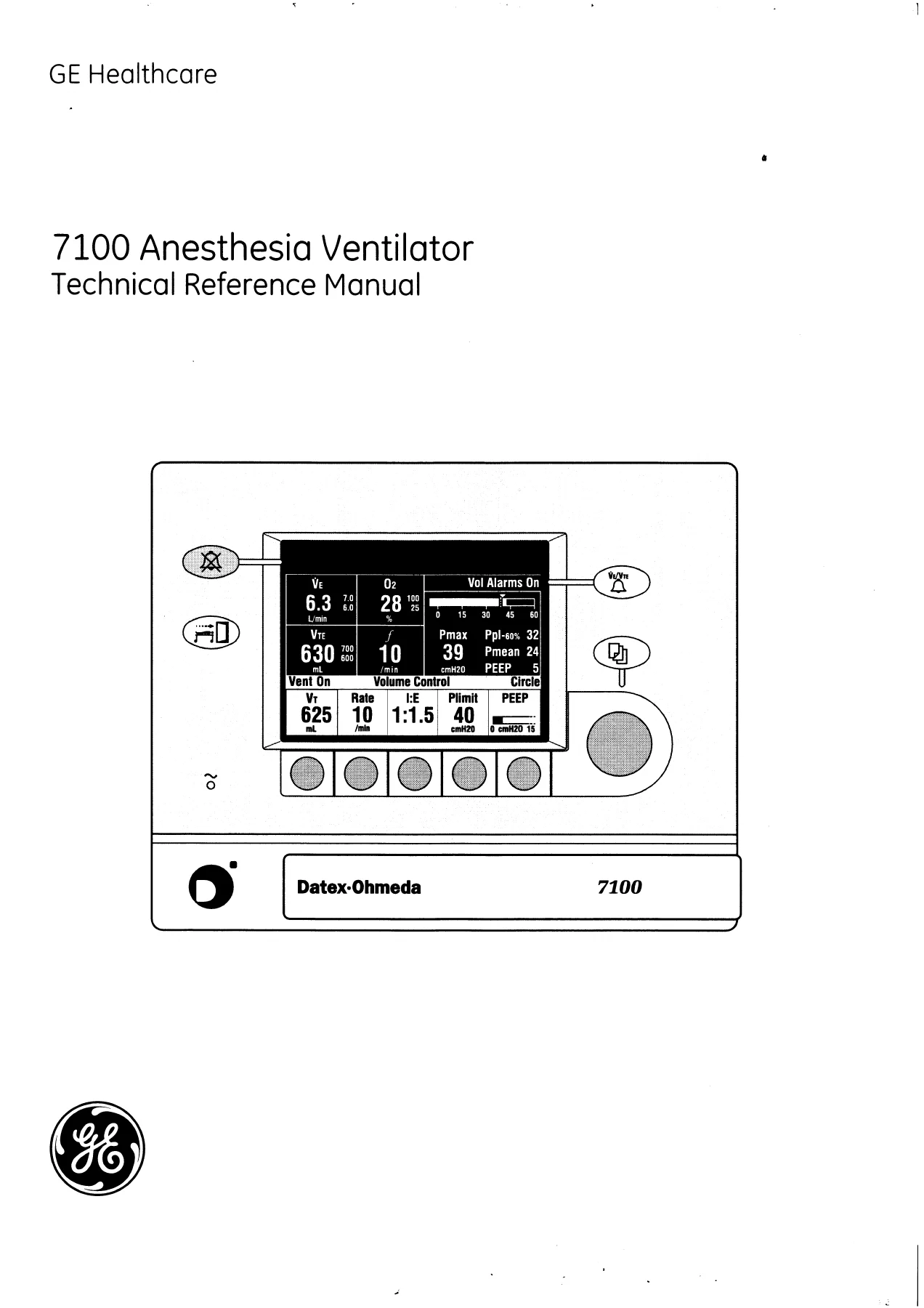
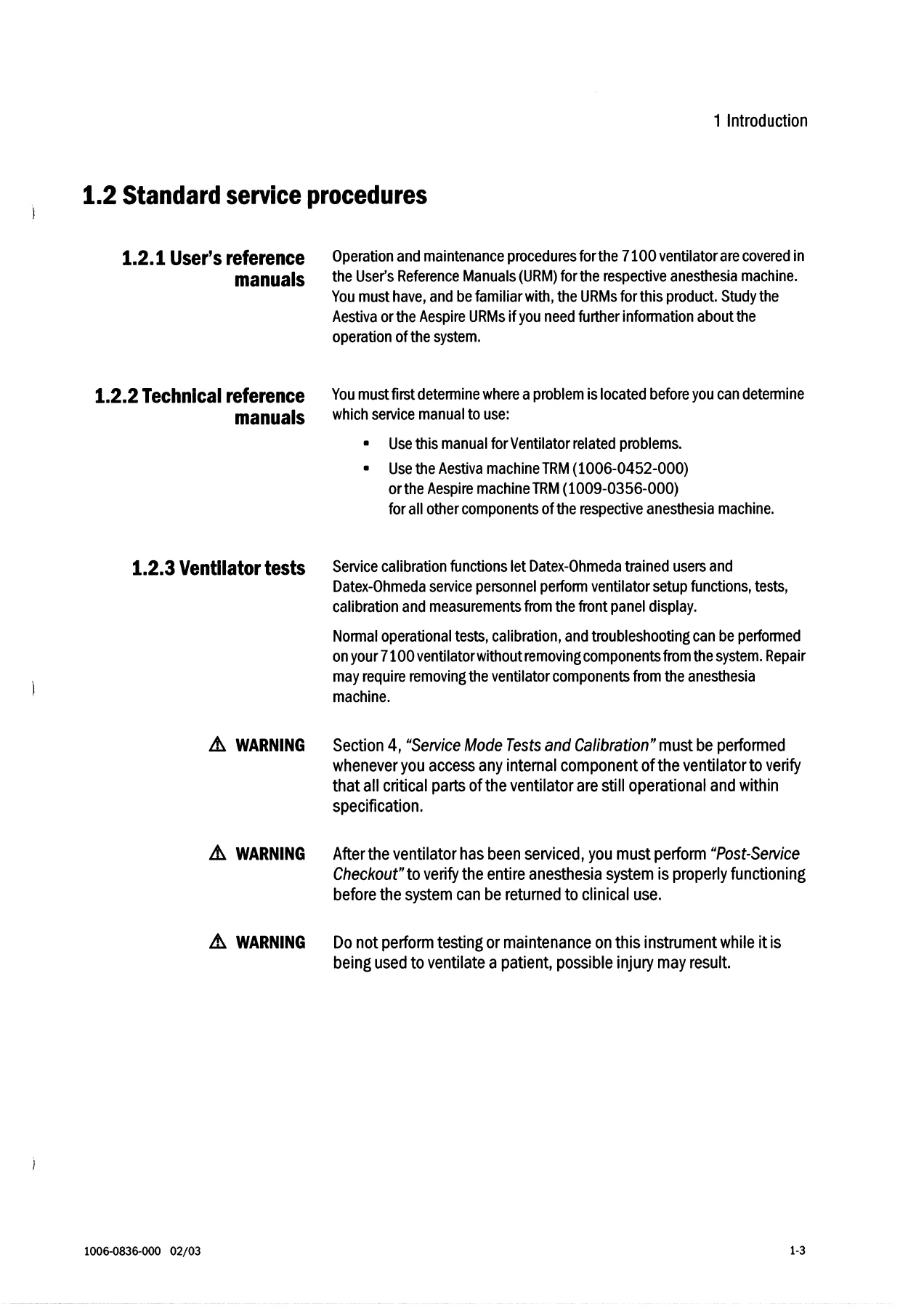
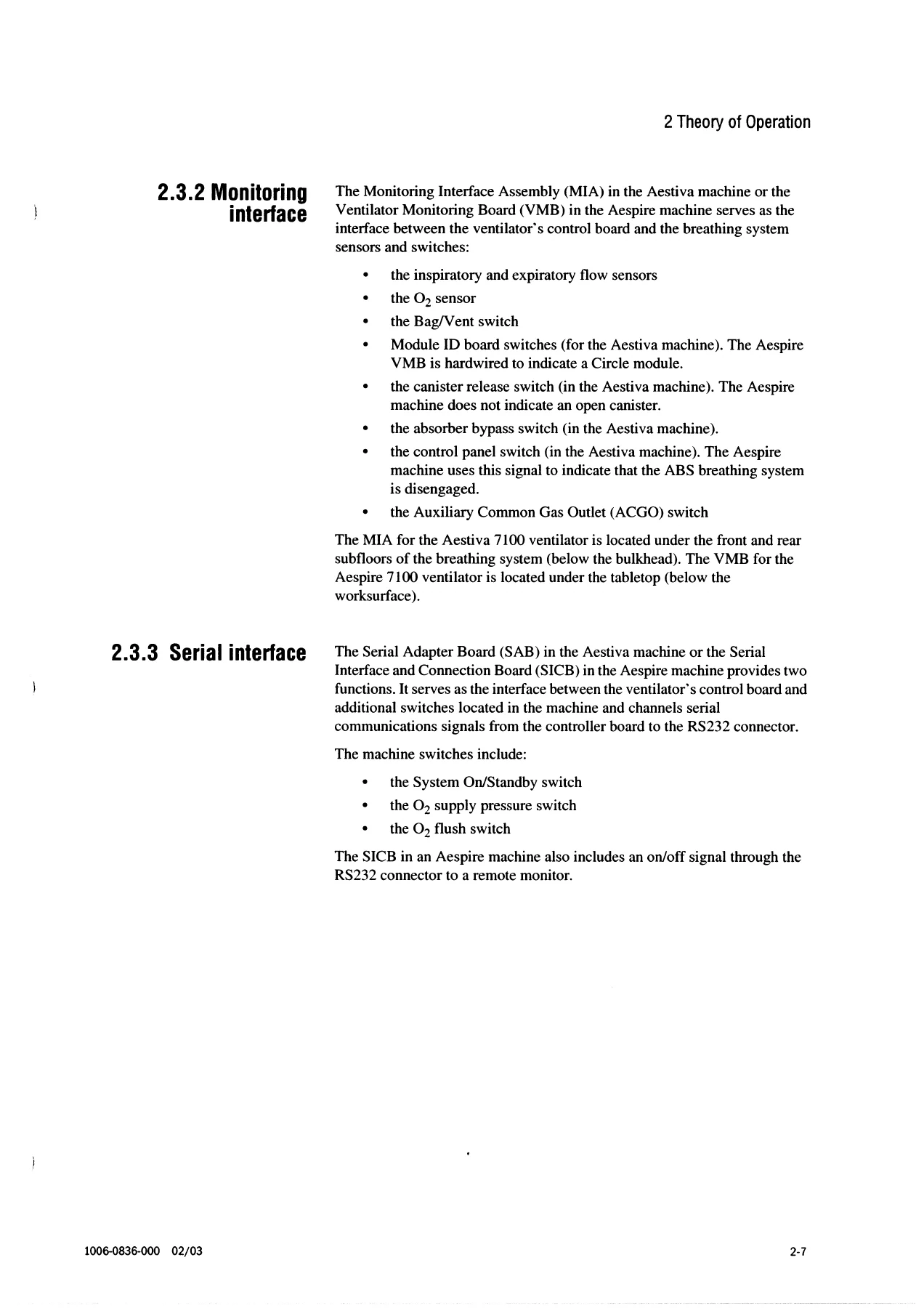
Datex-Ohmeda 7100 Anesthesia Ventilator Technical Reference Manual
Original price was: $39.95.$24.95Current price is: $24.95.
Comprehensive factory technical reference manual for the Datex-Ohmeda 7100 Anesthesia Ventilator used in Aestiva/5 and S/5 Aespire systems. Includes complete pneumatic schematics, electronic theory, service mode calibration procedures, and diagnostic flowcharts.
Description
Datex-Ohmeda 7100 Anesthesia Ventilator Technical Reference Manual Overview
The Datex-Ohmeda 7100 Anesthesia Ventilator Technical Reference Manual is the definitive factory engineering and service resource for clinical engineers, biomedical equipment technicians (BMETs), and hospital service personnel tasked with testing, calibrating, maintaining, and repairing the 7100 ventilator platform. As an electronically-controlled, pneumatically-driven, microprocessor-based ventilation system, the 7100 ventilator functions as an essential, integrated core component within both the Datex-Ohmeda Aestiva/5 7100 anesthesia machine and the Datex-Ohmeda S/5 Aespire anesthesia machine. This technical publication provides authoritative technical descriptions, pneumatic schematics, circuit functional blocks, internal diagnostic sequences, automated calibration routines, and component replacement procedures covering software revision 1.X systems.
File Details
- Manual Type: Technical Reference Manual (Field Service & Maintenance)
- Brand: Datex-Ohmeda / GE Healthcare
- Model: 7100 Anesthesia Ventilator
- Host Systems: Aestiva/5 7100 Anesthesia Machine and S/5 Aespire Anesthesia Machine
- Document Part Number: 1006-0836-000 (referenced alongside 1009-0836-000)
- Publication Revision Date: 02/03 (February 2003)
- Software Compatibility: Revision 1.X
- Language: English
- Page Count: 167 pages
- Format: High-resolution digital PDF download
Chapters Covered
- 1 Introduction
- 1.1 What this manual includes
- 1.1.1 Software versions
- 1.2 Standard service procedures
- 1.2.1 User’s reference manuals
- 1.2.2 Technical reference manuals
- 1.2.3 Ventilator tests
- 1.3 Symbols used in the manual or on the equipment
- 2 Theory of Operation
- 2.1 General Description
- 2.2 7100 ventilator features
- 2.2.1 Safety features
- 2.3 7100 ventilator components
- 2.3.1 Control Module
- 2.3.2 Monitoring interface
- 2.3.3 Serial interface
- 2.3.4 The Pneumatic Vent Engine
- 2.4 Electronic and electrical components
- 2.4.1 The Aestiva 7100 ventilator functional blocks
- 2.4.2 The Aespire 7100 ventilator functional blocks
- 2.4.3 Power Supply
- 2.4.4 Sealed Lead Acid Battery
- 2.4.5 Control Board
- 2.4.6 Monitoring interface
- 2.4.7 Serial interface
- 2.4.8 Pneumatic Vent Engine Board
- 2.5 Mechanical Subsystems
- 2.5.1 Supply Gas
- 2.5.2 Pressure Regulator
- 2.5.3 Inspiratory Valve
- 2.5.4 Exhalation (PEEP) Control
- 2.5.5 Bleed Resistor
- 2.5.6 Bellows Pressure Relief Valve
- 2.5.7 Mechanical Overpressure Valve
- 2.5.8 Free Breathing Valve
- 2.5.9 Breathing Circuit Flow Sensors
- 3 Post-Service Checkout
- 3.1 Post-service checkout
- 3.1.1 Test the 7100 ventilator
- 3.1.2 Test the anesthesia machine
- 4 Tests and Calibration
- 4.1 Self tests
- 4.2 Service Mode
- 4.3 About Ventilator
- 4.4 Alarm Log
- 4.5 Error Log
- 4.6 Language
- 4.7 User Settings
- 4.7.1 Screen Contrast
- 4.8 System Configuration
- 4.9 Calibrations
- 4.9.1 O2 Calibrations
- 4.9.2 Zero Flow and Airway Sensors
- 4.9.3 Adjust Drive Gas Regulator
- 4.9.4 Airway Sensor Span
- 4.9.5 PEEP Valve Calibration
- 4.9.6 Inspiratory Valve Calibration
- 4.9.7 Pressure Sensitivity
- 4.9.8 Service Calibrations Required
- 4.10 Diagnostic Tests/Tools
- 4.10.1 Display A/D Channels
- 4.10.2 Display Discrete I/O Signals
- 4.10.3 Display Battery Status
- 4.10.4 Test Panel Switches
- 4.10.5 Valves – Test Tool
- 4.10.6 Test CPU and Memory
- 4.10.7 Test EEPROM
- 4.10.8 Test Serial Port
- 4.10.9 Test 5V Fail Alarm
- 4.10.10 Test Inspiratory Valve
- 4.10.11 Test PEEP Valve
- 4.10.12 Test PEEP Safety Valve
- 4.10.13 Breathing System Leak Test
- 4.10.14 Test Pressure Limit Circuit
- 4.11 Upgrade Options
- 5 Troubleshooting
- 5.1 Troubleshooting instructions
- 5.2 Troubleshooting guide
- 5.3 Alarm and Error messages
- 5.4 Troubleshooting Flowcharts
- 5.4.1 Ventilator assessment process
- 5.4.2 No display troubleshooting
- 5.4.3 Inaccurate volume ventilation troubleshooting
- 5.4.5.B VMB board evaluation (Aespire machine)
- 5.4.6 No ventilation troubleshooting
- 5.4.7 High intrinsic PEEP troubleshooting
- 6 Maintenance
- 6.1 Maintenance Schedule
- 6.2 Free breathing valve maintenance
- 6.3 MOPV pressure relief valve test
- 6.3.1 Test setup
- 6.3.2 Test procedure
- 7 Repair Procedures
- 7.1 Software Installation
- 7.1.1 After replacing the Control Board or the Control Module
- 7.2 Control Module
- 7.2.1 Inside the control module
- 7.2.2 Control board
- 7.2.3 Battery and power supply
- 7.2.4 Front enclosure with control board removed
- 7.2.5 Front enclosure components
- 7.3 Pneumatic engine
- 7.3.1 Pneumatic Engine in an Aestiva machine
- 7.3.2 Pneumatic Vent Engine in an Aespire machine
- 7.3.3 Pneumatic engine components (Aespire machine)
- 7.3.4 Pneumatic engine components (Aestiva machine)
- 7.3.5 Supply gas inlet filter (Aestiva machine)
- 7.3.6 Insp/PEEP interface assembly and reservoir
- 7.3.7 Manifold and plate assembly
- 7.3.8 Pneumatic Engine Board and housing (Aestiva machine)
- 7.4 Monitoring Interface Assembly (MIA) in an Aestiva machine
- 7.5 Serial Adapter Board (SAB) and Power Cord/Harness
- 8 Illustrated Parts
- 8.1 Special instructions
- 8.2 Service tools
- 8.3 7100 Ventilator parts
- 9 Schematics and Diagrams
The chapters detailed above supply specialized service engineers with an uncompromised reference framework. Rather than merely skimming operational features, the documentation details how microprocessor-controlled feedback loops interact with proportional valves, differential pressure flow sensors, and safety manifolds, allowing engineering personnel to methodically trace physical signals, test component operational boundaries, and complete mandated overhaul cycles with full technical certainty.
System Architecture and Operational Theory
The internal architecture of the Datex-Ohmeda 7100 Anesthesia Ventilator integrates precision pneumatics with high-integrity digital supervisory circuits. The electronic subsystem is anchored by the 7100 Control Board, featuring a Motorola ColdFire MCF5206e microcontroller, 2 MB Flash ROM, 1 MB static RAM (SRAM), system watchdog circuits, and digital-to-analog converters managing valve drivers. The universal switching power supply operates across 85–264 VAC (47–63 Hz), converting line power into 6.0 VDC (at up to 5 A) and 9.0 VDC (at up to 0.5 A). The 6V rail powers digital circuitry, cooling fans, and LCD backlighting, while float-charging an internal sealed lead-acid battery rated to deliver 30 minutes of full emergency backup operation. Analog signal processing occurs across dedicated boards: the Monitoring Interface Assembly (MIA in Aestiva) or Ventilator Monitoring Board (VMB in Aespire) conditions signals from inspiratory and expiratory flow sensors and O2 cells, while the Pneumatic Engine Board (PEB/VEB) buffers the airway pressure transducer and drives the proportional flow, PEEP, and PEEP safety valves.
The mechanical and pneumatic engine subsystem regulates incoming hospital drive gas (medical oxygen or clean dry medical air supplied at 241 to 690 kPa / 35 to 100 psi). Gas passes through an internal 2-micron sintered metal filter into a non-relieving pressure regulator that steps inlet line pressure down to a consistent 172 kPa (25 psi). The microprocessor drives a proportional inspiratory flow valve to modulate gas delivery from 0 to 70 L/min at pressures between 0 and 100 cm H2O. Patient exhalation and PEEP pressures are governed by an exhalation valve containing an elastomeric diaphragm controlled via pilot pressure through a proportional PEEP valve, a PEEP safety valve, a 200 mL reservoir, and a calibrated bleed resistor exhausting clean drive gas. Patient safety is reinforced mechanically through a free-breathing check valve allowing spontaneous inhalation during ventilator pauses, an exhalation valve manifold routing scavenged gas to the AGSS, and a mechanical overpressure relief valve (MOPV) acting as a third-level physical safeguard releasing excessive pressure at approximately 110 cm H2O.
Service Mode Calibrations and Diagnostics
Proper field maintenance of the Datex-Ohmeda 7100 ventilator service manual environment requires entering the front-panel Service Mode to perform mandatory adjustments after hardware replacement, periodic inspections, or system warnings. Technicians access Service Mode during startup or by actuating Bag mode while depressing the VT/Pinsp, PEEP, and Menu keys simultaneously. The manual guides technicians through critical calibration procedures including:
IMAGES PREVIEW
- O2 Calibrations: Atmospheric (21% room air) and high-concentration (100% O2) calibrations taking into account programmed altitude compensation (-400 to 3600 meters).
- Zero Flow and Airway Sensors: Reads and resets differential pressure transducer zero offsets in EEPROM across inspiratory, expiratory, and airway pressure sensing channels.
- Adjust Drive Gas Regulator: Verifies and mechanically trims the internal pneumatic regulator output to 172 ± 17.2 kPa (25 ± 0.25 psi) using external test gauges connected to the manifold test port.
- Airway Sensor Span & Valve Calibration: Utilizes specialized calibrated flow orifices (Part No. 1504-3005-000 for Aestiva; Part No. 1504-3016-000 for Aespire) to calculate amplifier gain coefficients, step-test inspiratory valve delivery curves, and establish dynamic PEEP compensation tables.
- Pressure Sensitivity & Limit Testing: Computes common-mode sensitivity factors at 10, 20, 40, and 60 cm H2O, and verifies that the dual redundant hardware pressure limit circuit accurately trips at 109 cm H2O.
Diagnostic Tools and Troubleshooting Capabilities
Section 5 and Section 4.10 provide deep, structured fault isolation tools. The internal software features interactive diagnostic menus to display real-time counts and converted voltage values across all A/D channels (including power rails, battery current/voltage, and valve feedback loops), inspect discrete input/output switch states, test panel membrane switches and rotary encoders, and exercise individual valves independently using the Valves Test Tool. Technicians encountering system alarms—such as Minimum Shutdown errors, flow sensor discrepancies, battery charger faults, or communication failures—can cross-reference detailed alarm lookup tables and follow multi-step flowcharts isolating issues down to cable harnesses, transducer manifolds, the MIA/VMB assembly, or the main ColdFire control board.
Technical Capability and Service Delivery
Investing in the Datex-Ohmeda 7100 Anesthesia Ventilator Technical Reference Manual gives hospital biomeds, clinical engineering teams, and independent medical service organizations the capability to perform factory-level routine maintenance, complete scheduled annual overhauls, execute precise sensor and regulator calibrations, and conduct thorough post-service checkouts. Adhering to manufacturer-specified tolerances, nominal resistance values (such as verifying 1.5 ± 0.15 ohms across the inspiratory valve coil and 10 ± 1 ohms across the PEEP valves), and systematic checkout protocols is vital to ensuring absolute operating room safety, regulatory compliance, and consistent delivery of life-supporting ventilation. This publication is supplied as an instant, downloadable PDF, free of watermarks or shipping delays. It is readily viewable on desktop computers, workshop workstations, and field service tablets, and is fully printable for direct benchtop reference.


Reviews
There are no reviews yet.