★ TRUSTED BY 321,897+ PROFESSIONALS WORLDWIDE
🏢
Trusted Business
Verified & Licensed
🛡️
Virus Free Files
100% Safe Downloads
🔒
Secure Payment
SSL Protected
Instant Delivery
Available Immediately
Sale!

Gambro AK 98 Dialysis Machine Operator’s Manual 2016 – Program 2.xx PDF Download

Original price was: $39.95.Current price is: $24.95.

Complete operator’s manual for the Gambro AK 98 dialysis machine, program version 2.xx, published October 2016. Covers double and single needle haemodialysis, isolated ultrafiltration, profiling, blood pressure monitoring, DIASCAN, disinfection, maintenance, full technical specifications and a comprehensive alarm handbook.

Instant PDF Download
Available immediately
💾
Save to Your Device
Download & keep forever
🛡️
Antivirus Scanned
100% virus-free
🌍
Trusted Worldwide
175,000+ customers

Description

Gambro AK 98 Dialysis Machine Operator’s Manual – Program Version 2.xx

This is the complete operator’s manual for the Gambro AK 98 dialysis machine, published in October 2016 under order number MHCEN12745-10/16 and covering program version 2.xx. It is the essential day-to-day reference for anyone operating, setting up, or maintaining the AK 98 in a clinical or home healthcare environment. Every procedure is written for the operator — from switching the machine on and running the functional check through to ending a treatment, disinfecting the fluid path, and interpreting every alarm and attention the machine can produce.

The AK 98 is a single-patient haemodialysis machine designed for the treatment of renal failure and fluid overload. This manual documents both double needle and single needle treatment modes, isolated ultrafiltration, sodium and bicarbonate profiling, ultrafiltration rate profiling, non-invasive blood pressure monitoring, and the DIASCAN clearance measurement system. It also covers the full disinfection and cleaning cycle, including heat disinfection, chemical disinfection, integrated heat disinfection with a WRO 300 H unit, and storage procedures.

File Details

  • Manual type: Operator’s Manual
  • Brand / Manufacturer: Gambro (Gambro Lundia AB, a Baxter company)
  • Model: AK 98 Dialysis Machine
  • Program version: 2.xx
  • Publication date: October 2016
  • Order number: MHCEN12745-10/16
  • Language: English
  • File format: PDF
  • Page count: Approx. 386 pages

Complete PDF Bookmark Tree

Complete Bookmarks

The complete bookmarks in the “Gambro AK 98 Dialysis Machine Operator's Manual 2016 – Program 2.xx PDF Download” are as follows:

Operators handbookp. 3
1 Before you get startedp. 11
1.1 Important while reading the operator’s manualp. 12
1.1.1 About this operator´s manualp. 12
1.1.2 Safety definitionsp. 12
1.1.3 Values and settingsp. 12
1.1.4 Buttonsp. 12
1.1.5 About the screenp. 13
1.1.6 Symbolsp. 14
1.2 General warning and precautions before usep. 17
1.2.1 General precautions before usep. 17
1.2.2 Responsibility and disclaimerp. 19
1.2.3 Leakage current and potential equalisation connectionp. 20
1.2.4 Treatment locationp. 20
1.2.5 Central venous catheterp. 20
1.2.6 Connection of external electrical equipmentp. 20
1.2.7 How to move the AK 98 dialysis machinep. 20
1.2.8 Safety philosophyp. 21
1.3 Intended usep. 21
1.3.1 Intended usep. 21
1.3.2 Trainingp. 22
1.3.3 Disinfection and functional checkp. 22
1.3.4 Inlet water requirementsp. 23
1.3.5 Hygienic quality of central delivery systemsp. 23
1.3.6 Preparing dialysis fluidp. 23
1.4 Accessoriesp. 23
1.4.1 Concentrates, chemical disinfectants, accessories and disposablesp. 23
1.4.2 Concentratesp. 24
1.4.3 Chemical disinfectantsp. 24
1.4.4 Blood linesp. 25
1.4.5 Accessoriesp. 25
1.4.6 Ultrafilterp. 26
1.4.7 Dialyzersp. 26
1.4.8 Blood pressure measurement accessoriesp. 26
1.5 Glossaryp. 27
1.5.1 Glossaryp. 27
2 Machine Descriptionp. 29
2.1 Blood partp. 30
2.1.1 Blood part componentsp. 30
2.1.2 Blood part component detailsp. 31
2.2 Fluid partp. 38
2.2.1 Fluid part componentsp. 38
2.2.2 Fluid part component detailsp. 39
2.3 Rear componentp. 46
2.3.1 Rear componentsp. 46
2.3.2 Rear component detailsp. 47
3 Handling the dialysis machinep. 53
3.1 Operator's positionp. 55
3.1.1 Operator's positionp. 55
3.2 Switch the dialysis machine on and offp. 55
3.2.1 Main switchp. 55
3.2.2 On/off buttonp. 55
3.3 Indication light and buttonsp. 56
3.3.1 Indication lightp. 56
3.3.2 Buttons on the operator´s panelp. 56
3.4 The screenp. 57
3.4.1 Screen overviewp. 57
3.4.2 Venous and arterial pressure controls (1, 2)p. 58
3.4.3 Machine state indicator (3)p. 59
3.4.4 Time (4)p. 59
3.4.5 Blood path (5)p. 59
3.4.6 Fluid path (6)p. 60
3.4.7 Bypass pathp. 60
3.4.8 Blood pressure area (7, 8)p. 60
3.4.9 Diascan read out field and Diascan button (9, 10)p. 60
3.4.10 Treatment overview (11–15)p. 60
3.4.11 Alarm tab (16)p. 61
3.4.12 Information tab (17)p. 61
3.4.13 Treatment graph tab (18)p. 61
3.4.14 Information field (19)p. 61
3.4.15 Patient page (20)p. 62
3.4.16 Priming button (21)p. 62
3.4.17 Rinse back button (22)p. 62
3.4.18 Disinfection button (23)p. 63
3.4.19 Blood button (24)p. 64
3.4.20 Fluid button (25)p. 66
3.4.21 Fluid bypass button (26)p. 68
3.4.22 Ultrafiltration button (27)p. 68
3.4.23 Treatment history page (28)p. 68
3.4.24 Status bar (29)p. 70
3.4.25 Service menup. 70
3.5 Concentrate standby modep. 72
3.5.1 About concentrate standby modep. 72
3.5.2 To manually activate concentrate standby modep. 72
3.5.3 To resume preparation of dialysis fluidp. 72
3.5.4 To automatically enter concentrate standby modep. 73
3.6 Operate the machine during power failurep. 73
3.6.1 Power failure with battery back-upp. 73
3.6.2 Power failure without battery back-upp. 73
3.6.3 Return the blood to the patient manuallyp. 73
3.7 Change of dialyzer and blood lines during treatmentp. 74
3.8 Change of BICART cartridge during Treatmentp. 75
3.9 The ultrafiltration controlp. 75
4 Haemodialysis – Double needle treatmentp. 77
4.1 Basic functionalityp. 78
4.2 Start a double needle treatmentp. 78
4.2.1 Check before treatmentp. 78
4.2.2 Start functional checkp. 78
4.2.3 Set up the dialysis machinep. 79
4.2.4 Attach the arterial blood linep. 81
4.2.5 Attach the venous blood linep. 86
4.2.6 Attach the heparin syringep. 91
4.2.7 Priming the dialysis circuitp. 93
4.2.7.1 Priming descriptionp. 93
4.2.7.2 Manual primingp. 93
4.2.7.3 Assisted primingp. 95
4.2.8 Priming optionsp. 96
4.2.8.1 Extra primingp. 96
4.2.8.2 Recirculationp. 96
4.2.9 Set treatment timep. 97
4.2.10 Set ultrafiltration volumep. 97
4.2.11 Set heparin valuesp. 98
4.2.12 Connect the patientp. 99
4.2.13 Start the treatmentp. 101
4.3 End a double needle treatmentp. 102
4.3.1 End the treatmentp. 102
4.3.2 Confirm disconnect patientp. 103
4.3.3 Machine aftercarep. 103
5 Haemodialysis – Single needle treatmentp. 107
5.1 Basic functionalityp. 108
5.2 Preparationsp. 108
5.3 Connect the patientp. 111
5.4 Start the treatmentp. 112
5.5 End a single needle treatmentp. 114
6 Isolated ultrafiltrationp. 115
6.1 Basic functionalityp. 116
6.2 Handling isolated ultrafiltrationp. 116
6.2.1 Activate isolated ultrafiltrationp. 116
6.2.2 How to add a second and subsequent phase of isolated UFp. 117
6.2.3 Deactivate isolated ultrafiltrationp. 117
6.3 Additional informationp. 117
6.3.1 Heparinp. 117
7 Profilingp. 119
7.1 Generalp. 120
7.2 Profiling of sodium and bicarbonate concentrationsp. 120
7.3 Profiling of ultrafiltration ratep. 121
7.4 Profiling setting/activationp. 124
7.5 Profiling without a preset modelp. 124
7.5.1 Profiling ultrafiltration without a preset modelp. 124
7.5.2 Profiling sodium without a preset modelp. 125
7.5.3 Profiling bicarbonate without a preset modelp. 126
7.6 Set and activate profiling with a preset modelp. 127
8 Measuring blood pressurep. 129
8.1 Blood pressure monitor (BPM)p. 130
8.2 Blood pressure cuffp. 130
8.3 Direct blood pressure measuringp. 132
8.4 Interval blood pressure measuringp. 132
8.5 Measurement historyp. 133
8.6 Set alarm limitsp. 133
8.7 Patient care during blood pressure measuringp. 134
8.7.1 All patientsp. 134
8.7.2 Patients with high blood pressurep. 135
8.7.3 Patients with arrhythmiap. 136
9 DIASCANp. 137
9.1 How DIASCAN function worksp. 138
9.2 What DIASCAN function checksp. 138
9.3 Check K and Ktp. 138
9.4 Check Kt/Vp. 139
9.5 Measurement historyp. 140
9.6 Set a Kt/V target valuep. 141
9.7 Set an alarm for low K or Kt/Vp. 142
9.8 Factors that affect measuringp. 142
10 Disinfection and cleaningp. 145
10.1 Disinfection and cleaning – generalp. 146
10.2 Check before you startp. 146
10.3 Heat disinfectionp. 147
10.3.1 Description of heat disinfectionp. 147
10.3.2 Cleaning and decalcificationp. 147
10.3.3 Start a heat disinfectionp. 148
10.3.4 Start a heat disinfection with a CLEANCART cartridgep. 148
10.3.5 Start a heat disinfection with liquid citric acidp. 148
10.3.6 Start a short heat disinfection with liquid citric acidp. 149
10.3.7 Integrated heat disinfectionp. 149
10.3.7.1 Integrated heat disinfectionp. 149
10.3.7.2 To schedule a heat disinfection programp. 149
10.3.7.3 To turn off a scheduled programp. 150
10.3.8 Integrated heat disinfection with a WRO 300 H unitp. 151
10.3.8.1 Integrated heat disinfection with a WRO 300 H unitp. 151
10.4 Chemical disinfectionp. 151
10.4.1 About chemical disinfectionp. 151
10.4.2 Start a chemical disinfectionp. 151
10.4.3 Start a central chemical disinfectionp. 152
10.4.4 Chemical disinfection program with a WRO unitp. 153
10.4.5 Test for disinfectant residuesp. 153
10.4.6 Disinfection historyp. 154
10.4.7 About chemical disinfectantsp. 154
10.5 Rinse and Drainp. 155
10.5.1 Start rinse or drainp. 155
10.5.2 To schedule a rinse programp. 155
10.5.3 To turn off rinse program for a certain dayp. 156
10.6 Machine storage with chemical disinfectantp. 156
10.6.1 Fill the dialysis machine with chemical disinfectantp. 156
10.6.2 Start using a dialysis machine filled with chemical disinfectantp. 157
10.7 Referencep. 158
10.7.1 Disinfection, Decalcification and Cleaning Agents – Characteristicsp. 158
10.7.2 Cleaning and disinfection schedulep. 158
10.7.3 Flow pathp. 159
11 Disinfection with the AK 98 dialysis machine and WRO systemp. 161
11.1 General descriptionp. 162
11.2 Integrated heat disinfection with a WRO 300 H unitp. 162
11.2.1 Description of integrated heat disinfection with a WRO 300 H unitp. 162
11.2.2 Schedule an integrated heat disinfectionp. 162
11.2.3 Start an integrated heat disinfection manuallyp. 162
11.3 Central chemical disinfection program with a WRO unitp. 163
11.3.1 Description of central chemical disinfection program with a WRO unitp. 163
11.3.2 Start a central chemical disinfection with a WRO unitp. 163
11.4 Settings for rinsep. 165
11.4.1 Rinse settingsp. 165
12 IT Connectivityp. 167
12.1 Basic functionalityp. 168
12.2 Confirmed Patient ID and retrieval of patient prescription when the Patient ID is confirmedp. 168
12.3 Cancel prescription retrievalp. 170
12.4 Clearing Patient ID and patient prescriptionp. 170
12.5 Setting treatment parameters manuallyp. 171
12.6 Setting Station IDp. 171
12.7 Unconfirmed patient with data transfer onlyp. 172
13 Maintenance handlingp. 173
13.1 Maintenancep. 174
13.2 Blood Pump Rotorp. 174
13.2.1 Maintenence of the blood pump rotorp. 174
13.2.2 Clean the blood pump rotorp. 174
13.3 Clean the blood leak detectorp. 175
13.4 Water inlet tubep. 175
13.5 Pick-up tubesp. 175
13.6 Surfacep. 176
13.7 Change ultrafilterp. 176
13.8 Storagep. 177
13.9 Servicep. 177
13.10 Disposalp. 178
14 Technical data and specificationsp. 179
14.1 Performance and specification – Control Systemp. 180
14.1.1 Blood flow controlp. 180
14.1.2 Heparin pumpp. 180
14.1.3 Blood pressurep. 180
14.1.4 Blood pressure monitor (BPM)p. 180
14.1.5 Dialysis fluid preparationp. 181
14.1.6 Ultrafiltration controlp. 182
14.1.7 Ultrafiltration protectivep. 182
14.1.8 Profilingp. 182
14.1.9 DIASCAN functionp. 182
14.1.10 Disinfection and cleaning – chemical disinfectionp. 182
14.1.11 Disinfection and cleaning – heat disinfectionp. 183
14.1.12 Auto heat disinfectionp. 184
14.1.13 Heat disinfection program including WRO 300 Hp. 184
14.1.14 Disinfection and cleaning – rinse/drainp. 184
14.1.15 Disinfection and cleaning – exterior cleaningp. 185
14.1.16 Water supplyp. 185
14.1.17 Power supplyp. 185
14.1.18 Network connectionp. 186
14.1.19 Connection of external equipmentp. 186
14.1.20 Battery back-upp. 187
14.2 Performance and specification – Supervisory systemp. 187
14.2.1 Blood pressure supervisionp. 187
14.2.2 Air detectionp. 187
14.2.3 Extracorporeal blood loss due to coagulationp. 188
14.2.4 Dialysis fluid preparationp. 188
14.2.5 TMPp. 188
14.2.6 Blood leakage detectionp. 188
14.3 Alarm sound pressurep. 188
14.3.1 Alarm sound pressurep. 188
14.4 Physical datap. 188
14.4.1 Dimensions and weightp. 188
14.4.2 Infusion standp. 189
14.5 Materials in contact with dialysis fluid, concentrates, and waterp. 189
14.5.1 Polymersp. 189
14.5.2 Metalsp. 189
14.5.3 Other materialsp. 189
14.6 Environmental datap. 190
14.6.1 Operationp. 190
14.6.2 Transportation and storagep. 190
14.6.3 Electromagnetic environmentp. 190
14.6.4 Expected service lifep. 193
14.6.5 Energy and water consumptionp. 194
14.7 Standardsp. 194
15 Local regulatory registration (if applicable)p. 197
Alarm handbookp. 3
1 Alarmsp. 209
1.1 General about alarmsp. 211
1.1.1 Alarm indicationp. 211
1.1.2 General alarm handlingp. 212
1.1.3 External alarmp. 212
1.1.4 Alarm historyp. 213
1.1.5 Error listp. 214
1.1.6 How to find the alarm in the alarm handbookp. 214
1.2 High priority alarmsp. 215
1.3 Medium priority alarmsp. 243
2 Attentionsp. 269
2.1 Attention indicationp. 273
2.2 General attention handlingp. 273
2.3 How to find the attentionp. 274
2.4 List of attentionsp. 274

Chapters Covered

  • Before you get started — safety definitions, symbols, intended use, accessories, glossary
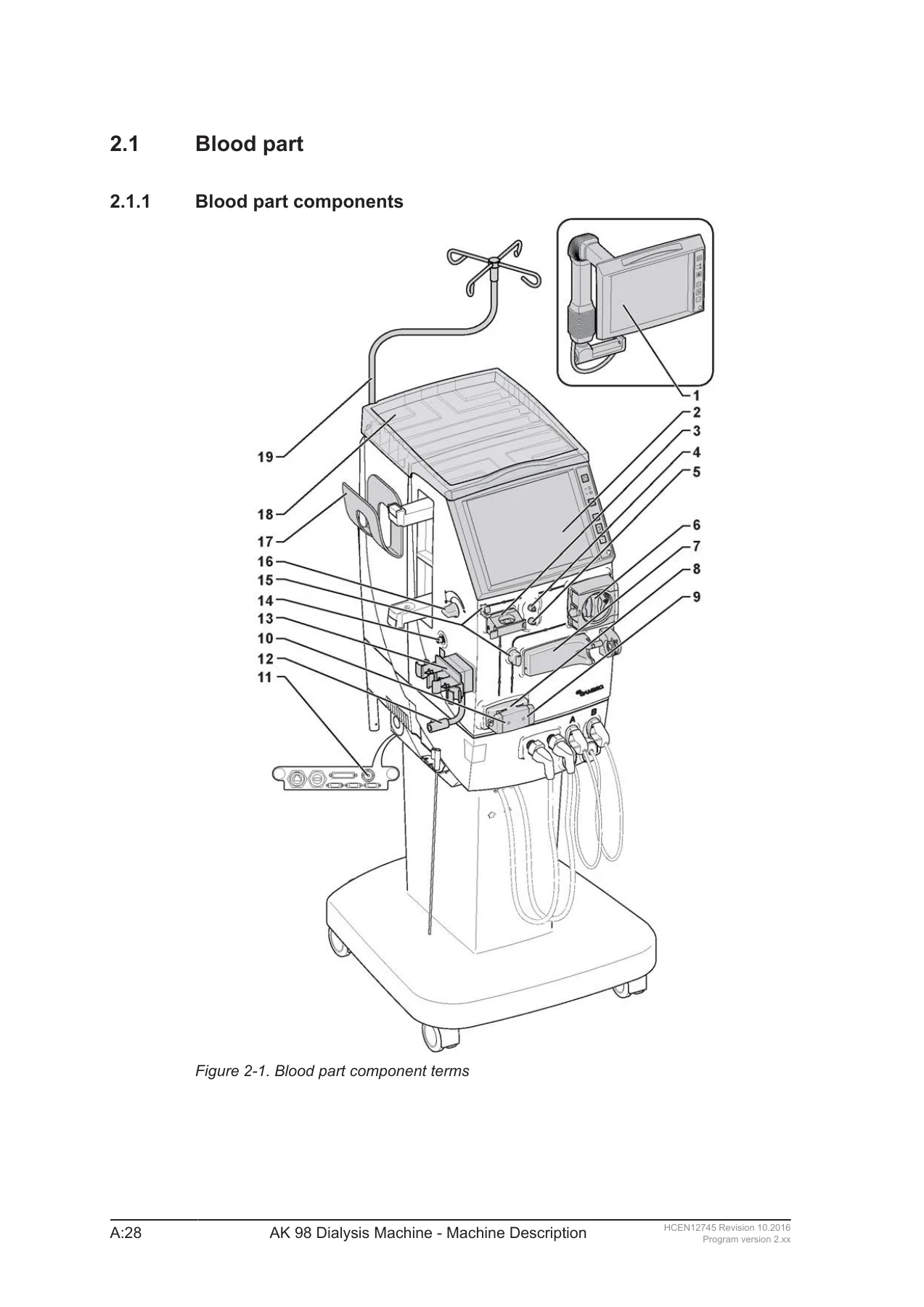
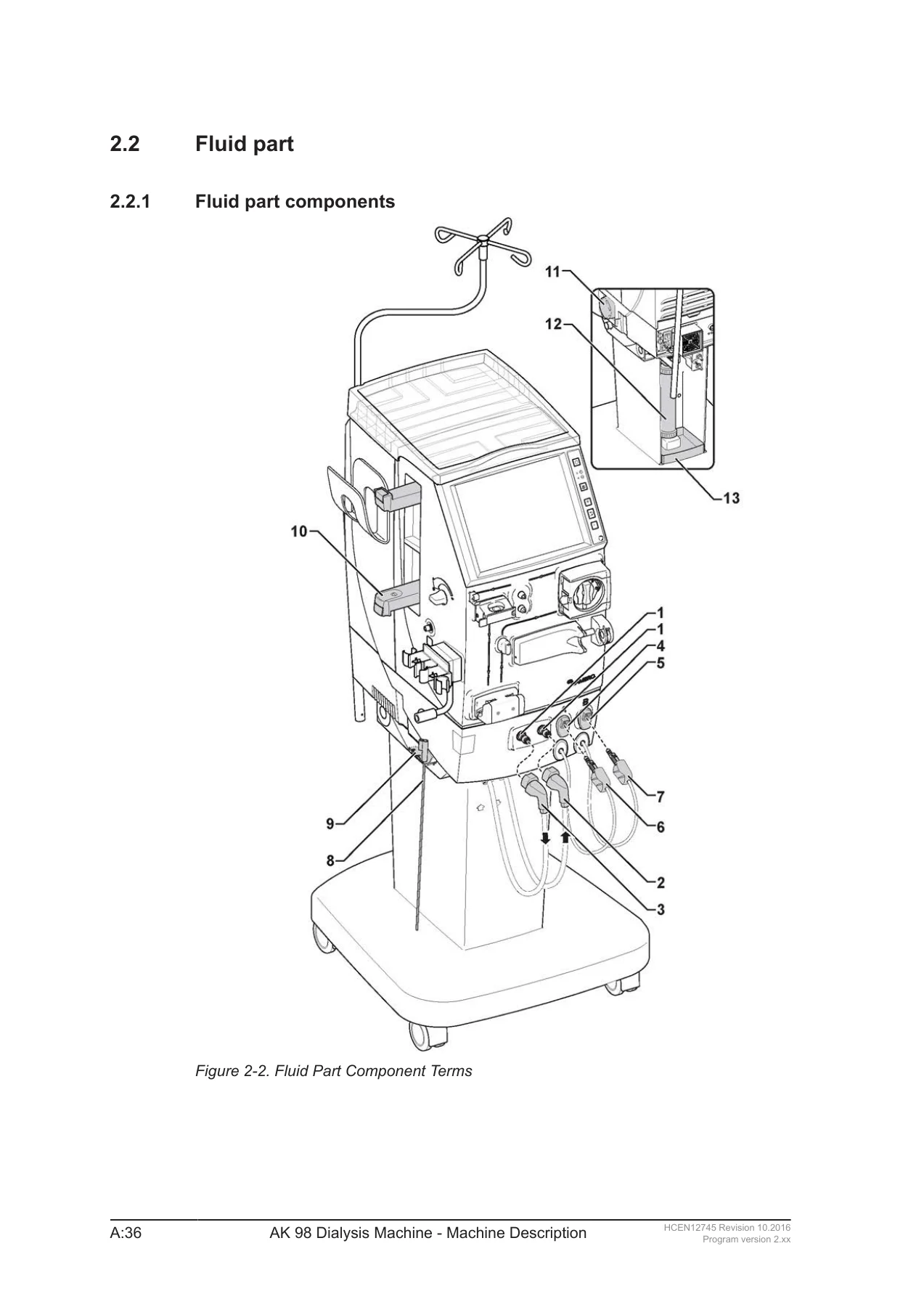
  • Machine Description — blood part components, fluid part components, rear components
  • Handling the dialysis machine — operator position, on/off, screen overview, concentrate standby mode, power failure operation
  • Haemodialysis – Double needle treatment — setup, arterial and venous blood lines, heparin syringe, priming (manual and assisted), recirculation, treatment start and end
  • Haemodialysis – Single needle treatment — basic functionality, preparations, patient connection, treatment start and end
  • Isolated ultrafiltration — activation, additional phases, deactivation
  • Profiling — sodium and bicarbonate concentration profiling, ultrafiltration rate profiling (linear, step, interval modes), preset models
  • Measuring blood pressure — BPM monitor, cuff usage, direct and interval measurement, alarm limits, patient care
  • DIASCAN — clearance measurement (K, Kt, Kt/V), measurement history, target values, alarm settings, factors affecting measurement
  • Disinfection and cleaning — heat disinfection (CLEANCART and citric acid), chemical disinfection (peracetic acid, hypochlorite), rinse and drain, machine storage
  • Disinfection with the AK 98 dialysis machine and WRO system — integrated heat disinfection, central chemical disinfection
  • IT Connectivity — patient ID confirmation, prescription retrieval, Station ID, CIS data transfer
  • Maintenance handling — blood pump rotor, blood leak detector, water inlet tube, pick-up tubes, surface cleaning, ultrafilter change, storage, service, disposal
  • Technical data and specifications — performance, control system, supervisory system, alarm sound pressure, physical data, materials, environmental data, standards
  • Alarm handbook — high priority alarms, medium priority alarms, attentions (500 series), with machine actions and operator actions for each

The AK 98 operator’s manual is organised so you can work straight through from initial setup to treatment completion without needing a separate service reference. The opening chapters establish the safety philosophy of the machine — the control system, the protective system, and how the two interact to keep the patient safe during treatment. From there, the manual walks through every step of machine setup: attaching the BICART cartridge, connecting the arterial and venous blood lines, loading the heparin syringe, and running the priming sequence.

Treatment chapters for double needle and single needle modes are detailed enough to follow at the bedside. They include the exact order of operations, the meaning of every screen indicator, and the decisions the operator needs to make when connecting the patient, setting ultrafiltration volume, and adjusting heparin values. The profiling chapter explains how to set up and activate sodium, bicarbonate, and UF rate profiles, including linear, step, and interval modes, and how profiling interacts with isolated UF phases.

The DIASCAN section explains how the machine measures clearance and calculates Kt and Kt/V, how to set target values and alarm limits, and which treatment actions affect measurement accuracy. Blood pressure monitoring is covered in its own chapter, with guidance on cuff selection, direct and interval measurement, alarm limit configuration, and patient care considerations for different patient groups.

Disinfection and cleaning receive thorough treatment because the AK 98 supports multiple disinfection pathways — heat disinfection with CLEANCART cartridges or liquid citric acid, chemical disinfection with peracetic acid or sodium hypochlorite, and integrated heat disinfection when paired with a WRO 300 H water purification unit. The manual includes the recommended cleaning and disinfection schedule, dwell times, concentrations, and the residue test procedure that must be performed after any chemical disinfection.

The technical data chapter gathers the machine’s performance specifications in one place: blood flow control, heparin pump accuracy, dialysis fluid preparation, ultrafiltration control, profiling limits, DIASCAN specifications, disinfection parameters, water supply requirements, power supply data, alarm sound pressure, and environmental operating ranges. The materials in contact with dialysis fluid, concentrates, and water are listed, along with the standards the machine complies with.

IMAGES PREVIEW

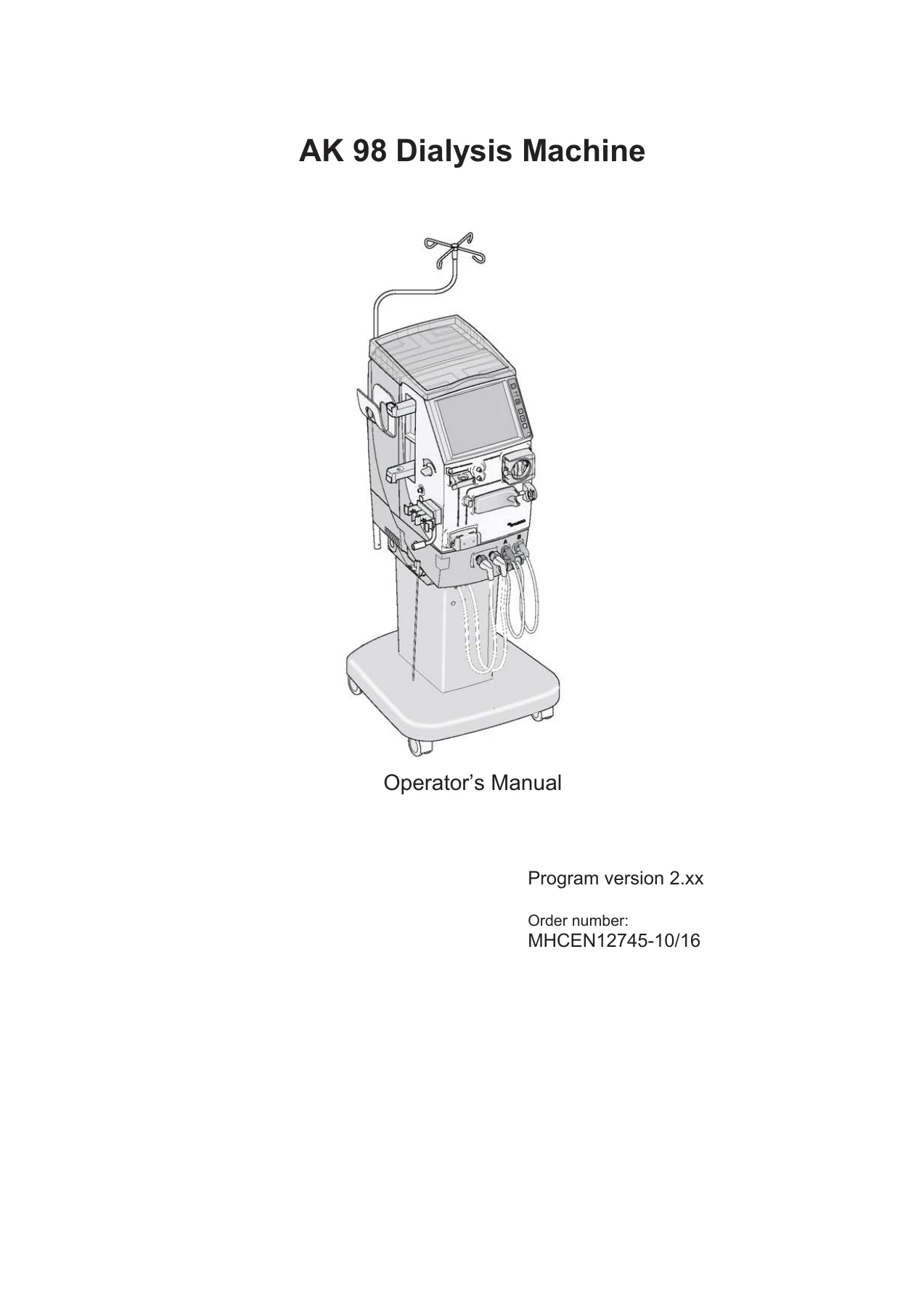
Gambro AK 98 Dialysis Machine Operator's Manual 2016 - Program 2.xx PDF Download — PDF page 1 preview
Gambro AK 98 Dialysis Machine Operator's Manual 2016 - Program 2.xx PDF Download — PDF page 30 preview
Gambro AK 98 Dialysis Machine Operator's Manual 2016 - Program 2.xx PDF Download — PDF page 38 preview

The alarm handbook is effectively a second manual inside this one. It lists every high priority alarm, medium priority alarm, and attention the AK 98 can generate, each with a description of what triggers it, what the machine does automatically in response, and what the operator must do. This is the section you reach for when an alarm interrupts a treatment at 3 a.m. — it tells you whether to correct the blood line, centralise pressure limits, adjust concentrate, or call an authorised service technician.

What This Manual Enables You to Do

With the Gambro AK 98 Dialysis Machine Operator’s Manual on hand, you can set up the machine from a cold start, run the functional check, prepare the blood and fluid paths, connect a patient, start and monitor a double needle or single needle treatment, manage ultrafiltration and profiling, use DIASCAN and blood pressure monitoring, end the treatment correctly, and carry out the full aftercare and disinfection routine. You can also interpret every alarm and attention the machine produces and take the correct operator action without guessing.

Correct procedures matter because the AK 98’s protective system depends on the operator setting alarm limits, connecting blood lines properly, and responding to alarms in the right order. The manual spells out those dependencies — for example, the venous blood line must be correctly seated in the priming detector for alarm supervision to activate, and the ultrafiltration protective system uses independent flow sensors that need the operator to set the correct UF volume and treatment time.

The manual is delivered as an instant PDF download. There is no physical shipment, no waiting for a disc or binder, and no shipping cost. You can open it on any device — desktop, laptop, tablet, or phone — and print the pages you need for the machine side. Whether you are a dialysis nurse, a home haemodialysis patient, a clinical educator, or a biomedical technician supporting AK 98 machines, this manual gives you the complete operator-level reference in one searchable document.
Reviews

There are no reviews yet.

Be the first to review “Gambro AK 98 Dialysis Machine Operator’s Manual 2016 – Program 2.xx PDF Download”

What Our Customers Say

★★★★★ Live reviews from customers
Loading customer reviews...
0
    0
    Your Cart
    Your cart is emptyReturn to Shop
    🛒
    Recently Purchased
    🕒 verified order