
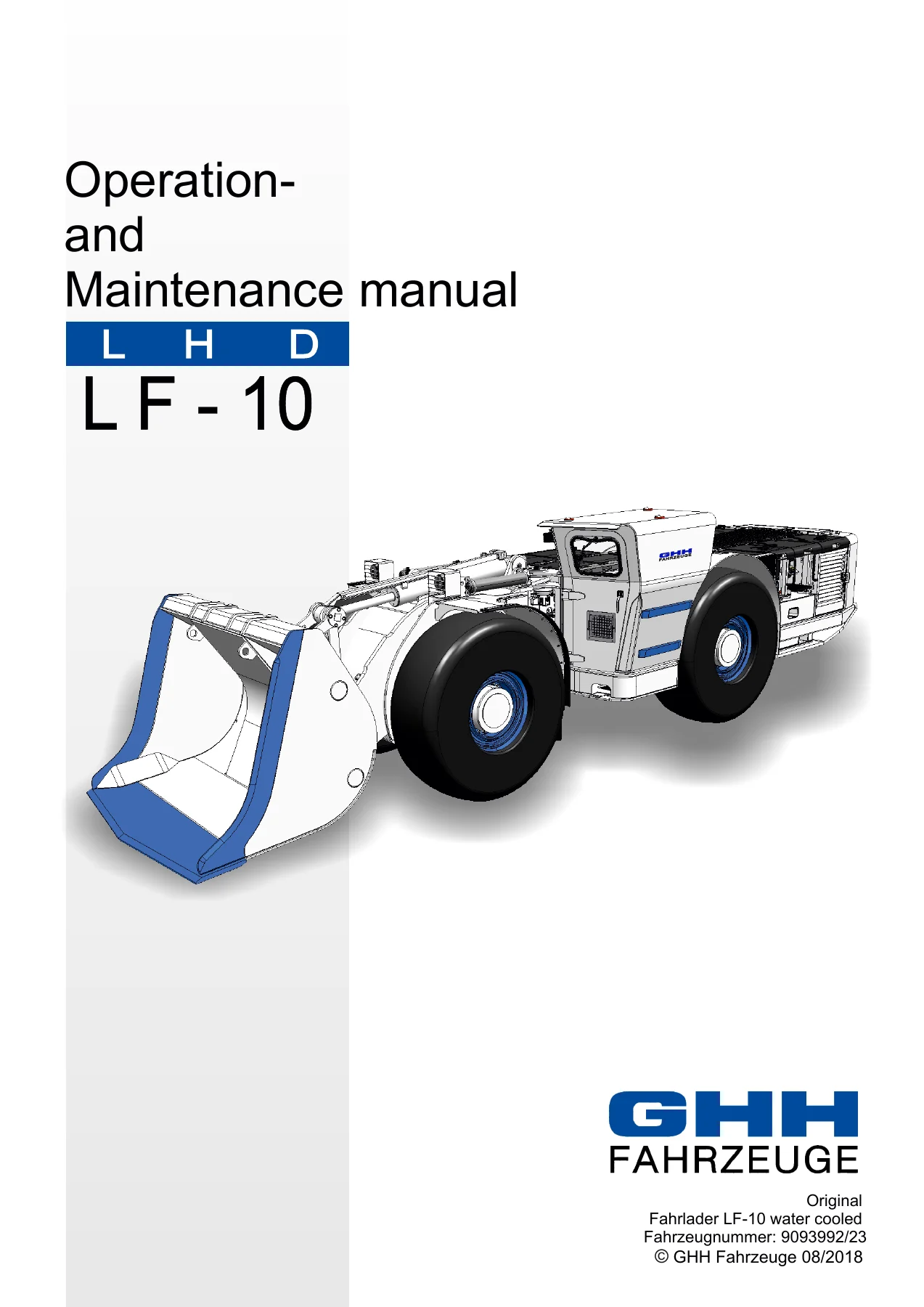
GHH Fahrzeuge LF-10 LF-10.2 Loader Operation and Maintenance Manual – 2018 PDF
Original price was: $29.95.$17.95Current price is: $17.95.
Complete GHH Fahrzeuge operation and maintenance manual for the water-cooled LF-10 and LF-10.2 underground loader – cab controls, tramming, work mode, safety devices, fault messages, technical data and filling volumes in one 109-page PDF.
Description
The GHH Fahrzeuge LF-10 / LF-10.2 Operation and Maintenance Manual is the manufacturer-issued documentation set for this water-cooled underground loader, presented here as a complete PDF. It is organised into four main parts – Introduction, Operation, Maintenance and System drawings – and takes the reader from the machine’s intended use and safety concept through to daily operating procedures, scheduled servicing and the vehicle’s full technical data.
File Details
- Manual type: Operation and Maintenance Manual
- Manufacturer: GHH Fahrzeuge GmbH, Emscherstrasse 53, D-45891 Gelsenkirchen, Germany
- Machine: GHH LF-10 / LF-10.2 Fahrlader (LHD loader)
- Vehicle number shown in the document: 9093992/23
- Issue year: 2018
- Language: English
- Length: 109 pages
- Format: PDF
Chapters Covered
- 1 Introduction
- 1.1 Use of the operating manual
- 1.2 Warranty conditions for mining vehicles, tunnel construction vehicles, airport technology
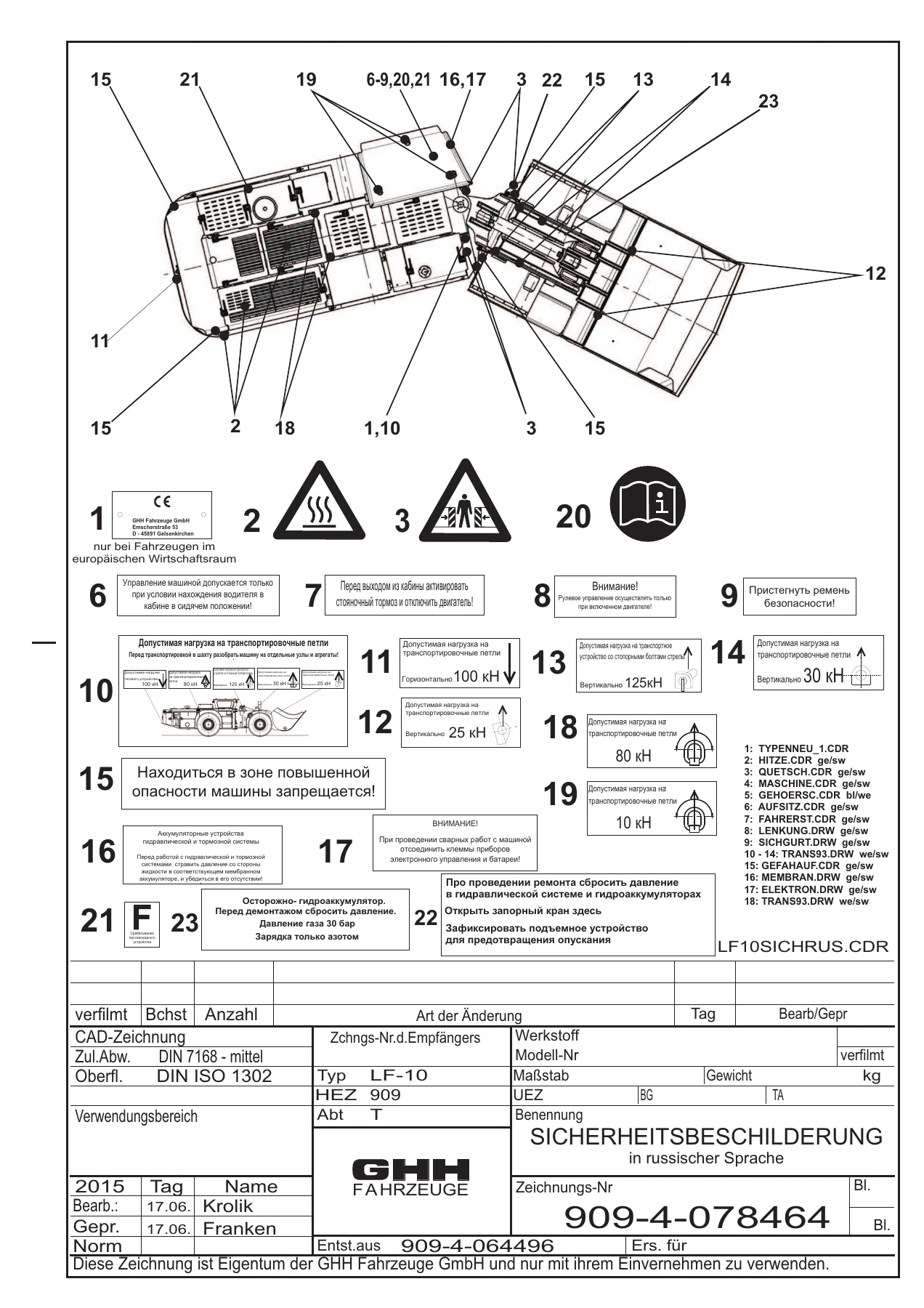
- 1.3 Safety – intended use, safety notices and symbols, mandatory and danger symbols, basic safety instructions, responsibility of the owner, requirements imposed on personnel, general safety instructions for specific operating phases, safety instructions for electrical energy, welding, hydraulics, auxiliary materials, dust and gas, towing and decommissioning, safety devices
- 1.4 Short description – scaler: application, construction, engine part, payload unit, vehicle frame, steering lock, intended use
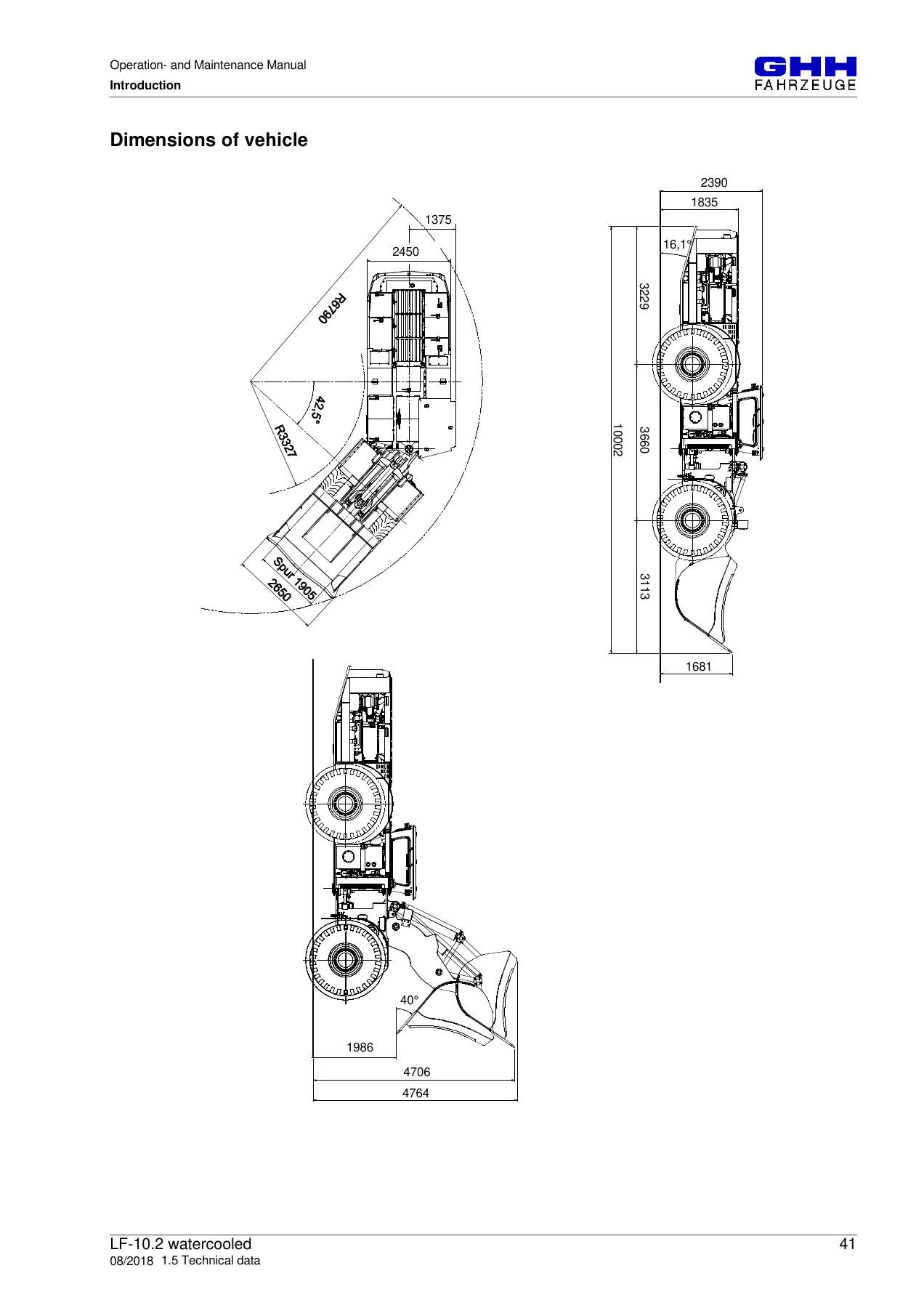
- 1.5 Technical data – vehicle dimensions, sound pressure level
- 1.6 Vehicle characteristic data – rating plates, vehicle rating plate, tire pressure plate
- 2 Safety instructions – operation
- Training and prior to commissioning, fuelling with diesel, boarding, driver seat, seatbelt, commissioning
- 2.1 Operator’s cab, control and monitoring devices
- 2.2 Driver seat and armrest adjustment
- 2.3 Starting the engine, switching off the engine, exiting the vehicle
- 2.4 Traction mode – driving, steering function, steering lock, downhill travel, downhill travel in converter mode, towing the vehicle, towing mode
- 2.5 Work mode – bucket filling, bucket filling in floating position, emptying the bucket, Ride Control, TIMO, SAEM
- 2.6 Information, warning and fault messages – multifunction display stand mask, display icons, service menu, air conditioning
- 2.7 Winter operation – engine oil, fuel injectors, compression pressure, cooling system, dry air filter, fuel system, fuel tank, water separator, fuel pump, differential, hydraulic system, electrical system, alternator, starter
- 2.8 Decommissioning the vehicle and recommissioning after a period of decommissioning
- 2.9 Loading, attachment points, transport, assembly of dismantled vehicles at the implementation site
- 3 Maintenance
- 4 System drawings
Together these parts describe the LF-10 and LF-10.2 from the outside in. The introduction fixes the machine’s intended operating envelope – non-explosive, non-pit-gas underground areas – and sets out the rules that govern everything after it, including which grades of personnel are permitted to work on the electrical, hydraulic, brake and steering systems. The operation part then walks the operator through the cab layout, joystick functions, starting and stopping sequence, gear selection and speeds, downhill driving in converter mode, the steering lock logic and the emergency exit routes. The warning and fault message chapter decodes the icons shown on the multifunction display, so a fault is identified before it becomes a breakdown.
Safety Devices Documented
A significant share of the manual is devoted to the safety systems fitted to this loader, each described with its activation conditions and the checks required to keep it working:
- Emergency stop – the cab-mounted mushroom pushbutton plus a second pushbutton at the right rear of the vehicle; pressing either switches off the diesel engine, applies the parking brake and deactivates the steering and working hydraulics.
- Steering lock – engages automatically with the engine running when the direction selector is in neutral and the armrest is raised or the cab door is opened, and when the parking brake is engaged under the same conditions.
- Emergency exit – via the cab door or by removing the side window above the rear wheel using the window seal release loop.
- Lifting arm locking mechanism – pin retainers in the articulated joint area that must both be engaged before anyone works under a raised lifting arm.
- Seatbelt – fitted to the driver’s seat, with condition checks before every shift.
- Fire extinguishing system – manual-pneumatic release switches in the cab and on the left side of the vehicle.
Technical Data You Can Work From
The technical data chapter is not a summary – it is the reference a workshop actually uses. It records the LF-10.2’s main dimensions, the deadweight and payload figures, laden and unladen axle loads, the four tramming speeds, the maximum admissible gradient and roll angle, and the tractive force. Engine data is given for the Deutz TCD 2013 L06 COM IIIA water-cooled diesel with turbocharging and intercooling, rated 200 kW at 2300 rpm, along with the air intake, exhaust, starter and alternator details. Tire size, rim and inflation pressures are listed per axle, as are the brake and steering system designs, hydraulic pump flow rates and system pressures, cylinder counts and lift times, the 24 V electrical system and battery rating, and every filling volume from the 320 litre fuel tank to the 5.5 litre planetary gear housings.
Towing, Downhill Travel and Winter Preparation
The traction chapter sets out the conditions under which the loader may be moved without driving it. Towing is permitted only at walking speed and over short distances, and only with a functioning brake system, on-board voltage and sufficient reservoir pressure – the manual states a brake pressure higher than 120 bar, and warns that below 110 bar safe release of the service brake is no longer assured, so the towing procedure must be stopped before the brakes overheat. A dedicated towing mode button lets the vehicle be towed with the drive engine stopped while remaining steerable through the left-hand joystick, using battery-supplied emergency pumps that hold the necessary pressures for roughly 8 to 10 minutes. Downhill travel is described in converter mode, where the engine brakes through the converter and transmission and the converter oil temperature gauge must be watched; a warning icon appears above 120 degrees C.
Winter operation has its own chapter, because low temperatures change how the LF-10 behaves. It covers the warm-up phases required below 0 degrees C before engine speed is raised, the coolant antifreeze requirement, winter diesel and paraffin precipitation in the fuel system, daily draining of the water separator, the transmission and hydraulic oil grades for cold conditions, and the battery, alternator and starter checks that decide whether a cold start succeeds.
What This Manual Lets You Do
With this GHH LF-10 LF-10.2 operation and maintenance manual on hand you can run the machine correctly rather than approximately. That means starting it from the cab in the prescribed sequence, selecting the right gear for a gradient instead of letting the service brake overheat, reading the multifunction display icons accurately when a warning appears, and knowing which faults require an immediate shutdown rather than a slow run back to the workshop. The manual states plainly that the prescribed maintenance and inspection tasks must be completed in full and within the intervals given, and that only the recommended oils, greases and original spare parts should be used – both conditions of the warranty terms printed in the opening chapter.
IMAGES PREVIEW
Because it arrives as an instant PDF download, there is no shipping and no waiting. The file opens on a laptop, tablet or phone in the workshop or at the face, and any page – a dimension drawing, a fault message table, a filling volume list – can be printed and carried to the machine.


Reviews
There are no reviews yet.