
John Deere 300 Series OEM Engines Technical Manual TM1190 – PDF Download
Original price was: $39.95.$24.95Current price is: $24.95.
The complete John Deere 300 Series OEM Engines Technical Manual TM1190 in PDF, covering 3-164D, 3-179D, 4-219D, 4-239D, 4-239T, 4-276D, 4-276T, 6-329D, 6-359D, 6-359T, 6-414D and 6-414T diesel engines. Removal, repair, overhaul, fuel injection, turbocharger, electrical and system testing procedures with torque values and special tools.
Description
File Details
- Manual type: Technical Manual (shop service, repair and overhaul manual)
- Brand: John Deere
- Series: 300 Series OEM Engines
- Document number: TM1190
- Edition: TM1190 (01DEC84), English
- Publisher: John Deere Engine Works, Deere and Company, Moline, Illinois
- Language: English
- File format: PDF
- Page count: 438 pages
Engines Covered by the John Deere 300 Series OEM Engines Technical Manual TM1190
This technical manual was written for the 300 Series OEM engine family and covers both the naturally aspirated and turbocharged diesel versions used across OEM installations:
- 3-164D and 3-179D – three cylinder diesel
- 4-219D, 4-239D, 4-239T, 4-276D and 4-276T – four cylinder diesel and turbocharged diesel
- 6-329D, 6-359D, 6-359T, 6-414D and 6-414T – six cylinder diesel and turbocharged diesel
All engines share the same basic architecture: internal combustion, four strokes per cycle, in-line cylinder block, diesel fueling, valves in the cylinder head, liquid coolant and pressure lubrication. The turbocharged variants add a turbocharger in place of natural aspiration. The manual also documents the serial number breakpoints at which revised pistons, connecting rods, oil coolers and fuel injection pumps came into production, so you can tell which parts and procedures apply to the engine in front of you.
Chapters Covered
- Section I – General Information
- Contents and Index, Introduction, Alphabetical Index
- Recommended torque values for coarse and fine thread hardware
- Section 4 – Engine
- Group 0400 – Removal and Installation
- Group 0401 – Crankshaft and Main Bearings
- Group 0402 – Camshaft and Valve Actuating Means
- Group 0403 – Connecting Rods and Pistons
- Group 0404 – Cylinder Block
- Group 0407 – Oiling System
- Group 0408 – Ventilating System
- Group 0409 – Cylinder Head and Valves
- Group 0410 – Exhaust Manifold
- Group 0413 – Fuel Injection System
- Group 0414 – Intake Manifold
- Group 0415 – Engine Balancer
- Group 0416 – Turbocharger
- Group 0417 – Water Pump
- Group 0418 – Thermostats, Housing and Piping
- Group 0419 – Engine Oil Cooler
- Group 0420 – Fuel Filter
- Group 0421 – Fuel Transfer Pump
- Group 0422 – Starting Motor and Fastening
- Group 0423 – Alternator and Generator Mountings
- Group 0429 – Fan Drive
- Group 0433 – Flywheel, Housing and Fastenings
- Group 0499 – Specifications and Special Tools
- Section 5 – Engine Auxiliary Systems
- Group 0510 – Cooling Systems
- Group 0515 – Speed Controls
- Group 0520 – Intake Systems
- Group 0599 – Specifications and Special Tools
- Section 16 – Electrical Systems
- Group 1672 – Alternator, Regulator and Charging System Wiring
- Group 1674 – Wiring Harness and Switches
- Group 1676 – Instruments and Indicators
- Group 1699 – Specifications and Special Tools
- Section 19 – Sheet Metal and Styling
- Group 1910 – Hood or Engine Enclosure
- Section 40 – PTO Drive
- Group 4052 – PTO Clutch
- Group 4099 – Specifications and Special Tools
- Section 90 – System Testing
- Group 9010 – Engine
- Group 9015 – Electrical System
- Group 9035 – Specifications and Special Tools
Read as a whole, the manual follows the way a technician actually works. Sections 4 through 40 handle removal, repair, testing of components already off the engine, installation and adjustment, group by group. Section 90 then steps back and explains how each system operates, how to diagnose a malfunction, what to inspect visually, how to test it and how to bring it back into adjustment. Specification and torque value pages are grouped and illustrated at the end of each section rather than scattered through the text, so you can pull a figure without hunting through the whole book.
Engine Mechanical Repair and Overhaul
The engine section carries the full tear-down and rebuild sequence for the 300 Series block. That includes crankshaft end play measurement and main bearing clearance checks, crankshaft gear, front and rear wear ring and oil seal replacement, vibration damper inspection and run-out limits, camshaft end play and gear backlash, timing gear train removal, backlash and end play measurement for every gear in the train, valve lift checking, rocker arm and push rod service, valve clearance adjustment on three, four and six cylinder engines, cylinder head flatness and thickness checks, valve and valve seat grinding angles, valve guide wear and knurling, piston and liner clearance checks, piston ring groove measurement, piston pin and bushing fitting, cylinder liner removal, protrusion measurement, packing installation and liner seating, plus the piston cooling orifice service.
Fuel, Turbocharger and Electrical Systems
Fuel injection coverage is split by pump type. The manual deals with ROTO-DIESEL pumps and both Roosa-Master Model JDB and Model DM pumps, including pump removal, drive shaft and drive gear service, internal timing line alignment, pump timing when the front plate has been replaced, and fuel system bleeding. Fuel injection nozzle removal, carbon seal and seal washer replacement, nozzle bore cleaning and nozzle installation are covered with the specified connector torques.
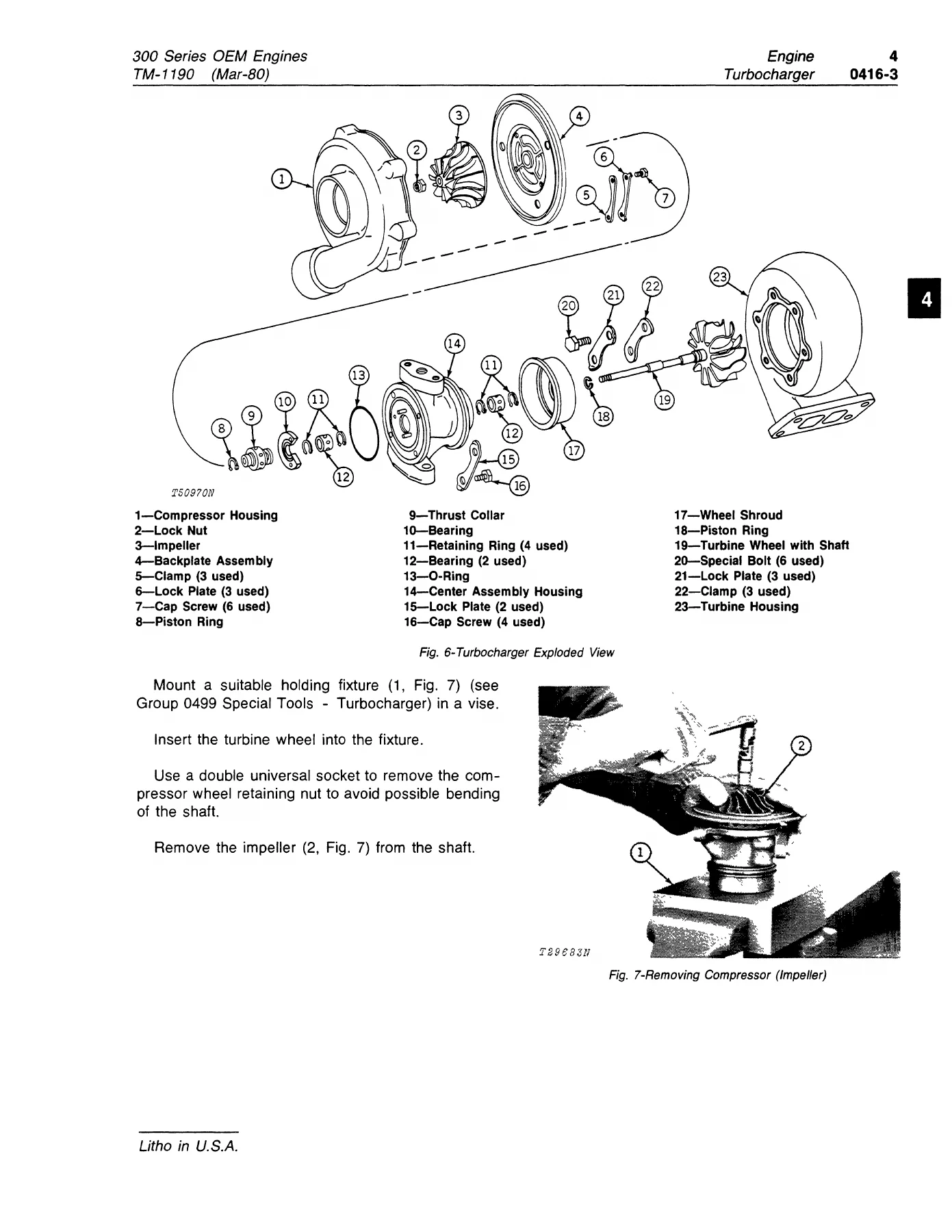
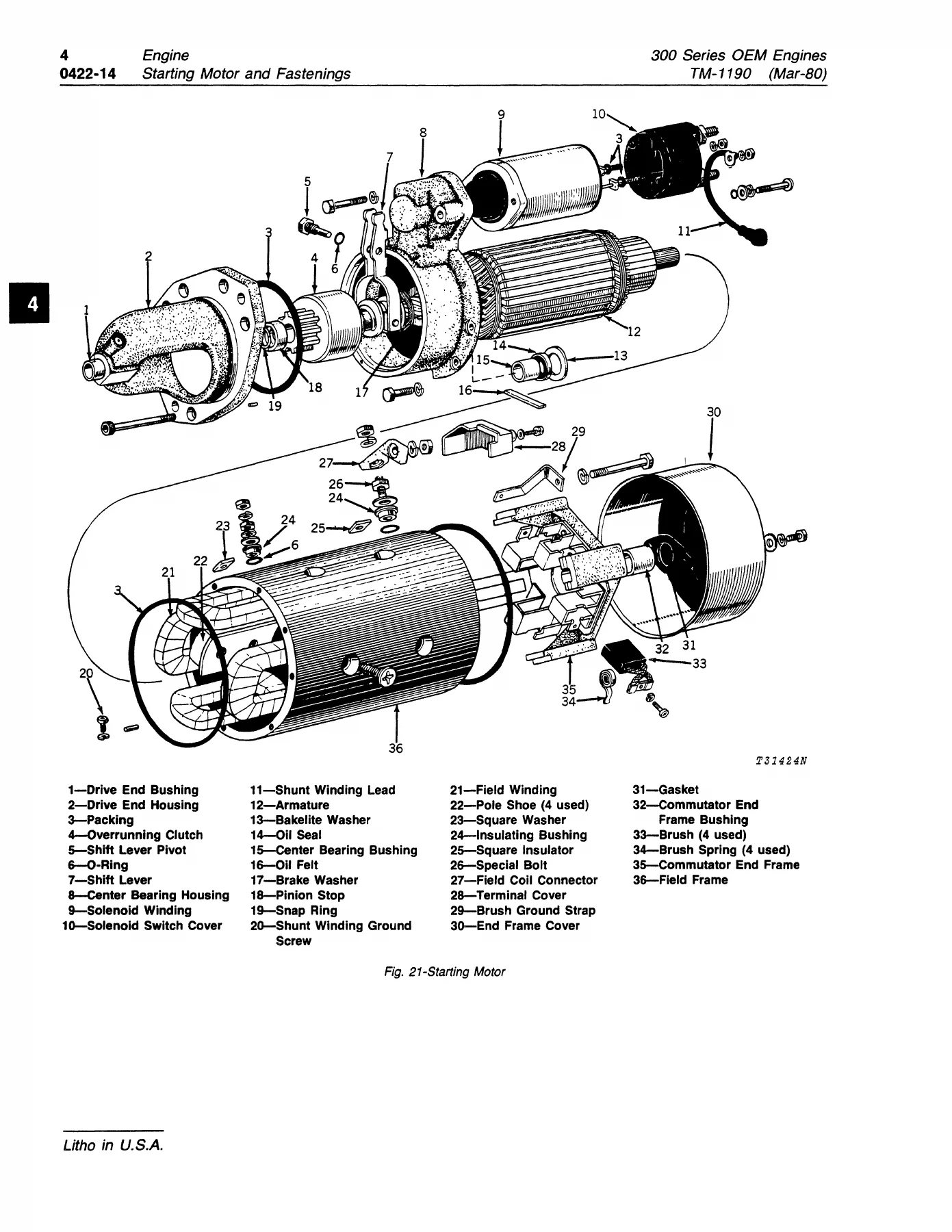
Turbocharger coverage includes radial and axial bearing movement checks with dial indicator limits, full disassembly, cleaning, inspection, replacement of O-rings, lock plates, piston rings and retaining rings, reassembly with compressor wheel nut torque and the final rotating assembly binding check. Electrical coverage spans Delco-Remy and John Deere starting motors with solenoid pull-in, hold-in, return and no-load test circuits, brush and brush spring service, bushing specifications, armature open, short and ground testing, field and shunt winding tests, plus alternator and charging system wiring, wiring harness and switches, and instruments including ammeter, hour meter, tachometer, pressure gauge, temperature gauge and safety switch.
Specifications, Torque Values and Special Tools
Every group ends with a specification block, and the fastening tables are specific rather than generic. You get crankshaft and main bearing torque figures, connecting rod cap screw torque values that differ between black and natural steel coloured screws and between engine families, cylinder head torque sequences for three, four and six cylinder engines with the correct cap screw lengths called out for the 4-276 and 6-414, main bearing cap screw torque, camshaft thrust plate torque, idler gear and oil pump gear torques, injection pump drive gear nut torque, rocker arm support cap screw torque, flywheel cap screw torque, cylinder liner flange height limits, and a separate fuel injection pump test stand specification section listing pump model numbers against their John Deere part numbers.
Special tool coverage is detailed alongside the procedures, naming the pullers, drivers, seal installers, bushing drivers, timing tools, ring groove gauges, liner pullers, nozzle pullers and seal compressing tools used at each step, including the JD, JDE, KCD and D-series tool numbers.
Why This John Deere 300 Series OEM Engines Technical Manual TM1190 Belongs in the Shop
This is the document that lets you pull a 3-164D, 4-276T or 6-414T apart and put it back together to the numbers the factory published. Torque values that were revised between production runs, piston types that must match the liner, connecting rod cap screws that must never be swapped between old and new rods, injection pump timing that has to be set with the correct piston stroke and not by eye, and cylinder liner protrusion that decides whether the head gasket will hold – all of it is in here, tied to the correct engine and serial number break.
IMAGES PREVIEW
Order the John Deere 300 Series OEM Engines Technical Manual TM1190 and the file is available for instant PDF download the moment payment clears. No shipping, no waiting on a paper book, no lost pages. Read it on a phone or tablet at the machine, print the torque and specification pages for the bench, or keep the whole manual on a shop laptop and search it by group number. Whether you are servicing a single engine or running an OEM service operation across all twelve models, having the complete TM1190 on hand means the specification is always within reach.
Reviews
There are no reviews yet.