
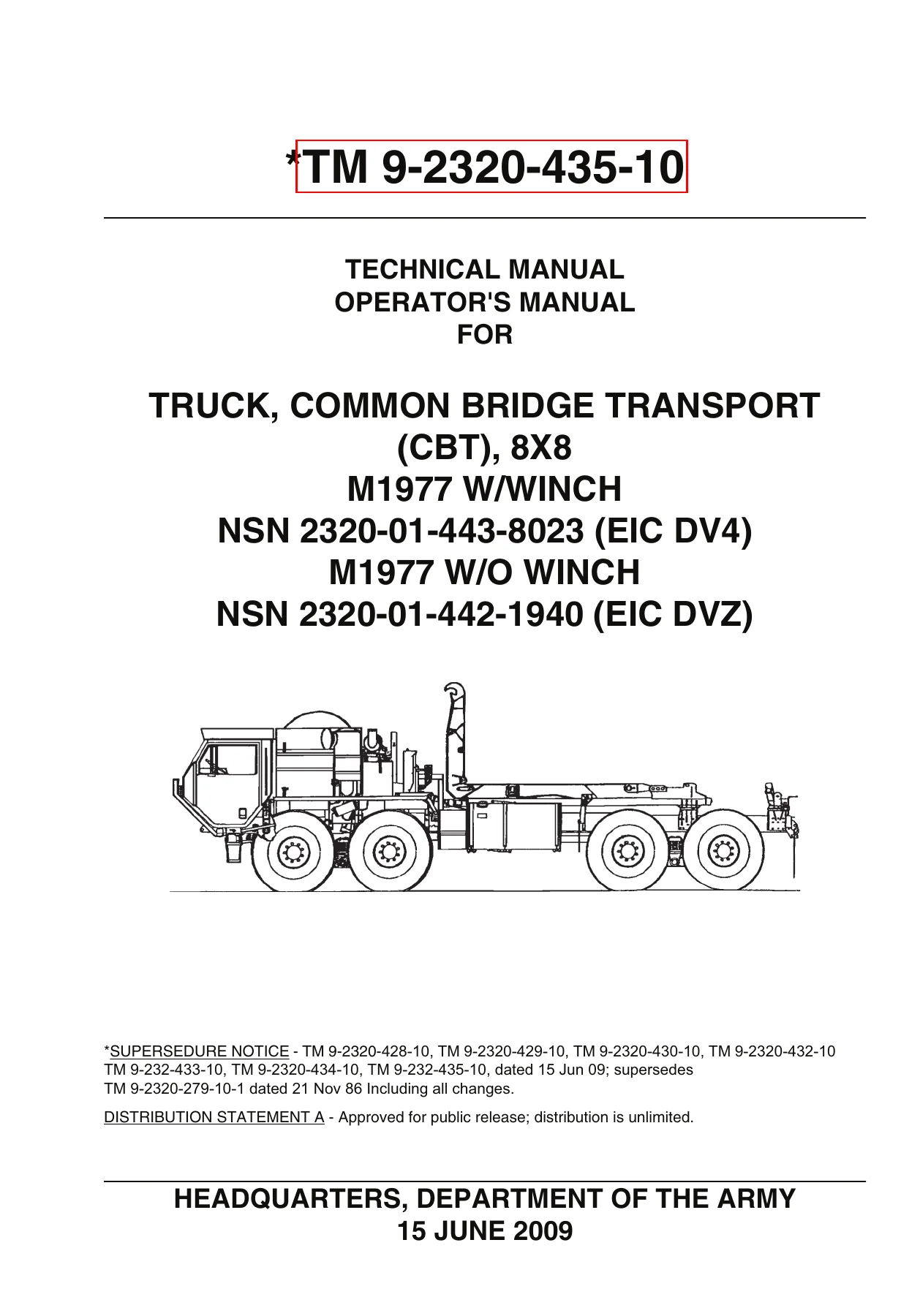
M1977 Common Bridge Transport 8×8 Operator’s Manual TM 9-2320-435-10 – June 2009
Original price was: $39.95.$23.95Current price is: $23.95.
Complete June 2009 operator’s manual for the M1977 Common Bridge Transport (CBT) 8×8, covering with-winch and without-winch configurations, vehicle operation, Load Handling System and Bridge Adapter Pallet procedures, bridge-bay handling, troubleshooting, PMCS, lubrication, and operator maintenance.
Description
M1977 Common Bridge Transport 8×8 Operator’s Manual TM 9-2320-435-10 – June 2009
This M1977 Common Bridge Transport 8×8 Operator’s Manual TM 9-2320-435-10 – June 2009 is the Department of the Army technical manual for the M1977 CBT in both M1977 W/WINCH and M1977 W/O WINCH configurations. It is built around real operator tasks: learning the controls, operating the truck on and off road, using the Load Handling System, moving Bridge Adapter Pallets and bridge bays, responding to system faults, carrying out PMCS, and performing the operator-level maintenance procedures assigned in the manual. The publication also gives equipment data, system descriptions, safety information, illustrations, and work-package procedures for the M1977’s major vehicle and bridge-transport functions.
File Details
- Manual type: Operator’s Manual / Technical Manual
- Vehicle: Truck, Common Bridge Transport (CBT), 8×8
- Models: M1977 W/WINCH and M1977 W/O WINCH
- Manufacturer: Oshkosh Truck Corporation
- Manual number: TM 9-2320-435-10
- Date: 15 June 2009
- Language: English
- Pages: 1168
- File format: PDF
M1977 CBT Vehicle and System Coverage
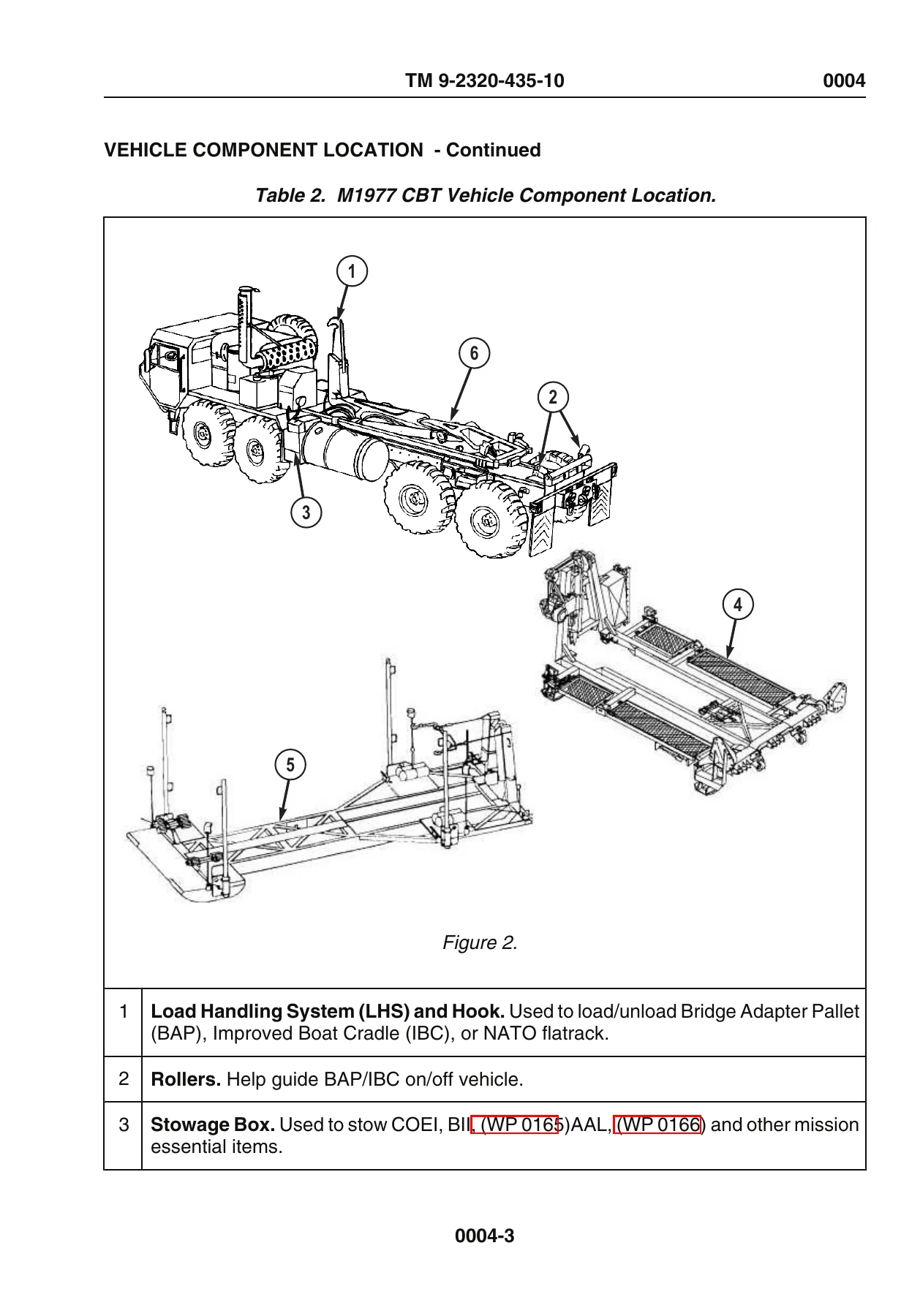
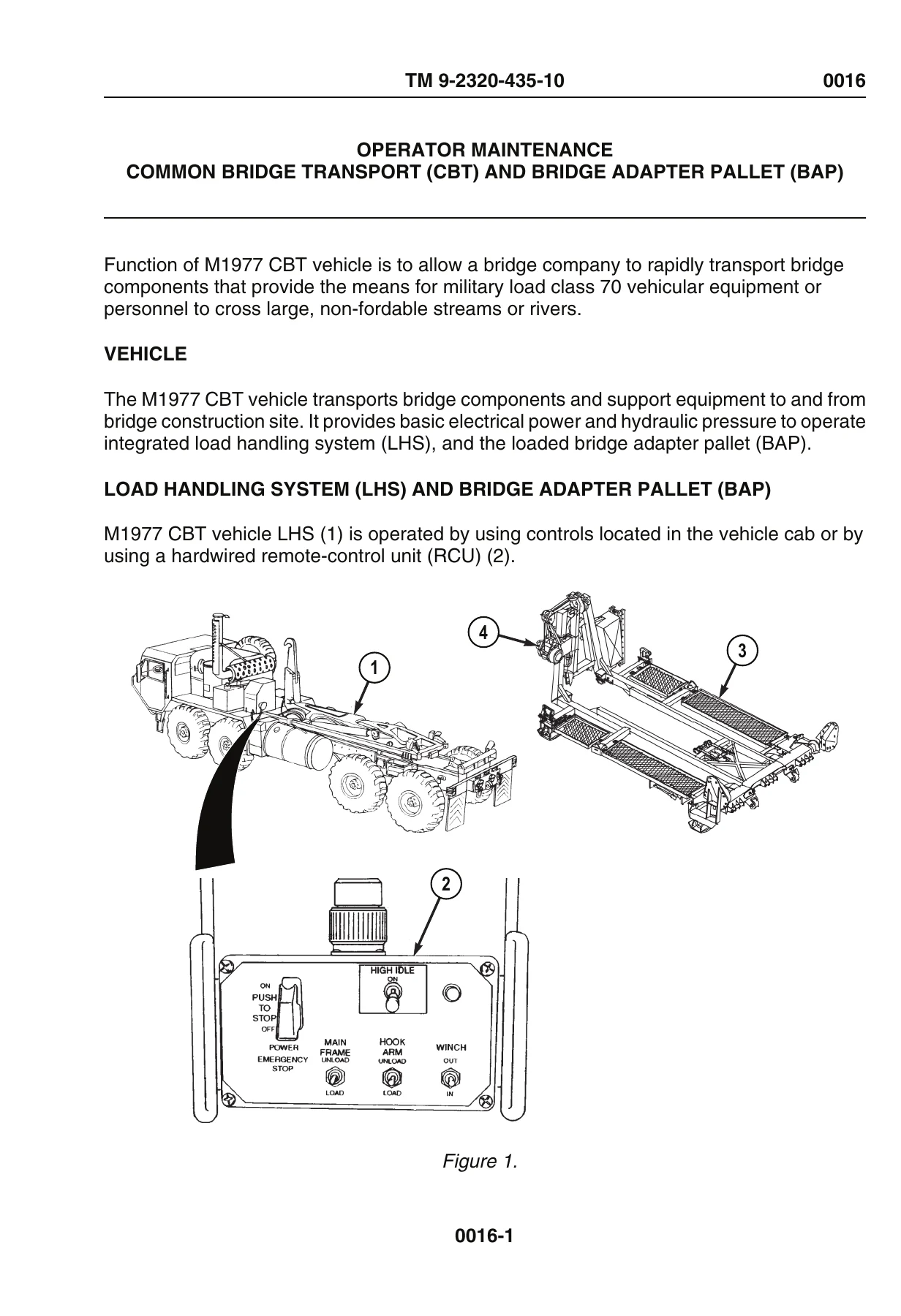
The manual identifies the M1977 CBT as a tactical wheeled vehicle with an integrated Load Handling System capable of self-loading and unloading. Its bridge-transport role includes loading, transporting, unloading, launching, and retrieving bridge erection boats, interior bridge bays, and ramp bridge bays. The manual explains how the Bridge Adapter Pallet works with the LHS, how the BAP supports interior or ramp bays during movement, and how the system is used as part of ribbon-bridge launch and retrieval operations.
Technical coverage is broad enough to support day-to-day operation and informed troubleshooting. Equipment-data work packages cover vehicle dimensions and weights, operating performance, tire pressures and speeds, the Detroit Diesel 8V92TA engine, the Allison HT740D automatic transmission, the Oshkosh 55000 transfer case, air brakes, steering, wheels and tires, the electrical system, self-recovery winch data, and the Load Handling System. The system-description sections then show how the electrical, air, hydraulic, steering, power-train, engine, and load-handling systems are arranged and how their major components interact.
The M1977 CBT operator manual also distinguishes the vehicle’s two configurations. The with-winch configuration is identified by NSN 2320-01-443-8023, while the without-winch configuration is identified by NSN 2320-01-442-1940. Where the self-recovery winch is fitted, the manual covers its controls, hydraulic drive, cable handling, recovery procedures, snatch-block use, and connection to another vehicle.
Chapters Covered
- Chapter 1 – General Information, Equipment Description and Theory of Operation
- Introduction, scope, nomenclature, abbreviations, safety, and warranty program
- Equipment characteristics, capabilities, features, and differences between models
- Equipment data, vehicle dimensions, weights, performance, tire pressures, and operating speeds
- Location and description of major components
- Self-recovery winch, electrical system, air system, and main hydraulic system
- Steering system, power train, engine systems, cab, wheels and tires
- Common Bridge Transport and Bridge Adapter Pallet theory and component coverage
- Chapter 2 – Operator Instructions
- Cab-mounted foot and hand controls, steering-column controls, tunnel-panel controls, and instrument-panel indicators
- Heater-compartment controls, seat and seatbelt adjustments, hydraulic selector valve, LHS remote control, and LHS hydraulic manifold
- Optional and mission equipment controls including arctic engine heater, gas particulate filter unit, chemical alarm, decontamination kit, radio hardware, rifle stowage, and machine-gun mount
- Windshield wipers and washer, cab heat and defrost, fire extinguisher, access ladder, and cab drain plugs
- Loading and unloading the Bridge Adapter Pallet from the ground
- Loading and unloading bridge bays
- Controlled bridge-bay launch, free bridge-bay launch, high-bank launch, and calm or fast water bridge-bay retrieval
- Loading and unloading NATO flatracks
- Normal transfer of the BAP between vehicle and trailer and BAP hold-down-lock checks
- Starting and shutting down the engine; parking, service, and trailer brake operation
- Transmission, transfer case, engine brake, forward and reverse driving, highway and city driving, off-road driving, steep grades, slippery conditions, and parking
- Bridge-bay and bridge-erection-boat operation
- Vehicle lighting, blackout lighting, work lights, portable beacon, turn signals, and emergency flashers
- Wheel chocks, seat adjustment, seatbelts, tire chains, and water fording
- Interim NBC decontamination procedures
- Self-recovery using the winch, snatch-block installation, winch-cable connection to another vehicle, disabled-vehicle towing, and tow-bar procedures
- Operation in extreme heat, dust, sand or mud, desert, cold and extreme cold, forest or rocky terrain, and saltwater areas
- Manual procedures for electrical or hydraulic power loss, including solenoid bypass, manual BAP loading and unloading, and emergency load removal
- Highway emergency markers, manual spring-brake release, limp-home operation with a flat tire and no spare, slave starting, and immediate action for loss of air or hydraulic pressure
- Stowage and sign guide
- Chapter 3 – Troubleshooting Procedures
- Air-pressure warning, air-system leakage, trailer-brake, air-horn, washer, heater, and lighting faults
- Engine no-crank, crank/no-start, rough running, loss of power, excessive smoke, overheating, low oil pressure, and excessive oil consumption
- Hydraulic-system slow, fast, jerky, or inoperative conditions and self-recovery winch faults
- Steering difficulty, shimmy, wander, pull, slow response, and intermittent response
- Transmission and transfer-case operating problems, transmission-temperature warnings, wheel wobble, and abnormal tire wear
- Chapter 4 – Preventive Maintenance Checks and Services (PMCS)
- PMCS introduction and readiness criteria
- Before-operation checks
- During-operation checks
- After-operation checks
- Weekly preventive maintenance
- Monthly preventive maintenance
- Semiannual preventive maintenance
- Chapter 5 – Maintenance Instructions
- Lubrication instructions for the engine, transmission, transfer case, axles, hydraulic reservoir, radiator, self-recovery winch, oil-can points, and other lubrication points
- Opening and closing heater valves and pre/post towing procedures
- Vehicle cleaning
- Changing the wheel and tire assembly
- Cleaning the fuel-tank strainer and servicing the air-cleaner element
- Servicing tires
- Opening and closing the battery box
- Opening and closing engine covers and removing/installing the engine side panel
- Chapter 6 – Supporting Information
- References
- Components of End Item and Basic Issue Items lists
- Additional Authorization List
- Expendable and Durable Items List
Across these six chapters, TM 9-2320-435-10 combines vehicle familiarization with step-by-step operator procedures, fault isolation, scheduled checks, servicing, and mission-equipment operation. The large number of illustrated work packages is particularly useful when a task depends on identifying a control, latch, hose, valve, pin, lock, indicator, or specific point on the truck, LHS, BAP, or related equipment.
Bridge Handling, Recovery, and Field Operation
A major strength of this M1977 Common Bridge Transport operator’s manual is the depth devoted to CBT-specific work rather than only normal truck driving. Procedures cover preparation and site checks, operator and assistant responsibilities, LHS cab and remote controls, PTO and high-idle use, BAP locks and guides, loading and unloading sequences, bridge-bay launch methods, retrieval, flatrack handling, and transfer between the vehicle and trailer. The manual repeatedly integrates safety limits and control positions into the procedure so the operator can follow the sequence while understanding when the truck is or is not in a safe transport configuration.
Recovery coverage is similarly practical. For vehicles equipped with the self-recovery winch, the manual includes the winch system description, pull-capacity information, self-recovery procedures, snatch-block installation and removal, cable connection to another vehicle, and related safety requirements. Towing procedures, front-lift preparation, slave starting, flat-tire limp-home procedures, and immediate actions for loss of air or hydraulic pressure add field-oriented reference material for abnormal situations.
Troubleshooting, PMCS, and Operator Maintenance
The troubleshooting chapter is organized around symptoms an operator can actually encounter. It addresses starting and running complaints, air and brake issues, hydraulic problems, steering behavior, transmission and transfer-case concerns, electrical and lighting faults, wheel and tire conditions, and self-recovery winch operation. This lets the M1977 CBT operator trace the manual’s approved checks before escalating a fault to the appropriate maintenance level.
Preventive maintenance is divided into before, during, after, weekly, monthly, and semiannual checks. The maintenance chapter then supports recurring operator tasks with lubrication instructions, wheel and tire work, air-cleaner service, fuel-tank strainer cleaning, tire servicing, cleaning, heater-valve operation, and access to battery and engine-compartment areas. Safety warnings are integrated throughout, including hydraulic pressure, electrical systems, lifting operations, moving machinery, tires, brakes, fuel and flammable materials, and CBT/LHS operations.
Operate and Maintain the M1977 CBT With the Correct Procedures
The M1977 Common Bridge Transport 8×8 Operator’s Manual TM 9-2320-435-10 – June 2009 gives operators and maintainers one detailed reference for normal driving, bridge-transport operations, Load Handling System and BAP procedures, recovery, troubleshooting, PMCS, lubrication, and operator maintenance. Having the correct control sequences, safety precautions, equipment data, and illustrated work packages available is especially valuable when operating a specialized vehicle whose bridge-handling and hydraulic systems require the right setup and sequence.
Your purchase is delivered as an instant PDF download after payment. There is no physical book and no shipping delay. Open the manual on a computer, tablet, or phone, keep it available with your maintenance records, and print the pages you need for workshop or field reference.
Reviews
There are no reviews yet.