
Pacific Aerospace CT/4E Airtrainer Maintenance Manual PDF
Original price was: $39.95.$24.95Current price is: $24.95.
Complete Pacific Aerospace CT/4E Airtrainer maintenance manual covering scheduled inspections, airframe structures, flight controls, landing gear, electrical power, engine and propeller servicing – 536-page PDF.
Description
This Pacific Aerospace CT/4E Airtrainer Maintenance Manual is the airframe, engine and systems servicing document issued by Pacific Aerospace Corporation Limited, Hamilton Airport, New Zealand. It carries the information needed to perform all normal servicing, inspection, basic airframe repairs, troubleshooting, adjustment, and component removal and installation on the CT/4E Airtrainer. The introductory issue is dated November 1998, and the revision record shows pages updated through May 2004.
File Details
- Manual type: Maintenance Manual
- Manufacturer: Pacific Aerospace Corporation Limited, Hamilton Airport, Hamilton, New Zealand
- Aircraft: CT/4E Airtrainer
- Language: English
- File format: PDF
- Page count: 536 pages
- Publication dates: Introduction November / 98, with revisions issued through May / 04
Chapters Covered
The manual follows a numbered chapter system that runs from general handling and servicing through to the complete power plant group:
- 05 – Time Limits & Scheduled Maintenance: pre-flight inspection, 25, 50, 100 and 500 hour schedules, airworthiness limitations, heavy landing and abnormal flight load inspections
- 06 – Leading Particulars / Dimensions & Areas: wing, fuselage, empennage, landing gear, engine and propeller data, access panels and walkways
- 07 – Lifting & Shoring: aircraft lifting and slinging, nose wheel jacking, main wheel jacking, trestling
- 08 – Levelling & Weighing: levelling points, weighing preparation, centre of gravity calculation
- 09 – Towing & Taxing: ground handling no-push areas, towing limits, taxiing procedures
- 10 – Parking & Mooring: parking brake, tie-downs, flyable and indefinite storage, return to service
- 11 – Required Placards
- 12 – Servicing: cleaning, refuelling and defuelling, engine oil and brake system replenishment, fuel / oil / grease specifications, lubrication charts
- 21 – Air Conditioning: heating and ventilation description, control cable removal and installation
- 24 – Electrical Power: alternator system, voltage regulator, R.F. filter, battery, master relay and switch, ammeter shunt, load distribution, circuit breakers, bonding and earthing, wiring insulation tests
- 25 – Safety Equipment & Furnishings: pilot seats, five-point safety harness, fire extinguisher, first aid kit
- 27 – Flight Controls: ailerons, elevator, rudder, flaps, elevator and rudder trim, lateral stability augmentation system
- 28 – Fuel System
- 31 – Indicating Systems
- 32 – Landing Gear
- 33 – Lights
- 34 – Navigation
- 51 – Structures
- 52 – Doors
- 53 – Fuselage
- 55 – Stabilizers
- 56 – Windows
- 57 – Wing
- 61 – Propeller
- 71 – Power Plant
- 72 – Engine
- 73 – Engine, Fuel & Controls
- 74 – Ignition System
- 76 – Engine Controls
- 77 – Engine Indicating
- 78 – Exhaust
- 79 – Oil
- 80 – Engine Starting
- Supplements: Instrument Installation and Avionics Installation
What This CT/4E Manual Gives You
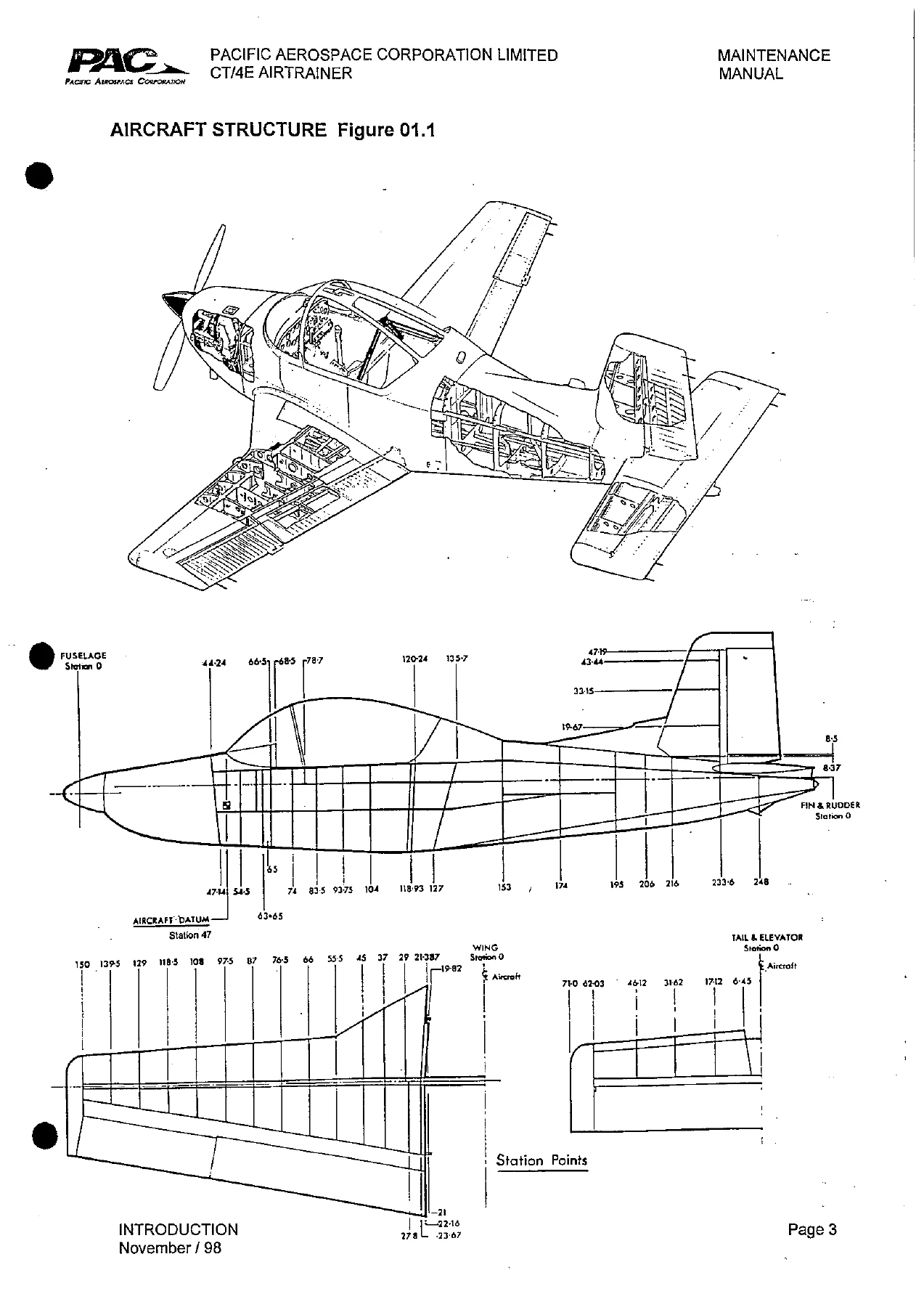
The document opens with a plain structural breakdown of the aircraft – fuselage, left hand wing, right hand wing and empennage – and explains that the wing and empennage units share a common method of construction using sheet alloy ribs and spars with stressed alloy skinning, while the fuselage is built on six longerons with pressed sheet alloy frames and stressed skins. From there the manual defines which parts of the aircraft are treated as primary structure and which are excluded, so you know exactly where a repair stops being a cosmetic job and becomes a structural one.
The general maintenance rules are set out early and they matter: split pins, lockwire and similar items are treated as consumable and must not be reused; where pipes and flexible hoses are disconnected, plugs should be fitted to keep foreign matter out; and American AN standard bolts and nuts are used throughout the airframe apart from the few exceptions noted in the relevant chapter text.
Scheduled Maintenance and Inspection Planning
Chapter 05 is the backbone of the CT/4E Airtrainer maintenance manual. It lays out the time limits and the recommended maintenance schedule built around aircraft flight time and calendar time, with inspection intervals at 25, 50, 100 and 500 hours. The inspection schedule is presented as a working checklist divided into engine group, cockpit group, fuselage and empennage group, wing group, landing gear group and general items, so each task can be signed off and recorded against the airframe serial number.
Airworthiness limitations are listed alongside the schedule, including the wing assemblies and the wing centre splice with their service life in flight hours and the requirement to dismantle and inspect in accordance with the relevant service bulletin at the stated interval. An unscheduled maintenance section covers heavy landing and abnormal flight load inspections, taking you through the symmetry check, main and nose landing gear examination, wing and engine mount inspection, fuselage skin check and empennage inspection that follow a hard arrival.
Structures, Systems and Controls
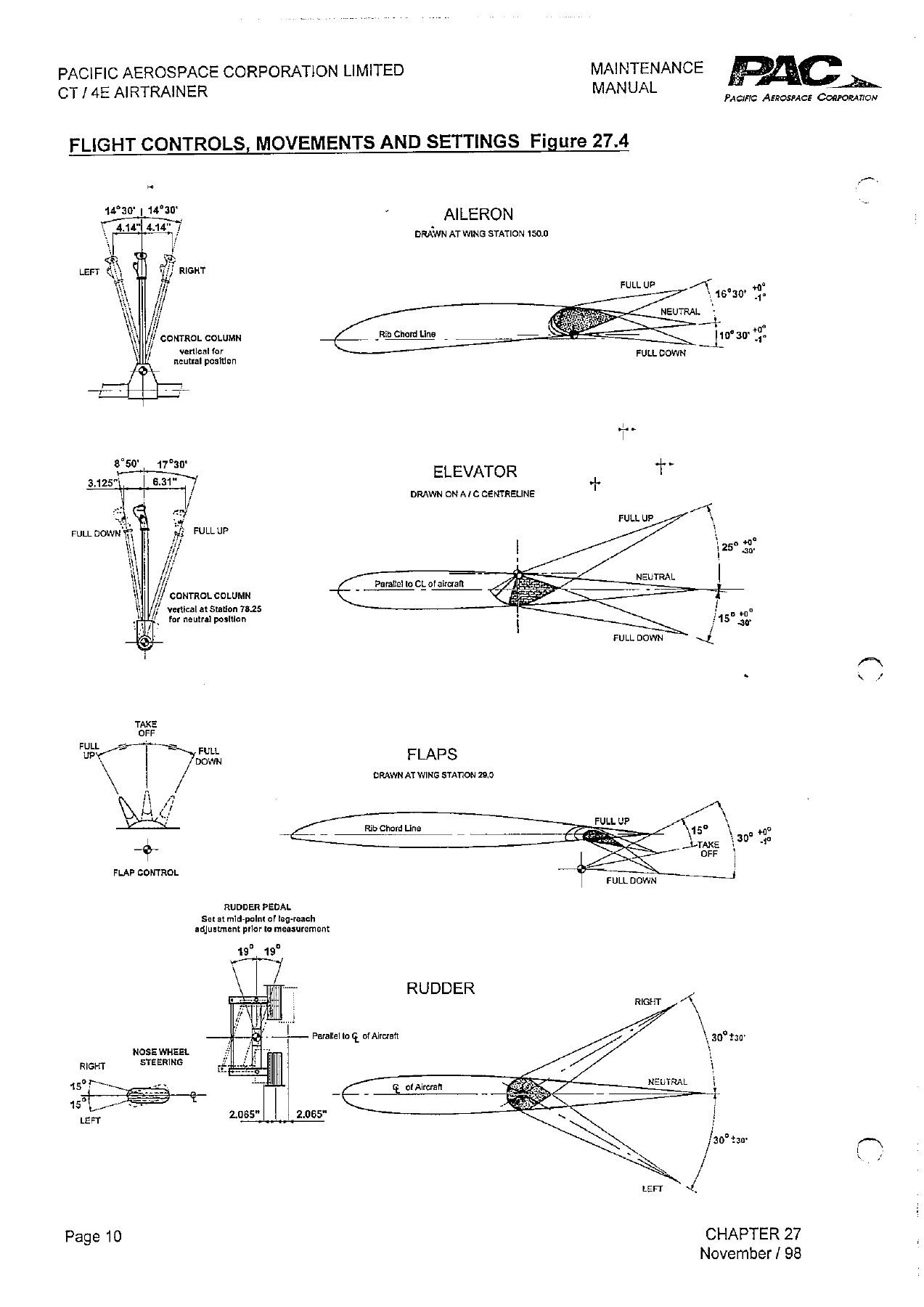
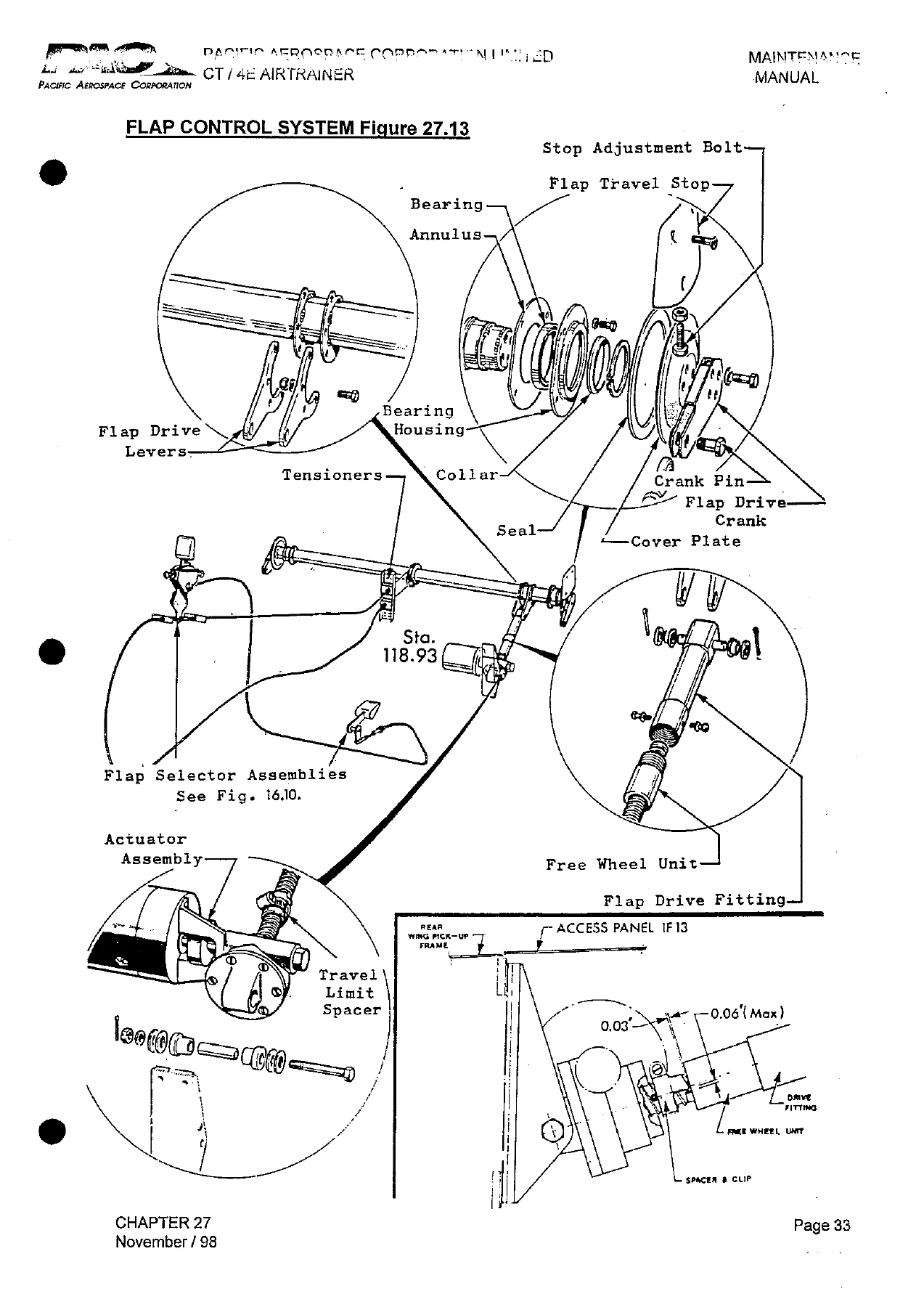
Chapter 27 on flying controls is one of the most detailed parts of the Pacific Aerospace CT/4E Airtrainer Maintenance Manual. It documents aileron, elevator, rudder and flap construction, then walks through removal and installation of each surface, the pushrod and bellcrank systems, rigging procedures with their specific travel figures, and static friction load tests for the aileron and elevator systems. The rudder control rigging section includes cable tensioning data and the sprocket alignment procedure, and the flap system coverage extends to the torque tube, actuator, follow-up cables, travel limit spacers and selector synchronisation.
Electrical coverage in Chapter 24 describes a 24 volt DC negative earthed single wire earth return system and explains the alternator, regulator, battery master relay, ammeter shunt and bus bar arrangement, together with removal and installation procedures for each component and the wiring insulation resistance test limits.
Specifications and Consumables
Chapter 06 gives the aircraft’s dimensions and areas, wing and empennage geometry, landing gear and tyre data, engine and propeller identification, and fuel capacity. Chapter 12 gives the fuel, oil and grease specification table with NATO, US MIL and British equivalents, the oil quantity recommendations for long range, normal, aerobatic and minimum safe flight, and the lubrication charts for flying controls, engine controls, undercarriage and brakes, and the canopy mechanism.
Get the CT/4E Airtrainer Maintenance Manual
Whether you are running an annual inspection, chasing an intermittent control feel, replacing a flap actuator, re-rigging ailerons, tracing a charging fault or working through a heavy landing inspection, this Pacific Aerospace CT/4E maintenance manual gives you the removal and installation sequences, the rigging figures and the servicing data you need. Correct procedures and the right specifications are what keep a CT/4E airworthy and keep the paperwork defensible, and having the material on hand saves the guesswork and the wasted labour that comes with working from memory.
IMAGES PREVIEW
The manual is delivered as an instant PDF download after payment – no shipping, no waiting. Open it on a laptop in the hangar, a tablet on the wing, or print the pages you need for the job at hand.
Reviews
There are no reviews yet.