
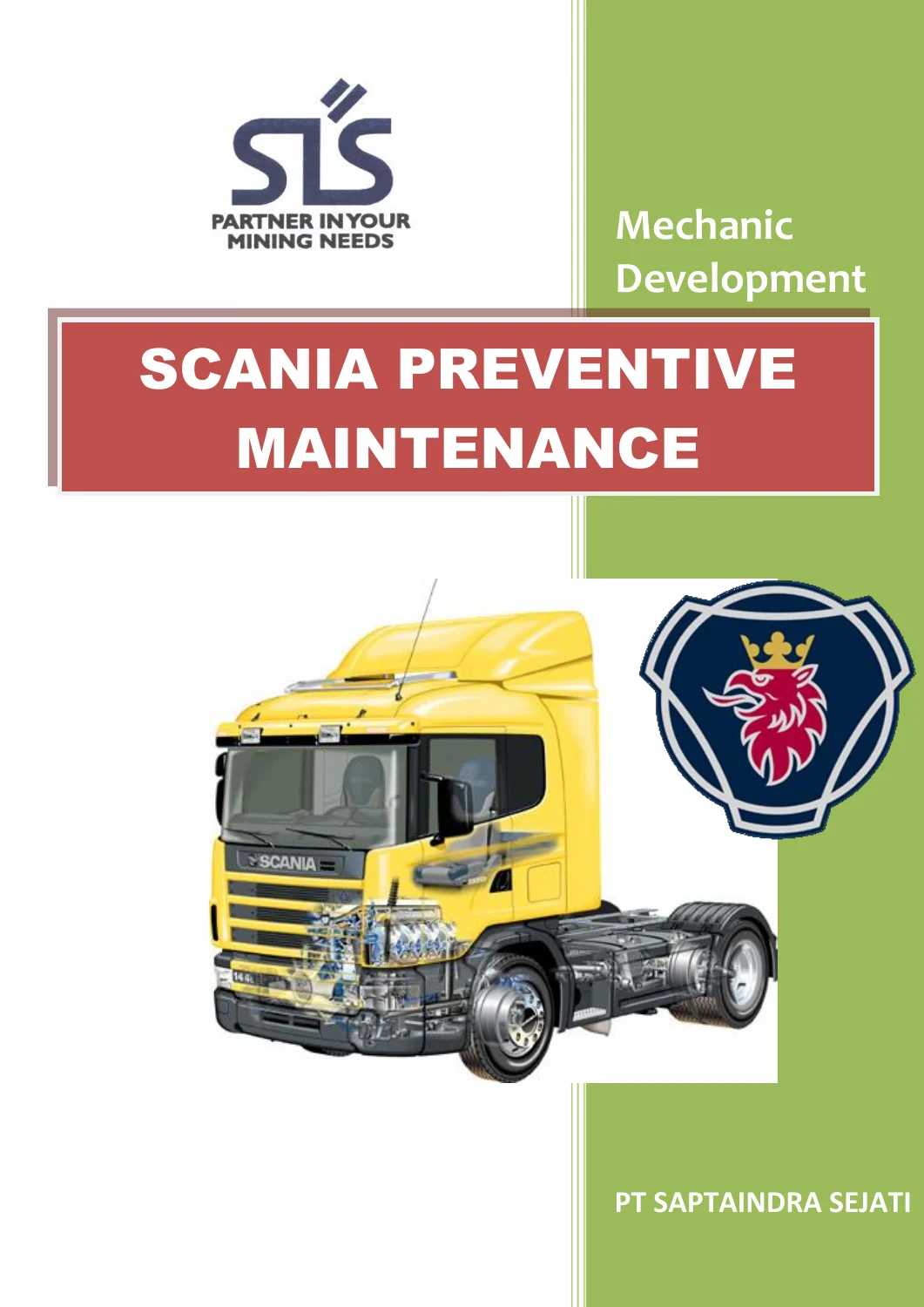
Scania Preventive Maintenance Mechanic Development Manual PT Saptaindra Sejati 4-Series PDF
Original price was: $32.95.$18.95Current price is: $18.95.
Compiled PT Saptaindra Sejati mechanic development pack covering SIS planned-maintenance SOPs, oil-sampling standards for a mixed mining fleet, and Scania 4-series maintenance instructions with fluids data in Indonesian and English.
Description
File Details
- Manual type: Mechanic development / planned maintenance compilation (SIS SOPs plus Scania 4-series maintenance instructions)
- Brand / publisher wrapper: PT Saptaindra Sejati (SIS) – Mechanic Development
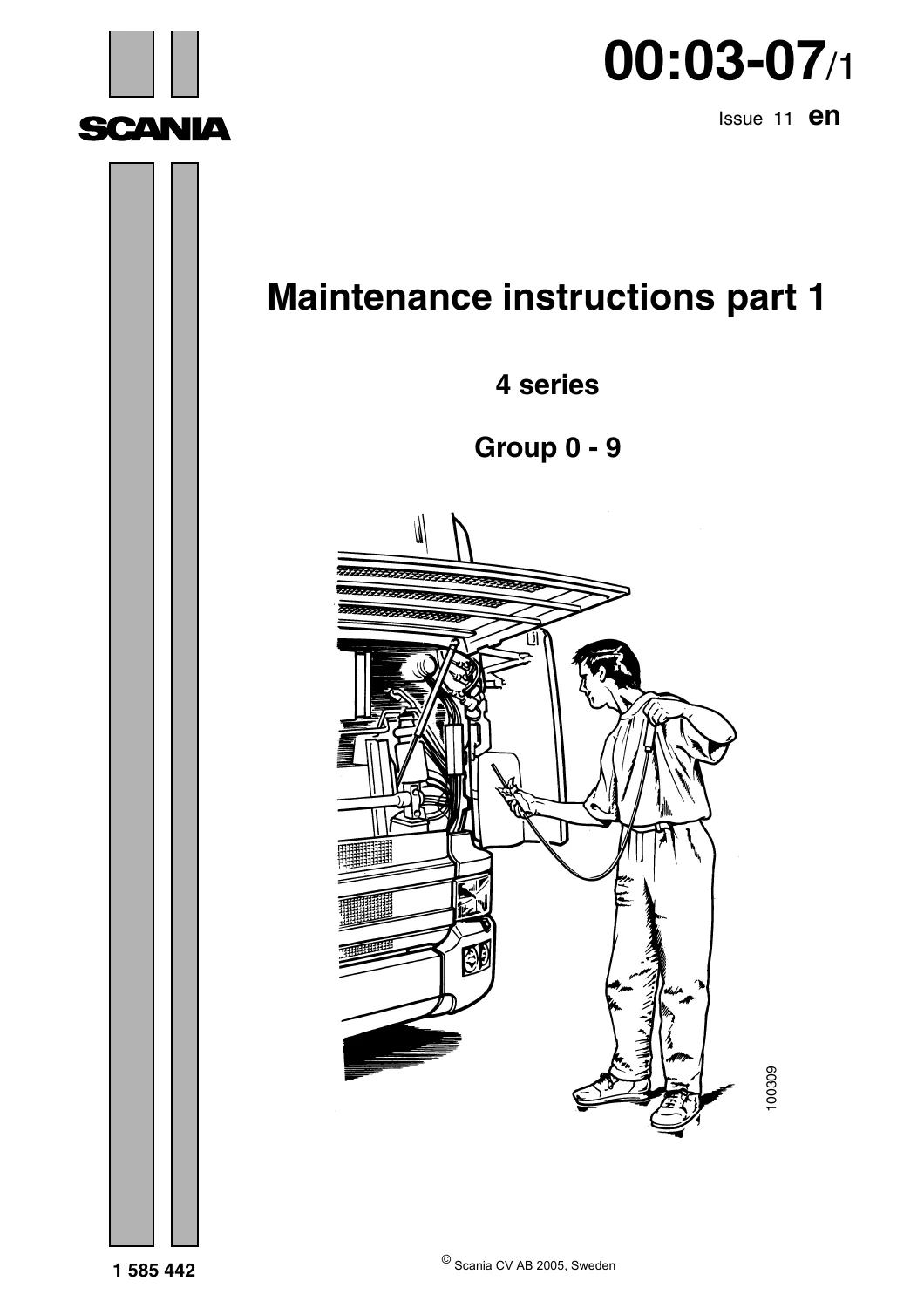
- Scania booklets included: 00:03-09 Fuel, lubricants and fluids; 00:03-07/1 Maintenance instructions part 1 (Groups 0-9); 00:03-07/2 Maintenance instructions part 2 (Groups 110-19)
- Scania issue data shown: Issue 11 en, part no. 1 585 442, 4 series, copyright Scania CV AB 2005
- SIS document examples: PLO/09/008/SOP Planned Maintenance (Rev. 0); related INK/STD forms for PS, PAP, PPM, PPU and midlife
- Language: Indonesian and English
- Page count: 382
- File format: PDF
What This Pack Actually Is
The Scania Preventive Maintenance Mechanic Development Manual PT Saptaindra Sejati 4-Series PDF is not a single-model overhaul book for one machine. It is a jobsite training compilation used by PT Saptaindra Sejati. The front half sets out the company’s Maintenance Management System and planned-maintenance rules for a mixed mining fleet. The later half embeds Scania 4-series maintenance instruction booklets and the matching fuel, lubricant and fluid tables. Buyers who need company SOP flowcharts, oil-sample bottle counts, and Scania 4-series inspection work in one file will find that combination here. Buyers looking for a complete engine rebuild or wiring atlas for one chassis should treat this as a preventive-maintenance and fluids package, not a full workshop overhaul set.
SIS Planned Maintenance Framework
The opening charts map SIS-MMS from production planning through maintenance scheduling, backlog control, data management, failure analysis and performance measurement. Supporting blocks cover manpower and mechanic development, audit, tools and facilities, equipment management and SHE awareness. SOP PLO/09/008/SOP Planned Maintenance states the purpose: control the planned-maintenance process from budget and parts through execution, aligned with ISO 9001:2008 elements listed in the document (quality records, facilities, work environment, process planning, identification and traceability, process monitoring, continual improvement and corrective action).
Definitions used throughout the SIS pages include Hour Meter (HM), Ready For Use (RFU), Work Order issued through Ellipse, Periodic Service (PS), Program Analisa Pelumas (PAP), Program Pemeriksaan Mesin (PPM), Program Pemeriksaan Undercarriage (PPU), backlog, midlife overhaul, Ground Engaged Tool (GET), consumable goods, Master Plan Overhaul, Redo PS, Purchase Requisition and Purchase Order. Periodic Service is scheduled on 250-hour multiples: PS 250 (1), PS 500 (2), PS 1000 (3) and PS 2000 (4). Equipment without an hour meter follows calendar intervals from the Operation Maintenance & Manual (OMM).
Policy text assigns yearly master scheduling to the Plant Planner using year-end HM, component life, last overhaul, planned working hours, scrap plans and trends from PPM, PAP, PPU, backlog, trouble, oil consumption and cost. Yearly planning starts in September and is finished in October. PS delay tolerance is 50 operating hours past the due point; beyond that the unit is not to be operated. Wheel-type units take PS in the workshop; track-type units may be serviced in the field or workshop. RFU is declared only after a final check, and the clock starts when MCR receives the RFU report. Cleanliness of grease pumps, oil pumps, compressors, hose reels and tanks is a daily Group Leader duty.
PPU intervals printed in the SOP are 500 hours for dozers and 1000 hours for excavators, shovels and drilling machines, with weekly reports to Head Office. PPM is scheduled every 1000 hours with Periodic Service and may be pulled forward when a condition test is needed. PAP oil samples are taken at Periodic Service (or earlier if a lubricant problem appears), with the component still hot, no settled oil, clean bottles and tools, and a completed sample card. Samples must reach Logistics within one day of collection.
IMAGES PREVIEW
Chapters Covered
- SIS Maintenance Management System (SIS-MMS) overview and numbered process map
- SOP Planned Maintenance PLO/09/008/SOP – purpose, scope, references, definitions, policy
- INK Pelaksanaan Periodic Service PLO/09/004/INK – document and parts readiness, wash, visual check, PAP sample, PS and backlog work, final inspection, ground test, RFU
- INK Pengambilan Contoh Oli PLO/09/007/INK – vacuum-pump method and drain method
- STD Parameter Oil Sampling PLO/09/004/STD – bottle counts by main model and PS interval
- INK Pelaksanaan PPM & VHMS PLO/09/005/INK – 1000-hour inspection, VHMS download (cable or wireless), backlog from out-of-spec findings
- INK Pelaksanaan PPA PLO/09/008/INK – attachment / GET inspection, immediate repair versus backlog
- INK Pelaksanaan PPU PLO/09/006/INK – undercarriage visual check, wear measurement, replacement scheduling
- SOP Program Midlife Overhaul PLO/09/011/SOP – turbocharger, starter, water pump, alternator, air compressor, nozzle and related sub-components
- SOP Work Order Unscheduled Maintenance PLO/09/005/SOP – downtime status, Mechanic Order List, warehouse requisition, field versus workshop split
- Preventive maintenance theory – fuel types and sulphur, cetane, oil categories and deterioration limits, TAN, flashing point / fuel dilution, coolant and radiator valve, corrosion resistor, air cleaner and precleaner, grease selection and molybdenum disulfide lubricants
- Scania 00:03-09 Fuel, lubricants and fluids – volumes, engine oil tables, diesel and RME notes, Scania LDF / ACEA grades, gearbox and axle oils, coolant mix, ACL grease, A/C refrigerant R134a
- Scania 00:03-07/1 Maintenance instructions part 1, 4 series, Groups 0-9 – general lubrication, engine, cooling, fuel and exhaust, clutch, gearbox, propeller shafts, front and rear axles, hubs and wheels
- Scania 00:03-07/2 Maintenance instructions part 2, 4 series, Groups 10-19 – brakes and retarder, frame, suspension, steering, electrical diagnostics, cab tilt, Interactor 500, fifth wheel and tow hook
- Scania LDF approved-oil list
Taken together, the compilation gives a planner the company rules for when a unit comes off the line, and gives a mechanic the Scania 4-series inspection steps, fluid grades and fill volumes to carry out that service. The theory chapters explain why sulphur, soot, water quality and grease thickener matter on a dusty jobsite. The oil-sampling standard tells the sampler how many bottles to pull on PS 250 through PS 2000 for each listed machine class.
Oil Sampling Coverage in the SIS Tables
PLO/09/004/STD lists sample points and bottle quantities by main model. Classes printed in those tables include bulldozers (Komatsu D375, D85ESS-2, D155A-6), motor graders (Caterpillar 24M and 16M, Komatsu GD825A and GD705A), wheel loaders and wheel dozers (WA800-3, WA500-3, WD600-3), articulated dump trucks (Komatsu HM400-1, Volvo A40D, CAT740), rigid dump trucks (HD785-7, HD785-5, HD465-5, HD465-7, Renault Kerax350), drilling machines (Drilltech D245S and D50KS, Tamrock Pantera1100, Furukawa HCR1500ED, Sandvik DP1100), prime mover Volvo FH16, and excavators (Liebherr R9250, Komatsu PC1250-7/8, PC2000-8, PC3000-6, PC1800-6, PC750-7, PC800-7, PC400-7, PC200-7, Hitachi EX1200-5 and EX2500-5). Engine-only samples are typical at PS250; later intervals add power train, hydraulic, axle, swing and travel compartments as specified per model. Those tables govern PAP bottle counts. They are not a substitute for each OEM’s full shop manual.
Scania 4-Series Maintenance Instructions
From the fluids booklet onward, the Scania Preventive Maintenance Mechanic Development Manual PT Saptaindra Sejati 4-Series PDF follows Scania 4-series trucks and buses. Engines named in the volume and oil-change tables include D9 (including the 5-cylinder), DC11, D12, D16, DSC11, DSC14 and OSC11. Ethanol engines DS111 E01 appear only in the fuel-approval notes. Coolant volumes printed as approximate figures are about 30 litres for the 9-litre 5-cylinder, 40 litres for the 9-litre, 50 litres for 11- and 12-litre, and 80 litres for 14- and 16-litre engines, plus about 20 litres extra when a retarder is on the cooling circuit.
Engine oil capacities in 00:03-07/1 are given as ranges: 30-37 litres (9-litre 5-cylinder), 23-30 litres (9-litre and 11-litre 2-valve), 28-35 litres (11- and 12-litre 4-valve), 22-30 litres (14-litre) and 26-32 litres (16-litre). The 00:03-09 vehicle table adds first-fill versus oil-change volumes and filter volumes (1.6 litres on D16, 2.0 litres on the other listed types). Gearbox examples include GR900 / GRS900 family fills around 15.7-16.8 litres, GR801 at 8.9 litres, Allison GA750-series and GA851-series change and total volumes, ZF automatic change/total volumes, Scania retarder 5 litres at change / 7.5 litres total, and axle and hub fills for R560/660/780, RP730-835, RD760, RB/RBP bogie gears and RH730-835 hubs.
Part 1 work includes chassis lubrication and ACL system fill (NLGI 0-NLGI 2), tool-kit check, engine oil and oil-cleaner service, insert filter, crankcase ventilation, poly-V-belt and belt tension, valve and unit-injector setting on 9-litre 5-cylinder, 9/11/12-litre 6-cylinder, and 14/16-litre engines, PDE and HPI injector checks, air cleaner and intake manifold, coolant and coolant-filter renewal, corrosion-inhibitor measurement, fuel-filter renewal and bleeding (including 9-litre 5-cylinder PDE bleeding), gas-engine notes, Scania particle-filter cleaning, clutch fluid and wear, torque-converter level and filter, manual and automatic gearboxes, Opticruise, transfer box, ZF-Transmatic, propeller-shaft and support-bearing checks, front and rear axle oil, tag-axle lift, hub reduction gears, wheel-bearing check, wheel-nut tightening and tyre tread limits.
On the 9-litre 5-cylinder PDE engine the booklet prints a cold unit-injector height of 66.9+/-0.1 mm, intake valve clearance 0.45 mm, exhaust 0.70 mm, injector rocker locknut 39 Nm and valve rocker locknut 35 Nm, with flywheel marks (TDC Down 0°, 72°, 144° and related angles) and tool 99 309 for rotation. Wheel-nut torques printed in the hubs section are 600 Nm for disc wheels, 315 Nm for 28-inch spoke wheels, 350 Nm for other spoke wheels and 270 Nm for a brake drum secured in a spoke hub, using torque socket 98 661 or spoke socket 588 117. Tyre tread is not to fall below 3.0 mm for retread or traffic-safety minimum in the text; the worn-tyre warning is given as 1.6 mm.
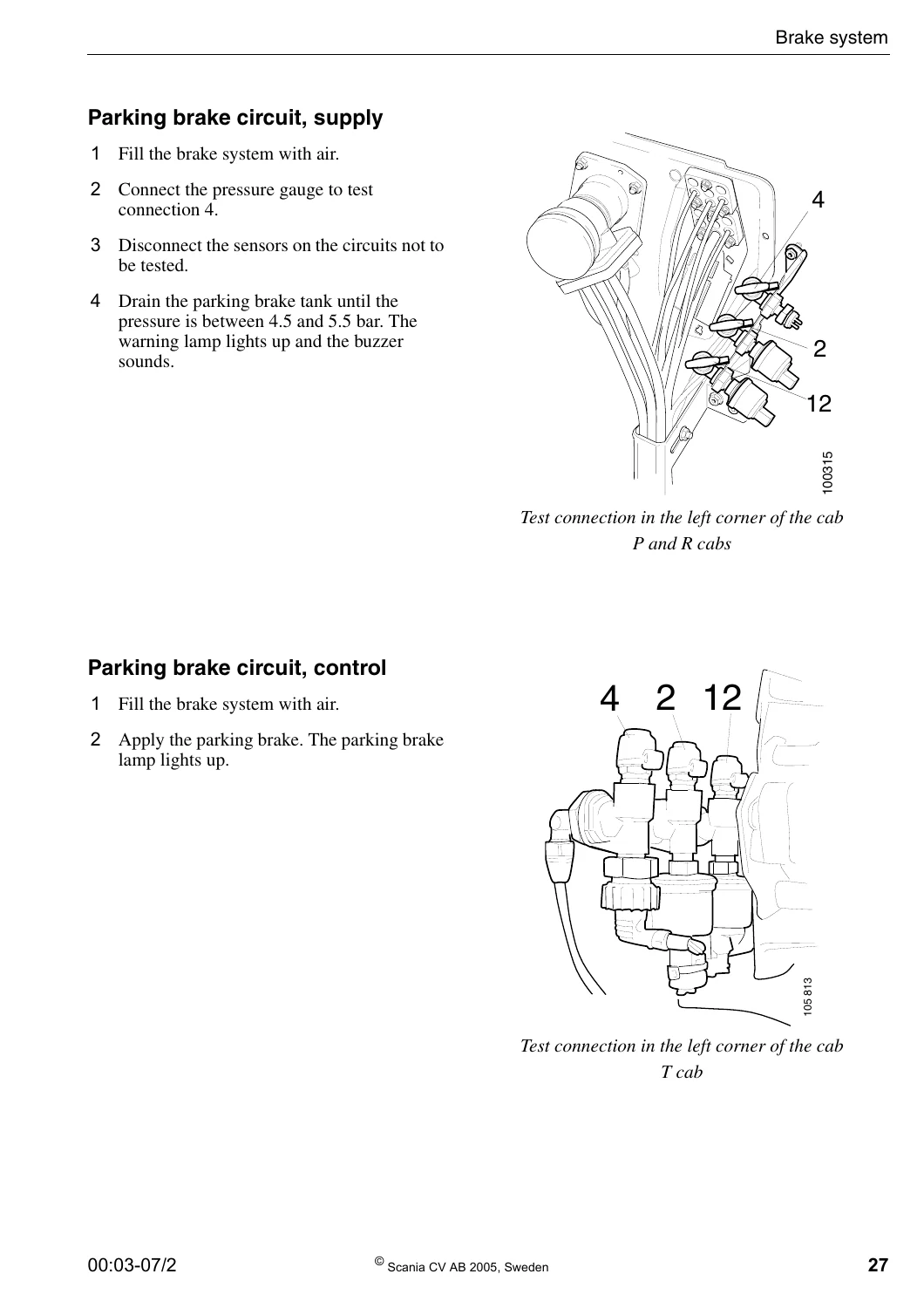
Part 2 covers air dryer function, drum and disc brakes (including Scania Diagnos / SD2 pad-wear checks), brake piston stroke, Scania retarder oil and filter (level plug 26 Nm), warning lamps and sensors, circuit integrity and check valves, trailer relay valve, load-sensing valve on air suspension, secondary brake valve tests with 2.5 bar and 15 bar gauges, liquid separator, engine and gearbox brackets, frame drilling limits, suspension clamp bolts, balance tandem, torque rods, air-spring height checks, power-steering oil, double-front-axle weight split, battery fluid and charge, headlamp aim, fault-code read/clear with PC and VCI through Scania Diagnos, EDC, Opticruise, Allison gearbox codes, Bosch ABS/TC CP12, Bosch EBS, Wabco ABS/TC D, retarder electrics, ELC air suspension, cab tilt pump and drive-level setting, heater filter, Scania Interactor 500 dust filter, bodywork interface notes, fifth wheel and tow hook.
Fluids, Fuel and Coolant Rules in the Scania Booklets
Engine-oil approvals are split by emission step: Euro 1 and Euro 2 list ACEA E3, E4, E5, DHD-1 and Scania LDF; Euro 3 lists ACEA E5, E7, DHD-1 and Scania LDF. Low-viscosity LDF oils SAE 5W-30 and 10W-30 have printed ambient windows. Transmission oil is API GL-5 where stated; Scania retarder oil is ATF meeting Allison C4 or C4-compliant SAE 5W-30 / 10W-30 engine oil. Clutch fluid is SAE J 1703 (DOT 3 or 4). Power steering is ATF Type A Suffix A. Diesel may include up to 5% by volume RME when the fuel meets the quality text; ethanol is limited to part no. 1 412 812 on the named DS111 engines.
Coolant is water plus 35-45% by volume Scania Anti-freeze 1 745 202 (not above 60% in pre-mix where frost protection is required) or 8-12% Scania corrosion inhibitor 1 745 199 where freezing is not a risk. Approved third-party antifreezes named include Havoline XLC and Glysantin G48; approved inhibitors include Havoline XLI and Glysacorr G93. Air-conditioning work on R134a systems specifies Scania dehydrator 1 337 496. ACL grease flow pressure at lowest use temperature is max 1.4 bar per DIN 51805.
How a Jobsite Crew Would Use the File
A planner building the yearly PS, midlife and overhaul calendar works from the SIS master-plan rules and the supporting forms listed in PLO/09/008/SOP (daily inspection, PS, PPM, PPU, pit-stop, yearly service program, schedule overhaul, availability and failure reports, PAP lead-time monitoring, backlog summary). A Group Leader running a Periodic Service follows the PLO/09/004/INK flow: confirm Form PS, job card, daily plan and PAP report, confirm parts and tools, wash the unit, record actual HM, pull oil samples by vacuum or drain method, execute the PS checklist and any agreed backlog, run PPM/PPU/PPA if those jobs sit on the same window, then final-inspect, ground-test and sign RFU—or park the unit as unscheduled breakdown if a part is missing and the machine is not safe to release.
On a Scania 4-series truck or bus the same crew opens the 00:03-07 booklets for the actual oil grade, fill volume, valve or injector setting, brake-circuit test point and Diagnos sequence. The fluids booklet stays on the bench for coolant mix, LDF oil choice and component fills. That split—company process in the front, Scania task detail in the back—is the reason this compilation exists as a mechanic-development text rather than as a single OEM binder.
Get the Procedures on the Bench
With the Scania Preventive Maintenance Mechanic Development Manual PT Saptaindra Sejati 4-Series PDF a mechanic can run SIS Periodic Service, PAP sampling, PPM/VHMS checks, PPU wear measurement and midlife sub-component planning, then carry out Scania 4-series inspection work on engine oil and valves, injectors, cooling and fuel filters, clutch and gearbox fluids, axles and hubs, brakes and retarder, air suspension, steering, cab tilt and on-board diagnostics. Using the printed intervals, fill volumes, clearances and torque figures reduces guesswork on oil grade, injector height, wheel-nut torque and brake test pressures. After payment the file is delivered instantly as a PDF, with no shipping wait, readable on any device and printable for the workshop copy.
Reviews
There are no reviews yet.