
Tecnam P-Mentor Aircraft Flight Manual Ed.1 Rev.7 2023 – PDF Download
Original price was: $39.95.$23.95Current price is: $23.95.
Complete 390-page Tecnam P-Mentor Aircraft Flight Manual, Doc 2002/1032 Ed.1 Rev.7 dated January 2023. Covers limitations, emergency and normal procedures, performance, weight and balance, systems description, maintenance, and the full supplement set. Instant PDF download.
Description
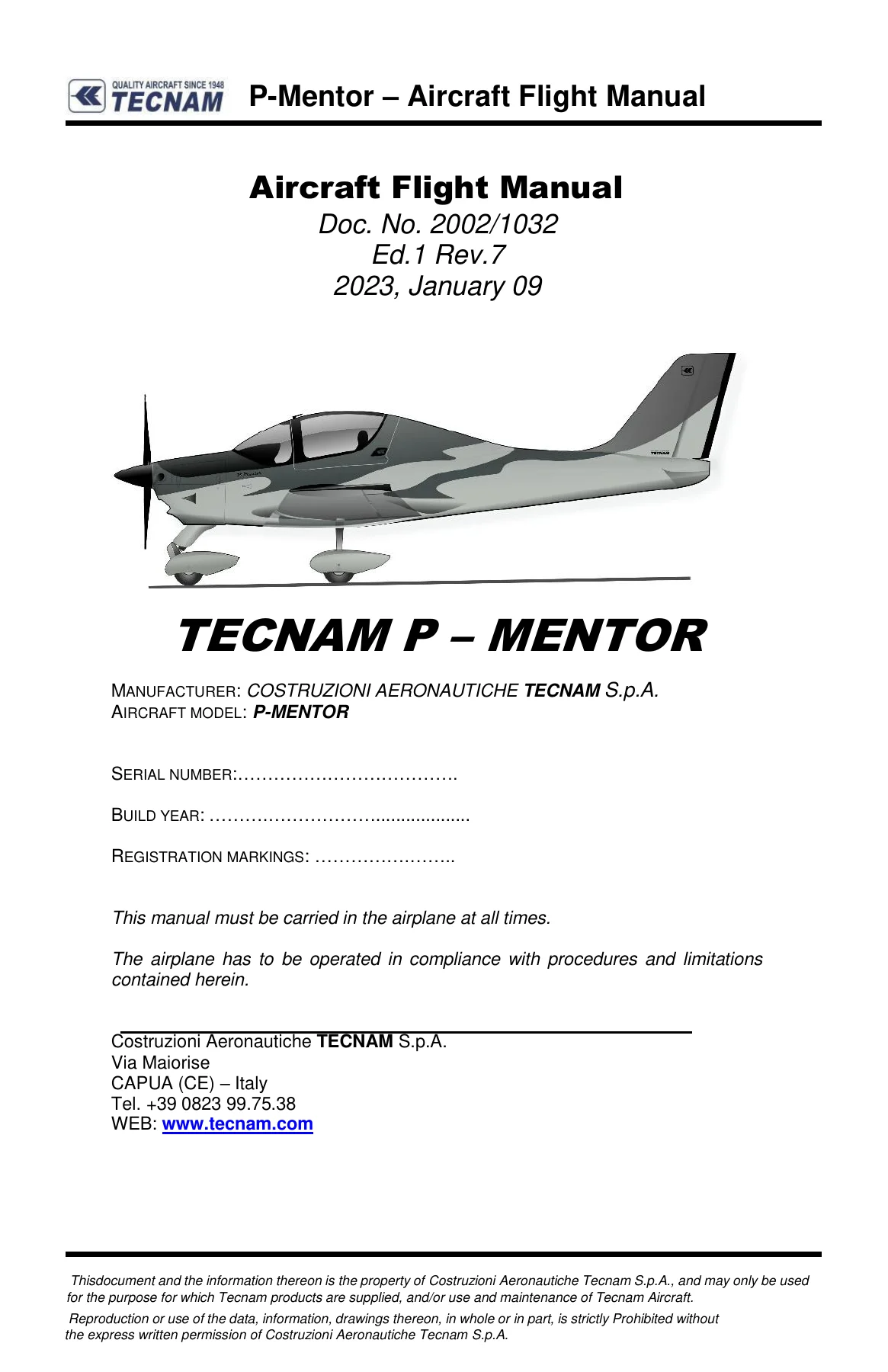
Tecnam P-Mentor Aircraft Flight Manual – Edition 1 Revision 7, 09 January 2023
This is the complete Tecnam P-Mentor Aircraft Flight Manual, document number 2002/1032, Edition 1 Revision 7, issued 09 January 2023 by Costruzioni Aeronautiche TECNAM S.p.A. The manual covers the full scope of P-Mentor operation and ownership: general description and dimensions, operating limitations, emergency and normal procedures, performance charts, weight and balance, airframe and systems description, aircraft care and maintenance, and the entire supplement set including the Garmin GFC500 autopilot, GNC 255A COM/NAV, KR87 ADF, KN63 DME, landing gear extraction simulation, GTR 225A COM radio, and the Argentine AFMS. It is the complete 390-page reference, not an excerpt or a partial scan.
File Details
- Manual type: Aircraft Flight Manual (AFM)
- Manufacturer: Costruzioni Aeronautiche TECNAM S.p.A.
- Aircraft model: P-Mentor
- Document number: 2002/1032
- Edition: 1st Edition
- Revision: Rev. 7
- Date: 09 January 2023
- Language: English
- Page count: 390 pages
- File format: PDF
Chapters Covered
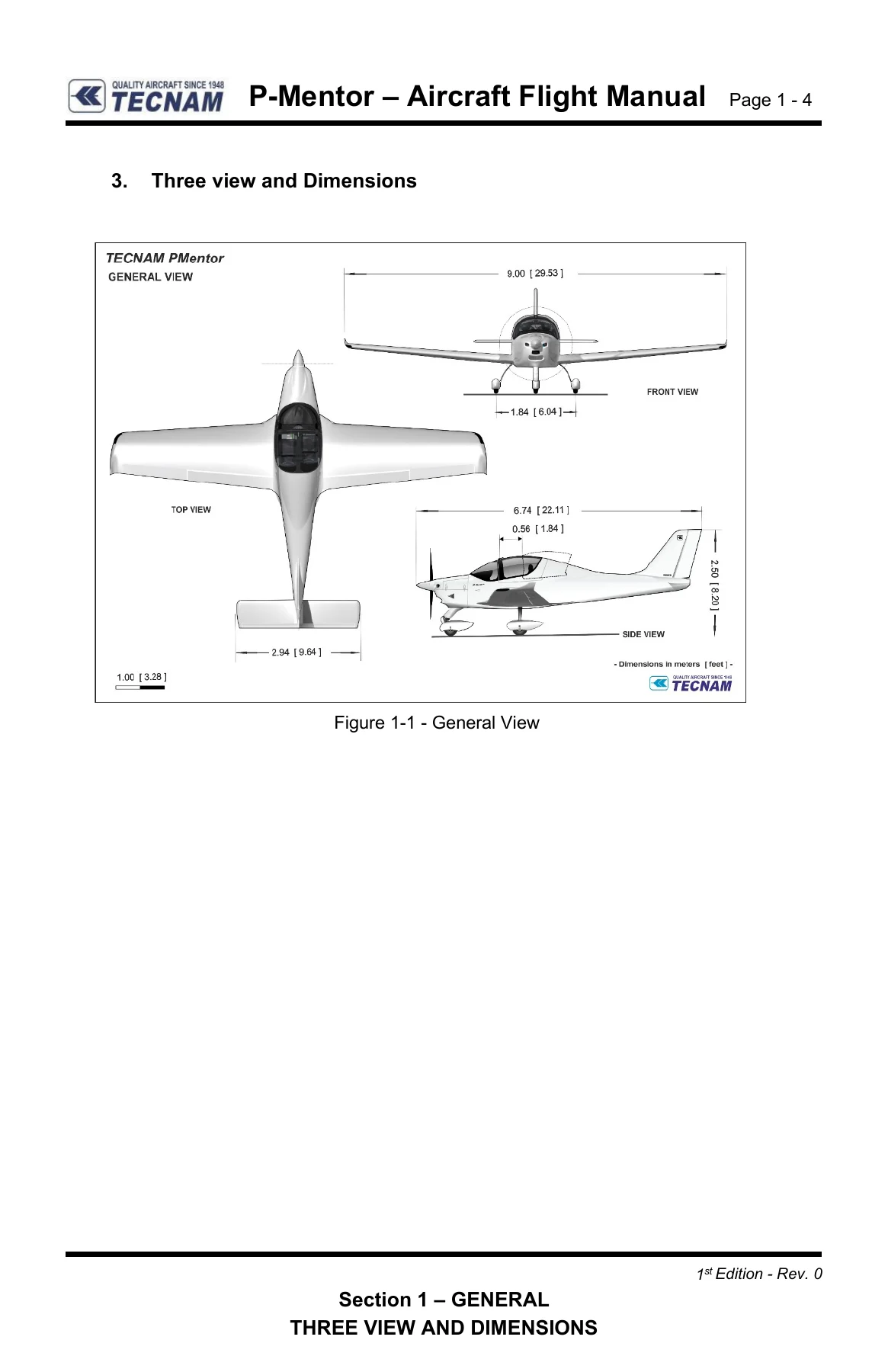
- Section 1 – General: Introduction, warning/caution/note definitions, three-view and dimensions, engine, propeller, governor, maximum weights and specific loadings, fuel/lubricant/coolant, acronyms and terminology, unit conversion chart, litres/US gallons conversion chart, designation of circuit breakers.
- Section 2 – Limitations: Speed limitations, airspeed indicator markings, powerplant limitations, instrumentation markings, fuel, oil, coolant, operative and additional limitations, weights and centre of gravity limits, manoeuvres and load factor limits, seats and baggage, limitation placards, avionic system limitations, kinds of operation, PBN (RNAV and RNP) operational capability.
- Section 3 – Emergency Procedures: Reference airspeeds, annunciator and alert summary, electrical system failures (low volt, generator failure, backup battery, loss of essential/main/avionic bus), pitot-static system failures, avionic system failures, engine securing, aircraft evacuation, powerplant emergencies (engine failure, propeller overspeed, coolant/EGT/MAT/oil limit exceedances), fuel system, in-flight engine restart, LANE A/B warnings, smoke and fire, flight controls, recovery from unintentional spin, icing, rescue system deployment, emergency landing, landing gear failures.
- Section 4 – Normal Procedures: Airspeeds for normal operations, pre-flight inspection (cabin and walk-around), full checklist from before starting engine through engine starting, warm-up, taxiing, before take-off, take-off, climb, cruise, descent, before landing, balked landing/missed approach/go-around, landing, engine shutdown, post-flight checks.
- Section 5 – Performance: Use of performance charts, demonstrated operating temperature, gradient/rate of climb and descent, airspeed indicator system calibration, ICAO standard atmosphere, stall speed, crosswind, take-off performance, take-off rate of climb, en-route rate of climb, cruise performance, landing performance, balked landing performance, noise data.
- Section 6 – Weight and Balance: Weighing procedures, levelling, weighing record, weight and balance determination for flight, baggage loading, equipment list.
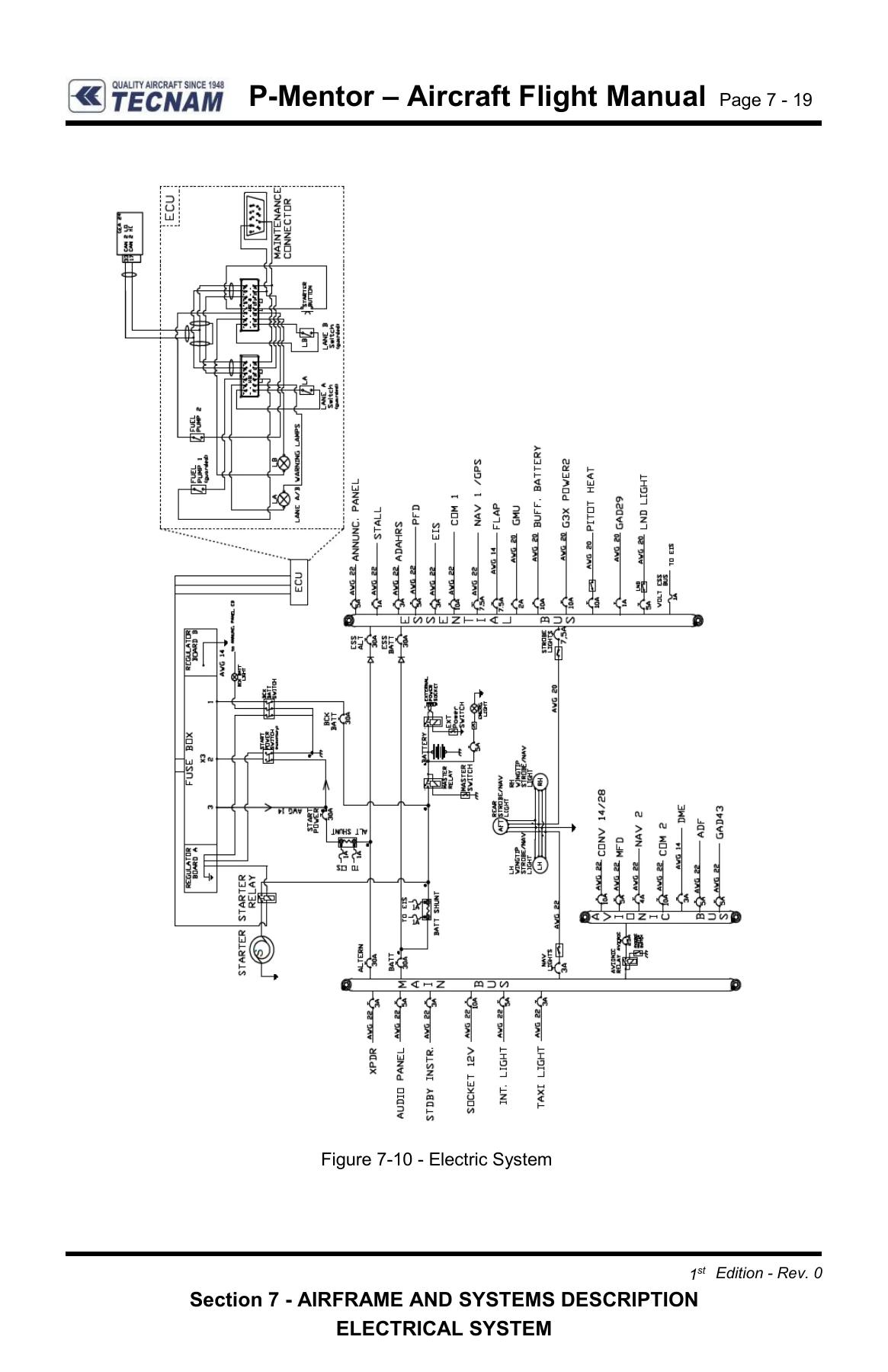
- Section 7 – Airframe and Systems Description: Wing, fuselage, empennages (horizontal tail, vertical tail), landing gear, flight controls, instrument panel, cabin heat, seats and safety harness, canopy, powerplant (engine, propeller, air intake, control levers, fuel, cooling, lubrication), electrical system (EMS, warning panel, annunciator panel, stall warning, master switch, external power, engine starter panel), avionic system (Garmin G3X Touch suite, GDU 460, GTN 650Xi, GNC 255A, GMA 245R, GTP 59, GSU25, GMU 11, GTX 345R, GEA 24, GI-275), pitot-static pressure systems, lights, parachute system, placards.
- Section 8 – Aircraft Care and Maintenance: Inspection intervals, aircraft changes or repairs, refuelling, landing gear tire pressure control, cleaning and care, ice removal.
- Section 9 – Supplements: S01 Garmin GFC500 Autopilot, S02 Garmin GNC 255A, S03 KR87 ADF System, S04 KN63 DME System, S05 Landing Gear Extraction Simulation, S07 GTR 225A, S08 AFMS for Argentine Aircraft.
The document is structured as a genuine operating manual. A general and limitations section pins down every speed, weight, and CG limit the aircraft must be flown within. The limitations section includes the Kinds of Operation Equipment List (KOEL) and avionics limitations. Emergency and normal procedures are written as checklists with boxed bold-face memory items where TECNAM requires them. Performance data is presented in tabular and graphical form for take-off, climb, cruise, landing, and balked landing. A full weight and balance methodology covers the weighing record and CG envelope. The systems description goes deep into the Rotax 912 iSc 3 Sport engine installation, the dual-alternator 14 VDC electrical architecture, the Garmin G3X Touch avionics suite, the pitot-static system, lighting, and the optional parachute recovery system. The supplement section then layers in the specific avionics and equipment configurations that can be installed on individual aircraft.
What This Manual Lets You Do
Used properly, this Tecnam P-Mentor Aircraft Flight Manual supports the complete range of flight, ground, and maintenance tasks the aircraft demands. Pilots get the exact speed limitations, weight and CG limits, normal and emergency checklists, and performance figures needed to plan and fly the P-Mentor safely. Instructors get the full reference for briefing and standardising P-Mentor operations. Maintenance personnel get the systems description, tire pressures, refuelling safety, and supplement-level information covering the Garmin GFC500 autopilot, GNC 255A, KR87 ADF, KN63 DME, and GTR 225A installations, plus the landing gear extraction simulator and the Argentine AFMS supplement. Because the manual carries the aircraft’s own limitation placards, circuit breaker designations, and equipment lists, it can also be used as a direct reference when verifying placarding, avionics configuration, or equipment installed against the airframe.
Delivery
IMAGES PREVIEW
Instant PDF download after checkout, no shipping and no waiting for a physical copy. The file opens on any device, can be printed for the hangar or flight bag, and can be kept on a tablet or laptop for quick reference. Because it is the full 390-page Tecnam P-Mentor Aircraft Flight Manual with every section and supplement included, it replaces the need to track down individual section revisions separately.
Reviews
There are no reviews yet.