
Volvo Penta D4 D6 Groups 20-26 Workshop Manual 47700149 – 01-2025 PDF
Original price was: $44.95.$26.95Current price is: $26.95.
306-page Volvo Penta D4 and D6 Groups 20-26 workshop manual, publication 47700149 (01-2025), covering specifications, troubleshooting, engine overhaul, fuel injection, turbo/supercharger, lubrication and cooling-system service.
Description
Volvo Penta D4 and D6 Engine Workshop Coverage
The Volvo Penta D4 D6 Groups 20-26 Workshop Manual 47700149 – 01-2025 PDF is a 306-page workshop reference covering engine service work across Groups 20 through 26. It combines specifications, safety instructions, special service tools, troubleshooting, complete-engine disassembly and assembly, internal engine inspection, fuel-system procedures, turbo and supercharger work, lubrication-system service, and fresh-water and sea-water cooling procedures. The manual identifies D4 and D6 variants throughout the technical data and procedure sections, including D4-180, D4-210, D4-225, D4-260, D4-300 and D6-280, D6-310, D6-330, D6-350, D6-370 and D6-435 families.
This is a hands-on engine workshop volume rather than an owner’s operating guide. Procedures are illustrated with engine photographs, component drawings, tightening sequences, tool references and measured limits. The opening information explains that the working methods are based on a workshop scenario and describes Volvo Penta Special Tools where those tools have been developed for the operation.
File Details
- Manual type: Workshop Manual
- Brand: Volvo Penta
- Models: D4, D6
- Group coverage: 20-26
- Publication number: 47700149
- Issue/date marking: 01-2025
- Language: English
- Page count: 306
- File format: PDF
Workshop Information for Diagnosis, Measurement and Repair
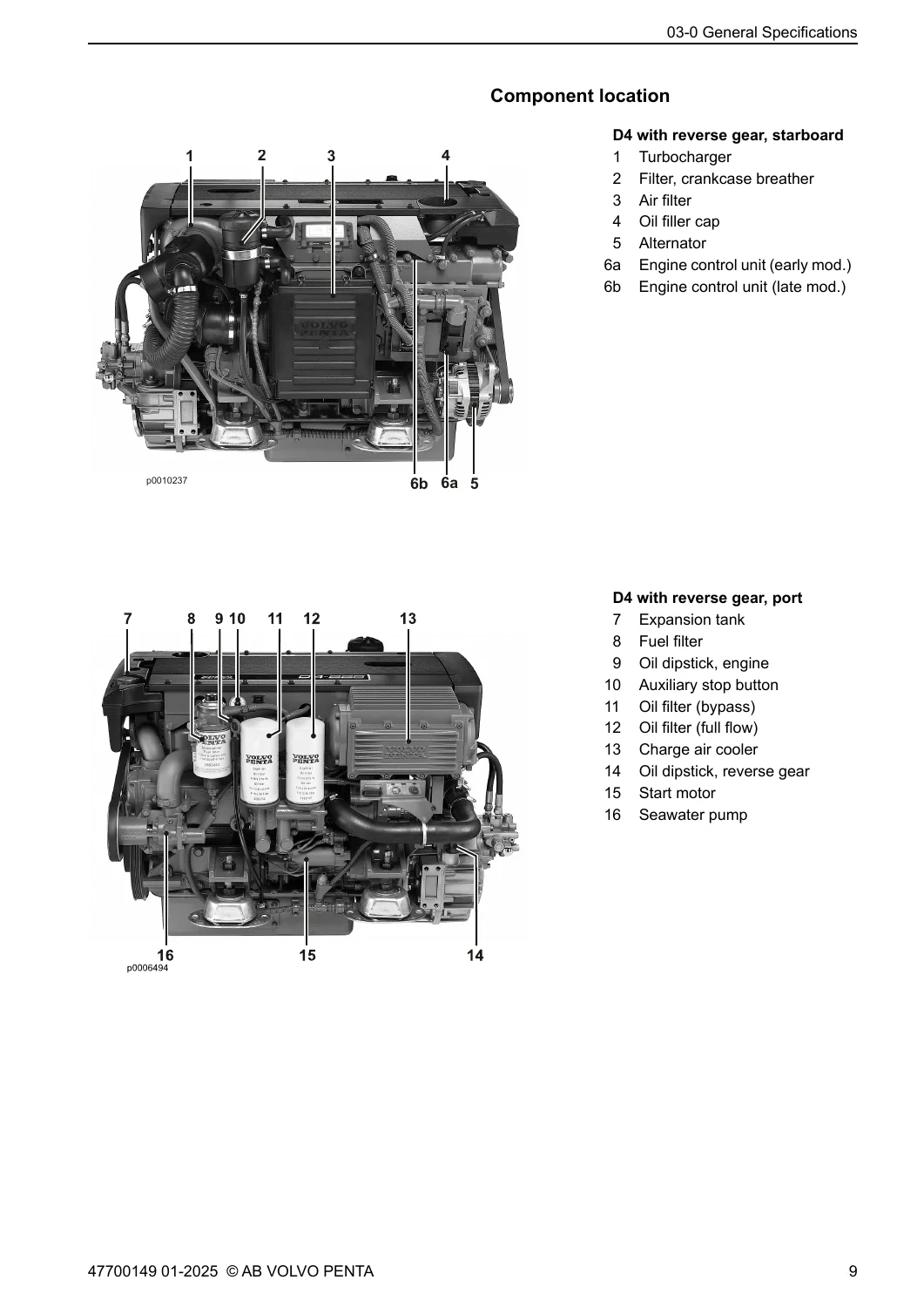
Before the long repair sequences begin, the manual provides general specifications and component-location illustrations for D4 and D6 installations. The technical data includes engine dimensions and service limits, general and component-specific tightening torques, sealant locations, lubrication data, fuel-system pressure information, turbocharger data, cooling specifications and electrical-system values. These sections are intended to be used alongside the repair steps so that inspection and assembly can be checked against the values stated in the same volume.
Troubleshooting is organized around symptoms a technician may actually encounter. The engine-information section gives checks for an engine that will not start with the starter engaged, a starter that does not engage, an engine that starts and then stops, an engine that stops during normal operation, low perceived power, black exhaust smoke, blue or white smoke, vibration, overheating, coolant loss, low oil pressure and high oil consumption. The checks point the reader toward areas such as fuel feed, air inlet, starter voltage, coolant level, seawater intake, thermostat, heat exchanger, oil condition, crankcase ventilation and related components.
The manual also includes a VODIA-based relative cylinder compression test. It explains that this is a comparison between cylinders rather than an absolute compression-pressure measurement and states that the test should be repeated several times to establish a meaningful trend. That operation is specifically marked as requiring prior theoretical and/or instructor-led training.
Complete Engine Disassembly and Assembly
A major portion of this Volvo Penta D4 D6 workshop manual is devoted to complete-engine teardown and rebuild. The disassembly sequence works through covers, expansion tank, crankcase ventilation, air intake, belt drives, control-unit connections, alternator, filters, fuel hoses, seawater filter where applicable, charge-air cooler, common rail and injectors, wiring harnesses, turbocharger, thermostat housing, exhaust manifold, seawater pump, starter motor, heat exchanger/oil cooler, inlet manifold, high-pressure pump, circulating pump, crankshaft pulley, cam-chain components, camshafts, cylinder head, oil sump, oil pump, D4 balance-shaft housing or D6 reinforcement frame, flywheel, pistons, connecting rods, crankshaft and related parts.
IMAGES PREVIEW
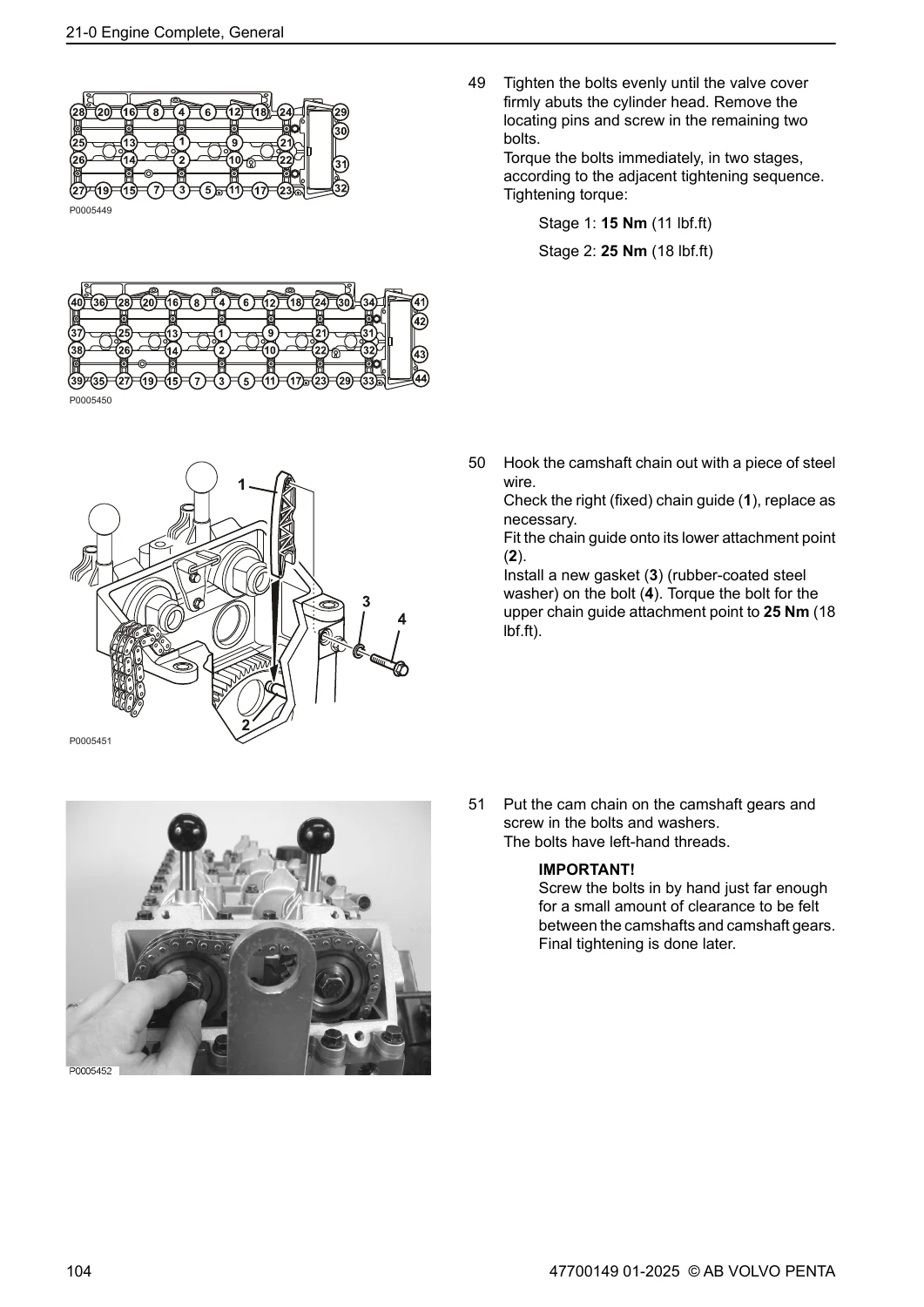
The assembly section then brings those systems back together with the specified preparation, sealants, locating tools, tightening stages and orientation checks. It covers main-bearing installation, crankshaft end-float checking, flywheel-housing sealing, piston and ring installation, connecting-rod tightening, crankshaft seals, D4 balance-shaft alignment, D6 reinforcement components, oil-pump and oil-sump sealing, cylinder-head gasket installation, five-stage cylinder-head tightening, camshaft installation and timing, chain tensioner setup, injector and delivery-pipe installation, charge-air cooler connections, fuel hoses, electrical harness routing, filters, covers and belt tensioning. This depth makes publication 47700149 especially useful when the job has moved beyond routine maintenance into measured inspection, component replacement or internal-engine repair.
Cylinder Head, Valve Train, Timing and Crank Mechanism
Separate chapters go further into the internal engine. Cylinder-head work includes removal and assembly, inspection for damage and warping, injector copper-sleeve replacement and cylinder-head pipe-connection sizing for the applicable earlier engines. The valve-mechanism material covers valve-guide inspection and replacement, valve-seat and valve grinding, valve-seat replacement and the associated dimensional limits. Timing coverage includes the D4 balance-shaft housing overhaul, camshaft inspection, camshaft checking and adjustment, index-wheel positioning and flywheel indication.
The crank-mechanism section covers connecting-rod inspection, crankshaft and bearing inspection, crankshaft overhaul guidance, polygon-hub replacement, flywheel ring-gear replacement, flywheel runout, flywheel-housing indication and Aquamatic flywheel-housing service. These chapters pair inspection methods with allowable clearances, runout values, dimensions and reuse instructions where stated.
Fuel, Turbocharging, Lubrication and Cooling Work
Fuel-system coverage extends from supply-side suction checks to the high-pressure common-rail components. The manual gives procedures for measuring fuel-line vacuum, checking high-pressure pump pressure, replacing the high-pressure pump, checking injector return flow, replacing injectors, servicing the pressure reducing valve and rail-pressure sensor, and bleeding the fuel system. The specification section identifies the Bosch CP 3.3 high-pressure pump and provides rail-pressure information, while the repair chapters emphasize cleanliness and protective plugging of opened fuel unions.
For inlet and exhaust work, the manual covers turbocharger removal and installation, turbocharger inspection, compressor-housing cleaning, mechanical-supercharger fault tracing and magnetic-coupling work for applicable variants. It provides turbocharger end-float and radial-clearance checks and identifies where supercharger behavior or magnetic coupling should be investigated. Some electrical aspects of EVC and supercharger control are referred to the separate electrical-system workshop information rather than being fully repaired in this Groups 20-26 volume.
The lubrication chapters include engine oil-pressure checking, lube-oil pump inspection and oil-valve housing inspection in the heat exchanger/oil cooler assembly. The specification material records oil grades, service interval conditions, oil volumes and operating oil-pressure values. Cooling-system material includes internal cleaning, charge-air-cooler pressure testing, heat exchanger/oil cooler overhaul, coolant-pump work, thermostat function checking and thermostat-housing overhaul. It continues through charge-air-cooler removal, installation and overhaul, plus sea-water system and sea-water pump work. Procedures repeatedly call out cleanliness, new seals or O-rings where required, pressure testing, specified tightening torque and correct sealant use.
Chapters Covered
- General Information
- 00-0 General
- Specifications
- 03-0 General Specifications
- 03-2 Specifications, Engine
- 03-21 Engine
- 03-22 Lubrication System
- 03-23 Fuel System
- 03-25 Inlet and Exhaust System
- 03-26 Cooling System
- 03-3 Specifications, Electrical – Electrical System
- 03-6 Specifications, Steering
- Safety and Other Instructions
- 05-1 Safety Instructions
- Special tools
- 08-2 Special Service Tools
- Chemical Products
- 18-0 General
- General
- 20-0 Engine Information, General – Troubleshooting
- 20-9 Miscellaneous
- Engine
- 21-0 Engine Complete, General – Engine Disassembly and Engine Assembly
- 21-1 Cylinder Head
- 21-2 Cylinder Block
- 21-3 Cylinder Liner, Pistons
- 21-4 Valve Mechanism
- 21-5 Timing Gears and Shaft
- 21-6 Crank Mechanism
- 21-9 Miscellaneous
- Lubricating and Oil System
- 22-0 Lubricating and Oil System, General
- 22-1 Oil pump and Line
- 22-3 Oil cooler
- Fuel System
- 23-4 Fuel Tank, Fuel Lines, Evaporator
- 23-6 Injection Pump, Regulator
- 23-7 Injectors and Delivery Pipes
- 23-9 Miscellaneous
- Inlet and Exhaust System
- 25-5 Turbo and supercharger
- 25-9 Miscellaneous
- Cooling System
- 26-0 Cooling System, General – Check and Fault Trace
- 26-1 Radiator, Heat Exchanger
- 26-2 Coolant Pump, Thermostat
- 26-5 Charge Air Cooler with Connections
- 26-6 Sea Water System, Sea Water Pump
- 26-9 Miscellaneous
- Index
- References to Service Bulletins
Taken as a whole, the chapter structure moves from identification, specifications, safety and tools into fault finding and then into increasingly detailed mechanical work. It supports both system-level diagnosis and component-level disassembly, inspection, replacement and reassembly, while keeping critical torque, clearance, pressure and sealing information close to the procedures that depend on it.
Variant and Workshop Notes
The illustrations and procedures cover several D4 and D6 engine variants, and the manual notes that some visual details can differ from the actual engine while the essential information remains applicable. Individual steps distinguish between D4 and D6, early and late models, supercharged engines, reverse-gear installations, Aquamatic/AQ and IPS applications, and specific variants such as D6-435 where the hardware or procedure differs. Checking the product designation and serial number on the engine decal or type plate before starting work is therefore important.
Safety and cleanliness are integral to the procedures. The manual gives dedicated safety instructions, cleanliness requirements for bearing work, chemical-product references and a substantial special-tool section. It also warns that work on fuel systems, lubrication systems, turbochargers, bearings and seals requires particular care to keep dirt and foreign material out. Detailed EVC electrical-system fault tracing and repair is outside this Groups 20-26 volume and is referred to separate electrical-system service information.
Repair with the Correct D4/D6 Procedures at Hand
The Volvo Penta D4 D6 Groups 20-26 Workshop Manual 47700149 – 01-2025 PDF gives technicians and experienced owners a structured reference for diagnosing engine symptoms, checking service limits, dismantling and rebuilding major engine components, servicing the common-rail fuel system, inspecting turbo and supercharger components, checking lubrication performance, and repairing cooling-system components. Using the stated sequences, dimensions, torque settings, tool references and sealing instructions helps keep complex work aligned with the procedures and values specified for these D4 and D6 engines. Delivery is by instant PDF after payment, with no shipping to wait for; the file can be opened on compatible computers, tablets and phones and can be printed for workshop use.
Reviews
There are no reviews yet.