
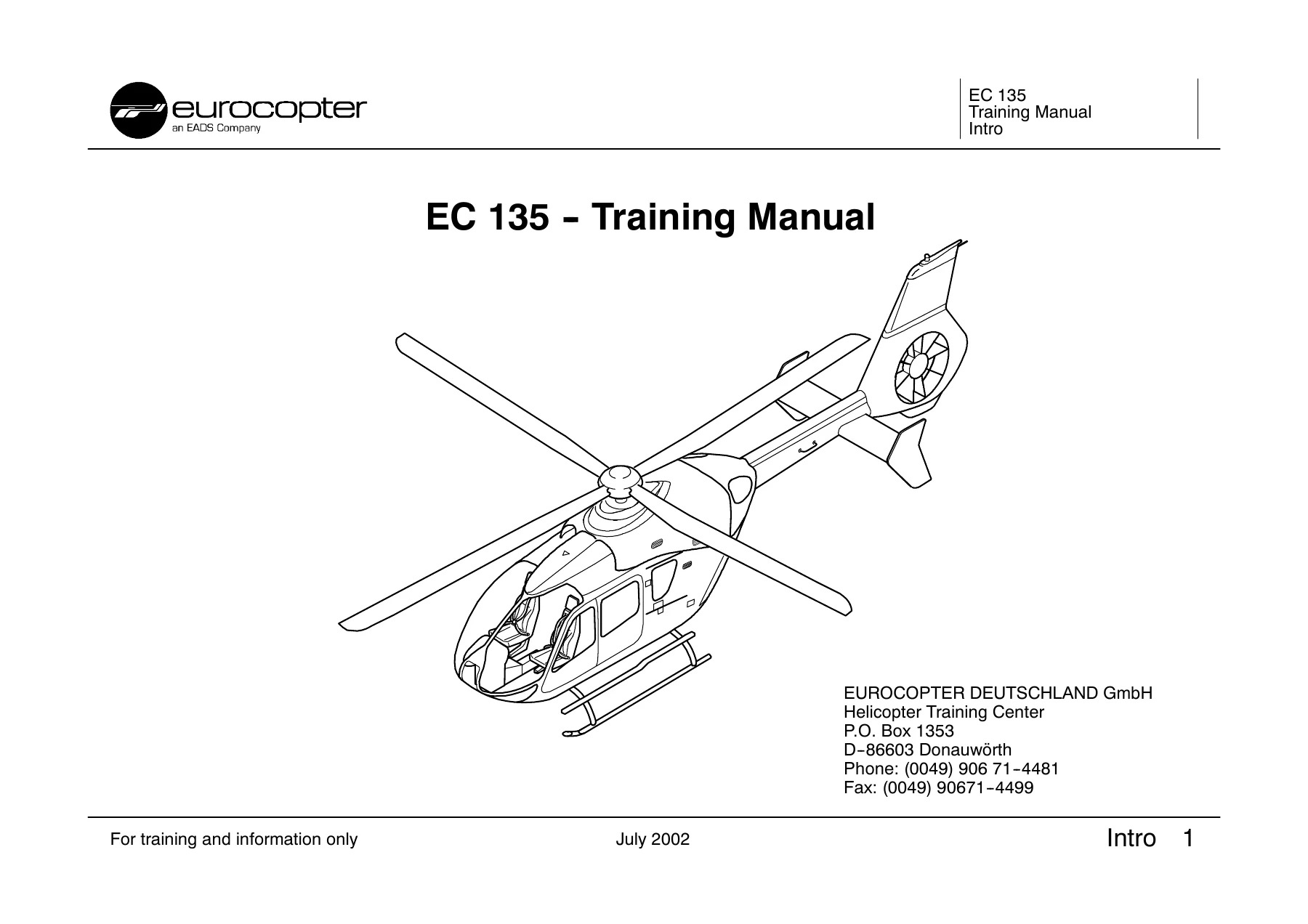
Eurocopter EC 135 Helicopter Training Manual – P1 P2 T1 T2 Pilot & Maintenance Course
Original price was: $34.95.$19.95Current price is: $19.95.
Complete Eurocopter EC 135 training manual covering P1, P2, T1 and T2 variants. 552 pages of systems descriptions, cockpit displays, engine controls, hydraulics, fuel, electrical and inspection procedures for pilots and maintenance personnel.
Description
Eurocopter EC 135 Helicopter Training Manual
This Eurocopter EC 135 Training Manual is the complete course document used to instruct pilots and maintenance personnel on the EC 135 helicopter. It covers the P1, P2, T1 and T2 variants in a single volume, taking into account ATA 104 specifications and correlating to the sequence of factory training. With 552 pages of systems descriptions, cockpit display explanations, engine control theory, hydraulic and fuel system detail, and inspection scheduling, this is a deep technical reference for anyone operating, servicing or studying the EC 135.
File Details
- Manual Type: Helicopter Training Manual
- Brand: Eurocopter
- Model: EC 135 (P1, P2, T1, T2)
- Language: English
- Page Count: 552
- File Format: PDF
- Edition: 1st Edition December 2000
- Revisions: 1st Revision June 2002, 2nd Revision July 2002
- Publisher: Eurocopter
Chapters Covered
The EC 135 training course is divided into modules that follow the factory training sequence. Each module builds from general information through to detailed system operation and inspection.
- 00 General Information — Development history of the EC 135, general description, maintenance concept across organizational, intermediate and depot levels, documentation layout with ATA numbering, reference planes (fuselage stations, buttock lines, waterlines), cockpit arrangement for CPDS and CDS configurations, instrument panel layouts, triple rotor RPM indication, torque indicator, dual TOT indicator, dual N1 and ΔN1 indicators, oil temperature and pressure indicator, Cockpit Display System operation including caution and advisory displays, Central Panel Display System functions and modes, CPDS switch-over functions, maintenance menu, flight report, overlimit recording, data loading, A/C config page, warning unit, switch unit, overhead console and pitot-static system.
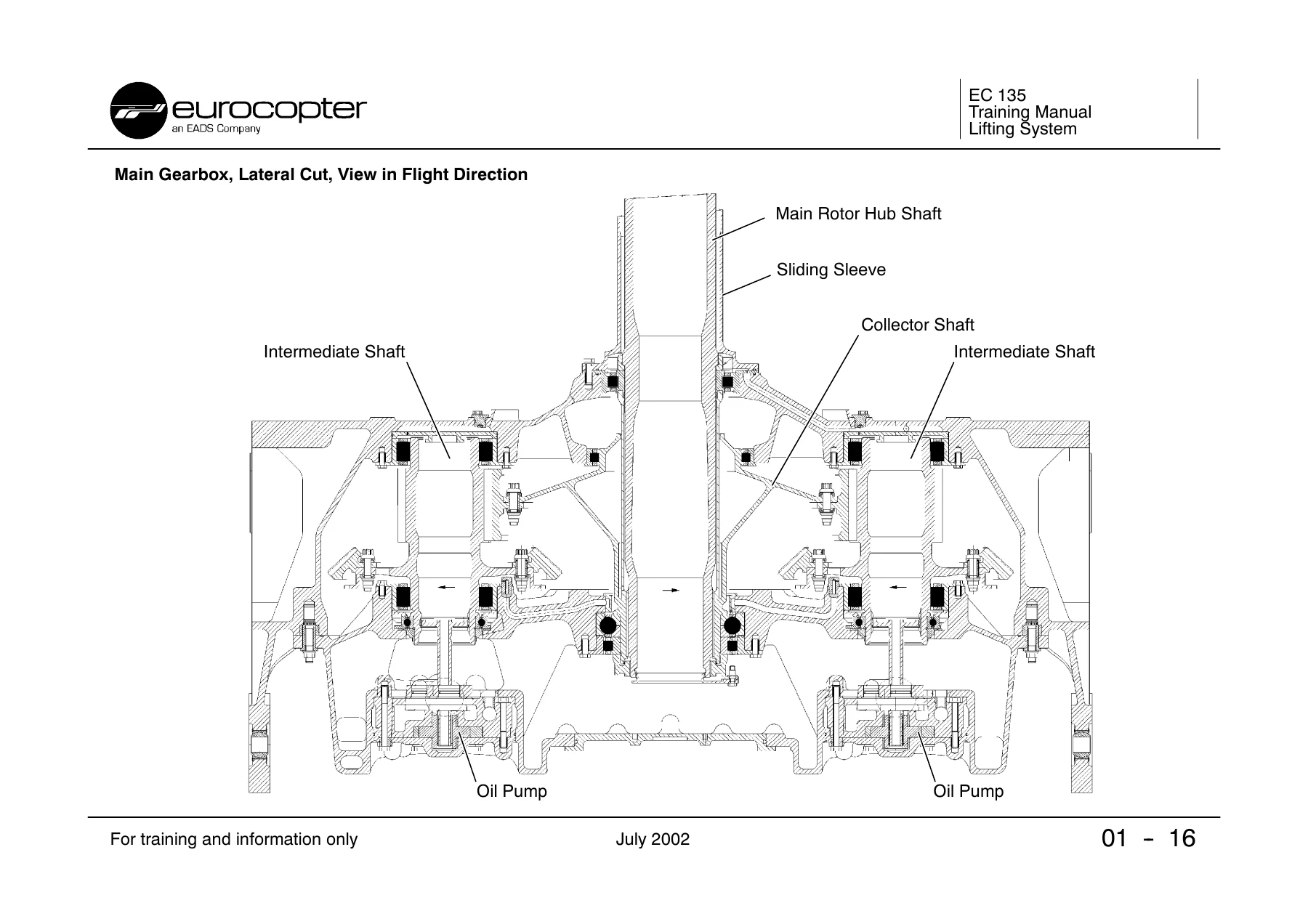
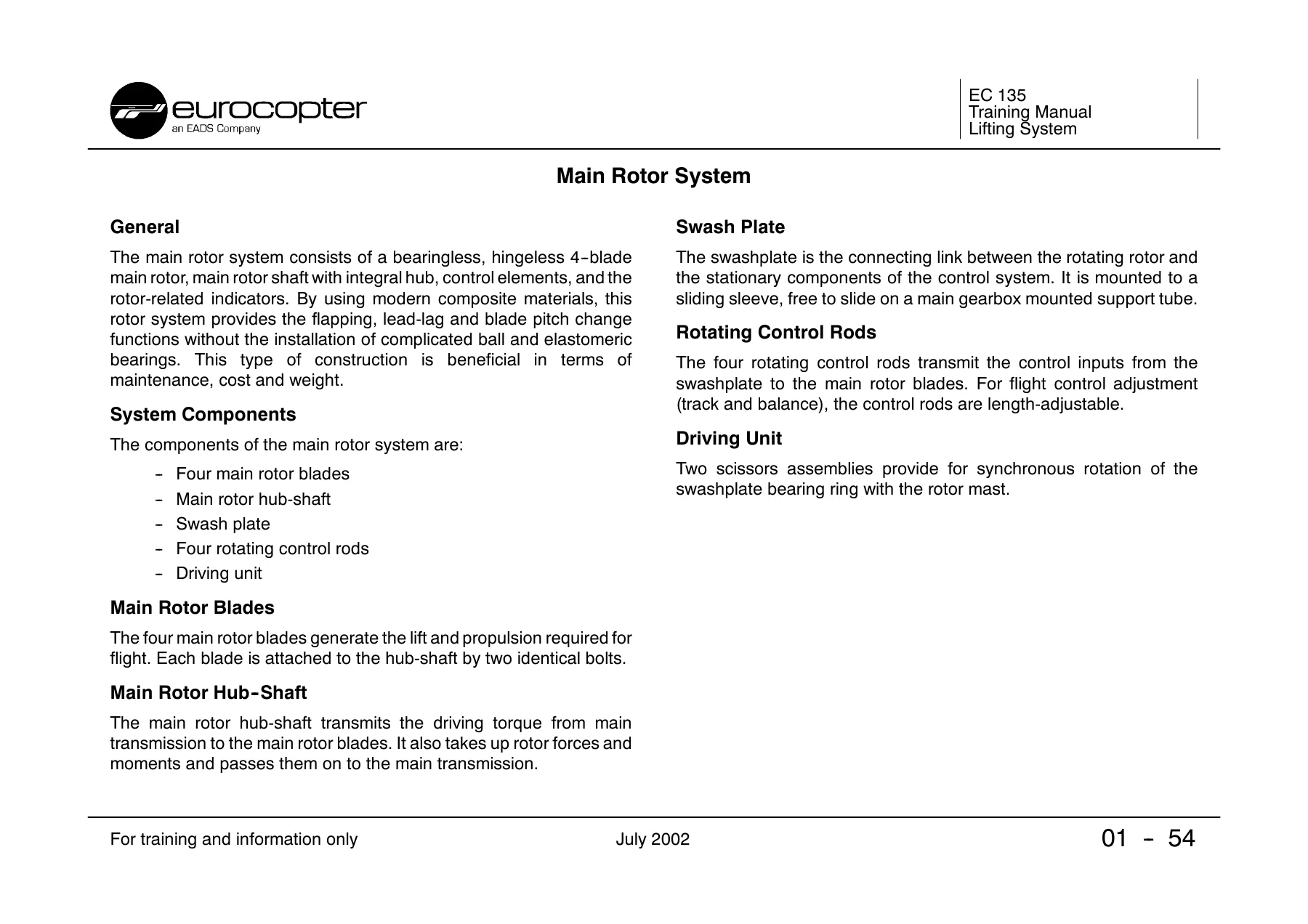
- 01 Lifting System — Main rotor drive, driveshafts (Bendix and Kaflex types), main transmission modules, LH and RH input drives with freewheel units, tail rotor output drive, main gearbox power flow and geartrain, lubrication system with dual oil pumps, oil filter and cooler, XMSN oil temperature and pressure indication, chip detection, oil distribution, fan drive, oil cooling system, main rotor hub shaft, mast moment measuring system with strain gauge bridge and induction transmitter, rotor brake system and indication, main transmission mounts including ARIS anti-resonance isolation system, oscillation damper (Y-damper), main rotor system with four-bladed bearingless design, main rotor blade construction, blade root, pitch control cuff, airfoil section, lead-lag dampers, rotor blade adjustments and track and balance.
- 02 Fuselage — Cabin structure including cabin framework, cabin roof and control post, main fuselage structure with side panels, transmission deck, engine deck, rear structure attachment cone and equipment deck, cabin floor and subfloor structure, lower shell, cockpit doors, sliding doors with emergency exit, rear doors, service covers, windshields, nose windows and side windows.
- 03 Tail Unit — Fenestron principle and tail rotor thrust, tail unit assemblies, horizontal stabilizer with end plates and spoilers, tail boom construction, tail rotor drive with foreward, center and aft driveshafts, flexible couplings and bearings, vertical fin with Fenestron structure, tail rotor with ten blades, hub body, pitch change spider, tension-torsion bars, thrust nut, tail rotor gearbox with input pinion and output gear wheel, control unit, oil system, balancing installation and tail rotor inspection clearances.
- 04 Flight Control — Principle of flight control, collective control with friction brake and pitch stop, cyclic control with vibration decoupling unit, mixing lever assembly, swash plate with sliding sleeve, cardan ring and duplex ball bearing, rotating control rods, driving unit with scissors assembly, track and balance installation, trim system with longitudinal and lateral trim actuators, tail rotor control with pedal assembly, Flexball cable, yaw actuator, Fenestron actuator, hydraulic system with two pressure supply systems, hydraulic pump, reservoir, valve block, normal operation, test function, hydraulic actuators with follow-up principle, MHA and EHA description, mechanical override, system test, electro-hydraulic actuator SAS decoupling, indication and testing system, Fenestron actuator, three-axis stability augmentation system, yaw SAS with fiber optical gyro and yaw actuator, pitch and roll SAS with computer and electro-hydraulic actuators, and pitch damper for dual pilot IFR.
- 05 Landing Gear — Landing gear with crosstubes, skids, skid shoes, bonding jumpers and entrance steps, touchdown limitations, measurement of ground clearance.
- 06 Power Plant — Fuel system with main tank, split supply tank, expansion tank and venting, fuel distribution with transfer pumps, prime pumps and transfer lines, equipment plates, fuel pumps and drain valves, fueling system with filler neck and air no fuel valve, power supply and monitoring of fuel pumps, fuel supply lines and shut-off valves, fuel quantity indication and monitoring, low level warning, fuel low pressure caution and filter contamination caution, Turbomeca ARRIUS engine description including reduction gearbox module, gas producer and power turbine, oil subsystem, fuel subsystem, torque indication, gas temperature indication, Pratt & Whitney 206 B(2) engine with reduction gearbox, turbomachinery, oil subsystem, fuel subsystem, temperature indication, engine control T2/P2, electronic power control, engine ignition, control unit in overhead panel, automatic engine starting, power sharing of power turbines, droop compensation, topping function, CAT A mode, training mode, overspeed protection, monitoring and error diagnostic, engine emergency control with twist grip, major differences between P2/T2 and P1/T1 versions, oil cooling system, engine mounts and alignment, firewalls, fire warning system, fire extinguishing system and engine drain lines.
- 09 Electrical System — Electrical power supply, DC power generation with starter/generators and electrical master boxes, battery system with battery master box, switches GEN I, GEN II and BAT MSTR, CDS/CPDS and warning unit indications, external power receptacle with power connector, intercom socket and circuit breaker, DC power distribution through overhead panel and circuit breaker consoles, complete system function including operation with battery, automatic engine starting, operation with one generator, parallel and separated generators, external power unit, shedding busbar connection and fault reactions, AC power system with static inverter, circuit breakers, switches, AC busbars and modules.
- 10 Inspections — Types of inspections including visual inspection, condition inspection, functional tests and inspection for cracks, scheduled checks and inspections covering preflight check, complementary check 50 Fh, complementary check 100 Fh, intermediate inspection 400 Fh, 12-month inspection, periodical inspection 800 Fh or 2 years, supplementary inspections according to operating time, conditional inspections after maintenance activities and operational incidents, ground run and functional check flight.
This EC 135 helicopter training manual is not simply an outline — it explains the why and how behind each system. The lifting system module walks through the ARIS anti-resonance isolation system with its spring/mass damper principle and the pendulum protrusion used for failure detection. The flight control module breaks down the mixing lever assembly geometry showing exactly how collective and cyclic inputs are transmitted to the swash plate without cross-coupling. The power plant module compares the Turbomeca ARRIUS and Pratt & Whitney 206 B engine architectures, their FADEC systems, the differences between P1/T1 and P2/T2, and the training mode logic used for realistic OEI practice. Throughout the manual, torque values, pressure settings, temperature limits, clearances and adjustment procedures are given in the units used by the manufacturer.
Cockpit Versions and Engine Variants
The manual covers two major cockpit configurations: the CPDS (Central Panel Display System) with multifunction screens and analog flight instruments, optionally combined with FCDS (Flight Control Display System), and the CDS (Cockpit Display System) with analog flight instruments or EFIS. The CPDS cockpit replaced the standard CDS cockpit, and the manual documents both in detail including screen layouts, switch functions, caution and advisory displays, and the switch-over logic when one or more screens fail.
Engine coverage spans the EC 135 P1 with Pratt & Whitney PW 206 B engines, the EC 135 P2 with PW 206 B2 engines, the EC 135 T1 with Turbomeca ARRIUS 2B1, 2B1A and 2B1A_1 engines, and the EC 135 T2 with ARRIUS 2B2 engines. Both engine types are in the 450 kW class. The maximum take-off weight for both standard versions is 2720 kg with upgrade to 2835 kg MTOW possible, and 2900 kg with external load.
What This Manual Enables
For pilots, this EC 135 training manual provides the system knowledge needed to understand cockpit indications, interpret caution and advisory messages, manage engine emergencies, and use the training mode for OEI practice. For maintenance personnel, it delivers the operating principles behind every major assembly — from the freewheel units in the main transmission to the duplex hydraulic boost system and the Fenestron tail rotor gearbox. With this manual you can follow the maintenance concept from organizational level tasks through intermediate and depot level work, understand the inspection intervals and conditional inspection triggers, and prepare for factory training or type rating with the exact course material used by Eurocopter.
IMAGES PREVIEW
Every page is a printable PDF that works on any device. After purchase, the download link is delivered instantly — no shipping, no waiting, no physical media to lose. Whether you are a pilot studying for a type rating, a mechanic preparing for an inspection, or an operator building a technical library, this Eurocopter EC 135 Training Manual gives you the manufacturer’s own course content in a single, searchable PDF.
Reviews
There are no reviews yet.