
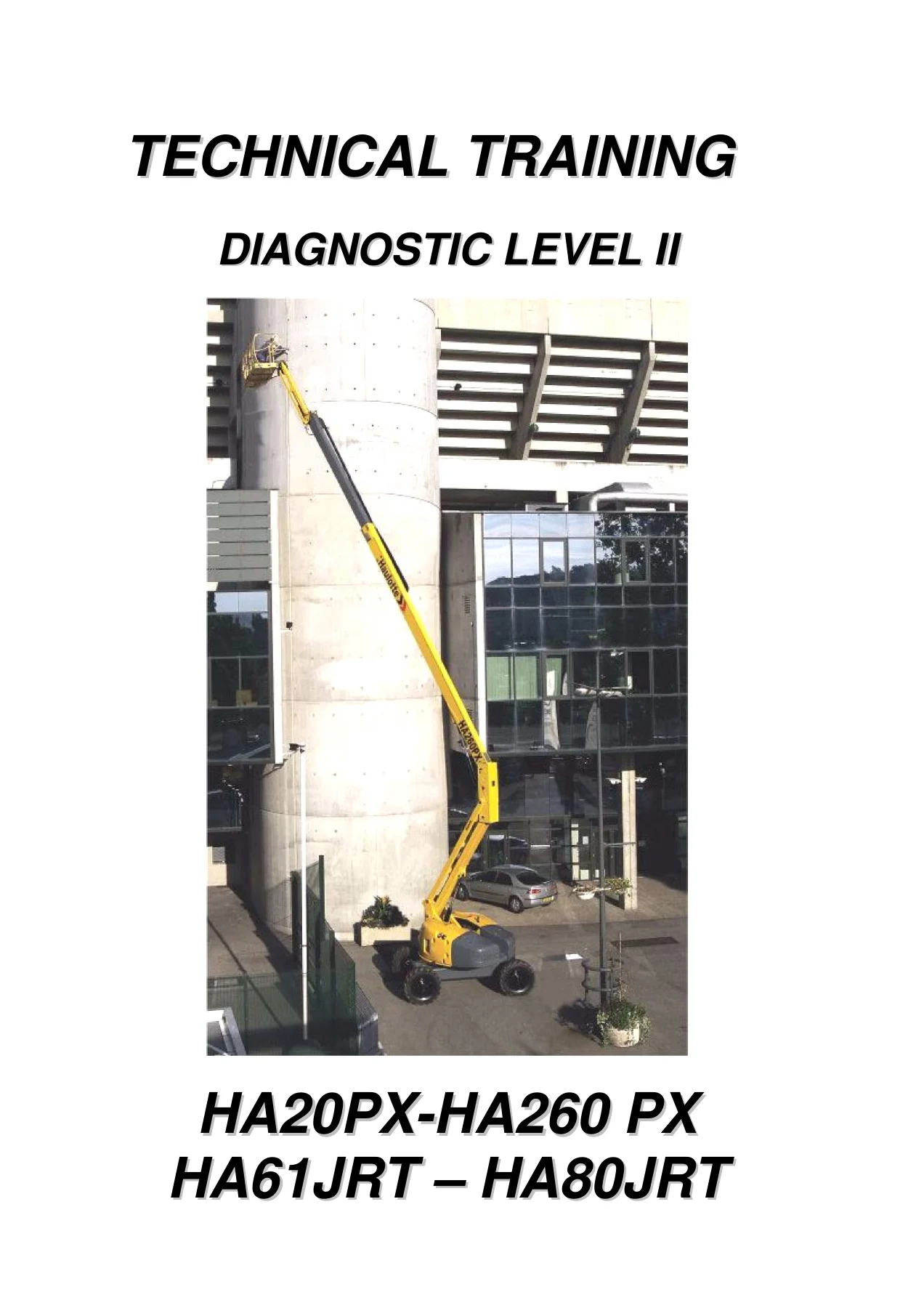
Haulotte HA20PX & HA260PX Diagnostic Level II Technical Training Manual
Original price was: $39.95.$24.95Current price is: $24.95.
128-page Haulotte Diagnostic Level II technical training manual for HA20PX (HA61JRT) and HA260PX (HA80JRT) aerial work platforms, covering wiring and hydraulic schematics, logical operation equations, Optimizer console adjustments, overload and reach limitation calibration, and the module Node B machines above serial AD122967.
Description
Haulotte HA20PX & HA260PX Diagnostic Level II Technical Training Manual
This is the full Diagnostic Level II technical training document issued for the Haulotte HA20PX (HA61JRT) and HA260PX (HA80JRT) self-propelled articulated boom lifts. It is written for technicians who already know the machine and now need to trace faults through the electrical and hydraulic circuits rather than replace parts by guesswork. The manual carries document number 2420339050 E03-11 and runs to 128 pages of schematics, symbol keys, logical equations and calibration procedures.
Rather than a simple user guide, this is a diagnostic workbook: it teaches the method as well as supplying the diagrams. Every function of the machine — drive, steering, boom lift, telescope, arm, turret slew, jib, basket compensation and basket rotation — is broken down into the conditions that must be present for it to work, the conditions that prohibit it, and the conditions that modify it.
File Details
- Manual type: Technical training manual — Diagnostic Level II
- Brand: Haulotte
- Models covered: HA20PX (HA61JRT), HA260PX (HA80JRT)
- Document number: 2420339050 E03-11
- Language: English
- Page count: 128 pages
- File format: PDF
- Engine covered: Deutz F4L2011 L 04i
Chapters Covered
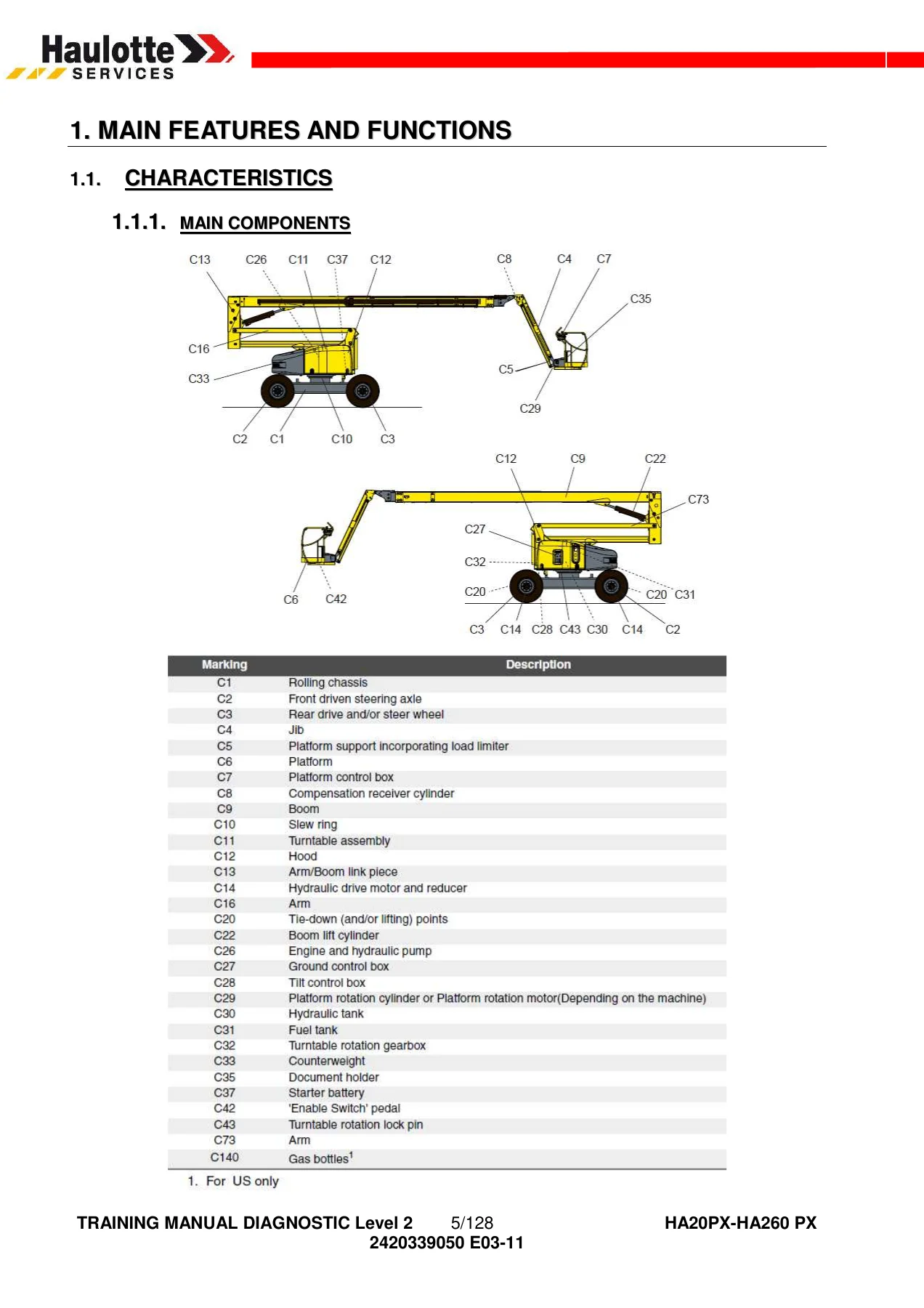
- 1. Main features and functions — main components, overall dimensions, working zones, features, upper and lower commands and indicators
- 2. Study of the wiring schematics — standardized symbols, methodology of control (electric continuity, on/off valve control, component control), the wiring diagram, low control panel S020057, upper control panel S020058, lower control box printed circuit, weighing board BPE, slip ring 157P248040, localization of the main safety units, list of components, logical equations of operation
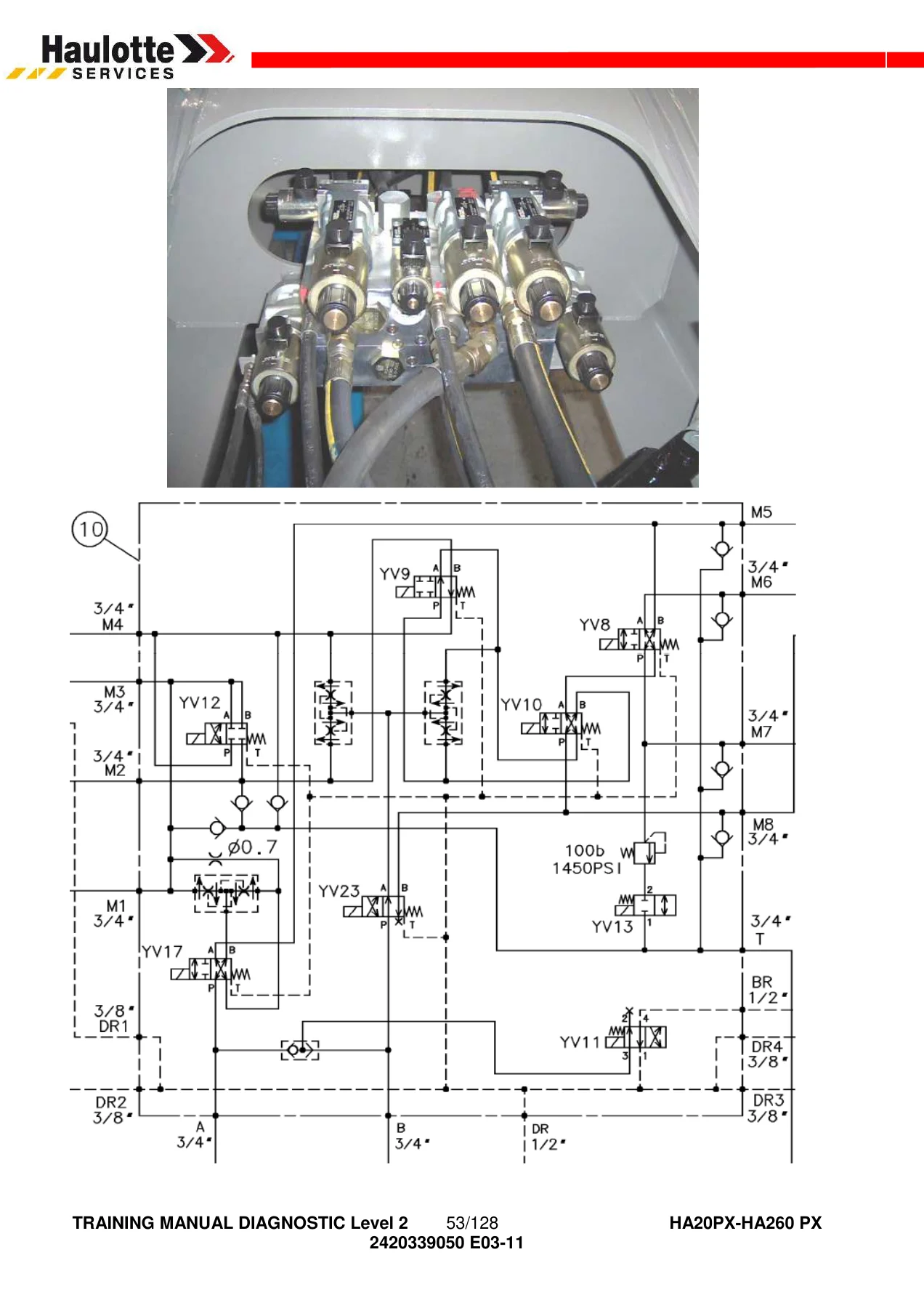
- 3. Study of the hydraulic schematics — standardized symbols, hydraulic diagram 157P243400, main hydraulic manifolds (chassis, turret, drive block, steering block, on/off block, proportional block PVG), the bundles (turret 157P245580, chassis 157P245570), logical equations HA260PX
- 4. Adjustments — Optimizer console use and connection, parameter settings, system of load control (principle, angle sensors, overload board BPE, management of nominal load overlap, standard calibration procedure, alarm codes, sensor values, inclination limitation, checking sensors on the BPE board), adjustment of pressures (pressure table, plug ports, adjustment of load sensing, flow and pump cubic capacity)
- 5. Breakdown service guide — no start, no movement, no arm lift, no turret rotation, no jib, no rotation basket, no compensation, no drive, low speed only, no steering
- 6. Summary of versions HA20PX–HA260PX
- 7. Special functions — system of reach limitation (HA260PX only): principle, calibration procedure, sensor values, outreach calibration above software V1.09
- 8. Models equipped with module Node B — differences, upper control box, CAN bus, module Node B1, components of the upper control box, list of alarms, angle sensor values, overload calibration, reach limit calibration, procedures for sensor adjustment (A1, A2, G1–G2, SL1–SL2, SL3–SL4, SQ7)
Logical equations are the backbone of this training manual. Each movement is presented as a table of necessary conditions, prohibiting conditions and modifying conditions, using the machine’s own component designations — SM1, SM2, SM3, SM4, SA1 to SA17, SB3 to SB6, SQ1 to SQ9, SL1 to SL4, A1, A2, G1, G2, and the electrovalve references YV1 through YV26. That means a technician can read a symptom such as “no arm lift” and immediately see which switch, joystick, valve or pressure condition is missing. The same structure is repeated on the hydraulic side, where each function is tied to its pump pressure, its position valve, its cylinder or motor, and the specific hydraulic faults that would prevent it.
Wiring and Hydraulic Schematics
The wiring section opens with the standardized symbol set used by Haulotte Group, then moves into the control methodology — how to check electrical continuity, how to check insulation against ground, how to verify the supply voltage and current draw of an on/off valve coil, how to test an electric relay across terminals 30, 85, 86, 87 and 87a, how to check a fuse by resistance, and how to test a diode in both directions. Only after that does it present the diagrams themselves.
The hydraulic section follows the same discipline. Standard symbols are given first — variable and fixed displacement pumps, check valves, piloted check valves, priority and shuttle valves, adjustable pressure relief valves, flow dividers, counterbalance valves, proportional 5/3 position valves, rotary cylinders and flow regulators. The diagrams then break the machine into its manifolds: the chassis block, the turret block, the detail drive block with its YV8 high speed, YV10, YV12 and YV17 medium/high speed valves, YV9 differential lock and YV11 brake release, the steering block with YV21 and YV22, the on/off block with YV14, YV15, YV18 and YV19, and the proportional PVG block carrying YV1, YV2, YV3, YV4, YV5 and YV6.
Two Machine Generations Covered
The manual deliberately spans two build standards. Machines up to serial AD122967 use the weighing board BPE, with two output relays whose state is read by the main Head module, and a jib learning calibration performed with nominal load in the basket. Machines after AD122967 — referred to as the NB version — move the upper control box functions onto a module Node B1 connected to the Head module by a CAN bus, with new joysticks JYB01, JYB02 and JYB03, a list of CAN-specific alarms such as MX01, and a revised overload calibration sequence driven from the Optimizer display.
Section 6 sets out the version history so the correct diagram set can be identified before work begins: machines without progressivity up to March 2004, machines with progressivity and EN 280 up to October 2005, machines from November 2005, machines from May 2008 with the engine choice option, and the HA260PX NB version from 2010 above AD122967 with wiring diagram 157P309330.
Calibration and Adjustment Content
Adjustment is treated as a diagnostic skill, not a side note. The Optimizer console connection point, its keypad layout, its menu tree and its access codes are all documented, followed by the parameter tables for movement times from both the upper and lower control boxes, the speed and ramp parameter menus, factory settings, and the maintenance options. The load control chapter explains how the four sensors — G1 and G2 pressure sensors in the jib cylinder chambers, A1 relative angle sensor and A2 absolute inclinometer — combine to produce a permitted pressure for any given jib position, and gives the standard calibration procedure step by step for machines below AD122967.
Diagnostic support includes the flashing-LED alarm codes of the weighing board for green, orange and red indicators, the sensor voltage values at the jib’s lowest position, at 0 degrees and at maximum position, and the pressure table for the machine covering general pressure, load sensing, standby unit, arm, boom, telescope, turret and on/off functions. The pressure adjustment section shows the plug port position and the LS, Pmax and cubic capacity adjustment points on the pump.
What This Manual Lets You Do
With this Diagnostic Level II training manual on the bench you can fault-find the HA20PX and HA260PX systematically instead of by substitution. You can follow a no-start condition through the battery, emergency stops, start buttons, key selector, oil temperature and pressure sensors, air filter, alternator warning, relays KA2 and KMG and the Head module. You can trace a no-movement complaint through the overload system, the slope sensor, fuse FU7, the LS electrovalve YV1, the dead man pedal and the CAN bus or Head module. You can work through each motion individually using the logical equations, confirm the electrovalve and pressure conditions, and then move to the hydraulic diagram only when the electrical side has been cleared.
You can also carry out the calibrations correctly — the overload jib learning routine, the reach limitation calibration at position 1 and position 2, and the sensor adjustment procedures for A1, A2, G1, G2, SL1, SL2, SL3, SL4 and the SQ7 telescopic detection sensor, including the magnet positions along the telescopic boom. Getting these wrong has a direct effect on machine stability and on whether the machine will work at all, which is why the manual gives the expected sensor voltages and the OK/NOK validation prompts for each step.
IMAGES PREVIEW
The manual is supplied as an instant PDF download. There is no shipping and nothing to wait for. It opens on a workshop laptop, a tablet or a phone, and any page — a wiring sheet, a hydraulic manifold detail, a logical equation table or a calibration display screenshot — can be printed and taken up onto the machine.


Reviews
There are no reviews yet.