
Philips Intera Achieva F2000 MRI Magnet Quench Procedure & Recovery Guide Service Procedure PDF Download
Original price was: $29.95.$18.95Current price is: $18.95.
Philips Intera/Achieva service procedure document section covering F2000 magnet quench — complete quench recovery procedures for attended and unattended quench events, helium consumption data, de-icing procedure, quench questionnaire, and decision flowchart. Instant PDF download.
Description
Philips Intera/Achieva F2000 Magnet Quench Procedure & Recovery
This document is Section 4.6 of the Philips Intera/Achieva Service Procedures Document (document number 4522 981 24052, CSIP Level 1, Revision 09.0), covering the complete procedure for managing, recovering from, and reporting an F2000 superconducting MRI magnet quench. A magnet quench — the sudden loss of superconductivity in the magnet coil — is one of the most critical and time-sensitive events an MRI service engineer can face. This section provides the structured decision flowchart, two complete recovery procedure sets (quench during servicing vs. unattended quench), quantitative helium consumption figures, the de-icing protocol, and the official Philips quench questionnaire required for incident reporting.
Systems This Document Applies To
- Intera MRI system with F2000 magnet
- Achieva MRI system with F2000 magnet
- Magnet types referenced with helium consumption data: T5, T5-NT, T10-NT, ACS-NT
Quench Decision Flowchart
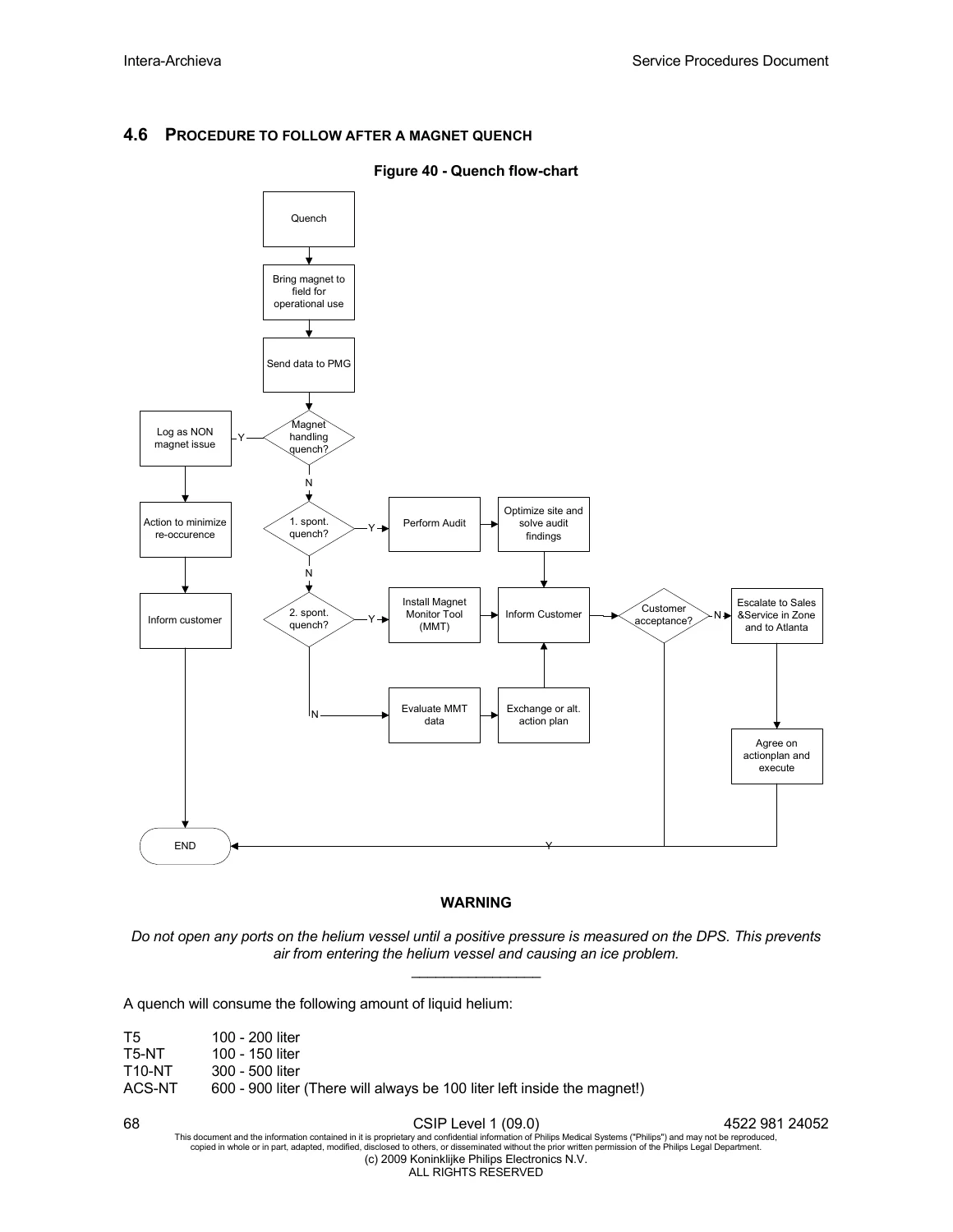
The document opens with a complete quench management flowchart covering: first quench response, data submission to PMG (Philips Magnet Group), evaluation of whether the magnet handled the quench correctly, spontaneous quench recurrence decision tree (1st vs. 2nd spontaneous quench), Magnet Monitor Tool (MMT) installation and data evaluation, site audit and optimization, customer acceptance, escalation to Sales & Service Zone and Atlanta, and exchange or alternate action planning.
Helium Consumption by Magnet Type
Specific helium loss figures stated for each magnet type during a quench: T5 — 100 to 200 litres; T5-NT — 100 to 150 litres; T10-NT — 300 to 500 litres; ACS-NT — 600 to 900 litres (with 100 litres always retained inside). Minimum helium level for a magnet on field: 30%.
Section 4.6.1 — Quench During F2000 Servicing
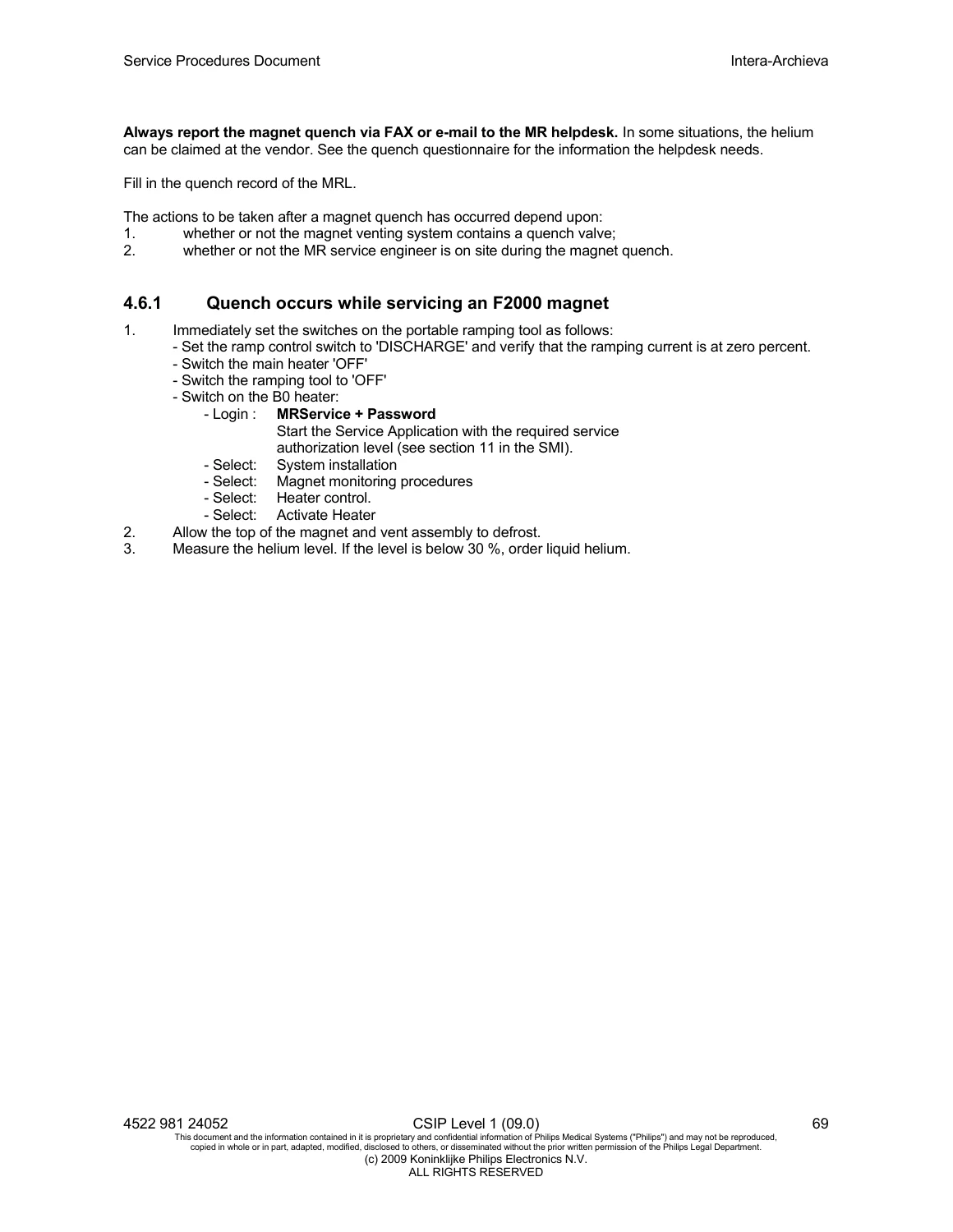
- Immediate actions: portable ramping tool switch sequence (DISCHARGE, main heater OFF, ramping tool OFF), B0 heater activation via Gyroscan software (login: MRService; path: System installation → Magnet monitoring procedures → Heater control → Activate Heater)
- Defrost sequence for magnet top and vent assembly
- Helium level measurement and ordering threshold (below 30%)
- Burst disk replacement (reference Chapter 5.5)
- Helium gas over-pressure check (>5 mBar required)
- Post-quench wait period: minimum 12 hours before ramping
- Linear shimming requirement after quench recovery
- Quench reporting via FAX/email/BBS to MR helpdesk
Section 4.6.2 — Quench When Magnet Not Being Serviced
- Refrigerator system shutdown sequence
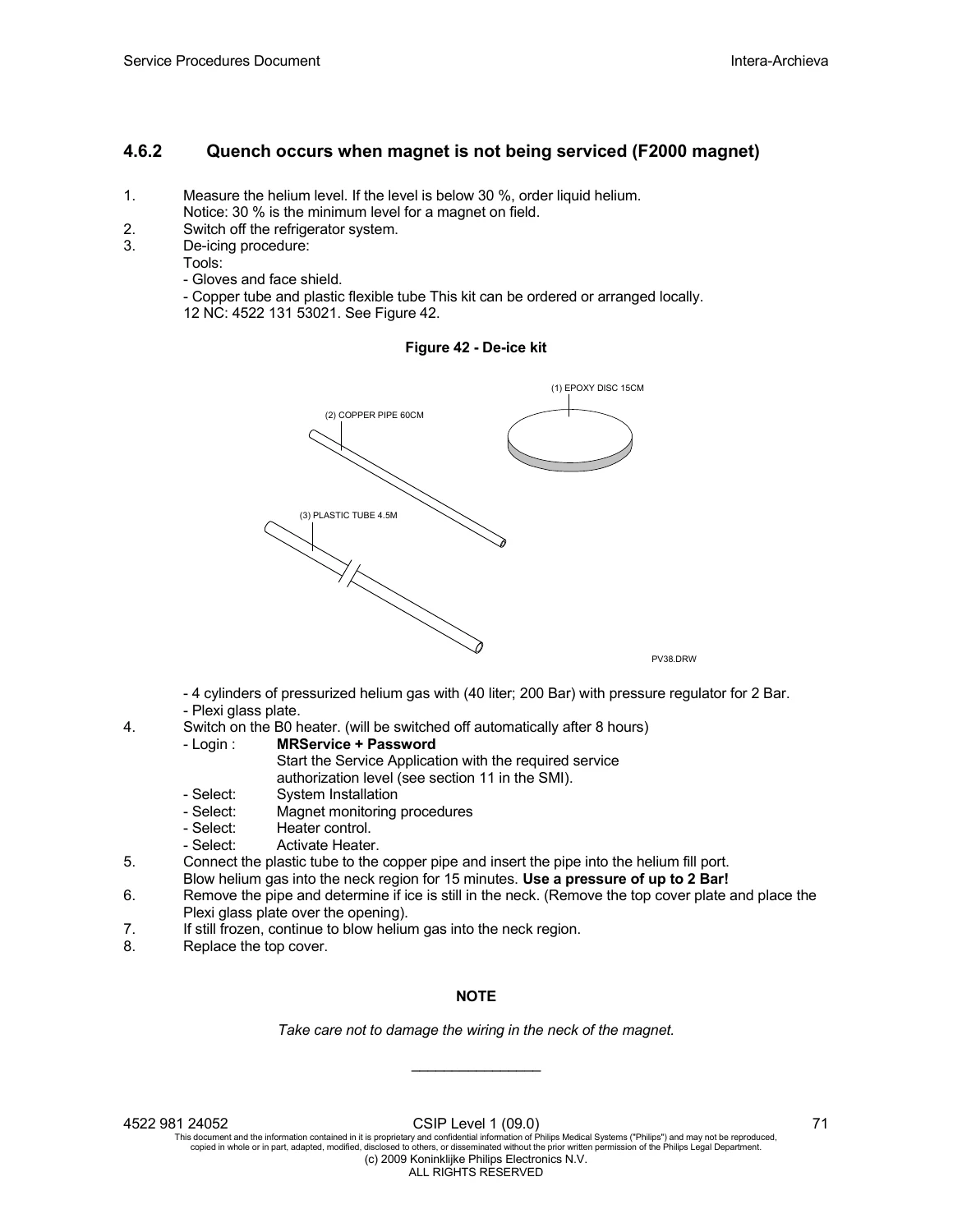
- De-icing procedure — full tool list including de-ice kit (12NC 4522 131 53021): copper pipe 60cm, epoxy disc 15cm, plastic tube 4.5m; 4 cylinders of helium gas (40 litre, 200 Bar with pressure regulator); Plexi glass plate; gloves and face shield required
- B0 heater activation (software path identical to Section 4.6.1)
- Helium gas injection into neck region at up to 2 Bar for 15 minutes per cycle
- Ice clearance verification procedure
- Burst disk replacement, pressure check, refrigerator restart
- 12-hour minimum wait, linear shimming, quench reporting
Section 4.6.3 — Official Quench Questionnaire
The complete Philips MR helpdesk quench questionnaire is reproduced in full, covering: branch office and hospital information, system SRN, magnet serial number, installation date, engineer identity, quench date and time, prior quench history, lead status at time of quench, magnet current at quench, hours per day on field, helium levels before and after, lead voltage at last ramp, over-pressure status, previous over-pressure messages, ice formation history, last helium fill date, helium level graphic requirement, burst disk and 5 psi valve O-ring damage status, compressor supply/return pressures, and activities at time of quench.
Why This Document Is Critical
A magnet quench recovery executed incorrectly — particularly failure to prevent air and moisture from entering the helium vessel before positive pressure is confirmed, or exposing the neck to atmosphere without proper de-icing — can result in permanent ice formation that is impossible to remove, leading to magnet loss. This document is the only comprehensive procedure for managing an F2000 quench event from immediate response through full return-to-field, including the de-icing protocol that most service teams will rarely need but cannot afford to improvise. The quench questionnaire alone ensures that Philips helpdesk receives all information needed to support subsequent root cause analysis and potential helium cost recovery from the vendor.
Instant PDF Download
Delivered instantly as a PDF upon purchase — accessible on any device the moment payment is complete, ready when you need it most.
Reviews
There are no reviews yet.