
Varian High Energy C-Series Clinac Periodic Maintenance Inspection PMI CTB-GE-725-T PDF Download
Original price was: $39.95.$24.95Current price is: $24.95.
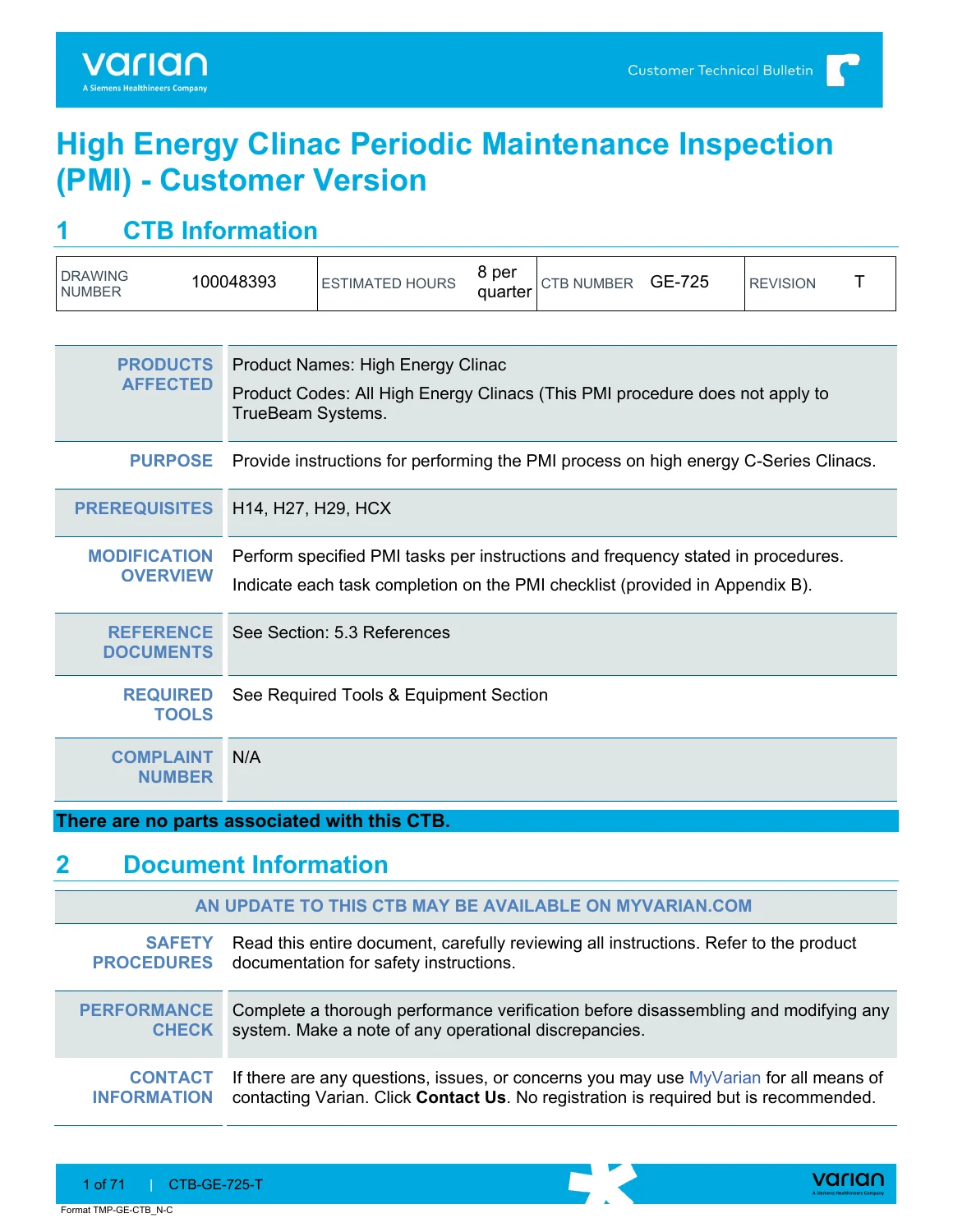
71-page English Varian High Energy Clinac Periodic Maintenance Inspection (PMI) Customer Version, CTB-GE-725-T Rev T, covering C2 and C3 High Energy C-Series Clinacs. Includes quarterly, semi-annual, annual and biennial inspections for stand, gantry, RF/klystron, gun driver, modulator, collimator, couch, accessories, console, beam performance and safety systems. Instant PDF download.
Description
Varian High Energy Clinac Periodic Maintenance Inspection (PMI) – CTB-GE-725-T Rev T
This 71-page English Periodic Maintenance Inspection manual provides the procedures and checklist structure used to inspect and maintain High Energy C-Series Clinac systems. The document is identified as CTB-GE-725-T, Revision T, dated 02 Dec 2024, with drawing number 100048393.
The stated purpose is to provide instructions for performing the PMI process on High Energy C-Series Clinacs. It covers scheduled inspection, cleaning, measurements, functional checks, lubrication, parameter comparison and preventive-maintenance activities across the major Clinac subsystems.
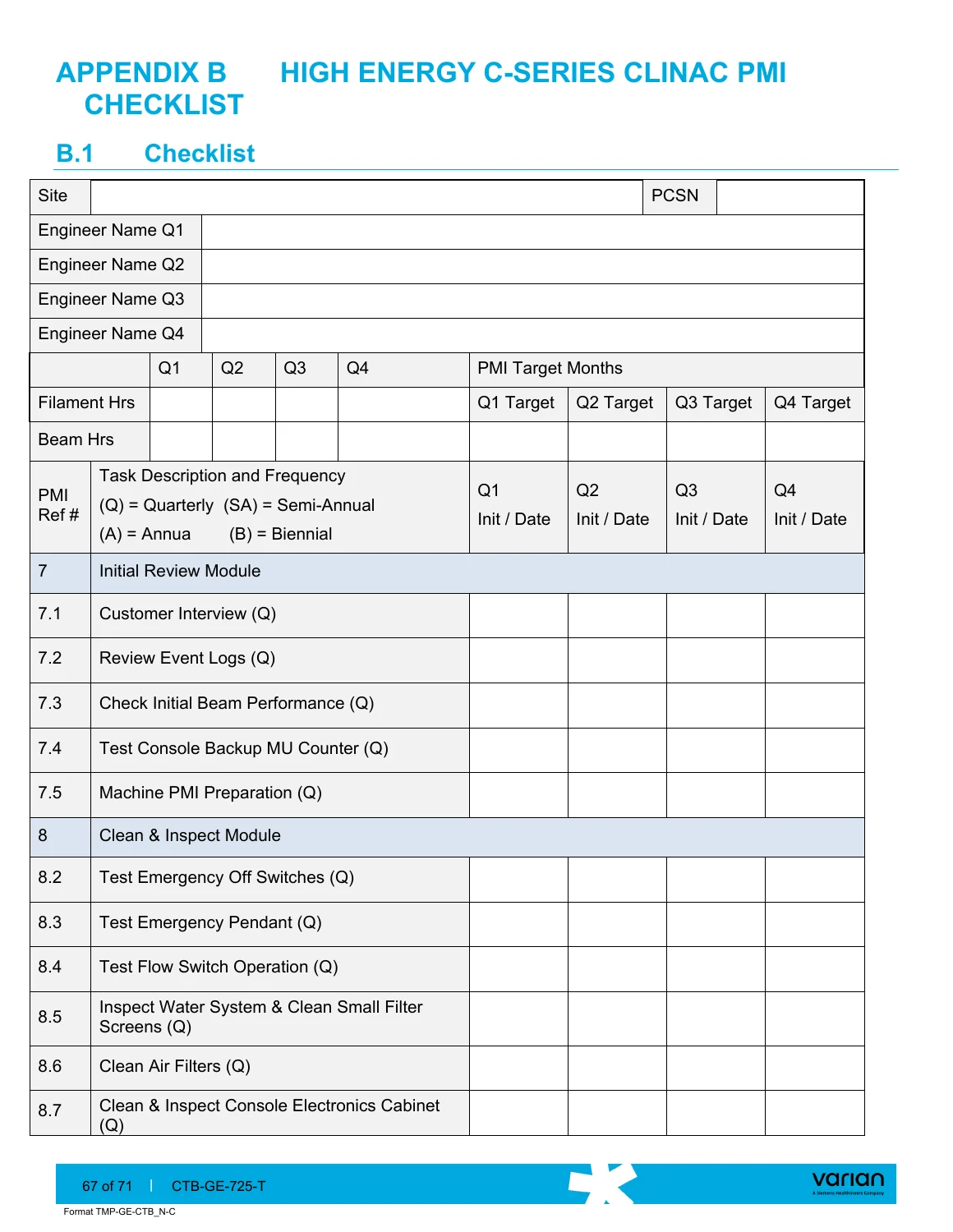
This is a highly focused maintenance document rather than a general operating guide. It organizes the accelerator into practical service modules and assigns each maintenance task a defined frequency: Quarterly (Q), Semi-Annual (SA), Annual (A) or Biennial (B). A complete four-quarter PMI checklist is included at the end of the PDF.
Equipment Covered
The document identifies the affected product as:
- Product name: High Energy Clinac
- Product codes: All High Energy Clinacs
- System requirement: High Energy C-Series Clinac, C2 and C3 versions
The manual explicitly states that this PMI procedure does not apply to TrueBeam systems.
C2 and C3 Clinac Generations Defined in the Manual
The terminology section gives specific generation information:
- C2: 2100C-C/D serial numbers 200 to 599 and 2300C/D serial numbers 1-99.
- C3: 2100C-C/D serial numbers 600 to present and 2300C/D serial numbers 100 to present, as stated in the document.
- The document states that the C3 group also includes all EX, iX and Trilogy Clinacs.
Additional configuration terminology includes EMC production changes, Klystron Linear Mode (KLM), older Shunt-T RF systems, KONA stand configurations, new and old air systems and Silhouette Clinac configurations.
Silhouette Clinac Coverage
The manual explains that Silhouette C-Series machines use C3 technology with a different stand mechanical layout and a reduced-footprint installation design. It identifies Silhouette systems by an S suffix after the machine type, with examples including 23EX-S and 2100C-S.
Important Applicability Limitation
This document is specifically for High Energy Clinac maintenance. It is not a Low Energy Clinac 6EX periodic-maintenance manual. Buyers requiring maintenance procedures specifically for Clinac 6EX or another Low Energy C-Series accelerator should obtain the corresponding Low Energy PMI publication.
Purpose of the PMI Program
The Periodic Maintenance Inspection is described as a service tool designed to thoroughly inspect the Clinac system at scheduled intervals throughout its operating life. The tasks are distributed over a one-year cycle and repeated in subsequent years according to the applicable maintenance arrangement.
The objectives include:
- Maintaining operational reliability
- Finding existing system problems
- Identifying potential problems before failure
- Comparing current operating values with historical PMI values
- Recording unresolved items for follow-up service
- Documenting completion of scheduled preventive-maintenance tasks
PMI and MCMS Maintenance Formats
The manual supports two maintenance formats:
- PMI: Traditional maintenance format normally involving four scheduled inspections per year.
- MCMS – Managed Continuing Maintenance System: An ongoing format in which maintenance tasks may be completed during routine service visits while following the document’s scheduling requirements.
Maintenance Frequencies
The complete checklist identifies the required frequency for individual tasks:
- Q – Quarterly: once every three months
- SA – Semi-Annual: twice per year
- A – Annual: once per year
- B – Biennial: once every two years
The checklist provides columns for Q1, Q2, Q3 and Q4 completion initials and dates, along with target maintenance months, filament hours and beam hours.
Initial Review Module
Every PMI begins with an assessment of the accelerator’s current condition before extensive maintenance work begins.
The Initial Review Module includes:
- Customer Interview – checking for ongoing machine problems reported by the department.
- Review Event Logs – reviewing approximately three months of Clinac event history for recurring interlocks or machine-performance problems.
- Check Initial Beam Performance – establishing the operating condition before maintenance begins.
- Test Console Backup MU Counter – checking the safety-critical backup monitor-unit counter operation.
- Machine PMI Preparation – preparing the gantry, stand, modulator and other service-access areas for inspection.
Clean & Inspect Module
The Clean & Inspect Module contains recurring preventive-maintenance work across the core machine.
Tasks include:
- Testing Emergency Off switches
- Testing the emergency pendant
- Testing water-flow switch operation
- Inspecting the water system
- Cleaning small filter screens
- Cleaning air filters
- Cleaning and inspecting the console electronics cabinet
- Replacing the console backup MU counter battery at the specified interval
- Cleaning and inspecting the stand
- Cleaning and inspecting the modulator
- Cleaning and inspecting the gantry
- Inspecting water hoses
- Replacing the water-system filter cartridge
- Replacing distilled water at the specified interval
Emergency Off and Safety-System Testing
The manual provides separate test methods for C2 and C3 configurations when checking Emergency Off functions. It also includes inspection of the stand EMO arrangement and emergency pendant.
The document repeatedly identifies safety-related components that require periodic verification, including:
- Emergency Off switches
- Emergency pendant and its battery
- Console backup MU counter
- High-voltage warning lights
- HV crowbar circuits
- Modulator interlocks
- Flow switches
- Couch limit switches
- Accessory collision and retention functions
Water System Inspection and Maintenance
Cooling and water-system reliability are covered throughout the PMI procedure. The manual includes:
- Water-system parameter comparison
- Flow-switch testing
- Small filter-screen cleaning
- Water-hose inspection for cracking, wear and leakage
- Filter-cartridge replacement
- Distilled-water replacement
- Water-temperature monitoring
- Water-overtemperature trip verification on applicable systems
- Inspection for water leakage throughout the stand and gantry
Stand Module
The Stand Module combines electrical, RF, vacuum, cooling and mechanical maintenance checks.
Scheduled tasks include:
- Verify cooling-fan operation
- Inspect the air system
- Compare water-system parameters
- Compare BMAG shunt values
- Compare Vacion pump current and voltage values
- Compare KSOL current
- Compare RF Driver and klystron parameters
- Verify water overtemperature trip setting on applicable systems
- Saturate the klystron on applicable non-KLM / Shunt-T systems
- Verify pulse-tank oil level
- Inspect gantry-chain tension
- Inspect gantry clutch / harmonic drive
- Inspect gantry-chain master link
- Inspect gantry rotation drive motor sprocket and shaft key
- Inspect and lubricate gantry rotation PRO components
Vacion Pump Measurements
The manual includes comparison of operating values for the accelerator vacuum pumps. It identifies the:
- Accelerator pump
- Gun pump
- Klystron pump
Current and high-voltage values are compared with the historical values recorded on the PMI labels so that changes over time can be recognized.
Klystron and RF Driver Checks
The PMI contains substantial RF-chain maintenance material, including:
- Checking recorded klystron and RF-driver serial numbers
- Comparing RF Driver output values by energy
- Measuring klystron filament voltage
- Comparing KLYI and KLYV waveform amplitudes with historical PMI data
- Separate instructions for C2 and C3 measurement arrangements
- Separate treatment of KLM and older Shunt-T systems
- Klystron saturation requirements for applicable Shunt-T systems
The guide contains photographs identifying BNC patch points and measurement locations used during these checks.
Pulse Tank Inspection
Annual maintenance includes checking the pulse-tank oil level. Separate instructions are provided for:
- Flattop Tank 1100345-XX
- Stepped Tank 829003-XX
The manual identifies the transformer and klystron-side considerations for each tank style and the relationship between low oil level and applicable FLOW interlock behavior.
Gantry Chain and Rotation Drive Inspection
The PMI includes extensive mechanical inspection of the gantry rotation system.
Coverage includes:
- Gantry chain tension
- Inspection at multiple gantry positions
- Specified chain-movement range
- Torque-limiter / harmonic-drive inspection
- Clutchless drive applicability
- Gantry-chain master-link orientation
- Master-link spring-clip retention
- Stand-cover interference checks
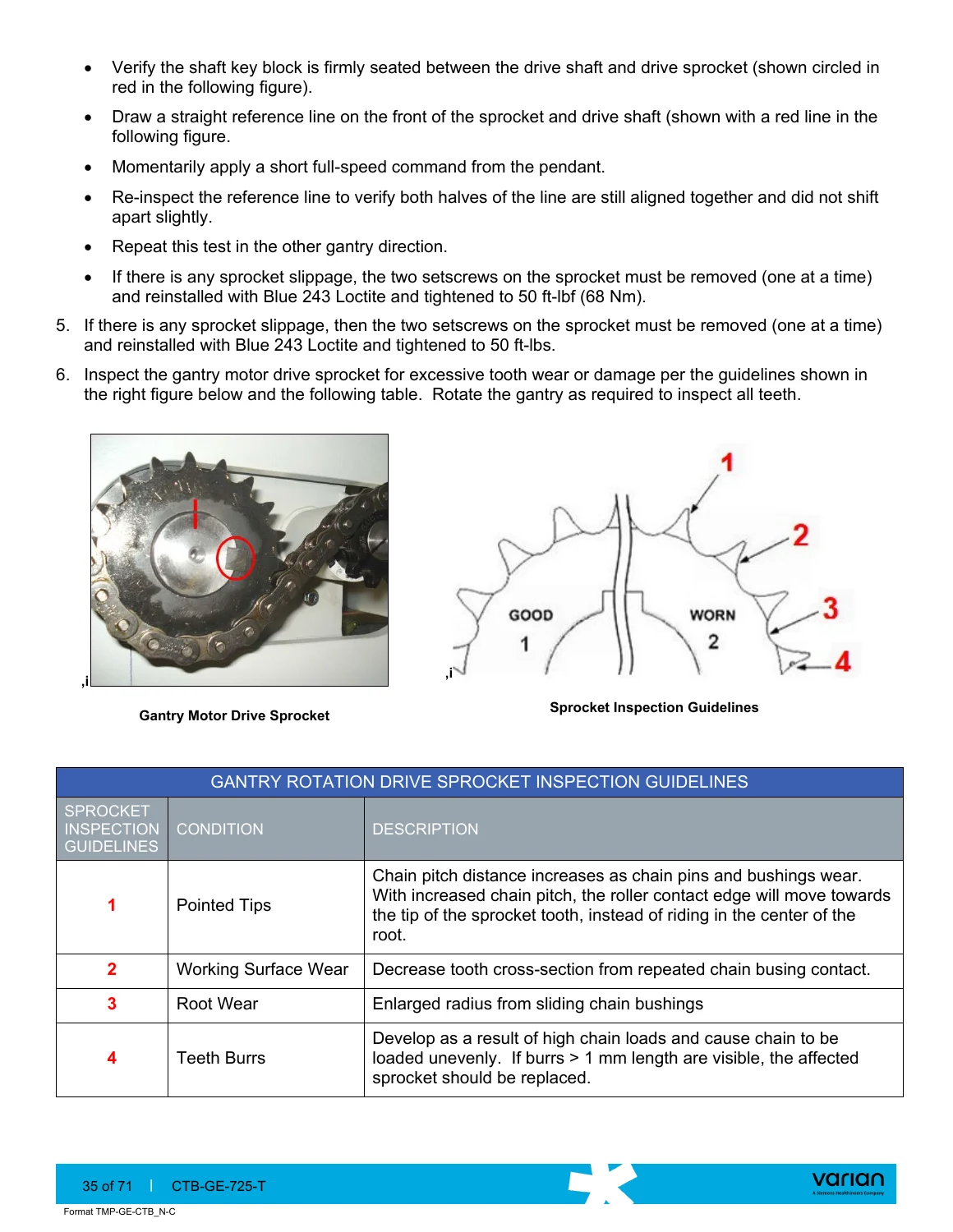
- Drive sprocket and shaft-key security
- Sprocket slippage checks
- Drive-sprocket tooth wear
- Pointed sprocket teeth
- Working-surface wear
- Root wear
- Tooth burrs
- PRO/SPRO drive component security
- Gantry PRO shaft lubrication
The manual includes illustrated sprocket-inspection guidelines showing acceptable and worn tooth profiles.
Gantry Module
The dedicated Gantry Module covers the mechanical, RF, steering and energy-selection systems contained within the rotating gantry.
Tasks include:
- Inspect gantry windup
- Inspect cables, hoses, water joints and guards during rotation
- Inspect air-solenoid valves
- Compare BMAG coil voltage
- Compare ASOL coil voltage
- Inspect the energy-switch assembly
- Inspect BMAG lead shielding
- Inspect target-drive assembly and operation
- Inspect carousel area
- Lubricate carousel bearing
- Lubricate gantry bearing
Energy Switch Inspection
The energy-switch maintenance section checks both the physical condition and operation of the assembly. Inspection areas include:
- Water-hose routing and stress
- Hose retention during gantry rotation
- Switch cycling
- Air-valve regulation
- Interlock-switch security
- Adjustment-collar security
Target Drive Assembly
The manual includes a detailed annual inspection of the target-drive system. It covers:
- Mechanical looseness
- Operation through supported energy positions
- Target-drive setscrews
- Target switch block
- TGT I coaxial cable condition
- Radiation-related cable insulation deterioration
- Cable retention and routing
An illustrated component diagram identifies the relevant target-drive inspection points.
Carousel Inspection and Lubrication
Carousel maintenance includes:
- Cam index-switch inspection
- Carousel locking-pin seating
- BMAG primary-collimator hose inspection
- Steering-coil wire inspection
- Filter/foil retaining screw inspection
- Biennial lubrication of the carousel outer bearing ring
Gun Driver Module
The Gun Driver Module contains quarterly and annual high-voltage and gun-control maintenance procedures.
Coverage includes:
- Verify HV warning lights and crowbar operation
- Clean and inspect the gun driver
- Inspect loose hardware and cable connections
- Check for signs of electrical arcing
- Inspect PCB and fiber-optic seating
- Inspect crowbar relay mounting
- Inspect gun-lead routing
- Inspect gun-driver HVPS capacitor condition
- Inspect safety-ground connections
- Compare gun-driver parameters
Digital Gun Driver Parameters
The document includes measurement and comparison of:
- Gun high-voltage values
- Grid default settings
- A/D monitor values
- Gun filament voltage
It provides separate information for digital and analog gun-driver configurations.
Analog Gun Driver Checks
For applicable analog gun-driver systems, the PMI includes comparison of:
- Gun high voltage in Hi and Lo modes
- Gun filament voltage
- Grid-bias voltage
Modulator Module
The Modulator Module addresses the high-voltage pulse-generation equipment and its associated cooling and safety systems.
Tasks include:
- Verify cooling-fan operation
- Verify high-voltage crowbar operation
- Verify MOD interlock operation
- Compare modulator parameters
- Inspect main and DeQing thyratron-related operating values
- Compare three-phase input power
- Compare thyratron filament values
- Monitor keep-alive voltage
The document distinguishes measurement locations for C2 Modulator, C3 Modulator and C3 Universal Modulator configurations.
Thyratron Condition Monitoring
The manual specifically discusses keep-alive voltage as an indicator of thyratron condition and provides guidance for recognizing a tube approaching end of life. This makes the PMI useful not only for scheduled inspection but also for proactive reliability planning.
Accessories Module
The Accessories Module provides quarterly inspection of treatment accessories.
Electron Applicators
Inspection areas include:
- Collision damage
- Applicator integrity and alignment
- Touchguard collision-circuit operation
- ACC interlock operation
- FFDA insert-related interlock testing
Wedges and Accessory Mounts
The guide includes inspection of:
- Wedge frames
- Loose or missing hardware
- Accessory Mount condition
- Compensator Mount condition
- Spring-loaded latches
- Teflon guide blocks
- Pressure bars
- Wear that could allow an accessory to become insecure
Collimator Module
The Collimator Module contains both mechanical inspection and scheduled lubrication tasks.
Coverage includes:
- Inspect and lubricate upper and lower jaws
- Jaw ball-screw lubrication
- Lower jaw sprocket inspection and lubrication
- Thrust-bearing lubrication
- Upper jaw gear lubrication
- Lubricate collimator rotation bearing
- Inspect collimator chain drive and tension
- Chain tension-block inspection
- Sensor-switch function on applicable tension blocks
- Halogen field-light maintenance where fitted
Field Light Service and Post-Service QA
The manual distinguishes between older halogen field lights, LED field lights and fiber-optic light-pipe configurations. For systems where the field-light assembly is serviced, it identifies required follow-up checks including:
- Light-field and crosshair walkout alignment
- Light-field versus X-ray coincidence verification
- Field-light projector fan operation
- Protection of nearby MLC fiber-optic cables from excessive heat
Beamstopper Module
For systems equipped with an actively used retractable beamstopper, the PMI includes semi-annual:
- Cleaning
- Inspection
- Rail access
- Lubrication of the specified bearing/block lubrication points
The manual states that this task may be marked not applicable for fixed beamstoppers or retractable units that are no longer used.
Couch Module
The Couch Module contains extensive recurring mechanical and safety inspection for the patient-positioning system.
Tasks include:
- Inspect IGRT couch top
- Inspect couch-top coating for damage, cracks or contamination
- Clean and inspect the lower couch area
- Inspect cables, connectors and safety grounds
- Clean, inspect and lubricate the lift drive
- Lubricate lift screw and drive components
- Clean, inspect and lubricate longitudinal/lateral carriage ways
- Inspect rails for rust or damage
- Measure EXACT couch longitudinal backlash
- Verify LNG, LAT and VRT limit-switch operation
- Re-center linear bearings when applicable
- Verify pendants, side panels and lamps
- Inspect EXACT couch-top Mylar finger guard
- Clean, inspect and lubricate VEO turntable
- Verify applicable turntable braking operation
Couch Travel and Backlash Checks
The guide includes specific inspection of longitudinal and lateral movement. For applicable EXACT couch configurations it identifies a backlash threshold and provides follow-up adjustment guidance when excessive movement is found.
It also explains how linear bearing cages can become displaced during normal use and provides a re-centering procedure for applicable ETR couch mechanisms.
Console Module
The Console Module combines power-supply monitoring, beam tuning, parameter comparison and output-versus-gantry-rotation testing.
Tasks include:
- Verify console cooling-fan operation
- Measure console +15V and +5V power-supply outputs
- Basic beam tuning
- Print Service Mode Analog Machine screens for historical comparison
- Compare console parameters
- Capture TGT I and LPWR2 waveforms
- Test beam output versus gantry rotation
Console Power Supply Monitoring
The manual explains that deterioration in power-supply fuse connections can affect output voltage. It identifies possible relationships between the +15V supply and tuning/dose calibration and between the +5V supply and random CTRL interlocks.
It provides specific measurement points and acceptable values for the relevant console supplies.
Basic Beam Tuning
The quarterly console procedure includes inspection of basic beam tuning across installed energies using Service Mode. Technical subjects include:
- PFN Servo
- Dose Servo
- Gun current
- RF driver / PFNV adjustment depending on configuration
- AFC balance
- TGT I waveform
- LPWR2 waveform
- Photon and electron rep-rate behavior
- PortalVision-related timing considerations
The manual also documents a Service Mode dose-rate anomaly affecting certain CD/EX software configurations and explains how the technician should account for it during tuning.
Beam Output Versus Gantry Rotation
An annual test checks whether beam output remains acceptably stable while the gantry rotates.
The procedure includes:
- Testing multiple gantry angles
- Recording output by installed energy
- Finding minimum and maximum measured values
- Calculating percentage difference
- Comparing results with historical PMI records
- Investigating sudden output changes associated with particular gantry angles
The guide explains that output variation can potentially originate from factors including aperture steering, AFC reflections, mechanical flexure/movement or external magnetic fields.
Wrap Up Module
The PMI ends with a structured return-to-service and documentation process.
Tasks include:
- Backup console software/configuration
- Perform Morning Checkout across installed energies and applicable arcs
- Review follow-up recommendations
- Review the Replacement Log Summary label
Machine Configuration Backup
The guide identifies four machine personality/configuration files:
- MANUF.CNF
- PHYSICS.CNF
- SERVICE.CNF
- ACCY.CNF
It emphasizes the importance of backing up machine configuration after service that changes PRO calibration, Physics Mode configuration or accelerator software.
Radiation Safe Mode Appendix
Appendix A contains a controlled Radiation Safe Mode procedure intended for qualified service work where RF power may need to be applied while maintenance is being performed in the treatment-room environment.
The appendix covers:
- Conditions requiring Radiation Safe Mode
- Radiation survey instrumentation requirements
- Personnel dosimetry
- Two-person operating requirements
- Machine configuration and verification before room entry
- ALARA principles
- Areas of the accelerator with elevated radiation potential
- Verification before performing work
- Restoring all safety interlocks and normal system operation afterward
This section carries extensive radiation-safety warnings and is explicitly intended for personnel trained and authorized to service the accelerator.
High Energy C-Series Clinac PMI Checklist Included
Appendix B contains a complete multi-page PMI checklist. The checklist is one of the most useful parts of the document because it condenses the entire scheduled maintenance program into a trackable Q1-Q4 format.
The checklist covers:
- Initial Review Module
- Clean & Inspect Module
- Stand Module
- Gantry Module
- Gun Driver Module
- Modulator Module
- Accessories Module
- Collimator Module
- Beamstopper Module
- Couch Module
- Console Module
- Wrap Up Module
Each task is marked with its quarterly, semi-annual, annual or biennial frequency and provides fields for completion initials and dates.
Tasks Specifically Included in the PMI Checklist
- Customer interview
- Event-log review
- Initial beam-performance check
- Console backup MU counter test
- Emergency Off tests
- Emergency pendant test
- Flow-switch test
- Water-system inspection
- Air-filter cleaning
- Stand, modulator and gantry inspection
- Water-hose and filter maintenance
- BMAG, Vacion, KSOL, RF Driver and klystron parameter checks
- Pulse-tank inspection
- Gantry-chain, clutch, sprocket and PRO inspections
- Gantry windup and air-solenoid inspection
- BMAG and ASOL voltage checks
- Energy-switch and target-drive inspection
- Carousel inspection and lubrication
- Gun-driver testing
- Modulator testing
- Electron applicator and wedge inspection
- Jaw and collimator maintenance
- Beamstopper maintenance
- Couch and turntable maintenance
- Console voltage and beam-tuning checks
- Beam output versus gantry rotation
- Console software backup
- Morning Checkout
- Follow-up review
What This Manual Includes
- A complete High Energy Clinac scheduled PMI procedure
- Quarterly, semi-annual, annual and biennial maintenance tasks
- Detailed C2/C3 applicability information
- Electrical measurements and historical parameter comparison
- RF Driver and klystron maintenance checks
- Vacuum-system parameter checks
- Gun Driver inspection and measurements
- Modulator inspection and measurements
- Mechanical gantry and drive inspections
- Lubrication procedures
- Water and cooling-system maintenance
- Couch preventive maintenance
- Accessory and collimator inspections
- Safety-system functional checks
- Basic beam-tuning checks
- Beam output versus gantry rotation testing
- Machine configuration backup requirements
- Radiation Safe Mode appendix
- Complete four-quarter PMI checklist
What This Manual Does Not Cover
The document itself defines several important limits to its scope.
- It does not apply to TrueBeam systems.
- It is for High Energy C-Series Clinacs and should not be represented as a Low Energy Clinac 6EX PMI manual.
- It does not include all routine customer QA procedures.
- The manual specifically states that standard customer QA tests such as certain position-readout alignment checks, MLC checks, field-light checks, rangefinder checks, laser checks, X-ray field coincidence checks and image-calibration quality checks are not part of this PMI procedure.
- It is not a full component-level repair manual for every Clinac subsystem.
- It is not a complete electrical schematic package.
- It is not an illustrated replacement-parts catalog.
- Several procedures refer the technician to separate CTBs, Safety Guides, Beam QA documentation, parts-kit documentation and service publications when additional instructions are required.
Why This PMI Manual Is Useful
This publication is particularly valuable because it organizes a large High Energy Clinac into a repeatable preventive-maintenance program rather than leaving the engineer to assemble inspections from unrelated subsystem manuals. It shows what should be inspected, how often it should be inspected, which values should be compared with historical machine data and which tasks require follow-up.
The combination of detailed procedures and a printable four-quarter checklist makes it useful both during the actual maintenance visit and for documenting the maintenance history of the accelerator.
Its coverage of RF, klystron, vacuum, gun driver, modulator, gantry mechanics, couch mechanics, cooling, interlocks, accessories, basic beam tuning and output stability provides a practical view of the systems most directly involved in High Energy C-Series Clinac reliability.
Safety and Personnel Requirements
This manual deals with high voltage, stored electrical energy, ionizing radiation, activated materials, lead shielding, mechanical motion and safety interlocks. The document repeatedly restricts these maintenance procedures to appropriately trained and qualified service personnel and contains extensive warnings regarding radiation, electrical, mechanical and contamination hazards.
It should therefore be used only by personnel whose training, authorization and site safety procedures are appropriate to the equipment and maintenance task involved.
Document Details
- Title: High Energy Clinac Periodic Maintenance Inspection (PMI) – Customer Version
- CTB number: GE-725
- Revision: T
- Revision date: 02 Dec 2024
- Drawing number: 100048393
- Product affected: High Energy Clinac
- Applicability: High Energy C-Series Clinac C2 and C3 versions
- TrueBeam applicability: No
- Language: English
- PDF page count: 71
- PMI frequencies: Quarterly, Semi-Annual, Annual and Biennial
- Checklist included: Yes
Instant PDF Download
This product is supplied as a 71-page digital PDF. After payment is completed, the document is available for immediate download and can be retained as a searchable maintenance reference on a compatible computer, tablet or mobile device.
No printed book is shipped. You receive the downloadable PDF document described on this page.


Reviews
There are no reviews yet.