
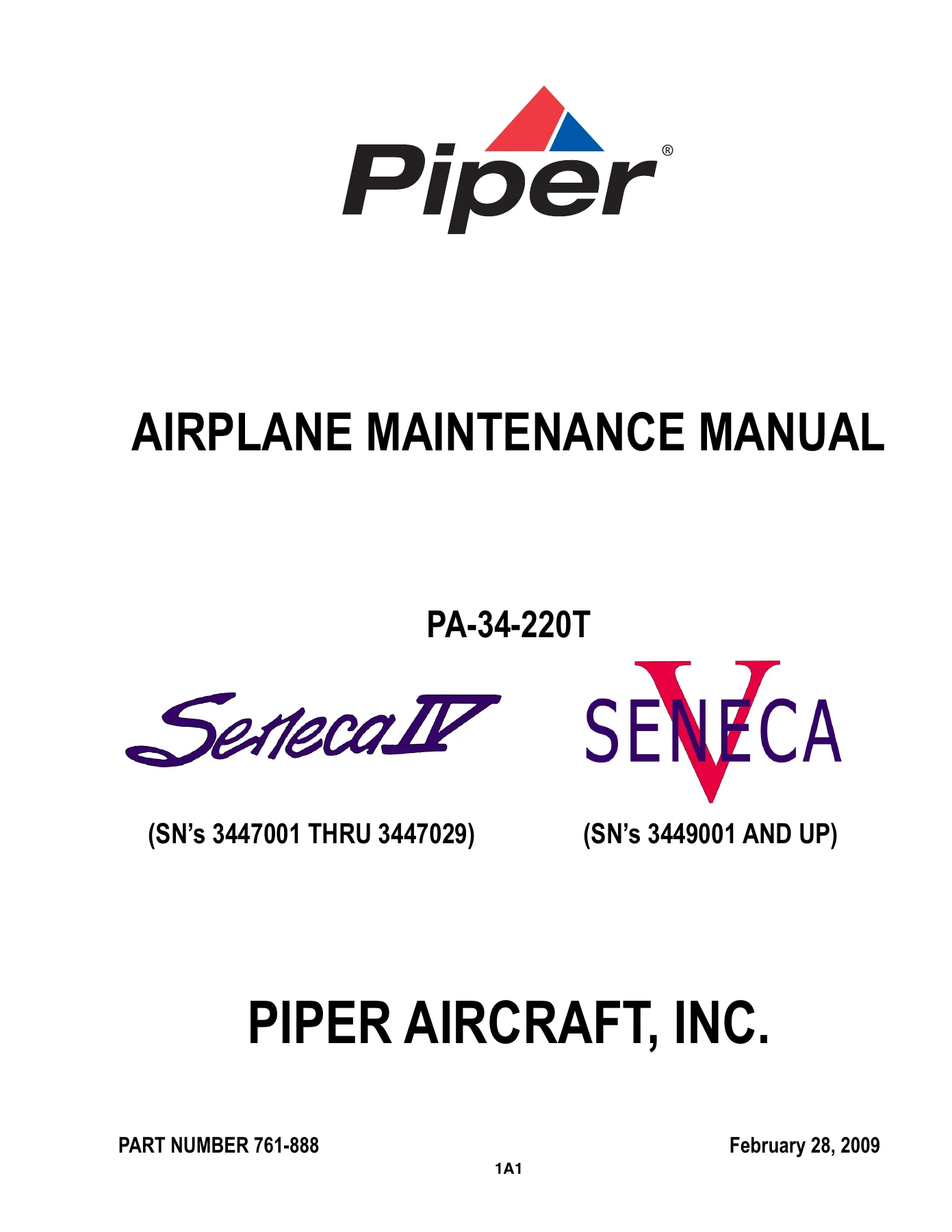
Piper PA-34-220T Seneca IV and Seneca V Airplane Maintenance Manual 761-888
Original price was: $42.95.$24.95Current price is: $24.95.
Piper Aircraft PA-34-220T Seneca IV and Seneca V airplane maintenance manual P/N 761-888 covering serials 3447001 thru 3447029 and 3449001 and up, with inspection, systems, structure, and power-plant procedures.
Description
Piper PA-34-220T Seneca IV and Seneca V Airplane Maintenance Manual 761-888
This download is the Piper Aircraft, Inc. Airplane Maintenance Manual for the PA-34-220T twin, written for Seneca IV airplanes serial numbers 3447001 thru 3447029 and Seneca V airplanes serial numbers 3449001 and up. Piper part number 761-888, revision dated February 28, 2009, is the Instructions for Continued Airworthiness required by FAR Part 23 Appendix G: Chapter 4 holds the airworthiness limitations and Chapter 5 holds the inspection program.
The book follows GAMA Specification No. 2 chapter numbering, so fuel work lives in Chapter 28, landing gear in Chapter 32, and power plant in Chapter 71. Hardware callouts appear only where a special application is required; the companion Parts Catalog P/N 761-887 is the place to confirm fasteners. ICA for non-Piper STC installations is not included. When an STC changes system interface or structure, inspect those areas to the STC holder’s own instructions.
File Details
- Manual type: Airplane Maintenance Manual (Instructions for Continued Airworthiness)
- Brand / model: Piper PA-34-220T Seneca IV and Seneca V
- Document number: 761-888
- Revision: PR090228, February 28, 2009 (originally issued July 12, 1995)
- Language: English
- Page count: 1602
- File format: PDF
Serial Effectivity and Powerplants
The Piper PA-34-220T Seneca IV and Seneca V Airplane Maintenance Manual 761-888 splits airframe and engine data by model. Seneca IV production serials run 3447001 through 3447029. Seneca V starts at 3449001 (prototype) and continues through later production serials listed in the introduction through 3449395 and up.
Seneca IV airplanes use Continental TSIO-360-KB (left, CW) and LTSIO-360-KB (right, CCW) turbocharged six-cylinder engines, FAA type certificate E9CE, 220 HP takeoff for five minutes and 200 HP continuous, with TCM pressurized magnetos timed at 20° BTC and 60-amp Teledyne Continental alternators. Seneca V airplanes use Continental TSIO-360-RB (left) and LTSIO-360-RB (right), 220 HP / 200 HP continuous at 2600 RPM, Precision RSA-5AD2 fuel injection, Slick/TCM pressurized magnetos timed at 22° BTC, and 85-amp Teledyne Continental alternators. Both models carry 8 U.S. quarts of oil per sump and burn 100 or 100LL avgas.
Fuel cells hold 64 gallons per wing (128 gallons total). Usable fuel is 123 gallons on Seneca IV and 122 gallons on Seneca V. Hartzell and McCauley two-blade installations are both documented, with paired hubs only and different low-pitch blade angles by model. Landing gear is retractable oleo gear on 6.00 x 6, 8-ply tires, 40 PSI nose and 55 PSI main, Parker 30-83 brakes, 11.1 ft tread and 60.4 ft turning radius.
Chapters Covered
- Chapter 4 Airworthiness Limitations — FAA-approved limitations section (4-00-00)
- Chapter 5 Time Limits / Maintenance Checks — General; Time Limits; Scheduled Maintenance; Special Inspections; Unscheduled Maintenance Checks
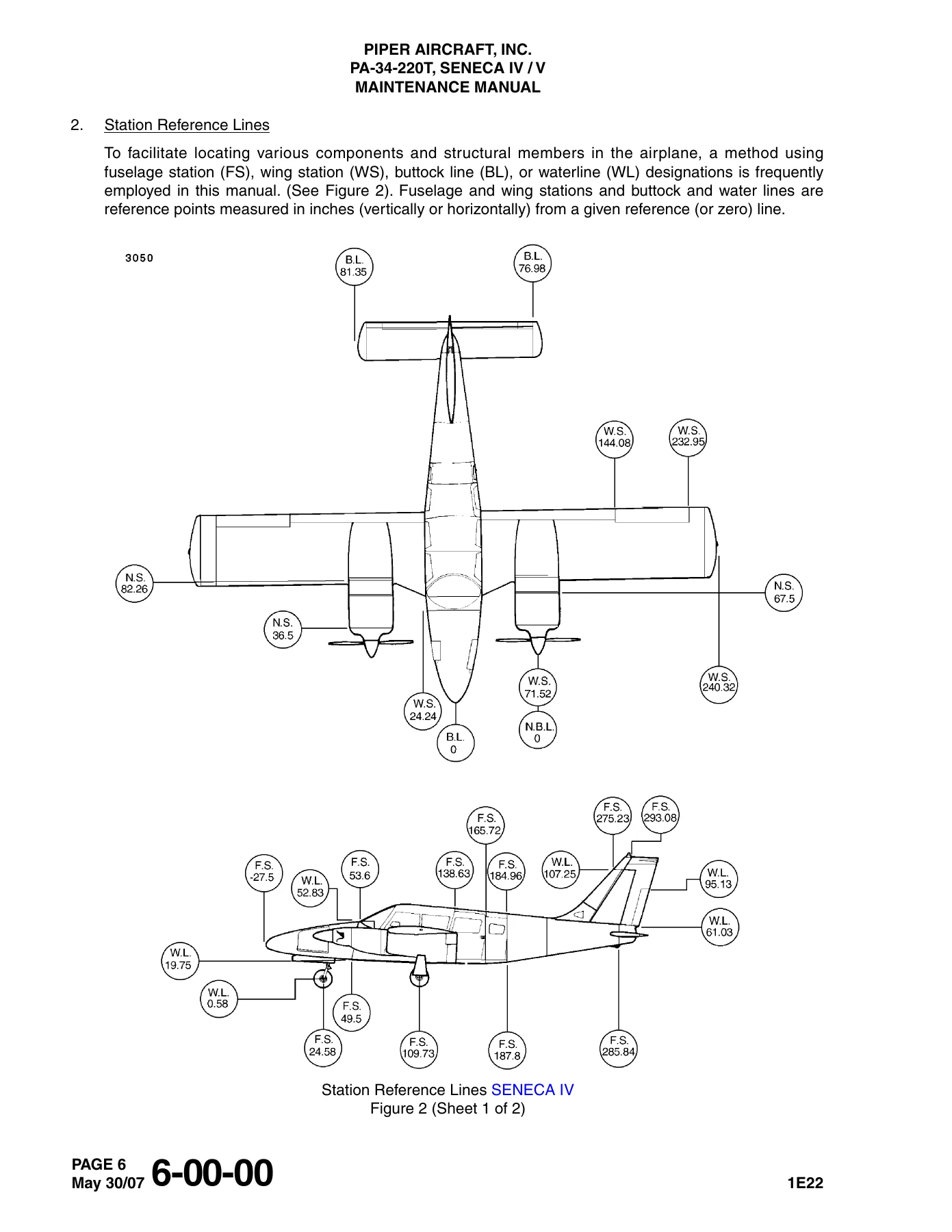
- Chapter 6 Dimensions and Areas — Leading particulars; station reference lines; access and inspection provisions
- Chapter 7 Lifting and Shoring — Jacking
- Chapter 8 Leveling and Weighing — Weighing; Leveling
- Chapter 9 Towing and Taxiing — Towing; Taxiing
- Chapter 10 Parking and Mooring — Parking; Mooring
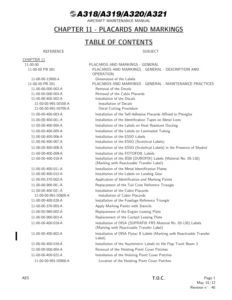
- Chapter 11 Placards and Markings — Exterior and interior placards
- Chapter 12 Servicing — Replenishing; scheduled servicing
- Chapter 20 Standard Practices – Airframe — General; painting
- Chapter 21 Environmental Systems — Distribution; heating; cooling
- Chapter 22 Autoflight — Autopilot
- Chapter 24 Electrical Power — DC generation; external power; load distribution
- Chapter 25 Equipment / Furnishings — Flight compartment; emergency equipment
- Chapter 26 Fire Protection — Extinguishing
- Chapter 27 Flight Controls — Aileron, rudder, stabilator, and flap controls
- Chapter 28 Fuel — Storage; distribution; indicating
- Chapter 29 Hydraulic Power — Main system
- Chapter 30 Ice and Rain Protection — Airfoils; pitot and static; windows and windshield; propellers; detection
- Chapter 31 Indicating / Recording Systems — Central warning systems
- Chapter 32 Landing Gear — Main and nose gear and doors; extension and retraction; wheels and brakes; position and warning
- Chapter 33 Lights — Flight, passenger, cargo, and exterior lighting
- Chapter 34 Navigation and Pitot/Static — Flight environment data; attitude and direction; dependent position determining
- Chapter 35 Oxygen — Crew/passenger systems
- Chapter 37 Vacuum — Distribution; indicating
- Chapter 39 Electrical / Electronic Panels — Instrument and control panels; equipment
- Chapter 51 Structures — Investigation and smoothness; repairs; electrical bonding
- Chapter 52 Doors — Passenger/crew; cargo
- Chapter 53 Fuselage — Main structure
- Chapter 55 Stabilizers — Stabilator; vertical stabilizer; rudder
- Chapter 56 Windows — Flight and passenger compartment
- Chapter 57 Wings — Auxiliary structure; attach fittings; flight surfaces
- Chapter 61 Propellers — Assembly; controlling
- Chapter 70 Standard Practices – Engine
- Chapter 71 Power Plant — Cowling; mounts; air intakes
- Chapter 73 Engine Fuel and Control — Distribution; indicating
- Chapter 74 Ignition — Electrical power supply; distribution
- Chapter 76 Engine Controls — Power control
- Chapter 77 Engine Indicating — Power; temperature; integrated engine instrument systems
- Chapter 79 Oil — Distribution; indicating
- Chapter 80 Starting — Cranking
- Chapter 81 Turbines — Turbo-supercharger
- Chapter 91 Charts and Wiring Diagrams — Charts and schematics
- Appendix 1 — Ground test procedure for Meggitt MAGIC ADAHRS and pitot-static system
Taken together, the Piper PA-34-220T Seneca IV and Seneca V Airplane Maintenance Manual 761-888 is the shop document a technician uses after the annual or 100-hour inspection checklist flags a discrepancy. It does not replace Continental engine overhaul manuals, Hartzell or McCauley propeller manuals, or vendor ICA for installed avionics; those publications are listed in the introduction and must be used with this book.
Inspection Program and Unscheduled Checks
Chapter 5 defines annual / 100-hour inspection, a progressive 50-hour program (Progressive Inspection Manual P/N 767-006), overlimits inspection, and special event inspections. Event-driven work covers lightning strike, hard or overweight landing, sudden engine stoppage, loss of oil, overtemp, flaps extended above maximum speed, flood damage, and severe turbulence. Operating-environment add-ons appear for high dust or industrial pollution and for high salt or high humidity. Aft wing attach fittings and aft wing spar-to-fuselage attachment have dedicated 100-hour structural looks. Engine overhaul interval referenced for Seneca V is 1,800 hours time-in-service or as specified in Continental Maintenance Manual P/N X-30645A.
Airframe, Gear, Fuel, and Hydraulics
Structure chapters walk corrosion-prone areas, fiberglass and thermoplastic repair, metal and wire stitching, safety-walk repair, and electrical bonding resistance checks. Wing work includes attach-fitting removal and installation, W.S. 49.25 rib inspection on earlier serials, and aileron / flap removal with control-surface balancing after paint or repair. Empennage procedures cover stabilator attach-bracket corrosion control, rudder and stabilator balancing limits, and trim-tab rigging.
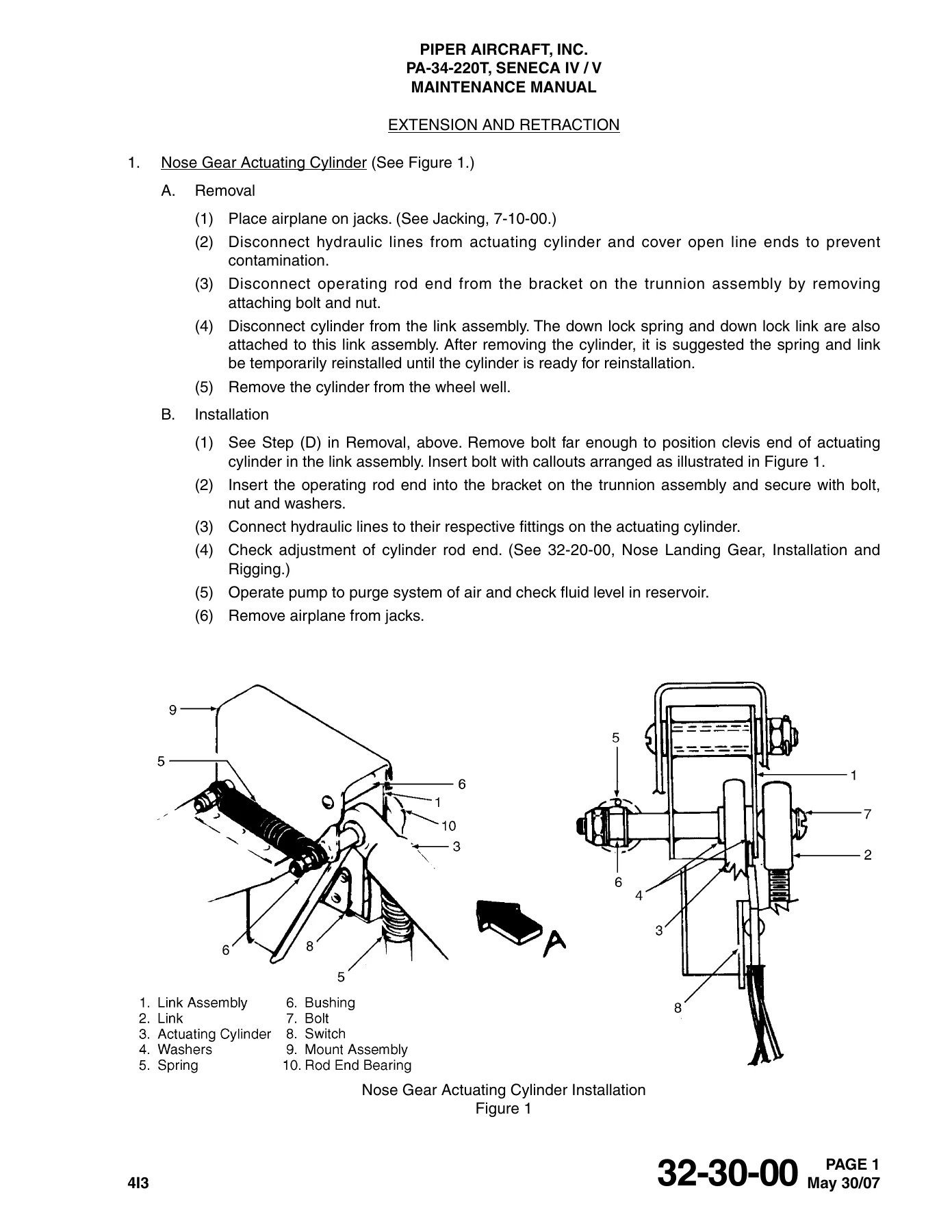
Landing-gear service includes main and nose oleo disassembly, door rigging, toe-in / toe-out, free-fall valve function, actuating-cylinder service, wheel and brake overhaul, bleeding, parking-brake valve work, and adjustment of up / down limit switches, squat switches, throttle switch, and manifold-pressure gear-warning switches. Hydraulic power uses an Oildyne pump with integral reservoir in the nose; leading particulars, line routing, pump characteristics, servicing with MIL-H-5606, and system testing are all in Chapter 29.
Fuel-system coverage includes bladder-cell removal and installation, inboard and outboard tank work, selector valve, filter servicing and flushing, vent and vapor return, leak test, and quantity-indicating calibration for both analog / DDMP and Avidyne installations, plus crossfeed annunciator rigging.
Environmental, Ice Protection, and Electrical / Avionics
Cabin heat uses a combustion heater with blower, duct switch, fuel regulator and shutoff valve, and electrical checks. Optional air conditioning is refrigerant-specific: R12 on Seneca IV and R134a on Seneca V, with compressor oil level, evacuation, charging, leak test, expansion valve, and condenser-scoop rigging. Ice protection splits into pneumatic boots on wing, vertical stabilizer, and stabilator; electric propeller deice with brush-block alignment and slip-ring centering; electrically heated windshield; heated pitot and stall vane; and ice-detection lighting.
Electrical power covers 28-volt generation, battery location differences (nose on Seneca IV, aft fuselage on Seneca V), external power, load distribution, and bonding. Chapter 91 is a full schematic set: alternator power, battery master, fuel pumps and quantity, flaps, landing-gear warning, magnetos, tachometer, TIT, DDMP / DAU interfaces, lighting, deice, autopilot, and both Meggitt MAGIC and Avidyne Entegra EFIS options. Autoflight chapters add pitch and roll servo installation, capstan wrapping, clutch-torque adjustment, and post-maintenance operational checkout. Appendix 1 is the ground-test procedure for Meggitt MAGIC ADAHRS and the pitot-static system.
Power Plant, Propeller, and Indicating
Power-plant chapters separate Seneca IV cable rigging (throttle, mixture, governor, idle speed, fuel-pump assembly, exhaust-bypass screw) from Seneca V controller, fuel-pump, and fuel-servo adjustments. Ignition covers magneto-to-engine timing, harness routing, and spark-plug service. Turbocharger work includes inspection, overboost valve, lockwiring of V-band couplings, and the Seneca IV exhaust-bypass screw thread count. Propeller chapters cover Hartzell and McCauley installation, governor rigging, unfeathering accumulator, synchrophaser, and typical nick blend-out. Engine indicating spans analog gauges, tachometer magnetic sensors, manifold-pressure transducers, CHT / EGT, and the Digital Display Monitoring Panel with RS-232 interface and calibration.
What This Manual Lets You Do
With the Piper PA-34-220T Seneca IV and Seneca V Airplane Maintenance Manual 761-888 on the bench, a mechanic can run the published inspection program, jack and level the airplane, service oleos and brakes, rig flight controls and flaps, replace fuel cells, overhaul the hydraulic pump circuit, time magnetos, adjust engine controls to the model-specific setup, service turbochargers and propellers, troubleshoot vacuum and pitot-static faults, and trace circuits on the Chapter 91 schematics. Those published limits, torque notes, switch adjustments, and serial-effectivity callouts are what keep a PA-34-220T inside the Piper ICA instead of improvised shop practice.
The file is a PDF you receive immediately after payment. Open it on a computer, tablet, or phone, print the chapter you need for the hangar, and keep the full 761-888 revision set with the airframe records. No printed book ships and no waiting on back-order manuals.
Reviews
There are no reviews yet.